
How Many Calories Are in Oat Flour?
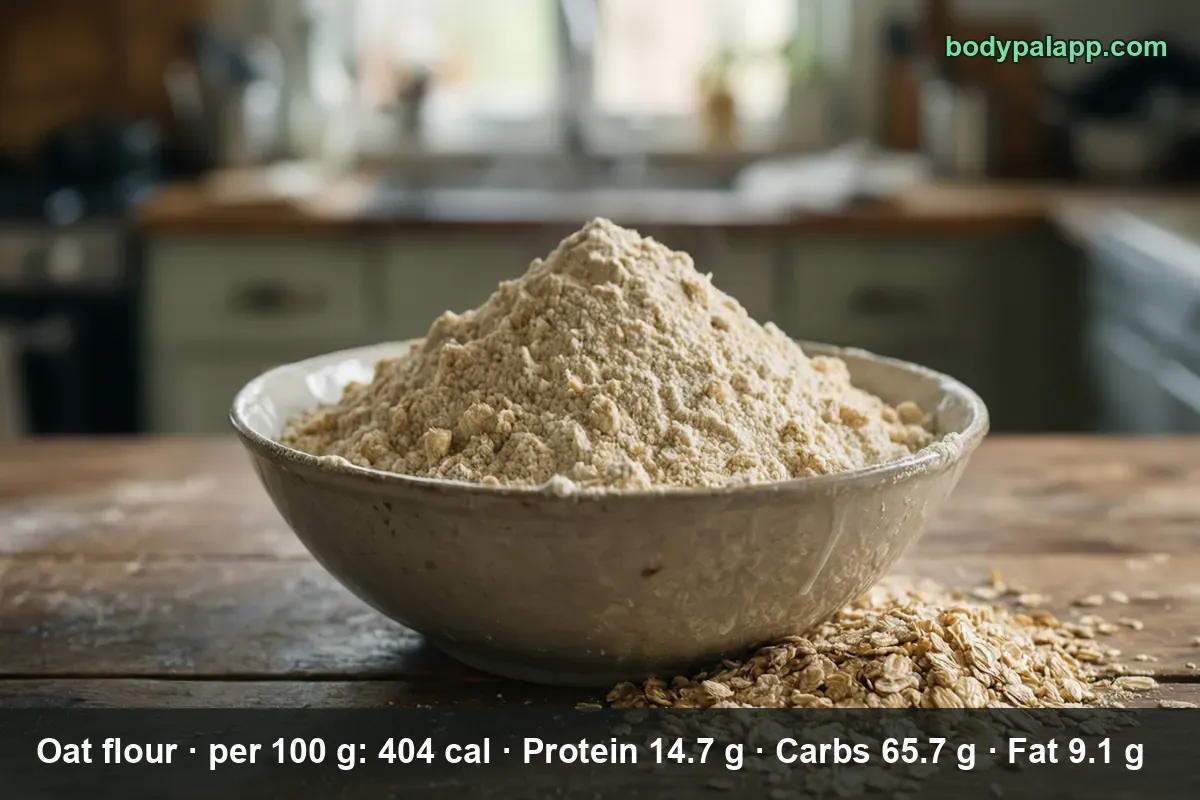
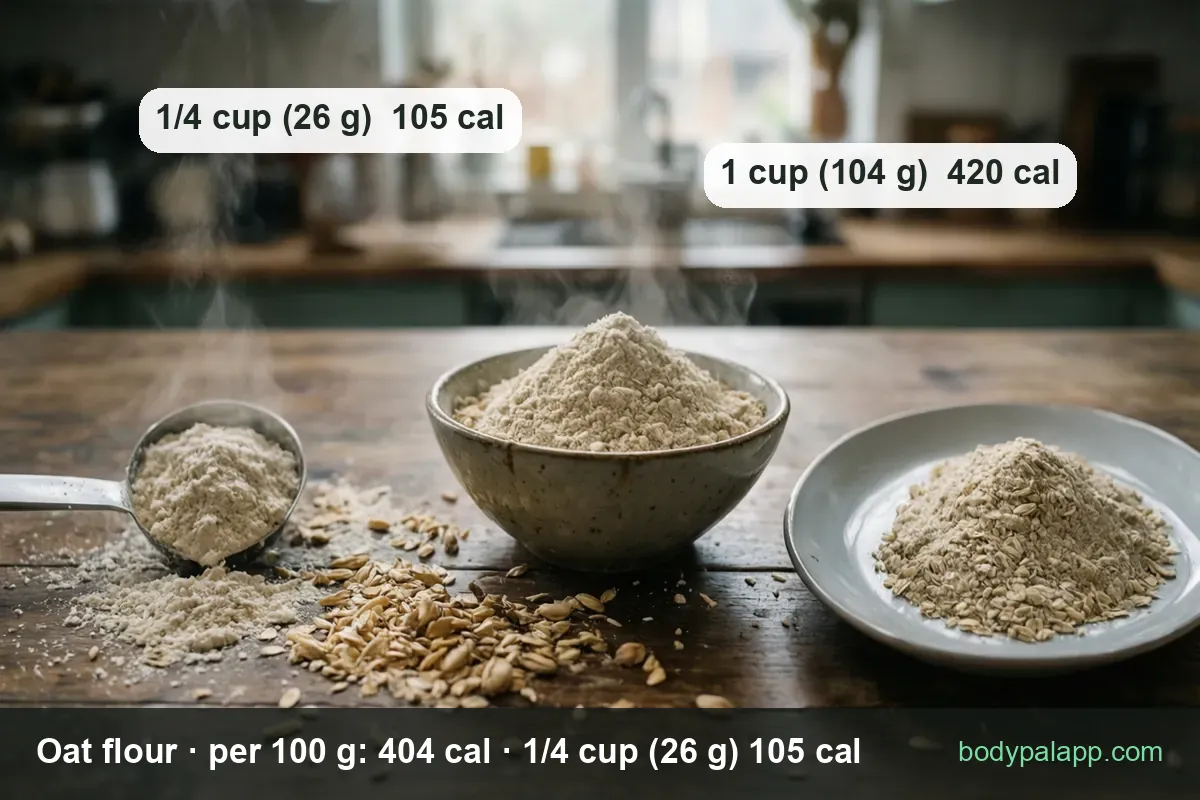
Oat flour is 105 calories in a quarter cup, the 26 g scoop most recipes start from, and 420 calories in a full 104 g cup. Per 100 g it runs 404 calories, which is more than white all-purpose flour. Cup for cup, though, it comes in lower. That contradiction is the whole story.
On this page
- Oat flour quick facts
- Cup, quarter cup, tablespoon
- Why the bag says 120 and the math says 105
- Whole grain, gluten-free and home-ground
- How does oat flour compare?
- The fiber number gets oversold
- Oat flour brands
- FAQ
Oat flour quick facts
The reference here is plain store-bought oat flour, the kind sold in a paper bag next to the all-purpose. The USDA row behind every figure on this page is SR Legacy 169741, Oat flour, partially debranned.
| Nutrient | Per 100 g | Per 1/4 cup (26 g) | % Daily Value |
|---|---|---|---|
| Calories | 404 cal | 105 cal | — |
| Total fat | 9.12 g | 2.4 g | 3% |
| Saturated fat | 1.61 g | 0.4 g | 2% |
| Carbohydrate | 65.7 g | 17.1 g | 6% |
| Dietary fiber | 6.5 g | 1.7 g | 6% |
| Total sugars | 0.8 g | 0.2 g | — |
| Protein | 14.66 g | 3.8 g | 8% |
| Sodium | 19 mg | 5 mg | 0% |
% Daily Value is based on a 2,000-calorie diet.
Verified nutrition data
Numbers on this page come from USDA FoodData Central, the U.S. Department of Agriculture’s food composition database, and from manufacturer labels where a branded product is named. Last verified September 2026. How we verify our data →
Two rows are missing on purpose. That USDA entry carries no added sugars figure and no trans fat figure, so neither is shown here rather than printed as a zero it never measured. Total sugars have no Daily Value under the FDA labeling rules, which is why that row ends in a dash.
The fat line is the one worth a second look. Nine grams per 100 g makes oat flour about nine times fattier than white wheat flour, and that fat is the reason it browns faster and goes rancid sooner in a warm cupboard.
Cup, quarter cup, tablespoon
| Portion | Weight | Calories |
|---|---|---|
| 1 tablespoon | 6.5 g | 26 cal |
| 1/4 cup | 26 g | 105 cal |
| 1/3 cup | 35 g | 141 cal |
| 1/2 cup | 52 g | 210 cal |
| 1 cup | 104 g | 420 cal |
| 1 oz | 28.35 g | 115 cal |
USDA lists exactly one household measure for this flour: 1 cup weighs 104 g. Everything smaller is that cup divided by us, so a quarter cup is 26 g and a tablespoon is 6.5 g, and the ounce row is the standard 28.35 g conversion. If you scoop by feel rather than by leveling, expect the real number to sit above the table, not below it, because oat flour packs down easily.
Raw versus cooked does not apply, which is unusual for a staple this size. Flour is sold dry, measured dry and logged dry. Water added during baking changes the weight of the finished item but not the calories that came out of the bag, so a batch of pancakes made with 1 cup of oat flour still carries 420 calories from the flour no matter how thin you pour them.
Why the bag says 120 and the math says 105
Pick up any American bag of oat flour and the panel says the same thing: 1/4 cup, 30 g, around 110 to 120 calories. Run the USDA cup through a calculator and a quarter cup is 26 g and 105 calories. Both are correct, and the gap is not a rounding argument.
The scoop is the difference. Manufacturers weigh their own quarter cup at 30 g, roughly 15% heavier than the 26 g that falls out of the USDA cup. Denser milling, finer particles, a firmer press into the measure. At 404 calories per 100 g, 30 g of this flour is 121 calories by our own math, which lands right on top of what the labels print.
Brands split along the same line. Bob's Red Mill lists 400 calories per 100 g and 120 per 30 g scoop; Quaker lists 367 per 100 g and 110 per scoop. That is a 10-calorie spread on identical measuring cups, from milling and how much bran stayed in.
Practical version: if you are logging from a bag, use the bag's own numbers. If you are logging a recipe someone else wrote in cups, use 105 per quarter cup and accept a few calories of slack. Mixing the two systems mid-recipe is where the error creeps in.
Whole grain, gluten-free and home-ground
| Version | Calories per 100 g | Fiber per 100 g | Fat per 100 g | Protein per 100 g |
|---|---|---|---|---|
| Oat flour, partially debranned | 404 cal | 6.5 g | 9.12 g | 14.66 g |
| Whole grain oat flour | 389 cal | 10.5 g | 6.31 g | 13.17 g |
| Rolled oats, before grinding | 389 cal | — | 6.9 g | 16.89 g |
Whole grain oat flour is the interesting one. USDA Foundation entry 2261421 puts it at 389 calories per 100 g with 10.5 g of fiber and 6.31 g of fat. The whole groat goes into the mill, bran and all, so you get 4 g more fiber and nearly 3 g less fat than the partially debranned flour for 15 fewer calories. Its calorie figure is calculated from the macros rather than measured in a bomb calorimeter, and that entry carries no saturated fat, sugar or cholesterol values at all, so those numbers are not shown for this variant rather than guessed at.
Gluten-free oat flour is the same food at the same price in calories. Bob's Red Mill sells both versions at 400 calories per 100 g and 120 per 30 g scoop. The gluten-free label describes where the oats were grown and which mill handled them, not what is in the flour. Nobody is paying a calorie penalty for the certification.
Oat flour ground at home starts as rolled oats, USDA entry 169705, at 389 calories per 100 g. Grinding changes nothing about the grain and everything about the volume. A cup of rolled oats weighs 156 g and carries 607 calories; run it through a blender and you get roughly a cup and a half of flour out the other side, on our own count of 156 g against a 104 g flour cup. Same calories, different cup.
That last point trips people up constantly. Swapping 1 cup of oats for 1 cup of oat flour in a recipe is not a like-for-like swap. It is a 187-calorie cut, because you just replaced 156 g of grain with 104 g of it.
How does oat flour compare?
| Flour | Per 100 g | 1 USDA cup | Calories per cup | Protein per cup | Fat per cup |
|---|---|---|---|---|---|
| Oat flour | 404 cal | 104 g | 420 cal | 15.3 g | 9.5 g |
| All-purpose white wheat | 364 cal | 125 g | 455 cal | 12.9 g | 1.2 g |
| Whole-grain wheat flour | 340 cal | 120 g | 408 cal | 15.9 g | 3.0 g |
| Millet flour | 382 cal | 119 g | 455 cal | 12.8 g | 5.1 g |
| Rolled oats | 389 cal | 156 g | 607 cal | 26.3 g | 10.8 g |
Read that table down the wrong column and you reach the wrong conclusion. By weight, oat flour is the most calorie-dense thing on the list at 404 per 100 g, ahead of every wheat option. By the cup, which is how anyone actually bakes, it is second-lightest at 420 calories, because its cup weighs 104 g against 125 g for all-purpose. Fluffier flour, lighter cup.
Our take: for a straight cup-for-cup swap out of all-purpose, oat flour is the better pick, saving 35 calories a cup and adding 2.4 g of protein to it. For the leanest cup on the shelf, whole-grain wheat flour wins at 408 calories with 15.9 g of protein and only 3.0 g of fat, and it is the one to reach for if the fat in oat flour is doing nothing for the recipe. Millet flour has no advantage here at all: it costs the same 455 calories a cup as white flour with less protein.
The fiber number gets oversold
Oat flour has a reputation as a fiber food, and the per-100 g column encourages it. At 6.5 g per 100 g, that is 23% of an adult Daily Value in a portion nobody eats in one sitting.
Scale it to the quarter cup that recipes actually call for and the fiber is 1.7 g, or 6% of the day. Useful, not transformative. Switch to whole grain oat flour and the same 26 g scoop delivers 2.7 g instead, which is the single easiest fiber upgrade available in this aisle and costs nothing. MyPlate counts both as whole grains toward the daily target, and the Dietary Guidelines for Americans put that target at making half your grains whole.
Sodium is the row that genuinely deserves the shrug: 19 mg per 100 g and 5 mg in a quarter cup, which rounds to 0% of the day. Plain oat flour brings none of the salt that self-rising and seasoned flour blends carry, so anything salty in an oat-flour bake came from the recipe, not the bag.
Protein holds up better than the fiber claim does. A quarter cup gives 3.8 g, and a full cup 15.3 g, which beats all-purpose white flour by a couple of grams per cup despite weighing 21 g less. Per calorie, oat flour is the stronger protein source of the two.
Most popular oat flour brands in the United States
Ranked by how widely each product appears among foods sold in the United States, from the BodyPal food database of over 3.3 million products. Calories are the figures printed on each Nutrition Facts label, checked against USDA FoodData Central.
| Product | Calories (per 100 g) |
|---|---|
| Bob's Red Mill Whole Grain Oat Flour | 400 cal |
| Bob's Red Mill Gluten Free Whole Grain Oat Flour | 400 cal |
| Quaker Oat Flour | 367 cal |
| Arrowhead Mills Organic Oat Flour | 367 cal |
| Bob's Red Mill Oat Flour | 400 cal |
| Quaker Oat Flour, 20 oz | 367 cal |
Brand popularity: BodyPal food database. Nutrition: manufacturer labels / USDA FoodData Central.
Oat flour FAQs
How many calories are in oat flour?
105 calories in a 1/4 cup (26 g), which is the scoop most recipes use, and 420 calories in a full 104 g cup. Per 100 g oat flour is 404 calories. A single tablespoon, 6.5 g, comes to 26 calories.
How many calories in 1 cup of oat flour?
420 calories. USDA weighs a cup of oat flour at 104 g, and at 404 calories per 100 g that works out to 420. The cup also carries 15.3 g of protein, 68.3 g of carbohydrate and 9.5 g of fat.
How many calories in 1/4 cup of oat flour?
105 calories by the USDA cup, where a quarter cup is 26 g. Bags in US stores print their quarter cup at 30 g instead, which is why the label says 110 to 120. Both are right; the scoops differ by about 15%.
Oat flour or all-purpose flour: which has fewer calories?
Oat flour by the cup, at 420 calories against 455 for all-purpose, a saving of 35. By weight the order flips: oat flour is 404 calories per 100 g and all-purpose is 364.
How much fiber is in oat flour?
6.5 g per 100 g, which drops to 1.7 g in a 1/4-cup serving, or 6% of the Daily Value. Whole grain oat flour does considerably better at 10.5 g per 100 g, giving 2.7 g in the same 26 g scoop.
How much oat flour does 1 cup of oats make?
About 1.5 cups. A cup of rolled oats weighs 156 g and holds 607 calories; ground into flour, that same 156 g fills roughly 1.5 cups, since a cup of the flour weighs only 104 g. Grinding changes volume, not calories.
Is oat flour gluten free?
Only when the bag says so, and the certification costs nothing in calories: 400 per 100 g and 120 per 30 g scoop, identical to the standard version from the same brand. Oats contain no gluten themselves, but they are commonly milled alongside wheat, which is what the label is really about.
Is oat flour high in protein?
Higher than white flour, yes: 14.66 g of protein per 100 g against 10.33 g for all-purpose, and 15.3 g per cup against 12.9 g. Rolled oats beat both by the cup at 26.3 g, mostly because that cup weighs 156 g.
Similar foods
- Sugar Cube — 9 cal per cube
- Sugar Packet — 14 cal per packet
- Vanilla Sugar — 17 cal per teaspoon
- Coconut Flour — 60 cal per 2 tbsp
- Sugar In The Raw Turbinado Sugar — 18 cal per teaspoon
- Sugar In The Raw Packet — 14 cal per packet
Count it without the math
Scoop the flour, point the camera, and BodyPal logs the calories, the fiber and the protein before the oven finishes preheating.


How long does it take to burn off oat flour?
A 1/4-cup (26 g) serving is 105 kcal. Enter your weight and the amount you ate to see how long it takes you to burn that off:
lb
| Activity | Time to burn 105 kcal |
|---|---|
| Walking, brisk | 21 min |
| Cycling, moderate | 13 min |
| Swimming, moderate | 15 min |
| Jogging | 12 min |
| Weight training, moderate | 23 min |
Times are for a 155 lb adult at a steady pace; change the weight to see yours. The amount is set to the portion in the text (26 g); change it to what you actually ate. BodyPal works this out from your steps automatically.
Want the bigger picture? Calculate your daily calorie needs — your maintenance figure, a target for losing or gaining, and the date you get there.