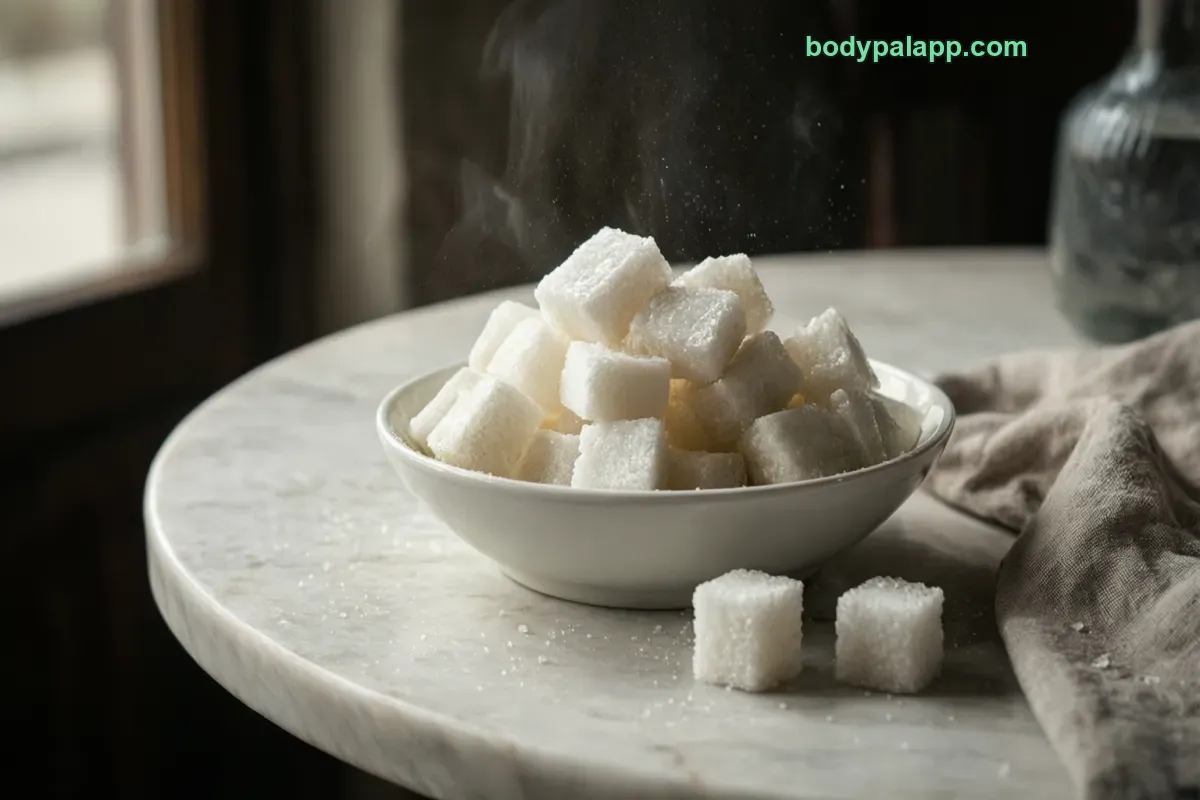
Sugar cube calories come to 9 for one 2.3 g cube and 401 per 100 g. Nearly every one of those calories is carbohydrate, and almost all of that is sugar, with no protein, no fiber and barely any sodium. A single cube barely registers. The count does the damage: cubes per cup, cups per day.
9kcal
1 sugar cube · 2 g, pressed granulated white sugar
0%protein
0 gProtein
2 gCarbs
0 gFat
How to burn off 9 kcal
—Walking, brisk
—Jogging
—Cycling, moderate
—Swimming
Skip the math. BodyPal counts these calories from your steps and workouts automatically.
Nutrition facts
Pressed granulated white sugar · per 2 g
Calories
9 kcal
Protein
0 g
Carbohydrate
2.3 g
Fat
0 g
Saturated fat
0 g
Cholesterol
0 mg
Sodium
0 mg
Potassium
0 mg
Iron
0 mg
Source: USDA FoodData Central
🛡️
Verified nutrition data
Numbers on this page come from USDA FoodData Central, the U.S. Department of Agriculture’s food composition database, and from manufacturer labels where a branded product is named. Last verified September 2026. How we verify our data →
Sugar cube: calories, protein and sodium by serving
Percent of daily value uses the FDA reference of 2,000 kcal a day.
Serving
kcal
Protein
Carbs
Fat
Sodium
% DV kcal
1 cube (2.3 g)
9
0 g
2.3 g
0 g
0 mg
0%
1 teaspoon (4.2 g)
17
0 g
4.2 g
0 g
0 mg
1%
100 g
401
0 g
99.6 g
0.3 g
1 mg
20%
3 × 1 cube (2.3 g)
28
0 g
0 mg
5 × 1 cube (2.3 g)
46
0 g
0 mg
One cube is 9 calories; three are 28
A standard cube weighs 2.3 g and carries 9 calories. On a 2000-calorie daily value, that rounds to 0 percent. The rounding hides what actually happens, because sugar cubes rarely travel alone and the number of cubes sets the total.
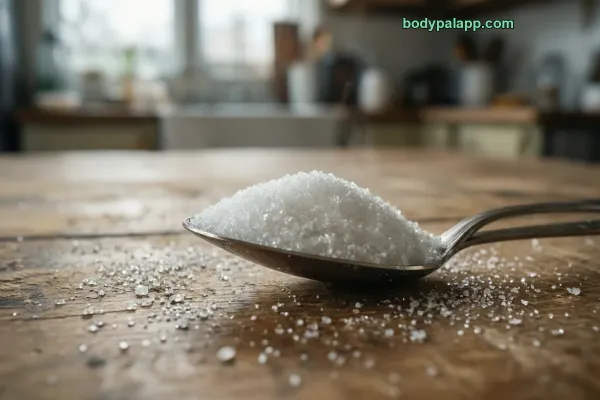
Two cubes bring 18 calories, three bring 28, and five reach 46 calories from 12 g of sugar. A level teaspoon of loose sugar weighs 4.2 g and comes to 17 calories, so two cubes land close to one teaspoon. Three cubes in your tea is a bit more than a teaspoon and a half.
The habit matters more than any single cup. Three cubes in each of several coffees a day turns a 28-calorie cup into a daily figure worth tracking. Because cubes are easy to count, they are one of the more honest foods to log: there is no heaped spoon to guess at.
Nearly every calorie is sugar
Per 100 g, sugar cubes hold 99.6 g of carbohydrate, the sugars row reads 99.8 g, and fat is a trace at 0.3 g. Protein is 0. The calorie split puts 99 percent on carbs and 1 percent on fat. No fiber slows it down, and nothing else on the label adds anything to speak of.
Pressing the sugar into a cube changes nothing nutritionally. A cube is granulated white sugar packed into a shape, so its numbers follow the USDA row for sugar. Brown, demerara, turbinado and panela-style cubes from brands such as La Medina, Gilway, Cumberland and Goya look and taste different, but they are still sugar first. The figures on this page are for plain white cubes.
Potassium is 2 mg per 100 g and sodium is 1 mg. Against daily values of 4700 mg and 2300 mg, both are effectively zero. A cube gives you energy and sweetness and nothing else, which is exactly what it is for.
A full 100 g is a fifth of a day's calories
The per-100 g view looks abstract until you remember how quickly a sugar bowl empties. At 401 calories, 100 g of cubes covers 20 percent of a 2000-calorie daily value. It does nothing toward the 50 g protein benchmark or the 28 g fiber benchmark.
On the serving table, single cubes and teaspoons sit at 0 or 1 percent of daily calories, and that is why they feel free. They are not free. They are small, and small numbers only show up once you add them together.
If you are cutting back on sugar, cubes have one practical edge over a spoon: each one is fixed at 2.3 g, so you cannot heap it. Going from three cubes to two in a drink takes the cup from 28 to 18 calories, and the ritual stays the same. That is an easier change to keep than giving up sweetened drinks altogether.
Cubes work best as a counted habit
Most cubes end up in tea or coffee, and black tea or coffee brings little energy of its own. That leaves the sugar as the main calorie source in the cup, so the cube count is the number worth logging. Milk or cream adds its own calories, so log it separately.
If you want to step down, cut one cube per cup instead of switching sweeteners overnight. Your taste adjusts gradually, and the count gives you a clear target each week. A sweetened drink alongside a meal with protein and fiber, like eggs or oatmeal, puts on the plate what the cube lacks.
Keep the cubes in one place and use the same cup size, and your log stays consistent from day to day. BodyPal can log a sugar cube from a photo, though typing in the cube count is just as quick. Either way, the arithmetic stays simple: 9 calories per cube, every time.
How does sugar cube compare?
Here is how a sugar cube compares with granulated sugar, a spoonful of sugar and sugar cane juice, per 100 g and per usual serving.
Verdict: Per 100 g, cubes at 401 calories, granulated sugar at 387 and a spoonful at 385 are practically the same food, so choose cubes if fixed portions help you count. Sugar cane juice drops to 74 calories per 100 g, but a 248 g cup reaches 184, which makes it the easiest way to drink more sugar calories than you planned.
Most popular sugar cube brands in the United States
Packaged cubes weigh 4 to 7 grams each, heavier than the 2.3 g cube used above, so one of their cubes counts for more. Source: manufacturer labels / USDA FoodData Central.
Sugar cube FAQs
How many calories are in one sugar cube?
One 2.3 g sugar cube has 9 calories. Two cubes come to 18 calories.
How many sugar cubes make 100 calories?
About 11 cubes, since each 2.3 g cube is 9 calories.
Sugar cube or a teaspoon of sugar: which has more calories?
A level teaspoon is 4.2 g and 17 calories, slightly less than two cubes at 18 calories.
How much sugar and carbs are in a sugar cube?
A cube has 2.3 g of carbs, essentially all sugar. Per 100 g, sugar is 99.6 g carbs and 99.8 g sugars with 0 g protein.
How many calories are in two sugar cubes?
Two sugar cubes have 18 calories from about 5 g of sugar. That is close to one level teaspoon of loose sugar, which comes to 17 calories.
How many calories do three sugar cubes add to a coffee?
Three sugar cubes add 28 calories to a cup, all from sugar. Dropping to two cubes brings the cup down to 18 calories without changing the drink much.
How many calories are in 100 g of sugar cubes?
100 g of sugar cubes has 401 calories, which is 20 percent of a 2000-calorie daily value. It also has 99.6 g of carbohydrate and 0 g of protein.
Do sugar cubes contain protein, fat or sodium?
Sugar cubes have 0 g of protein, just 0.3 g of fat and 1 mg of sodium per 100 g. 99 percent of their calories come from carbohydrate.
Is a sugar cube the same as granulated sugar?
Yes. A sugar cube is pressed granulated white sugar, at 401 calories per 100 g compared with 387 for loose granulated sugar. The only real difference is the fixed 2.3 g portion.