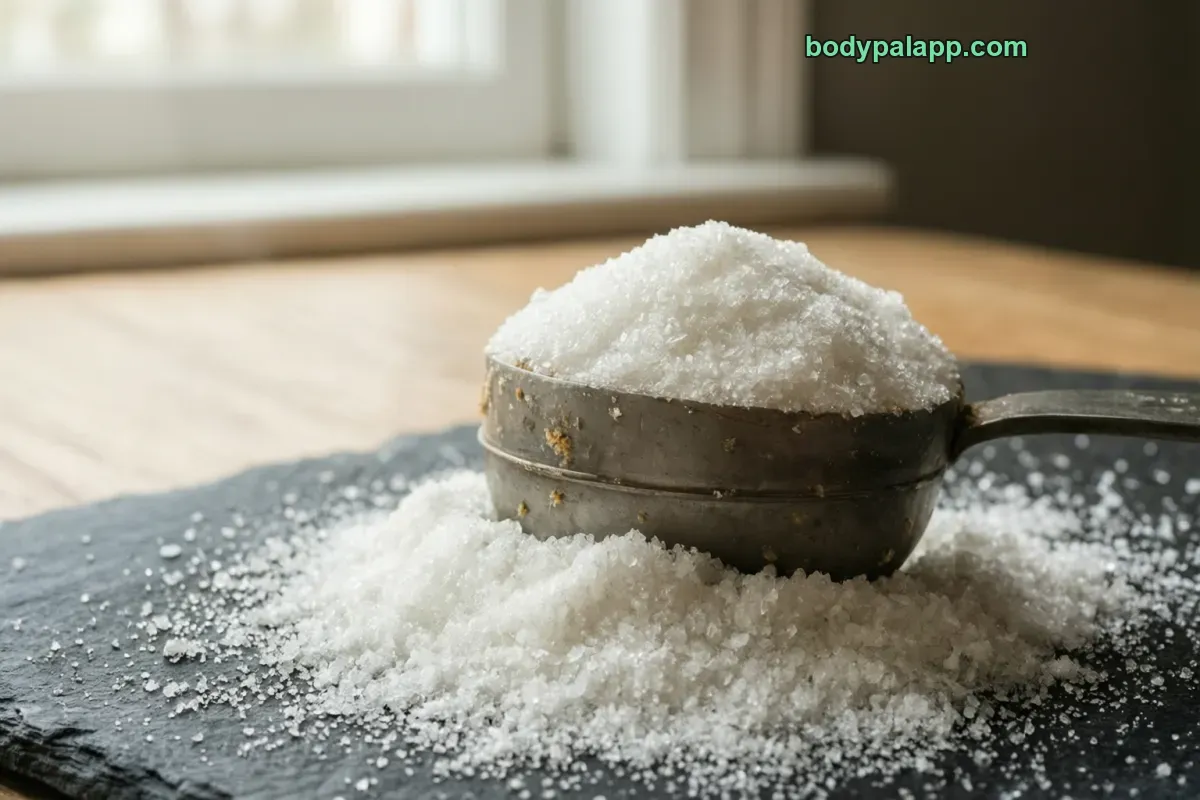
Granulated sugar calories come to 16 for 1 teaspoon (4.2 g) and 387 per 100 g. Every one of those calories is carbohydrate, with no protein, fat or fiber alongside. A single spoon barely registers. The total only matters once spoons multiply in coffee, tea and baking, and that is exactly where it tends to go unlogged.
16kcal
1 teaspoon · 4 g, granulated white sugar
0%protein
0 gProtein
4 gCarbs
0 gFat
How to burn off 16 kcal
—Walking, brisk
—Jogging
—Cycling, moderate
—Swimming
Skip the math. BodyPal counts these calories from your steps and workouts automatically.
Nutrition facts
Granulated white sugar · per 4 g
Calories
16 kcal
Protein
0 g
Carbohydrate
4.2 g
Fat
0 g
Saturated fat
0 g
Cholesterol
0 mg
Sodium
0 mg
Potassium
0 mg
Iron
0 mg
Source: USDA FoodData Central
🛡️
Verified nutrition data
Numbers on this page come from USDA FoodData Central, the U.S. Department of Agriculture’s food composition database, and from manufacturer labels where a branded product is named. Last verified September 2026. How we verify our data →
Granulated sugar: calories, protein and sodium by serving
Percent of daily value uses the FDA reference of 2,000 kcal a day.
Serving
kcal
Protein
Carbs
Fat
Sodium
% DV kcal
1 teaspoon (4.2 g)
16
0 g
4.2 g
0 g
0 mg
1%
1 packet (2.8 g)
11
0 g
2.8 g
0 g
0 mg
1%
1 cup (200 g)
774
0 g
200 g
0 g
2 mg
39%
100 g
387
0 g
100 g
0 g
1 mg
19%
3 × 1 teaspoon (4.2 g)
49
0 g
0 mg
5 × 1 teaspoon (4.2 g)
81
0 g
0 mg
A teaspoon is 16 calories, a cup is 774
One level teaspoon of granulated sugar weighs 4.2 g and adds 16 calories, about 1% of a 2000-calorie daily value. A single packet, the kind found at coffee counters, holds 2.8 g and 11 calories. Small numbers, but they rarely travel alone.
Stack the spoons and the total climbs in a straight line. 2 teaspoons come to 33 calories, 3 teaspoons to 49, and 5 teaspoons to 81. Spread across a few sweetened drinks, that last figure is easy to reach without noticing a single spoonful.
Baking is where the numbers turn serious. A full cup (200 g) carries 774 calories, or 39% of the daily value, before any flour, butter or eggs join it. If you trim a recipe's sugar, the savings per slice look modest, but they come out of every piece in the batch.
Every calorie is carbohydrate
The calorie split is as simple as food data gets: 100% carbohydrate, 0% protein, 0% fat. Per 100 g, granulated sugar holds 100 g of carbs, and 99.8 g of that is sugars. Fiber, protein and fat all sit at 0 g.
That makes sugar pure energy with nothing that adds bulk or slows a meal down. A teaspoon is 4.2 g of carbohydrate and nothing else, so its calories land exactly where the label says. There is no hidden fat or protein to account for.
The carbohydrate daily value used on this page is 275 g. A cup of sugar supplies 200 g of carbs on its own, which is most of that reference amount in a single ingredient. A teaspoon, by contrast, is a rounding error against it.
The sugars row is the only one that moves
Most of the nutrition table is empty. Sodium is 1 mg per 100 g, 0 mg in a teaspoon and 2 mg in a full cup. Potassium is 2 mg per 100 g. Cholesterol and saturated fat are both 0.
So the row to watch is sugars. A teaspoon adds 4.2 g, a packet 2.8 g, and a cup 199.6 g. With granulated sugar, grams of food and grams of sugar are nearly the same number, which makes it a handy reference when you read added sugars on other labels.
If you track sugar, counting teaspoons is the simplest method. 3 teaspoons weigh about 13 g, nearly all of it sugar, for 49 calories. 5 teaspoons weigh about 21 g and bring 81 calories. Once you know your usual number of spoons per drink, the daily tally is easy.
Sugar works best as a measured accent
Sugar brings sweetness and calories but no protein or fiber, so it does little to keep you full. Using it on top of foods that do, such as oatmeal, plain yogurt or fruit, gives those calories some company instead of leaving them on their own.
Measure rather than pour. A free-poured spoon can easily run larger than a level 4.2 g teaspoon, and the gap repeats with every cup of coffee. If you want fewer calories from sweetening, cutting back gradually is the plainest lever: going from 2 teaspoons to 1 roughly halves it.
BodyPal can log sugar from a photo of your plate, but a teaspoon stirred into coffee is invisible to any camera. Add those spoons by hand, since they are the part of the day most likely to slip through.
How does granulated sugar compare?
Here is how granulated sugar stacks up against a spoonful of sugar, sugar cane juice and a sugar cookie, per 100 g and per usual serving.
Verdict: Granulated sugar and a spoonful of sugar are effectively the same food at 387 and 385 calories per 100 g, so log them as one. If you want a sweet hit for the fewest calories, a level teaspoon at 16 beats a sugar cookie at 112, which also carries 23.1 g of fat per 100 g.
Granulated sugar FAQs
How many calories are in 1 teaspoon of sugar?
One level teaspoon of granulated sugar (4.2 g) is 16 calories. A single-serving packet (2.8 g) is 11 calories and a full cup (200 g) is 774.
Is sugar good for weight loss?
Each teaspoon adds 16 calories, so the total depends on how many spoons go in. Granulated sugar has 387 calories per 100 g and no protein or fat.
Sugar vs sugar cookie: which has more calories?
Per 100 g, granulated sugar has 387 calories and a sugar cookie has 489. A teaspoon of sugar is only 4.2 g, so it works out at 16 calories.
How many carbs are in a teaspoon of sugar?
A teaspoon has 4.2 g of carbohydrate, all of it sugars. Per 100 g that is 99.98 g of carbs, of which 99.8 g are sugars.
How many calories are in a packet of sugar?
A sugar packet of 2.8 g has 11 calories, all from carbohydrate. It holds 2.8 g of sugars and no protein, fat or meaningful sodium, so each packet you tear open is worth logging.
How many calories are in a cup of sugar?
A cup of granulated sugar (200 g) has 774 calories, 39% of the daily value. It carries 200 g of carbohydrate, 199.6 g of it sugars, and just 2 mg of sodium.
How many calories are in 2 teaspoons of sugar?
2 teaspoons of granulated sugar come to 33 calories. 3 teaspoons add up to 49 calories and 5 teaspoons to 81, all from carbohydrate with no protein or fat.
How many calories are in 100 g of sugar?
100 g of granulated sugar has 387 calories, 19% of the daily value. It is 100 g of carbohydrate, 99.8 g of it sugars, with 0 g of fat, protein and fiber.
Does sugar contain any sodium?
Barely. Granulated sugar has 1 mg of sodium per 100 g and 0 mg in a teaspoon. Even a full cup holds only 2 mg, 0% of the 2300 mg daily value.