
How many calories are in wheat flour?
One cup of all-purpose wheat flour weighs 125 g and carries 455 calories. Per 100 g the number is 364 calories, and a single tablespoon is only 28. Flour is dense, dry and easy to under-log, which is why the measuring cup does more damage to a food diary than the flour itself does.
On this page
- Wheat flour quick facts
- US servings, from a tablespoon to a full cup
- Bread, cake, self-rising and whole wheat
- The two rows that actually move
- How does wheat flour compare?
- Most popular wheat flour brands
- Wheat flour FAQs
Wheat flour quick facts
The record behind every number here is USDA SR Legacy 168894, "Wheat flour, white, all-purpose, enriched, bleached". That is the flour in the paper sack in most American kitchens, and it is the only white-flour record that comes with a household measure attached: 1 cup = 125 g. The unbleached twin (168936) and the unenriched version (169761) report identical calories and macros, so bleached or not makes no difference to a food log.
Two label rows are missing on purpose. USDA does not publish added sugars or trans fat for this SR Legacy record, and plain flour contains neither added sweetener nor partially hydrogenated fat, so there is nothing to report.
| Nutrient | Per 100 g | Per 1 cup (125 g) | % Daily Value |
|---|---|---|---|
| Calories | 364 | 455 | — |
| Total fat | 0.98 g | 1.2 g | 2% |
| Saturated fat | 0.15 g | 0.2 g | 1% |
| Carbohydrate | 76.31 g | 95.4 g | 35% |
| Dietary fiber | 2.7 g | 3.4 g | 12% |
| Total sugars | 0.27 g | 0.3 g | — |
| Protein | 10.33 g | 12.9 g | 26% |
| Sodium | 2 mg | 3 mg | 0% |
% Daily Value is based on a 2,000-calorie diet.
Verified nutrition data
Numbers on this page come from USDA FoodData Central, the U.S. Department of Agriculture’s food composition database, and from manufacturer labels where a branded product is named. Last verified September 2026. How we verify our data →
Cholesterol is zero, as it is in every plant food. Potassium runs 107 mg per 100 g, so a cup delivers 134 mg, about 3% of the Daily Value. The Daily Values used above are the FDA reference amounts printed on US nutrition labels.
US servings, from a tablespoon to a full cup
| Serving | Weight | Calories |
|---|---|---|
| 1 tbsp | 7.8 g | 28 kcal |
| 1 oz | 28.4 g | 103 kcal |
| 1/4 cup | 31.3 g | 114 kcal |
| 1/2 cup | 62.5 g | 228 kcal |
| 1 cup | 125 g | 455 kcal |
| Per 100 g | 100 g | 364 kcal |
Only the 1-cup line is a USDA household measure. The tablespoon, the ounce, the quarter cup and the half cup are our own arithmetic from the USDA 100 g figure, scaled straight down from 364 calories per 100 g.
Look at the spread. A cup is 455 calories and an ounce is 103, so the same word "flour" in your diary can mean 4.4 times as much depending on which measure you reached for. That gap is the single biggest logging error with flour, and it gets worse because a cup scooped straight from the bag is packed. USDA's 125 g assumes a spooned-and-leveled cup; a scooped one can run 140 g or more, which is another 55 calories nobody wrote down. A cheap kitchen scale removes the whole problem.
Bread, cake, self-rising and whole wheat
| Flour | Per 100 g | Typical serving | Calories |
|---|---|---|---|
| All-purpose, enriched | 364 kcal | 1 cup, 125 g | 455 kcal |
| All-purpose, unenriched | 364 kcal | 1 cup, 125 g | 455 kcal |
| Bread flour | 361 kcal | 1 cup, 137 g | 495 kcal |
| Cake flour | 362 kcal | 1 cup, 137 g | 496 kcal |
| Self-rising flour | 354 kcal | 1 oz, 28.4 g | 100 kcal |
| Whole wheat flour | 340 kcal | 1 oz, 28.4 g | 96 kcal |
| Whole wheat pastry, soft wheat | 332 kcal | 1 oz, 28.4 g | 94 kcal |
Per gram, these flours are nearly the same food. From 332 to 364 calories per 100 g is a spread of 32 calories across the whole shelf, and of the seven USDA wheat-flour records compared here, the whole-grain soft wheat row is the lightest per gram.
Bread flour looks heavier by the cup only because it is heavier in the cup: 137 g against 125 g. Per 100 g it is actually three calories lighter than all-purpose. What it really buys you is protein, 11.98 g against 10.33 g, which is the gluten that gives a loaf its chew. Cake flour goes the other way, 8.2 g of protein and the softest crumb, and its calories per 100 g are within two of all-purpose.
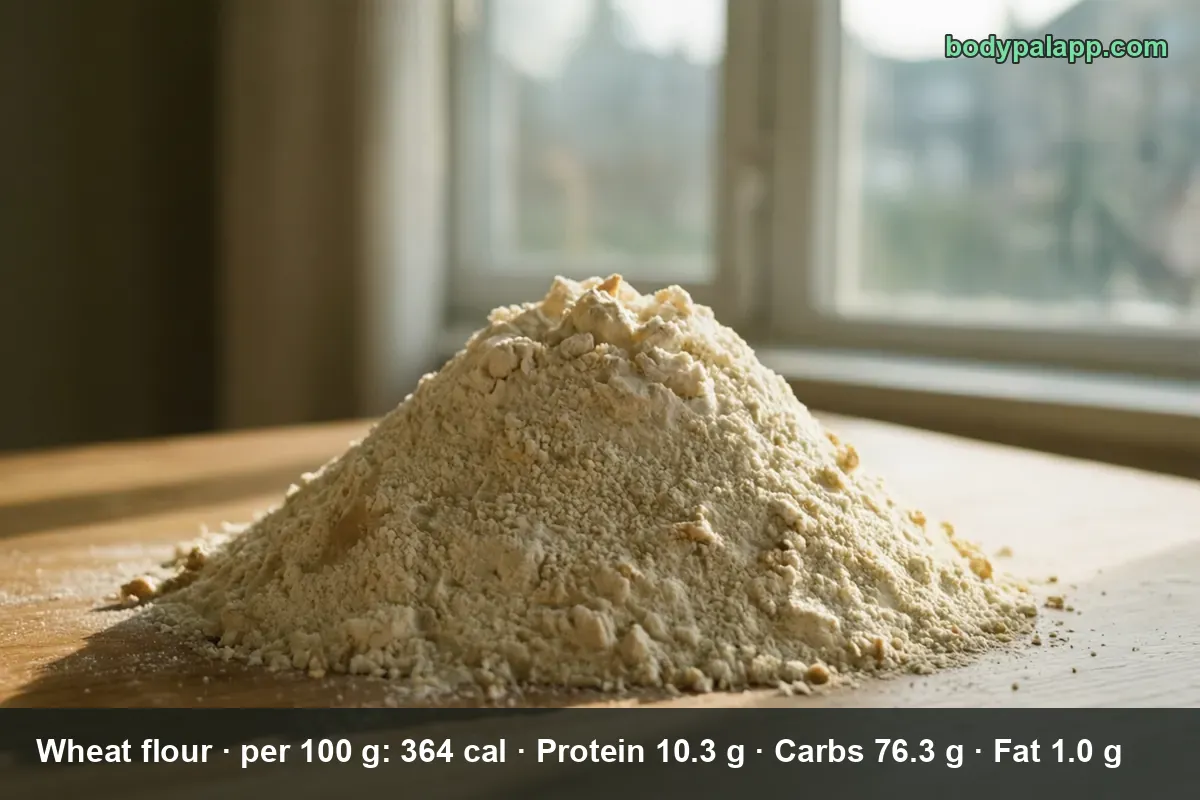
Whole wheat flour is the one genuine outlier, at 340 calories per 100 g. Keeping the bran and the germ dilutes the starch a little and adds a lot of fiber. The coarse, bran-flecked flour in the photo at the top of this page is exactly what that looks like in the bowl; the fine white powder most people mean by "wheat flour" has had all of it sifted out.
Branded bags land in the same band. King Arthur Unbleached White Whole Wheat runs 333 calories per 100 g, or 100 calories on its 30 g label serving, and Gold Medal White Whole Wheat is 367 per 100 g, 110 calories per 30 g. Jovial's organic einkorn is the lightest of these bags at 312 per 100 g. None of them changes the answer by more than a rounding error at the scale of a cookie recipe.
The two rows that actually move
Calories barely budge between flours. Sodium and fiber move a lot.
Self-rising flour carries 1,193 mg of sodium per 100 g, against 2 mg for plain all-purpose. That is 52% of the Daily Value in 100 g, roughly half a teaspoon of table salt, and it comes entirely from the salt and baking powder blended in at the mill, not from the wheat. The Dietary Guidelines for Americans put the adult ceiling at 2,300 mg a day. If you bake with self-rising flour regularly and you are watching sodium, the fix is simple: buy plain flour and add the leavening yourself, so you control the amount.
Fiber runs the other direction. All-purpose gives 2.7 g per 100 g, about 10% of the 28 g Daily Value. Whole-grain wheat flour gives 10.7 g, close to 38%. Swapping half the flour in a bake for whole wheat is one of the least painful ways to move that row, and it lines up with the MyPlate advice to make at least half your grains whole grains.
One more thing worth knowing about the enriched label: enrichment adds back iron and B vitamins lost in milling. It does not change calories. Enriched and unenriched all-purpose flour report the same 364 per 100 g.
How does wheat flour compare?
| Dry ingredient | Per 100 g | US serving | Calories |
|---|---|---|---|
| Wheat flour, all-purpose | 364 kcal | 1 oz, 28.4 g | 103 kcal |
| Semolina, enriched | 360 kcal | 1 oz, 28.4 g | 102 kcal |
| Corn flour, whole-grain white | 361 kcal | 1 oz, 28.4 g | 102 kcal |
| Wheat germ, crude | 360 kcal | 1 oz, 28.4 g | 102 kcal |
Our take: swapping one dry milled grain for another to save calories is wasted effort. All four land within a single calorie per ounce, because they are all mostly dry starch and protein. Choose on what they do instead. Semolina has 12.68 g of protein per 100 g and the bite that makes decent pasta. Corn flour brings only 6.93 g of protein but 3.86 g of fat and a flavor wheat cannot fake. Wheat germ is the odd one out with 23.15 g of protein and 9.72 g of fat per 100 g, which is why it works as a spoonful stirred into oatmeal rather than as a flour. For portion control, weigh the flour; the choice of bag is a baking decision, not a calorie one.
Most popular wheat flour brands in the United States
Ranked by how widely each product appears among foods sold in the United States, from the BodyPal food database of over 3.3 million products. Calories are the figures printed on each Nutrition Facts label, checked against USDA FoodData Central.
| Product | Calories (per 100 g) |
|---|---|
| King Arthur Unbleached White Whole Wheat Flour | 333 cal |
| Jovial 100% Organic Einkorn Whole Wheat Flour | 312 cal |
| Baker Miller All Purpose Wheat Flour | 355 cal |
| King Arthur 100% Whole Grain Sprouted Wheat Flour | 333 cal |
| Gold Medal Whole Wheat Flour | 353 cal |
| Gold Medal White Whole Wheat Flour | 367 cal |
Brand popularity: BodyPal food database. Nutrition: manufacturer labels / USDA FoodData Central.
Wheat flour FAQs
How many calories are in 1 cup of wheat flour?
455 calories in one cup, using the USDA weight of 125 g for white all-purpose flour. That cup also carries 95.4 g of carbohydrate and 12.9 g of protein, which is 26% of the Daily Value. A cup scooped rather than spooned weighs more, so weighing beats measuring.
How many calories in 100 g of wheat flour?
364 calories per 100 g for white all-purpose flour, enriched and bleached. The same 100 g holds 76.31 g of carbohydrate, 10.33 g of protein, 2.7 g of fiber and under a gram of fat. Whole-grain wheat flour is slightly lighter at 340 calories per 100 g.
Is wheat flour the same as whole wheat flour?
No: whole wheat flour is 340 calories per 100 g against 364 for white all-purpose, and it keeps the bran and germ, so fiber jumps from 2.7 g to 10.7 g per 100 g. Plain "wheat flour" on a US recipe almost always means the white, enriched kind.
How many calories in 1/4 cup of flour?
114 calories in a quarter cup, which is 31.3 g of all-purpose flour. That figure is our own arithmetic from the USDA 100 g number rather than a USDA serving. It brings about 23.9 g of carbohydrate and 3.2 g of protein. Four of them make the 455-calorie cup.
How much protein is in wheat flour?
10.33 g of protein per 100 g, or 12.9 g in a 125 g cup, which covers 26% of the Daily Value. Bread flour is higher at 11.98 g and whole-grain higher still at 13.21 g per 100 g. Cake flour sits lowest of the group at 8.2 g.
Is bread flour higher in calories than all-purpose flour?
Barely: 361 calories per 100 g for bread flour against 364 for all-purpose, and not in the direction people expect. By the cup it looks bigger only because it packs heavier: 137 g and 495 calories, against 125 g and 455. Weigh both and they match.
Why is self-rising flour so high in sodium?
1,193 mg of sodium per 100 g, which is 52% of the Daily Value and about half a teaspoon of table salt. Plain all-purpose flour has 2 mg. The salt and baking powder already blended in at the mill account for all of it; the wheat contributes almost nothing.
Do the calories change after the flour is baked?
No: the 455 calories in a 125 g cup of flour do not disappear in the oven. Flour is measured dry, so those calories are still in the finished loaf; baking mainly drives off water and concentrates what is left. Logging the flour you actually weighed beats guessing at a slice.
Similar foods
- Flour — 455 cal per cup
- All-Purpose Flour — 455 cal per cup
- White Flour — 455 cal per cup
- American Cheese — 75 cal per slice
- Corn Flour — 422 cal per cup
- Turkey Gravy — 26 cal per serving
Count it without the math
Point the camera at the bowl and BodyPal counts it for you, cup or ounce.


How long does it take to burn off wheat flour?
A 1-cup (125 g) serving is 455 kcal. Enter your weight and the amount you ate to see how long it takes you to burn that off:
lb
| Activity | Time to burn 455 kcal |
|---|---|
| Walking, brisk | 1 hr 31 min |
| Cycling, moderate | 57 min |
| Swimming, moderate | 1 hr 5 min |
| Jogging | 54 min |
| Weight training, moderate | 1 hr 41 min |
Times are for a 155 lb adult at a steady pace; change the weight to see yours. The amount is set to the portion in the text (125 g); change it to what you actually ate. BodyPal works this out from your steps automatically.
This table assumes you know your daily total. If you do not, the daily calorie calculator works it out from five numbers.