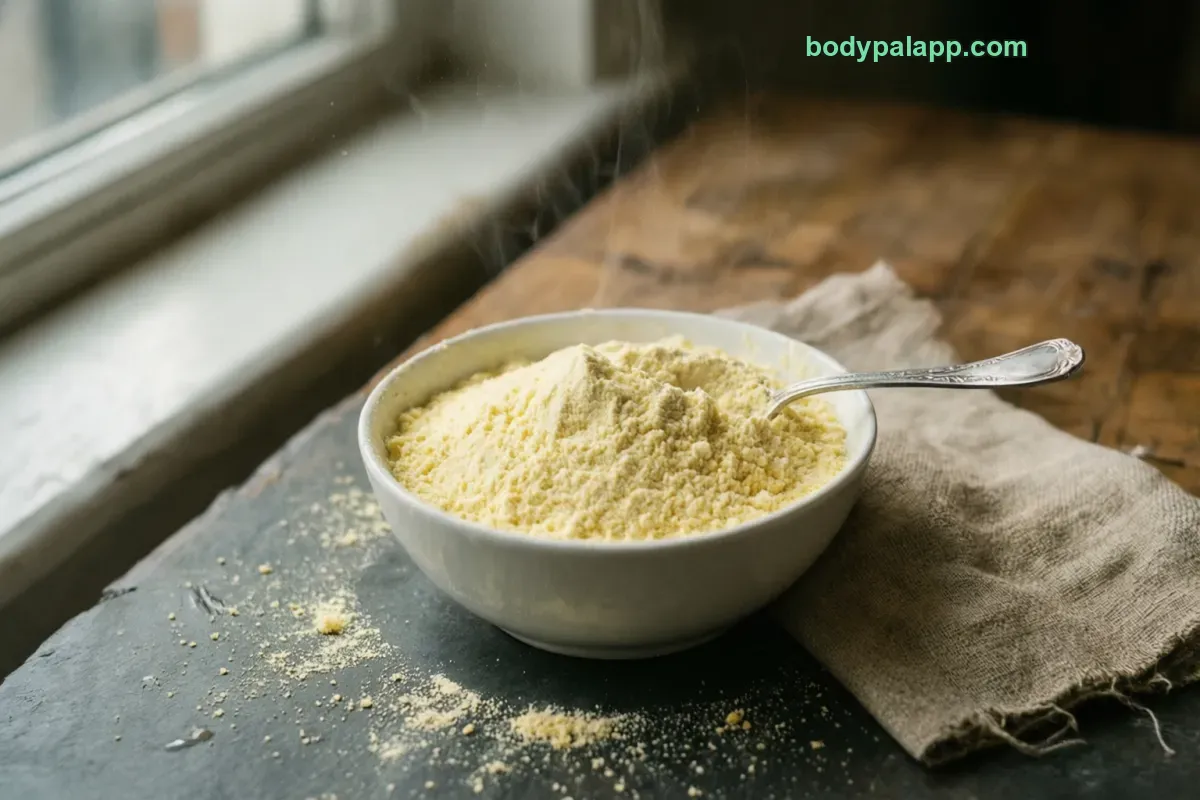
Corn flour calories come to 422 for 1 cup (117 g) and 361 per 100 g of whole-grain yellow corn flour. Carbs supply 83% of those calories, so the total moves almost entirely with how much flour you scoop. Sodium is close to zero, and fiber is a solid 7.3 g per 100 g.
422kcal
1 cup · 117 g, whole-grain, yellow
7%protein
8.1 gProtein
90 gCarbs
4.5 gFat
How to burn off 422 kcal
—Walking, brisk
—Jogging
—Cycling, moderate
—Swimming
Skip the math. BodyPal counts these calories from your steps and workouts automatically.
Nutrition facts
Whole-grain, yellow · per 117 g
Calories
422 kcal
Protein
8.1 g
Carbohydrate
90 g
Fat
4.5 g
Saturated fat
0.6 g
Cholesterol
0 mg
Sodium
6 mg
Potassium
369 mg
Iron
2.8 mg
Source: USDA FoodData Central
🛡️
Verified nutrition data
Numbers on this page come from USDA FoodData Central, the U.S. Department of Agriculture’s food composition database, and from manufacturer labels where a branded product is named. Last verified September 2026. How we verify our data →
Corn flour: calories, protein and sodium by serving
Percent of daily value uses the FDA reference of 2,000 kcal a day.
Serving
kcal
Protein
Carbs
Fat
Sodium
% DV kcal
1 cup (117 g)
422
8.1 g
89.9 g
4.5 g
6 mg
21%
1 oz (28 g)
101
1.9 g
21.5 g
1.1 g
1 mg
5%
100 g
361
6.9 g
76.9 g
3.9 g
5 mg
18%
Masa cup (114 g)
414
9.6 g
87.3 g
4.2 g
6 mg
21%
3 × 1 cup (117 g)
1,267
24.3 g
18 mg
5 × 1 cup (117 g)
2,112
40.5 g
29 mg
One cup is 21% of a day's calories
A level 1 cup (117 g) of corn flour carries 422 calories, which is 21% of the daily value used on this page. That cup also brings 8.1 g of protein, 89.9 g of carbs and 4.5 g of fat. Few people eat a cup on its own, but recipes for cornbread, arepas or a batch of tortillas often start with exactly that much or more.
The smaller unit is more useful for tracking. One 1 oz (28 g) portion is 101 calories, about 5% of the daily value, with 21.5 g of carbs and 2 g of fiber. If you dust fish or chicken before frying, you are usually closer to this end of the scale than to a full cup.
Batch recipes climb fast. Two cups (234 g) reach 845 calories, three cups (351 g) hit 1,267, and five cups (585 g) total 2,112. Divide the recipe total by the number of pieces you cut, and the per-portion figure becomes far easier to log than guessing from the finished bread.
Carbs bring 83% of the calories
Corn flour is a starch food first. Per 100 g it holds 76.9 g of carbs, 6.9 g of protein and 3.9 g of fat, which works out to a calorie split of 83% carbs, 7% protein and 9% fat. Sugars are only 0.6 g per 100 g, so nearly all of that carbohydrate is starch rather than sugar.
Protein is modest. A cup gives 8.1 g, or 16% of the daily value, and 1 oz gives just 1.9 g. Corn flour will not carry a meal's protein on its own, so the filling, topping or side dish has to do that job.
Fat is low but not zero, because this is whole-grain flour that keeps more of the kernel. The 3.9 g of fat per 100 g includes only 0.5 g of saturated fat. That small fat share is one reason corn flour runs a touch more than refined starches on fiber and flavor, while still being lean overall.
Fiber is the row worth noticing
Whole-grain corn flour delivers 8.5 g of fiber per cup, measured against a daily value of 28 g. Per 100 g it is 7.3 g, and even 1 oz brings 2 g. For a pantry flour, that is a meaningful amount, and it is the clearest nutritional difference between this flour and pure starch.
Sodium is the opposite story. A full cup has only 6 mg, which rounds to 0% of the daily value, and 100 g has 5 mg. Any salt in your cornbread, polenta or tortillas comes from what you add, plus baking powder or cheese, not from the flour itself. If you watch sodium, the flour is not where to look.
Cholesterol is 0, and potassium sits at 315 mg per 100 g. Those rows are quiet. The two numbers that actually shape how corn flour fits your day are calories from carbs and the fiber that comes along with them.
Masa runs close to plain corn flour
Masa harina, the treated corn flour used for tortillas and tamales, lands near the same place. A Masa cup (114 g) carries 414 calories, with 9.6 g of protein, 87.3 g of carbs and 4.2 g of fat. Protein reaches 19% of the daily value, a bit higher than the 16% in a cup of whole-grain corn flour.
Fiber in that masa cup is 7.3 g and sugars are 1.8 g, so the trade is small in both directions. If a recipe calls for one and you have the other, calories will barely shift. Texture and flavor change more than the numbers do.
Because corn flour is mostly carbs with little protein, pair it with foods that fill the gap: beans, eggs, chicken, fish or cheese in tortillas and arepas, and vegetables on the side. Brands such as Bob's Red Mill Corn Flour and Sabor di Terra Yellow Corn Flour sit in the same broad range, and BodyPal can log a plate of cornbread or tortillas from a photo.
How does corn flour compare?
Here is how corn flour stacks up against corn starch, white flour and all-purpose flour, per 100 g and per usual serving.
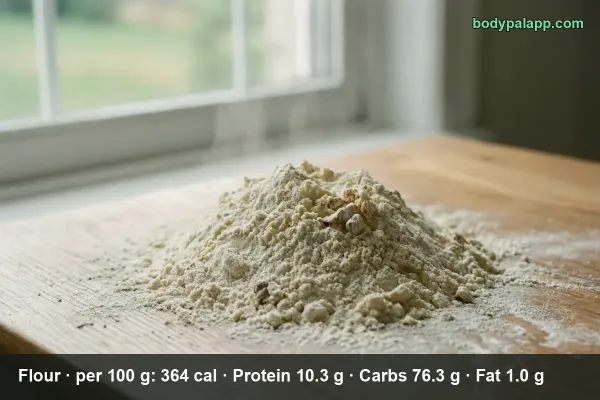
Verdict: Corn starch is the denser choice at 381 calories per 100 g with just 0.3 g of protein, so for thickening or baking where every calorie counts, corn flour at 361 or white flour at 364 is the better pick. For protein, white flour wins with 10.3 g per 100 g, while corn flour brings more fat, 3.9 g versus 1 g, plus its whole-grain fiber.
Most popular corn flour brands in the United States
3Amazonas Rainforest Harina Crema de Semola Corn Flour1/4 cup · 43 g395 kcal
4Bob's Red Mill Corn Flour29 g379 kcal
5Sabor di Terra White Corn Flour1/3 cup · 50 g360 kcal
6Sabor di Terra Yellow Corn Flour1/3 cup · 50 g360 kcal
7Rio Grande Purple Corn Flour28 g429 kcal
These labels are all for dry flour, the same state as the number above, so the gaps come from the corn type and how finely it is milled. Source: manufacturer labels / USDA FoodData Central.
Corn flour FAQs
How many calories are in corn flour?
One cup of whole-grain yellow corn flour (117 g) is 422 calories. A level 100 g scoop is 361 calories and one ounce is 101.
Is corn flour good for weight loss?
It is dense for its volume, since one cup is 422 calories, so the portion size decides. Whole-grain corn flour has 7.3 g of fiber per 100 g against 1.9 g in the degermed type.
Corn flour vs corn starch: which has more calories?
Corn starch is higher per 100 g at 381 calories versus 361 for corn flour, and corn flour also brings 6.9 g protein and 7.3 g fiber per 100 g.
How much protein is in corn flour?
6.9 g per 100 g, which is 8.1 g in a 117 g cup, alongside 76.9 g of carbs per 100 g.
How many calories are in 1 oz of corn flour?
One ounce (28 g) of corn flour has 101 calories. That portion includes 21.5 g of carbs, 1.9 g of protein, 1.1 g of fat and 2 g of fiber, a typical amount for dredging or thickening.
How much fiber does corn flour have?
Corn flour has 8.5 g of fiber per cup (117 g) and 7.3 g per 100 g. That is a solid share of the 28 g daily value, and it comes from the whole-grain kernel.
Does masa harina have more calories than corn flour?
A Masa cup (114 g) has 414 calories, while 1 cup (117 g) of corn flour has 422. The masa brings slightly more protein, 9.6 g versus 8.1 g, so the two are close.
Is corn flour high in sodium?
No. Corn flour has 6 mg of sodium per cup and 5 mg per 100 g, which rounds to 0% of the daily value. Salt in corn dishes comes from added ingredients.
How much sugar is in corn flour?
Corn flour has 0.7 g of sugars per cup and 0.6 g per 100 g. Nearly all of its 76.9 g of carbs per 100 g are starch, not sugar.