White flour calories come to 455 for 1 cup (125 g) and 364 per 100 g of all-purpose, enriched, bleached flour. Nearly all of that energy is starch: carbs supply 86% of the calories, while fat barely registers. The bigger swing is portion size, because recipes call for flour by the cup, and a few cups add up fast.
455kcal
1 cup · 125 g, all-purpose, enriched, bleached
12%protein
12.9 gProtein
95 gCarbs
1.2 gFat
How to burn off 455 kcal
—Walking, brisk
—Jogging
—Cycling, moderate
—Swimming
Skip the math. BodyPal counts these calories from your steps and workouts automatically.
Nutrition facts
All-purpose, enriched, bleached · per 125 g
Calories
455 kcal
Protein
12.9 g
Carbohydrate
95 g
Fat
1.2 g
Saturated fat
0.2 g
Cholesterol
0 mg
Sodium
3 mg
Potassium
134 mg
Iron
5.8 mg
Source: USDA FoodData Central
🛡️
Verified nutrition data
Numbers on this page come from USDA FoodData Central, the U.S. Department of Agriculture’s food composition database, and from manufacturer labels where a branded product is named. Last verified September 2026. How we verify our data →
White flour: calories, protein and sodium by serving
Percent of daily value uses the FDA reference of 2,000 kcal a day.
Serving
kcal
Protein
Carbs
Fat
Sodium
% DV kcal
1 cup (125 g)
455
12.9 g
95.4 g
1.2 g
3 mg
23%
100 g
364
10.3 g
76.3 g
1 g
2 mg
18%
1 oz portion (28 g)
102
2.9 g
21.4 g
0.3 g
1 mg
5%
3 × 1 cup (125 g)
1,365
38.7 g
8 mg
5 × 1 cup (125 g)
2,275
64.6 g
13 mg
One cup is 455 calories, and recipes rarely stop at one
A single cup of white flour weighs 125 g and carries 455 calories, about 23% of a standard daily calorie value. That cup also brings 12.9 g of protein and 95.4 g of carbohydrate. A smaller 1 oz portion (28 g), roughly what thickens a pan sauce or dusts a cutting board, comes to 102 calories.
Baking is where the totals climb. A recipe calling for 2 cups puts 910 calories of flour in the bowl, 3 cups means 1,365, and a big batch with 5 cups reaches 2,275 calories before any butter, sugar or eggs go in. Divide that by the number of slices or cookies and you see why the flour share alone is rarely trivial.
Cups are also an imprecise measure. Scooping straight from the bag packs flour down, so a heaped cup can weigh noticeably more than 125 g. If you log homemade baking, weighing the flour in grams is the most reliable way to keep the numbers honest.
Starch supplies 86% of the calories
Per 100 g, white flour holds 76.3 g of carbohydrate, 10.3 g of protein and just 1 g of fat. Translated into calories, that is an 86% carb, 12% protein and 2% fat split. Saturated fat sits at 0.2 g and cholesterol at 0, so the fat side of the label is close to empty.
Only a sliver of the carbohydrate is sugar: 0.3 g per 100 g and 0.3 g per cup. The rest is starch, which is what makes flour such a dense source of energy for its weight. Any sweetness in a finished cake or muffin comes from what you add, not from the flour.
Protein is modest but not nothing. A cup gives 12.9 g, about 26% of the daily value, which is why flour-heavy foods contribute more protein to a day than people expect. Still, per calorie, flour is a carbohydrate food first.
Fiber is the thin row, sodium is near zero
Refined white flour keeps little of the wheat's bran, and the fiber row shows it: 2.7 g per 100 g and 3.4 g per cup, set against a daily value of 28 g. For 455 calories, that is a small fiber return. If you want more fiber from your baking, swapping part of the white flour for a whole wheat blend is the usual route.
Sodium is the opposite story. Plain flour carries only 2 mg per 100 g and 3 mg per cup, which rounds to 0% of the daily value. Potassium is also low at 107 mg per 100 g.
That low sodium figure applies to the bag, not the bread. Salt, baking soda and baking powder are what push sodium up in finished baked goods, so if you watch sodium, read the recipe rather than the flour label.
Flour counts through the foods it builds
Almost nobody eats flour by the spoonful. It shows up in bread, pancakes, pasta, pie crust, gravy and breading, so its calories are spread across portions of finished food. Tracking the flour in a recipe, then splitting it by servings, gives a clearer picture than guessing from the end product.
Because white flour is mostly starch with little fiber or fat, foods built on it tend to digest quickly. Pairing them with a protein source, vegetables or a fat such as nuts or olive oil makes the meal more filling than flour-heavy food on its own.
Brands on the shelf, from Great River and Bob's Red Mill to Wheat Montana, sell all-purpose white flours that land in a similar range, while blends like Hodgson Mill 50/50 mix in whole wheat. BodyPal can log a finished dish from a photo when weighing every ingredient is not practical.
How does white flour compare?
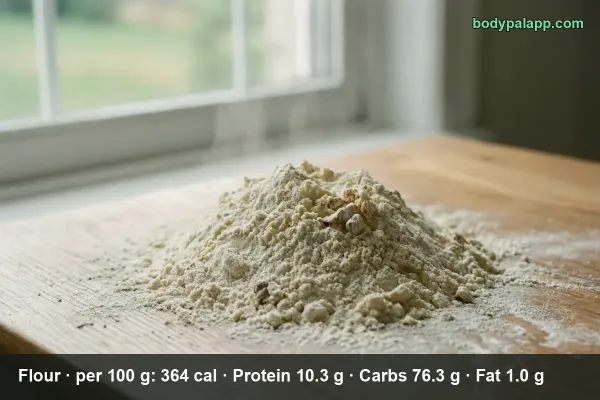
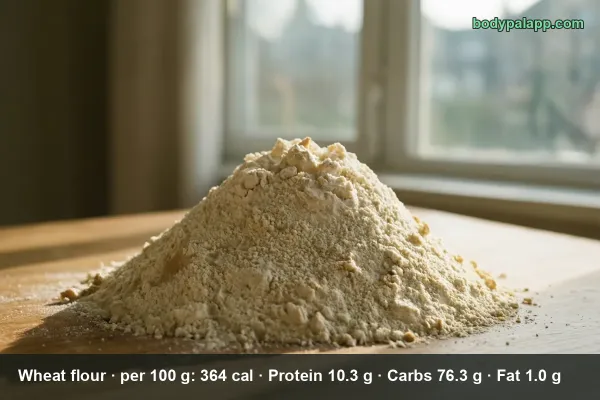
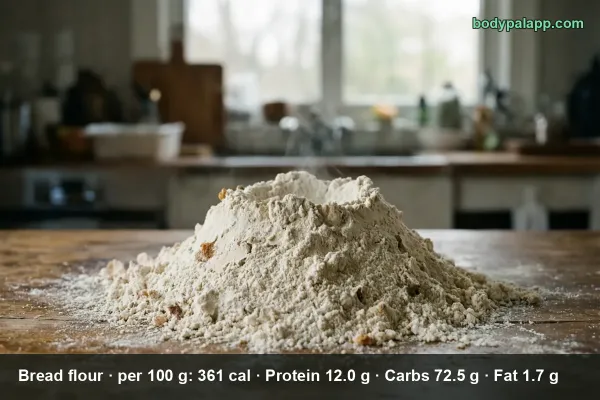
Here is how white flour stacks up against plain flour, wheat flour and bread flour, per 100 g and per usual serving.
Verdict: On calories it is a tie: flour and wheat flour match white flour at 364 per 100 g, and bread flour is barely lower at 361. Pick bread flour if you want a bit more protein, 12 g versus 10.3 g, and stick with all-purpose for everyday baking.
Most popular white flour brands in the United States
Ranked by popularity in the BodyPal database
# Productkcal / 100 g
1Great River 100% Organic All Purpose White Flour1/4 cup · 30 g367 kcal
2Hodgson Mill 50/50 Whole Wheat & White Flour1/4 cup · 30 g333 kcal
3Bob's Red Mill Unbleached White Flour1/4 cup · 34 g353 kcal
4Wheat Montana Premium All-Purpose Natural White Flour1/4 cup · 38 g342 kcal
Labels are for dry flour like the numbers above, but each brand weighs its quarter cup differently (30 to 38 g), and the Hodgson Mill row is half whole wheat, so it reads lower than plain white flour. Source: manufacturer labels / USDA FoodData Central.
White flour FAQs
How many calories are in a cup of white flour?
One cup of all-purpose white flour weighs 125 g and gives 455 calories. Per 100 g that is 364 calories.
Is white flour good for weight loss?
It is dense for its volume: 100 g holds 364 calories, 76.3 g carbs and only 2.7 g fiber, and a single cup already adds 455 calories to a recipe.
White flour vs bread flour: which has more calories?
They are almost the same, 364 calories per 100 g for all-purpose white flour and 361 for white bread flour. Bread flour carries more protein, 11.98 g per 100 g against 10.33 g.
How much protein is in white flour?
White flour has 10.33 g of protein per 100 g, so a 125 g cup provides 12.9 g. The same cup also has 95.4 g of carbs and 1.2 g of fat.
How many calories are in 1 oz of white flour?
A 1 oz portion (28 g) of white flour has 102 calories. It also carries 2.9 g of protein, 21.4 g of carbohydrate and 0.3 g of fat, about 5% of a standard daily calorie value.
How many calories are in 2 cups of white flour?
Two cups (250 g) of white flour come to 910 calories. That is a common amount for a loaf or a batch of cookies, and it adds 25.8 g of protein before any other ingredients go in.
How many carbs are in a cup of white flour?
A cup (125 g) of white flour holds 95.4 g of carbohydrate. Only 3.4 g of that is fiber and 0.3 g is sugar, so nearly all of it is starch.
Does white flour contain sugar?
Barely. White flour has 0.3 g of sugars per 100 g and 0.3 g per cup. Its carbohydrate is almost entirely starch, so sweetness in baked goods comes from added sugar.
How much sodium is in white flour?
White flour has 2 mg of sodium per 100 g and 3 mg per cup, which is 0% of the daily value. Sodium in baked goods comes from salt and leavening, not the flour.