
How many calories are in flour?
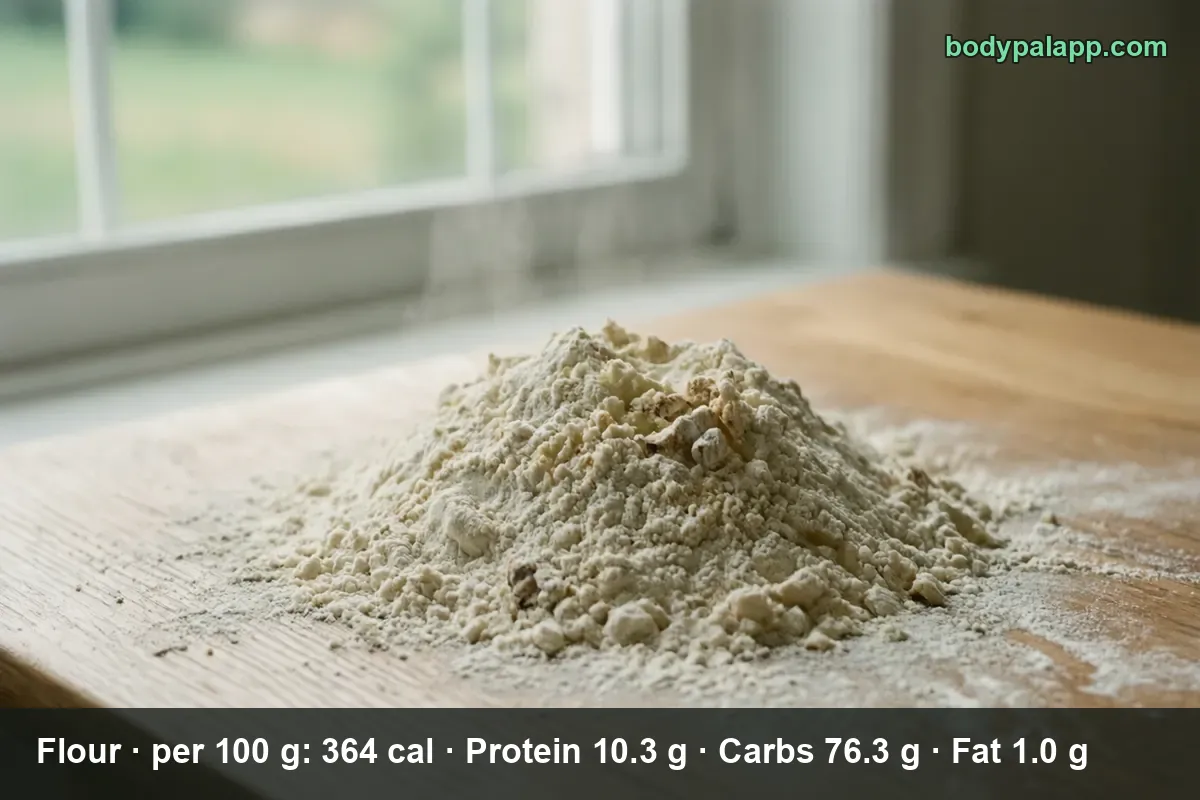
A 1-cup (125 g) serving of all-purpose white flour is 455 calories. Per 100 g the same flour runs 364 calories, and a quarter cup lands at 114. Flour looks harmless sitting in a measuring cup, but it is close to pure starch: 76.31 g of carbohydrate per 100 g, 10.33 g of protein, and almost no fat.
On this page
- Flour quick facts
- US servings, from a tablespoon to a full cup
- Whole wheat, bread, cake and almond flour
- Self-rising flour and the sodium row
- Fiber is where the flours split
- How does flour compare?
- Most popular flour brands
- FAQ
Flour quick facts
When an American types "calories in flour," the thing in the pantry is a paper sack of white all-purpose wheat flour. The record that matches it is SR Legacy 168894, "Wheat flour, white, all-purpose, enriched, bleached". It is the only all-purpose entry that carries a full profile — sugars, saturated fat and fiber together — and it comes with the household measure bakers actually use, 1 cup at 125 g.
There is a newer Foundation record for the same flour at 366 calories per 100 g, from a fresher round of sampling, but it has no sugar, saturated fat or fiber values at all. Mixing the two would mean averaging across sources, so the numbers below stay on one record from top to bottom.
| Nutrient | Per 100 g | Per 1 cup (125 g) | % Daily Value |
|---|---|---|---|
| Calories | 364 | 455 | — |
| Total fat | 0.98 g | 1.2 g | 2% |
| Saturated fat | 0.15 g | 0.2 g | 1% |
| Carbohydrate | 76.31 g | 95.4 g | 35% |
| Dietary fiber | 2.7 g | 3.4 g | 12% |
| Total sugars | 0.27 g | 0.3 g | — |
| Protein | 10.33 g | 12.9 g | 26% |
| Sodium | 2 mg | 3 mg | 0% |
% Daily Value is based on a 2,000-calorie diet.
Verified nutrition data
Numbers on this page come from USDA FoodData Central, the U.S. Department of Agriculture’s food composition database, and from manufacturer labels where a branded product is named. Last verified September 2026. How we verify our data →
Two rows you will not find here: added sugars and trans fat. SR Legacy does not publish either for this food, and flour is a single milled ingredient with nothing added and no partially hydrogenated oil in it. Cholesterol is 0 mg, as it is in every plant food. Potassium is 107 mg per 100 g, so 134 mg in a cup, 3% of the Daily Value — flour is not where your potassium comes from.
US servings, from a tablespoon to a full cup
| Serving | Weight | Calories |
|---|---|---|
| 1 tbsp | 7.8 g | 28 kcal |
| 1 oz | 28.35 g | 103 kcal |
| 1/4 cup | 31.3 g | 114 kcal |
| 1/2 cup | 62.5 g | 228 kcal |
| 1 cup | 125 g | 455 kcal |
| Per 100 g | 100 g | 364 kcal |
Only the 1-cup line and the 1 oz line are USDA portions. The tablespoon, the quarter cup and the half cup are our own arithmetic from the USDA 100 g figure, scaled off that 125 g cup, not USDA servings in their own right.
That gap between the cup and the bag is worth a second. Most major flour labels print their serving as 1/4 cup at 30 g and call it 110 calories. Four of those label servings come to 120 g and 437 calories by our own scaling — five grams and eighteen calories short of USDA's 125 g cup. Recipes count cups; labels count quarter cups; the two are not quite the same object.
Weighing is the fix, because a cup scooped straight out of the sack packs down harder than a cup spooned in and leveled. If you bake by volume, the cup on the counter is the loosest number in the whole recipe.
Store brands land almost exactly on the USDA figure. Great Value Organic, 365 Everyday Value, King Arthur Unbleached and Gold Medal all report 367 calories per 100 g, three above the USDA record; Pillsbury reports 355 and Bob's Red Mill 353. On the label all of them read 110 calories a serving, except Bob's Red Mill, which uses a heavier 34 g quarter cup and prints 120.
Whole wheat, bread, cake and almond flour
| Flour | Per 100 g | Typical 1/4 cup | Calories |
|---|---|---|---|
| All-purpose, white | 364 kcal | 30 g | 109 kcal |
| Whole wheat | 340 kcal | 30 g | 102 kcal |
| Bread flour | 361 kcal | 30 g | 108 kcal |
| Cake flour | 362 kcal | 30 g | 109 kcal |
| Self-rising | 354 kcal | 30 g | 106 kcal |
| White rice flour | 366 kcal | 30 g | 110 kcal |
| Almond flour | 622 kcal | 28 g | 174 kcal |
Across the wheat flours, the spread is trivial. Six of the seven rows sit between 340 and 366 calories per 100 g, and whole wheat is the only one under 350. Swapping bread flour for cake flour changes the crumb of a cake completely and changes the calorie count by one per quarter cup.
Almond flour is the exception that breaks the pattern. At 622 calories per 100 g it is about 1.7 times the heaviest wheat flour here, because it is ground nuts rather than milled grain — fat instead of starch. A quarter cup is 174 calories against 109. Baking a low-carb cake with it is a real carbohydrate cut, not a calorie cut.
One more thing worth knowing before you pay extra for a bag: bleached, unbleached and unenriched all-purpose flour are three separate USDA records with identical numbers, 364 calories and 10.33 g of protein per 100 g. Bleaching is a color and texture treatment. Enrichment adds iron and B vitamins back after milling; it adds no calories. You may prefer one for taste or for principle, but not one of those choices moves the count.
Self-rising flour and the sodium row
Self-rising flour is the one bag in the aisle where the interesting number is not calories. It comes premixed with baking powder and salt, and that shows up as 1,193 mg of sodium per 100 g against 2 mg in plain all-purpose — 52% of the Daily Value in 100 g, or 358 mg in a 30 g quarter cup. Per 100 g that is roughly half a teaspoon of table salt already stirred in.
For biscuits and pancakes that is exactly the point, and the recipe usually leaves out the salt to match. The trap is substitution in the other direction: pouring self-rising into a bread recipe that already calls for salt stacks two doses on top of each other. The FDA's Daily Value guide puts the sodium ceiling at 2,300 mg a day, and a cup of self-rising flour spread across a batch of biscuits eats a serious share of it. If you are watching sodium, plain flour plus your own measured baking powder gives you control that the premix does not.
Fiber is where the flours split
Calories are a poor way to choose a flour. Fiber is a good one. White all-purpose flour carries 2.7 g of fiber per 100 g, which is 10% of the 28 g Daily Value. Whole-grain wheat flour carries 10.7 g, or 38%. That is the whole argument for whole wheat in one line: 24 fewer calories per 100 g, and nearly four times the fiber.
Protein moves in the same direction — 13.21 g per 100 g in whole-grain against 10.33 g in white — because the bran and germ that get sifted out of white flour are where both live. MyPlate's grains guidance is to make at least half your grains whole, and the Dietary Guidelines for Americans say the same. Half your baking flour, not all of it, is a realistic version of that: whole wheat alone makes a dense loaf.
How does flour compare?
| Flour | Per 100 g | US serving | Calories |
|---|---|---|---|
| All-purpose, white | 364 kcal | 1/4 cup, 30 g | 109 kcal |
| Whole-grain wheat | 340 kcal | 1/4 cup, 30 g | 102 kcal |
| Bread flour | 361 kcal | 1/4 cup, 30 g | 108 kcal |
| Cake flour | 362 kcal | 1/4 cup, 30 g | 109 kcal |
Every row is scaled to the same 30 g so the flours are actually comparable; the quarter cups are our arithmetic from each USDA 100 g figure, not USDA servings.
Our take: stop shopping for flour by calories. At a 30 g quarter cup, seven calories separate the lightest wheat flour in the table from the heaviest, and no baker has ever tasted the difference. Choose bread flour when you want gluten and chew, cake flour when you want tenderness, whole wheat when you want the fiber, and weigh the flour instead of scooping it — that is where the counting errors really come from. For a weight-loss log, the number that matters is how many cups went into the recipe, since a single cup at 455 calories is most of a light lunch before anything else joins it. For staying full, whole wheat is the pick, on fiber alone.
Most popular flour brands in the United States
Ranked by how widely each product appears among foods sold in the United States, from the BodyPal food database of over 3.3 million products. Calories are the figures printed on each Nutrition Facts label, checked against USDA FoodData Central.
| Product | Calories (per 100 g) |
|---|---|
| Great Value Organic All Purpose Flour | 367 cal |
| 365 Everyday Value All-Purpose Flour | 367 cal |
| King Arthur Unbleached All-Purpose Flour | 367 cal |
| Pillsbury All Purpose Flour | 355 cal |
| Gold Medal Bleached Enriched Presifted All Purpose Flour | 367 cal |
| Bob's Red Mill Unbleached White All-Purpose Flour | 353 cal |
Brand popularity: BodyPal food database. Nutrition: manufacturer labels / USDA FoodData Central.
Flour FAQs
How many calories are in 1 cup of flour?
A 1-cup serving of all-purpose white flour weighs 125 g and carries 455 calories, since the USDA record runs 364 calories per 100 g. That cup also brings 95.4 g of carbohydrate and 12.9 g of protein, which is 35% and 26% of a day's value on a 2,000-calorie diet.
How many calories are in 1/4 cup of flour?
A quarter of the USDA cup is 31.3 g and 114 calories, our own arithmetic from the 100 g figure rather than a USDA serving. Most flour bags print a slightly smaller quarter cup of 30 g at 110 calories, so the package number sits about four calories below ours.
How many calories in 1 tablespoon of flour?
One level tablespoon of all-purpose flour is 7.8 g and 28 calories, scaled from the USDA 100 g value rather than taken from a USDA serving. Thickening a pan sauce with two tablespoons adds 57 calories and about 11.9 g of carbohydrate, with essentially no fat and no sodium.
Does whole wheat flour have fewer calories than white flour?
Slightly: whole-grain wheat flour is 340 calories per 100 g against 364 for white all-purpose, a difference of 24. A 30 g quarter cup is 102 calories instead of 109. The real gap is fiber: 10.7 g per 100 g against 2.7 g, which is 38% of the Daily Value against 10%.
Is bread flour higher in calories than all-purpose flour?
No: bread flour is 361 calories per 100 g, three below all-purpose flour at 364. What it does carry is more protein, 11.98 g against 10.33 g per 100 g, and that is what builds gluten and chew in a loaf. At a 30 g quarter cup the difference is 108 calories against 109.
How many carbs are in all-purpose flour?
All-purpose white flour holds 76.31 g of carbohydrate per 100 g. A 125 g cup works out to 95.4 g, which is 35% of the Daily Value, with 3.4 g of it as fiber and only 0.3 g as sugar. A 30 g quarter cup comes to 22.9 g of carbohydrate.
How much protein is in a cup of flour?
A 125 g cup of all-purpose flour carries 12.9 g of protein, 26% of the Daily Value. Bread flour is higher per 100 g at 11.98 g against 10.33 g, cake flour lower at 8.2 g, and whole-grain wheat flour highest of the four at 13.21 g per 100 g.
Why is self-rising flour high in sodium?
Self-rising flour comes premixed with baking powder and salt, so it carries 1,193 mg of sodium per 100 g against 2 mg in plain all-purpose. That is 52% of the Daily Value in 100 g, or 358 mg in a 30 g quarter cup — roughly half a teaspoon of table salt already stirred into the bag.
Similar foods
- All-Purpose Flour — 455 cal per cup
- Wheat Flour — 455 cal per cup
- White Flour — 455 cal per cup
- American Cheese — 75 cal per slice
- Corn Flour — 422 cal per cup
- Turkey Gravy — 26 cal per serving
Count it without the math
Point the camera at what you baked and BodyPal counts it for you, cups of flour and all.


How long does it take to burn off flour?
A 1-cup (125 g) serving is 455 kcal. Enter your weight and the amount you ate to see how long it takes you to burn that off:
lb
| Activity | Time to burn 455 kcal |
|---|---|
| Walking, brisk | 1 hr 31 min |
| Cycling, moderate | 57 min |
| Swimming, moderate | 1 hr 5 min |
| Jogging | 54 min |
| Weight training, moderate | 1 hr 41 min |
Times are for a 155 lb adult at a steady pace; change the weight to see yours. The amount is set to the portion in the text (125 g); change it to what you actually ate. BodyPal works this out from your steps automatically.
Burning it off is one side of it. The other is knowing your number: work out how many calories you need a day, with macros and a goal date.