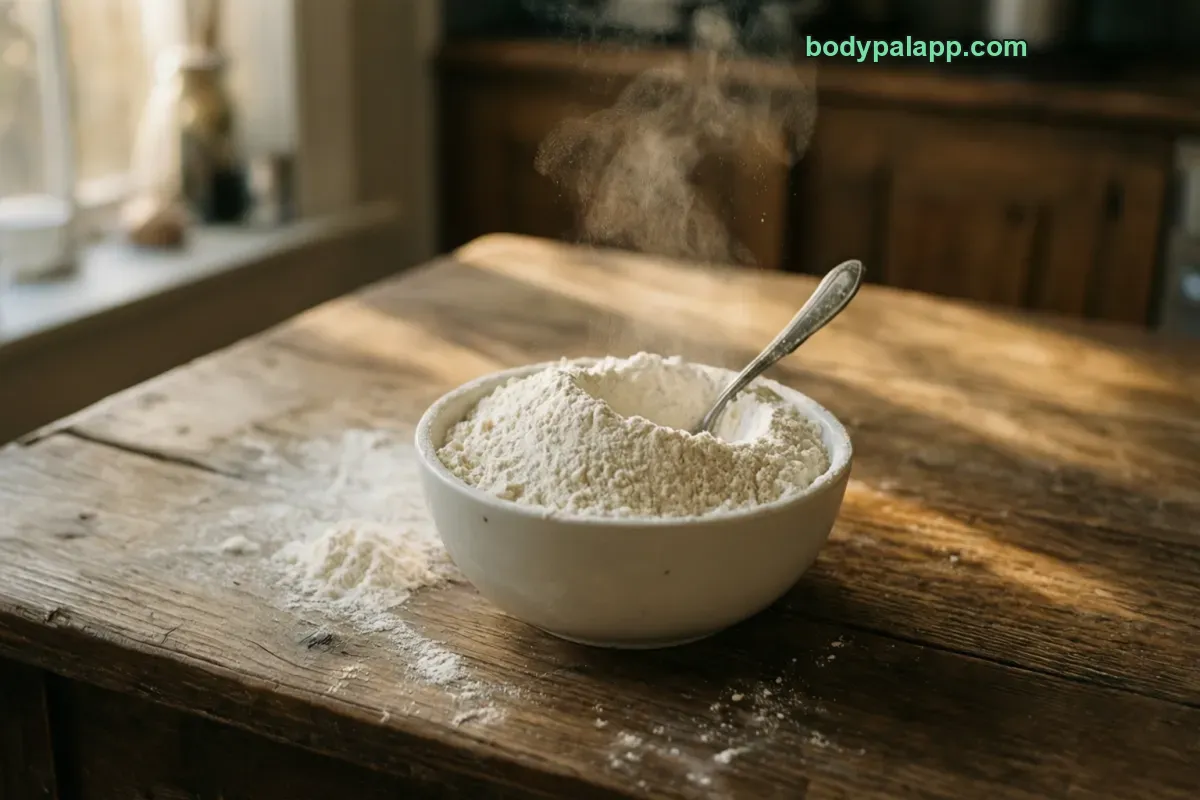
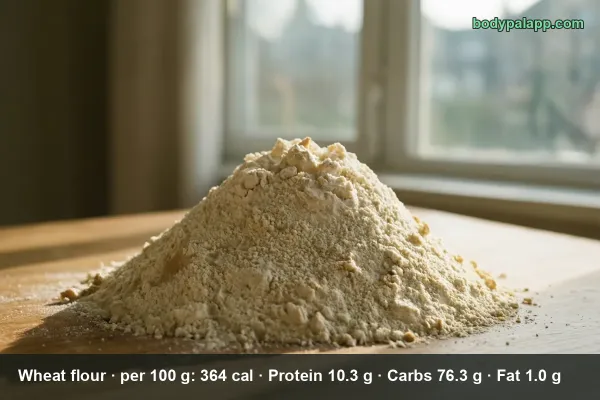
All-purpose flour calories come to 455 for 1 cup (125 g) and 364 per 100 g of enriched, bleached, dry flour. The thing to notice: 86% of those calories come from carbohydrate, while fat barely registers at 2%. The flour itself is predictable. How much ends up in the bowl is what moves your total.
455kcal
1 cup · 125 g, enriched, bleached, dry
12%protein
12.9 gProtein
95 gCarbs
1.2 gFat
How to burn off 455 kcal
—Walking, brisk
—Jogging
—Cycling, moderate
—Swimming
Skip the math. BodyPal counts these calories from your steps and workouts automatically.
Nutrition facts
Enriched, bleached, dry · per 125 g
Calories
455 kcal
Protein
12.9 g
Carbohydrate
95 g
Fat
1.2 g
Saturated fat
0.2 g
Cholesterol
0 mg
Sodium
3 mg
Potassium
134 mg
Iron
5.8 mg
Source: USDA FoodData Central
🛡️
Verified nutrition data
Numbers on this page come from USDA FoodData Central, the U.S. Department of Agriculture’s food composition database, and from manufacturer labels where a branded product is named. Last verified September 2026. How we verify our data →
All-purpose flour: calories, protein and sodium by serving
Percent of daily value uses the FDA reference of 2,000 kcal a day.
Serving
kcal
Protein
Carbs
Fat
Sodium
% DV kcal
1 cup (125 g)
455
12.9 g
95.4 g
1.2 g
3 mg
23%
100 g
364
10.3 g
76.3 g
1 g
2 mg
18%
1 oz (28 g)
102
2.9 g
21.4 g
0.3 g
1 mg
5%
3 × 1 cup (125 g)
1,365
38.7 g
8 mg
5 × 1 cup (125 g)
2,275
64.6 g
13 mg
One cup is 455 calories before anything else goes in
A single cup of all-purpose flour weighs 125 g and carries 455 calories, about 23% of a 2,000-calorie daily value. That is a lot for an ingredient most people never think of as food on its own. Flour rarely gets eaten plain, so the useful question is how much of it sits in the recipe you are making.
Recipes stack cups quickly. Two cups bring 910 calories, three cups 1,365, and a five-cup bread or cookie batch holds 2,275 calories from flour alone. Divide that by the number of slices, muffins or cookies, and you have the flour share of each piece before butter, sugar or oil enter the picture.
Small amounts are easier to forget. A 1 oz (28 g) scoop for dredging chicken or thickening gravy adds 102 calories, about 5% of the daily value. Not all of a dredging dish ends up on the food, but a thickened sauce keeps every gram. If you log by volume, spoon the flour into the cup and level it off; packing it in can push you well past 125 g per cup. A kitchen scale removes the guesswork entirely.
Carbs supply 86% of the calories
Per 100 g, all-purpose flour holds 76.3 g of carbohydrate, 10.3 g of protein and just 1 g of fat. In calorie terms that splits into 86% carbs, 12% protein and 2% fat. This is a starch ingredient, plain and simple.
The protein number is better than its reputation. A cup delivers 12.9 g, which is 26% of the 50 g daily value. That protein is what forms gluten when flour meets water, which is why it matters for texture as much as for nutrition. Still, nobody should count on flour as a protein source; the carbs outweigh it by a wide margin.
Fiber is modest at 2.7 g per 100 g and 3.4 g per cup, against a daily value of 28 g. Sugars are close to zero at 0.3 g per 100 g, and saturated fat sits at 0.2 g. In other words, nearly everything that makes a finished bake sweet, rich or fatty comes from what you add, not from the flour.
Plain flour is nearly sodium-free; mixes are not
Sodium is a non-issue in plain flour. There are 2 mg per 100 g and 3 mg per cup, which rounds to 0% of the 2,300 mg daily value. Cholesterol is 0, and potassium is a small 107 mg per 100 g against a daily value of 4,700 mg.
That changes the moment flour arrives premixed. Self-rising flour, biscuit mixes and pancake mixes carry leavening and salt, and the sodium row climbs fast. If you watch sodium, plain flour plus your own measured baking powder and salt gives you control that a box does not.
Brand matters less than type here. Store and name brands on this page, from Great Value Organic and Best Choice to Pillsbury and Bob's Red Mill, sell essentially the same milled wheat. Bleached versus unbleached affects color and texture more than the calorie count, so read the label for added ingredients rather than for small calorie differences.
Flour's calories ride along with butter and sugar
Flour is the base, not the whole story. A cake, pie crust or batch of cookies adds fat and sugar on top of the 455 calories in each cup, and those additions often outweigh the flour. When you estimate a homemade bake, count every ingredient and divide by servings.
If you want more staying power per bite, pair flour-based foods with protein and fiber. Eggs, Greek yogurt, beans or vegetables alongside a flatbread or pancake make the meal more balanced than the starch alone. Swapping part of the flour for a whole-grain option raises fiber, though it will not cut calories much.
Logging homemade food is easiest when you weigh the flour once and save the recipe. BodyPal can also log a finished dish from a photo, which helps for meals where you did not measure.
How does all-purpose flour compare?
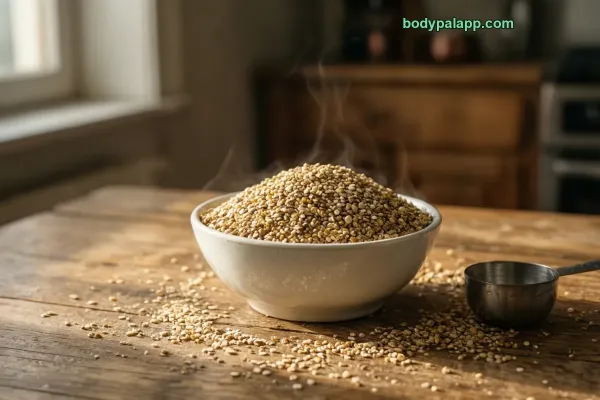
Here is all-purpose flour next to wheat flour, pancake mix and uncooked quinoa, per 100 g and per usual serving.
Verdict: Per 100 g these are nearly identical, at 364 calories for both flours and 368 for pancake mix and quinoa, so calories should not decide the choice. Pick quinoa if you want more protein at 14.1 g per 100 g, and skip pancake mix if you watch sodium, since it carries 1,082 mg per 100 g against 2 mg for plain flour.
Most popular all-purpose flour brands in the United States
Ranked by popularity in the BodyPal database
# Productkcal / 100 g
1Special Value All Purpose Flour1/4 cup · 30 g333 kcal
2365 Everyday Value All-Purpose Flour1/4 cup · 30 g367 kcal
3Clear Value All Purpose Flour1/4 cup · 30 g333 kcal
4Great Value Organic All Purpose Flour1/4 cup · 30 g367 kcal
5Exceptional Value Enriched Bleached All-Purpose Flour1/4 cup · 30 g333 kcal
6Bob's Red Mill Organic Unbleached White All-Purpose Flour1/4 cup · 34 g353 kcal
7Best Choice All Purpose Flour1/4 cup · 30 g367 kcal
8Pillsbury All Purpose Flour1/4 cup · 31 g355 kcal
How many calories are in a cup of all-purpose flour?
One cup (125 g) of all-purpose flour has about 455 calories, and one ounce (28 g) has about 102.
Is all-purpose flour good for weight loss?
It is calorie-dense at 364 calories per 100 g, with 76.3 g of carbs and 2.7 g of fiber.
All-purpose flour vs wheat flour: which has more calories?
They are the same at 364 calories per 100 g, since all-purpose flour is a white wheat flour.
How many carbs are in a cup of all-purpose flour?
One cup (125 g) has about 95.4 g of carbs, 3.4 g of fiber and 12.9 g of protein.
How many calories are in an ounce of all-purpose flour?
One ounce (28 g) of all-purpose flour has 102 calories. It brings 21.4 g of carbs, 2.9 g of protein and 0.3 g of fat, which is useful to know when you dredge meat or thicken a sauce.
How much protein is in all-purpose flour?
All-purpose flour has 10.3 g of protein per 100 g and 12.9 g per cup. That cup covers 26% of the 50 g daily value, though carbs still supply 86% of the calories.
Does all-purpose flour contain sodium?
Barely. Plain all-purpose flour has 2 mg of sodium per 100 g and 3 mg per cup, which is 0% of the daily value. It also has 0 mg of cholesterol.
How much fiber is in all-purpose flour?
All-purpose flour has 2.7 g of fiber per 100 g, 3.4 g per cup and 0.8 g per ounce. That is modest next to the 28 g daily value used on this page.
How many calories are in 2 cups of all-purpose flour?
Two cups (250 g) of all-purpose flour come to 910 calories. Three cups reach 1,365, so a typical batch of bread or cookies carries a large flour share before fat and sugar.