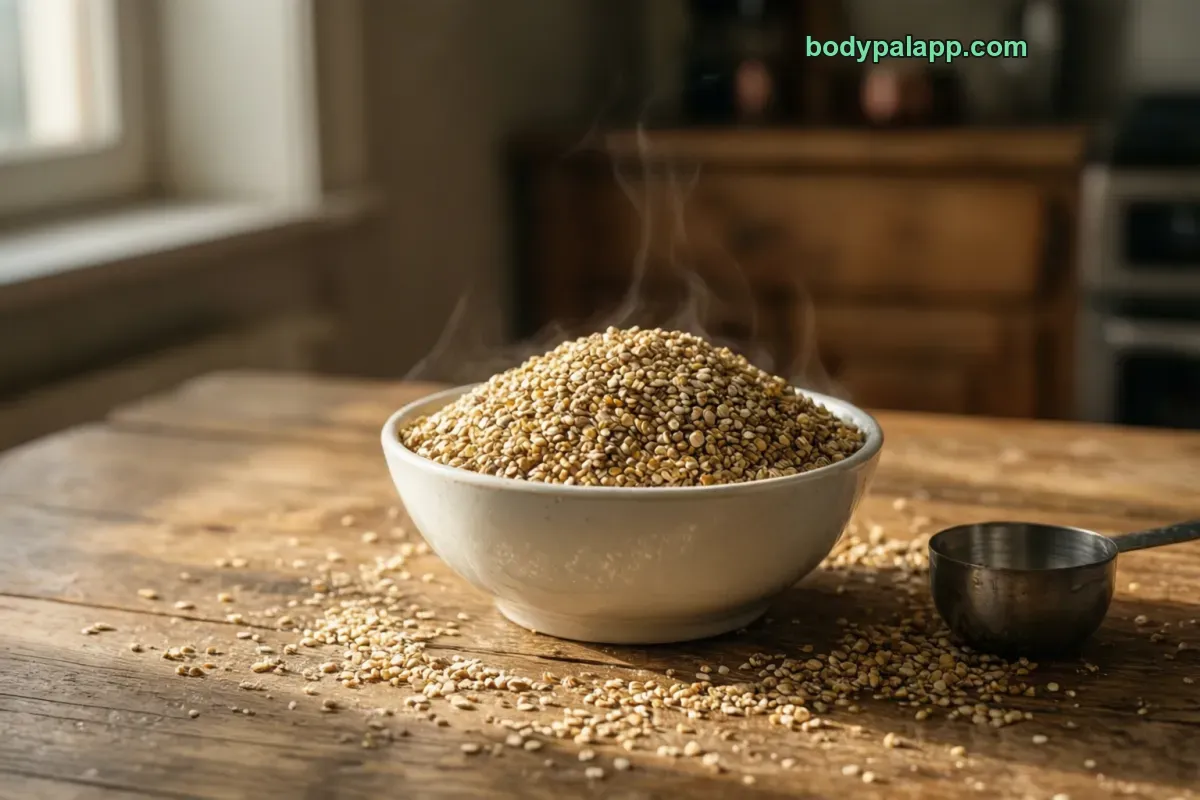
Uncooked quinoa calories come to 626 for 1 cup (170 g) of dry grain, or 368 per 100 g. The thing to notice is that these are dry-weight numbers. Quinoa takes on water as it cooks, so one dry cup becomes a much bigger pile on the plate, and the calories spread across all of it.
626kcal
1 cup · 170 g, uncooked, dry grain
15%protein
24 gProtein
109 gCarbs
10.3 gFat
How to burn off 626 kcal
—Walking, brisk
—Jogging
—Cycling, moderate
—Swimming
Skip the math. BodyPal counts these calories from your steps and workouts automatically.
Nutrition facts
Uncooked, dry grain · per 170 g
Calories
626 kcal
Protein
24 g
Carbohydrate
109 g
Fat
10.3 g
Saturated fat
1.2 g
Cholesterol
0 mg
Sodium
9 mg
Potassium
957 mg
Iron
7.8 mg
Source: USDA FoodData Central
🛡️
Verified nutrition data
Numbers on this page come from USDA FoodData Central, the U.S. Department of Agriculture’s food composition database, and from manufacturer labels where a branded product is named. Last verified September 2026. How we verify our data →
Uncooked quinoa: calories, protein and sodium by serving
Percent of daily value uses the FDA reference of 2,000 kcal a day.
Serving
kcal
Protein
Carbs
Fat
Sodium
% DV kcal
1 cup (170 g)
626
24 g
109.1 g
10.3 g
9 mg
31%
3 oz portion (85 g)
313
12 g
54.5 g
5.2 g
4 mg
16%
100 g
368
14.1 g
64.2 g
6.1 g
5 mg
18%
3 × 1 cup (170 g)
1,877
72 g
26 mg
5 × 1 cup (170 g)
3,128
120 g
43 mg
One dry cup is a 626-calorie measure
The default serving on this page is 1 cup (170 g) of dry grain. It carries 626 calories, 24 g of protein, 109.1 g of carbs and 10.3 g of fat. That single cup is 31% of the 2000-calorie daily value. It is a big portion of grain, and it looks small in the measuring cup only because nothing has been cooked yet.
The 3 oz portion (85 g) is the more realistic plate. It brings 313 calories, 12 g of protein and 6 g of fiber, or 16% of the daily calorie value. A 100 g scoop lands in between at 368 calories and 18% of the daily value.
Batch cooking moves the total fast. Two dry cups (340 g) hold 1,251 calories, three cups (510 g) hold 1,877, and a five-cup pot (850 g) reaches 3,128 calories with 120 g of protein. If you cook for the week, weigh the dry grain first, then split that total across your containers. It beats guessing from a cooked scoop.
Carbs supply 70% of the calories
Per 100 g, uncooked quinoa has 64.2 g of carbs, 14.1 g of protein and 6.1 g of fat. In calorie terms that is 70% carbs, 15% protein and 15% fat. Quinoa is a starchy grain first, and it should be logged that way.
The protein still counts. One dry cup gives 24 g, which is 48% of the 50 g daily value, and 100 g gives 14.1 g, or 28%. Two cups double that to 48 g. For a staple that sits next to rice and pasta in the pantry, that is a solid contribution.
Fat stays modest. Of the 6.1 g per 100 g, only 0.7 g is saturated, against a daily value of 20 g, and cholesterol is 0. If you track macros, treat quinoa as a carb source that brings protein along, not as a protein food that happens to have carbs.
Fiber and potassium stand out, sodium barely registers
Fiber is the row worth reading. Uncooked quinoa has 7 g per 100 g, 6 g in the 3 oz portion and 11.9 g in a full dry cup, measured against a daily value of 28 g. A single cup gets you a large share of the way there.
Potassium is 563 mg per 100 g, against a daily value of 4700 mg. That is a meaningful amount for a dry grain, and it arrives without salt. Sodium is 5 mg per 100 g and 9 mg per cup, which shows as 0% of the daily value at every serving on the page.
Even a five-cup batch holds only 43 mg of sodium before you add anything. So the salt in your quinoa is whatever goes into the cooking water, the stock or the dressing. If you watch sodium, that is where to measure; the grain itself is not the issue.
Build the plate around the 313-calorie portion
Quinoa works best as the starch on the plate, not the whole meal. The 3 oz dry portion at 313 calories leaves room for a protein, vegetables and a sauce without the meal getting out of hand. A full dry cup at 626 is close to a meal on its own before anything else goes on top.
What you add often moves the total more than the grain does. A tablespoon of corn oil (13.6 g) is 122 calories, so a generous pour in the pan or a drizzle over the bowl adds up quickly. Toasting the grain in oil, dressing a quinoa salad or stirring in cheese all count, and they belong in the log as separate items.
Pair quinoa with a lean protein and plenty of vegetables if you want a filling plate with predictable totals. BodyPal can log the food from a photo, but weighing the dry grain once gives you the cleanest starting number for every batch after.
How does uncooked quinoa compare?
Here is how uncooked quinoa stacks up against quinoa pasta, ground coffee and corn oil, per 100 g and per usual serving.
Verdict: For a lighter plate, quinoa pasta wins at 152 calories per 100 g and 201 per cup, about 0.4 times the density of dry quinoa. Dry quinoa is the denser pantry staple, but corn oil is about 2.4 times higher still at 900 per 100 g, so measure the oil more carefully than the grain.
Uncooked quinoa FAQs
How many calories are in a cup of uncooked quinoa?
One cup of dry quinoa weighs 170 g and has 626 calories. Per 100 g the grain is 368 calories.
How much protein is in uncooked quinoa?
Dry quinoa has 14.1 g of protein per 100 g, so a 170 g cup holds about 24 g and a 3 oz portion (85 g) about 12 g.
Is uncooked quinoa good for weight loss?
Dry quinoa is dense at 368 calories per 100 g, so portions are usually measured before cooking: an 85 g portion is 313 calories with 6 g of fiber.
Quinoa or brown rice: which has more calories?
They are close when dry, 368 calories per 100 g for quinoa and 367 for raw long-grain brown rice, but quinoa has 14.1 g of protein per 100 g against 7.5 g.
How many calories are in 100 g of uncooked quinoa?
There are 368 calories in 100 g of uncooked quinoa, with 14.1 g of protein, 64.2 g of carbs and 6.1 g of fat. That is 18% of the daily calorie value.
What else is in 100 g of raw quinoa besides calories?
Besides its 368 calories, 100 g of raw quinoa has 7 g of fiber, 563 mg of potassium, 5 mg of sodium, 0.7 g of saturated fat and 0 mg of cholesterol. Fiber and potassium are the rows worth noticing.
What is a sensible serving size of uncooked quinoa?
A 3 oz portion (85 g) of uncooked quinoa is 313 calories, 12 g of protein and 6 g of fiber. A full 1 cup (170 g) roughly doubles that to 626 calories, which is a large serving once cooked.
Are dry quinoa and raw quinoa the same for calories?
Yes, dry, raw and uncooked quinoa all mean the grain before cooking, at 368 calories per 100 g and 626 per cup. Cooked quinoa holds absorbed water, so use its own entry rather than these figures.