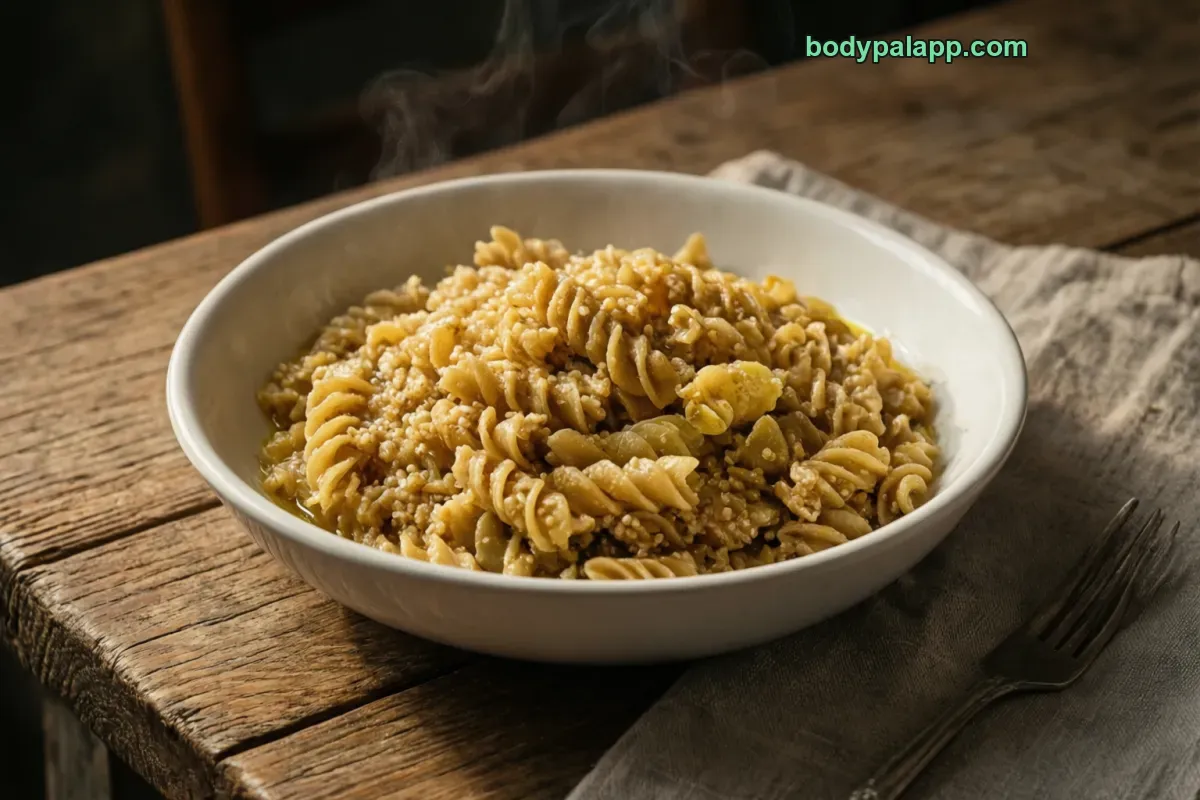
Quinoa pasta calories come to 201 for 1 cup (132 g) of cooked corn and quinoa pasta, or 152 per 100 g. Carbs supply 80% of those calories, so this is a starch first and a protein source a distant second, with 4.3 g of protein per cup. The bigger swing is how you fill the cup.
201kcal
1 cup · 132 g, cooked, corn and quinoa
8%protein
4.3 gProtein
41 gCarbs
2.7 gFat
How to burn off 201 kcal
—Walking, brisk
—Jogging
—Cycling, moderate
—Swimming
Skip the math. BodyPal counts these calories from your steps and workouts automatically.
Nutrition facts
Cooked, corn and quinoa · per 132 g
Calories
201 kcal
Protein
4.3 g
Carbohydrate
41 g
Fat
2.7 g
Saturated fat
0.2 g
Cholesterol
0 mg
Sodium
5 mg
Potassium
83 mg
Iron
1 mg
Source: USDA FoodData Central
🛡️
Verified nutrition data
Numbers on this page come from USDA FoodData Central, the U.S. Department of Agriculture’s food composition database, and from manufacturer labels where a branded product is named. Last verified September 2026. How we verify our data →
Quinoa pasta: calories, protein and sodium by serving
Percent of daily value uses the FDA reference of 2,000 kcal a day.
Serving
kcal
Protein
Carbs
Fat
Sodium
% DV kcal
1 cup (132 g)
201
4.3 g
41.1 g
2.7 g
5 mg
10%
1 cup elbows (111 g)
169
3.6 g
34.5 g
2.3 g
4 mg
8%
1 cup packed (166 g)
252
5.4 g
51.6 g
3.4 g
7 mg
13%
100 g
152
3.2 g
31.1 g
2.1 g
4 mg
8%
3 × 1 cup (132 g)
602
12.8 g
16 mg
5 × 1 cup (132 g)
1,003
21.3 g
26 mg
A packed cup jumps to 252 calories
The standard cup weighs 132 g and lands at 201 calories. Pasta is awkward to measure by volume, though. Short elbows leave air gaps, so a cup of them weighs 111 g and carries 169 calories, while a cup pressed firmly into the measure weighs 166 g and reaches 252. Same food, same cup, a very different number.
Restaurant plates and generous home bowls rarely stop at one cup. Two cups (264 g) come to 401 calories, three cups (396 g) reach 602, and a family-style pot of five cups (660 g) adds up to 1,003. The jump from a side portion to a main-course bowl is where most of the calories hide, not in the choice of pasta itself.
A kitchen scale settles the question. Weigh the cooked pasta and use 152 calories per 100 g, and the figure holds whatever the shape: penne, spaghetti, fusilli or elbows. If you track every day, BodyPal can also log the bowl from a photo, which helps when you plate by eye rather than by measuring cup.
Four in five calories come from carbs
The calorie split is lopsided: 80% carbs, 12% fat and 8% protein. Per 100 g that works out to 31.1 g of carbohydrate, 2.1 g of fat and 3.2 g of protein. A cup delivers 41.1 g of carbs, which is the number to watch if you count carbohydrates rather than calories.
The quinoa name suggests a protein boost, and the data does not really back that up. This version is mostly corn flour with quinoa flour mixed in, and a cup gives 4.3 g of protein, about 9% of the daily value. A packed cup nudges that to 5.4 g. Useful, but nowhere near enough to carry a meal on its own.
Fat stays low at 2.7 g per cup, and saturated fat is only 0.2 g per 100 g. That leaves the pasta itself as a fairly clean base. What you put on top decides whether the plate turns rich or stays light, so treat the pasta as the starch and plan the protein and fat separately.
Fiber is the quiet plus, sodium barely registers
Fiber is the most interesting row on the label. Cooked quinoa pasta has 3.3 g per 100 g, so a cup brings 4.4 g and a packed cup 5.5 g. Against a daily value of 28 g, one cup covers a meaningful slice, which helps a bowl feel more filling than its calorie count suggests.
Sodium is close to nothing. A cup holds 5 mg, which rounds to 0% of the 2300 mg daily value, and 100 g holds just 4 mg. Sugars are minimal too, at 0.4 g per cup, and there is 0 mg of cholesterol. Potassium is modest at 63 mg per 100 g.
That clean profile changes the moment the pasta meets a pot of salted water, a jarred sauce or a handful of grated cheese. If you watch sodium, the pasta is not your problem; the toppings are. Taste before you salt, and check the sauce label, because that is where the milligrams pile up.
Build the protein around the bowl
Because protein is only 8% of the calories, quinoa pasta works best as one part of a plate rather than the whole thing. Pair it with a lean protein such as chicken, shrimp, beans or lentils, and add a generous pile of vegetables. That combination fills the gaps the pasta leaves and stretches a single cup into a satisfying meal.
Sauce choice moves the total more than the pasta brand does. A tomato or vegetable sauce keeps the plate light, while cream, butter and cheese sauces can easily outweigh the pasta itself. Olive oil is fine, but it adds up quickly, so measure it rather than pouring freely.
Shelves carry several takes on this food, from Andean Dream and Sam Mills to Garofalo and Nature's Earthly Choice blends. Some mix corn, rice and quinoa, others lean harder on quinoa, so the label on your box is the final word. For gluten-free eaters it is an easy swap into any pasta recipe you already cook.
How does quinoa pasta compare?
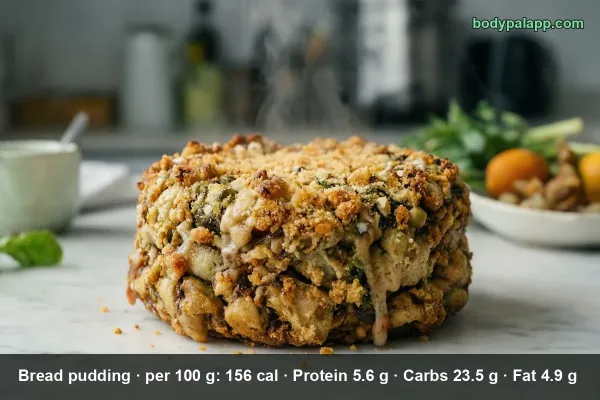
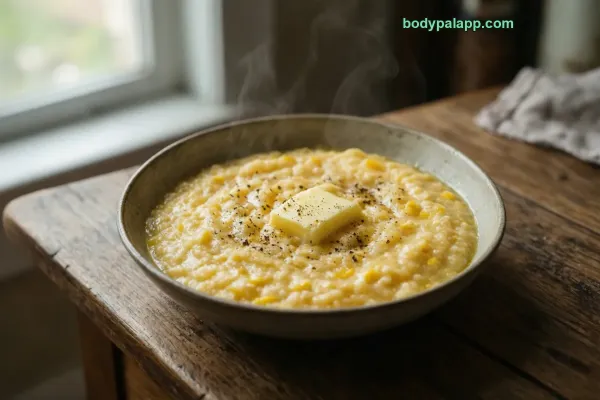
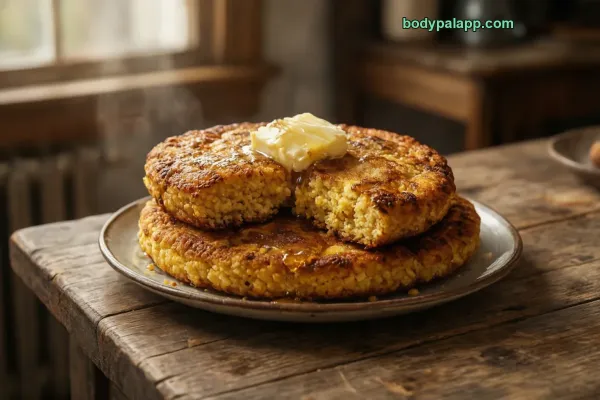
Here is how cooked quinoa pasta stacks up against bread pudding, corn grits and corn cake, per 100 g and per usual serving.
Verdict: For the lightest bowl, corn grits win at 71 calories per 100 g against 152 for quinoa pasta, though a 257 g cup still reaches 182. Skip corn cakes if you snack by the handful: at 387 calories and 488 mg of sodium per 100 g, they are the densest and saltiest option here.
Most popular quinoa pasta brands in the United States
Ranked by popularity in the BodyPal database
# Productkcal / 100 g
1Nature's Earthly Choice Quinoa Pasta Blend Penne2/3 cup · 56 g357 kcal
2Nature's Earthly Choice Quinoa Pasta Blend Spaghetti57 g351 kcal
3Andean Dream Royal Quinoa Pasta Organic Orzo2 oz · 56 g370 kcal
4Pereg 100% Quinoa Pasta Fusilli57 g368 kcal
5Andean Dream Organic Quinoa Pasta Spaghetti2 oz · 56 g370 kcal
7Garofalo Gluten Free Corn, Rice, Quinoa Pasta Penne Rigate2/3 cup · 56 g357 kcal
Box labels read 357 to 370 calories per 100 g because they count dry pasta, while the numbers above are for cooked pasta. Source: manufacturer labels / USDA FoodData Central.
Quinoa pasta FAQs
How many calories are in a cup of quinoa pasta?
One cup of cooked quinoa pasta (132 g) is about 201 calories. A 100 g serving is 152 calories.
Is quinoa pasta good for weight loss?
A cup (132 g) holds 201 calories, 4.4 g of fiber and 2.7 g of fat. The same cup of regular cooked pasta sits near the same level, at 157 calories per 100 g against 152 for quinoa pasta.
Quinoa pasta vs regular pasta: which has fewer calories?
Cooked quinoa pasta is 152 calories per 100 g and regular cooked pasta is 157, so the gap is 5 calories. The protein differs more: 3.2 g against 5.8 g per 100 g.
How much protein is in quinoa pasta?
A cup (132 g) has 4.3 g of protein, 41.1 g of carbs and 4.4 g of fiber. Per 100 g that is 3.2 g of protein.
What are the nutrition facts for quinoa pasta?
Per 100 g of cooked quinoa pasta you get 152 calories, 31.1 g carbs, 3.2 g protein, 2.1 g fat, 3.3 g fiber, 0.3 g sugars and 4 mg sodium. It also has 0 mg cholesterol and 63 mg potassium.
How many calories are in 100 g of quinoa pasta?
100 g of cooked quinoa pasta has 152 calories, about 8% of the daily value. Carbs supply 80% of those calories, fat 12% and protein 8%, so it behaves like any other starchy side.
How many carbs are in a cup of quinoa pasta?
A cup (132 g) of cooked quinoa pasta has 41.1 g of carbohydrate, of which 4.4 g is fiber and only 0.4 g is sugar. A packed cup (166 g) rises to 51.6 g of carbs.
How much fiber does quinoa pasta have?
One cup of cooked quinoa pasta has 4.4 g of fiber, and 100 g has 3.3 g. A packed cup reaches 5.5 g, a solid share of the 28 g daily value for a pasta dish.
Is quinoa pasta low in sodium?
Yes. A cup of cooked quinoa pasta contains just 5 mg of sodium, which is 0% of the 2300 mg daily value. Any real sodium in the dish comes from salted cooking water, sauce or cheese.