
How many calories are in bread pudding?
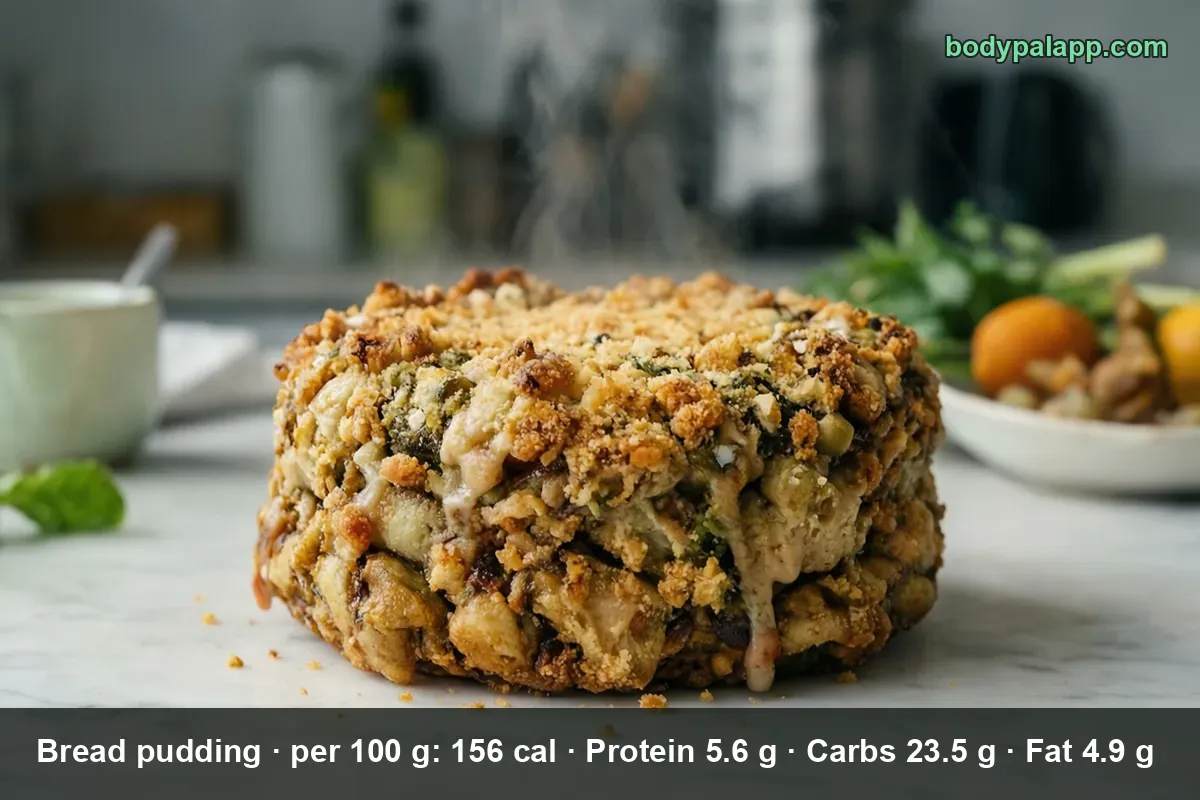
A 1-cup serving weighs 200 g and carries 312 calories. Per 100 g the dish runs 156 calories, which is modest for a dessert, because the custard is mostly milk and eggs poured over stale bread. A bakery-size piece of 99 g lands at 154 calories. The scoop size decides everything here.
On this page
- Bread pudding quick facts
- US servings, from a cubic inch to a full cup
- Bakery and store bread pudding runs heavier
- Guava, apple brioche and salted caramel
- Cholesterol is the row to watch
- How does bread pudding compare?
- Most popular bread pudding brands
- FAQ
Bread pudding quick facts
These figures come from FNDDS 2705680, "Pudding, bread", the Survey 2021-2023 record for the dish as it is actually made and served: bread, milk, eggs, sugar, baked. It is the only USDA entry for the dish itself rather than for a packaged product, and it is the one that matches a homemade pan or a restaurant ramekin. Store-bakery tubs are a different animal and they get their own section below.
One thing this record does not cover: the sweet-versus-savory split. A savory bread pudding built with cheese, herbs and stock is a separate dish, and none of the figures here apply to it.
| Nutrient | Per 100 g | Per 1 cup (200 g) | % Daily Value |
|---|---|---|---|
| Calories | 156 | 312 | — |
| Total fat | 4.86 g | 9.7 g | 12% |
| Saturated fat | 1.7 g | 3.4 g | 17% |
| Carbohydrate | 23.53 g | 47.1 g | 17% |
| Dietary fiber | 1 g | 2.0 g | 7% |
| Total sugars | 15.1 g | 30.2 g | — |
| Protein | 5.6 g | 11.2 g | 22% |
| Sodium | 206 mg | 412 mg | 18% |
| Cholesterol | 61 mg | 122 mg | 41% |
| Potassium | 211 mg | 422 mg | 9% |
% Daily Value is based on a 2,000-calorie diet.
Verified nutrition data
Numbers on this page come from USDA FoodData Central, the U.S. Department of Agriculture’s food composition database, and from manufacturer labels where a branded product is named. Last verified September 2026. How we verify our data →
Two rows are missing on purpose. USDA does not publish added sugars for this FNDDS record, so the total-sugars figure cannot be split into milk sugar and recipe sugar, and it cannot be scored against the FDA Daily Value of 50 g for added sugars. Trans fat is absent from this edition too, so that row is dropped rather than guessed.
The sodium is worth a second look: 412 mg in a cup is about a fifth of a teaspoon of table salt, sitting inside something you eat with a spoon and sugar.
US servings, from a cubic inch to a full cup
| Serving | Weight | Calories |
|---|---|---|
| 1 cubic inch | 14 g | 22 kcal |
| 1 oz | 28 g | 44 kcal |
| 1 piece, bakery size | 99 g | 154 kcal |
| 1 cup | 200 g | 312 kcal |
| Per 100 g | 100 g | 156 kcal |
The cup is the USDA household measure for this record, and it is the honest default when you spoon pudding out of a baking dish. The 99 g piece is the serving size printed on most store labels, so it is the right one to use when you are eating from a bakery container; at the USDA density it works out to 154 calories, our own arithmetic from the 100 g figure rather than a USDA serving. The 1 oz line is scaled the same way.
Here is the trap. People log "a slice" and picture something small, then serve themselves a heaped cup. Those two numbers are 154 and 312 — a clean doubling. Bread pudding is soft and dense, so it fills a measuring cup with far more mass than a slice of cake would, and volume estimates drift high. If you can weigh the portion once, do it; the eyeball error on this dish is bigger than on almost any other dessert.
Bakery and store bread pudding runs heavier
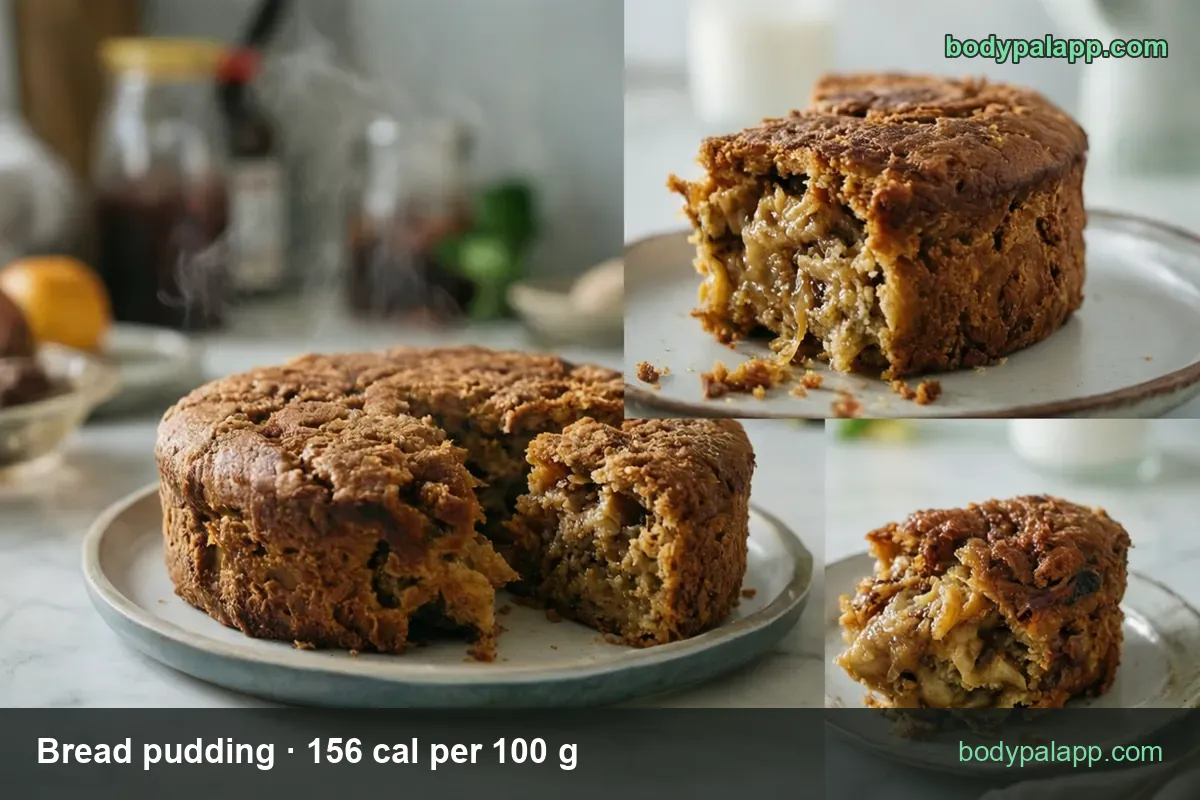
This is the gap most calorie pages miss. The USDA dish record is 156 calories per 100 g. Most commercial bread pudding in the US runs from 170 to 307 per 100 g, because retail recipes lean on butter, cream, egg yolks and a sugar glaze that a home custard does not carry.
| Version | Per 100 g | Typical piece | Calories |
|---|---|---|---|
| USDA record, homemade or restaurant style | 156 kcal | 1 piece (99 g) | 154 kcal |
| Store bakery bread pudding, plain | 232 kcal | 1 piece (99 g) | 230 kcal |
| Deli slice in a container | 235 kcal | 1 container (170 g) | 400 kcal |
| Refrigerated tub, lighter formula | 170 kcal | 1/2 cup (128 g) | 218 kcal |
| Rich bakery formula | 307 kcal | 4 oz (113 g) | 347 kcal |
Same 99 g of pudding, 154 calories from a home pan and 230 from a supermarket case: 76 calories of difference bought entirely with fat and sugar. The 170 g deli slice is the one to respect, at 400 calories before any sauce. On the other end, a half-cup tub at 218 calories is the lightest of the store servings here, which makes it the easy pick if you want the dessert without rearranging the day.
Brand labels back this up. Lakeview Farms sits at 170 calories per 100 g, Deltropico at 222, Publix at 232 to 235, Chef Odell at 154, and Companion at 307 — a two-fold spread across products with the same three words on the front.
Guava, apple brioche and salted caramel
Flavored bread puddings are logged as separate USDA records, and the sauce is not an optional extra you can subtract.
| Flavor | Per 100 g | Portion | Calories |
|---|---|---|---|
| Guava | 222 kcal | 3.5 oz (99 g) | 220 kcal |
| Apple brioche | 291 kcal | 1/2 cup (110 g) | 320 kcal |
| Lemon blueberry | 153 kcal | 3 oz (85 g) | 130 kcal |
| Brioche with salted caramel sauce | 246 kcal | 4 oz (114 g) | 280 kcal |
Apple brioche is the heaviest of the four per 100 g at 291, nearly double the plain USDA record. Lemon blueberry is the outlier in the other direction: at 153 calories per 100 g it is the only flavored version here that comes in under the plain dish, and its 3 oz portion of 130 calories is the lightest of the flavored portions here. Fruit in place of some of the custard does that.
Salted caramel is instructive. The sauce is baked into the record, not added at the table, which is why 246 per 100 g is higher than plain but lower than apple brioche. If you pour caramel over a home pudding yourself, the pudding number above does not include it.
Cholesterol is the row to watch
Most people scanning a dessert label look for sugar or saturated fat. On bread pudding, the row that jumps is cholesterol: 122 mg in a cup, 41% of the 300 mg Daily Value, and by far the biggest percentage on the panel. Whole eggs in the custard are the reason. Saturated fat comes in at 17% and sodium at 18%, both lower.
The protein line is the pleasant surprise. A cup delivers 11.2 g, 22% of the Daily Value, which is more than most desserts of the same size manage, and again it is the eggs and milk doing the work. That protein is why a cup of bread pudding sits better as a shared plate after dinner than a sugar-only dessert of similar calories.
Fiber tells the other half of the story. Despite being built on bread, the dish gives only 1 g per 100 g, 2 g in a cup, 7% of the Daily Value. MyPlate counts a serving of bread pudding toward grains, but with 30.2 g of total sugars in that same cup, this is a dessert on the profile, not a bread. Treat it as one when you plan the day.
How does bread pudding compare?
| Dessert | Per 100 g | US serving | Calories |
|---|---|---|---|
| Bread pudding | 156 kcal | 1 cup, 200 g | 312 kcal |
| Banana pudding | 160 kcal | 1 cup, 200 g | 320 kcal |
| Trifle | 169 kcal | 1 cup, 200 g | 338 kcal |
| Chocolate pudding, ready-to-eat | 142 kcal | 1 cup, 200 g | 284 kcal |
The 200 g cup basis for the three neighbors is our own arithmetic from their USDA 100 g figures, so all four sit on the same footing.
Our take: for calorie control, chocolate pudding wins on paper at 284 a cup, and it is the only one of the four that is lighter than bread pudding per 100 g. But it brings 2.09 g of protein per 100 g against 5.6 g for bread pudding, so it empties faster. For satiety per calorie, bread pudding is the better plate of the group — the most protein, the most substance, and only 28 calories a cup above the ready-to-eat cup you would buy in a four-pack. Trifle is the one to skip on a tight day at 338. If you want the dessert and the smallest number, take a bakery-size 99 g piece at 154 rather than a cup of anything here.
Most popular bread pudding brands in the United States
Ranked by how widely each product appears among foods sold in the United States, from the BodyPal food database of over 3.3 million products. Calories are the figures printed on each Nutrition Facts label, checked against USDA FoodData Central.
| Product | Calories (per 100 g) |
|---|---|
| Deltropico Gourmet Bread Pudding | 222 cal |
| Publix Bread Pudding | 232 cal |
| Publix Bread Pudding Slice | 235 cal |
| Lakeview Farms Bread Pudding | 170 cal |
| Companion Bread Pudding | 307 cal |
| Chef Odell Bread Pudding | 154 cal |
Brand popularity: BodyPal food database. Nutrition: manufacturer labels / USDA FoodData Central.
Bread pudding FAQs
How many calories are in a serving of bread pudding?
A 1-cup serving is 312 calories, and the smaller bakery-size piece of 99 g is 154. The gap is portion size, not recipe: both come from the same USDA figure of 156 calories per 100 g. Weigh the dish once and you will know which of the two you are eating.
How many calories are in one cup of bread pudding?
One cup weighs 200 g and gives 312 calories, with 47.1 g of carbohydrate, 11.2 g of protein and 9.7 g of fat. That is the USDA household measure for this record, so it is the safest number to log when you scoop the pudding out of a baking dish.
How many calories are in a slice of bakery bread pudding?
A 99 g store-bakery piece is about 230 calories, roughly 76 more than the same weight of the USDA homemade record at 154. Store recipes mostly sit between 170 and 307 calories per 100 g because they use more butter, cream and sugar. A 170 g deli slice reaches 400 calories.
How much sugar is in bread pudding?
A cup holds 30.2 g of total sugars, or 15.1 g per 100 g. USDA does not publish added sugars for this record, so that total cannot be scored against the FDA Daily Value of 50 g for added sugars. Some of it is milk sugar and the rest is the recipe.
Is bread pudding high in cholesterol?
One cup carries 122 mg of cholesterol, 41% of the 300 mg Daily Value, and that is the highest percentage on the panel for this dish. The eggs in the custard are the reason. Sodium at 412 mg is only 18%, and saturated fat at 3.4 g is 17%.
Is bread pudding healthier than banana pudding or flan?
Per 100 g bread pudding is the lightest of the three at 156 calories, against 160 for banana pudding and 178 for flan. It also carries the most protein, 5.6 g per 100 g. On a cup basis that is 312 calories versus 320 for banana pudding.
How many carbs are in bread pudding?
A cup holds 47.1 g of carbohydrate, 17% of the Daily Value, with 2 g of fiber and 30.2 g of total sugars inside that figure. Per 100 g it is 23.53 g. Most of it comes from the bread and the sugar in the custard, not the milk.
Does adding caramel or vanilla sauce change the calories?
Yes — a brioche bread pudding made with salted caramel sauce runs 246 calories per 100 g against 156 for the plain USDA record, and a 4 oz (114 g) portion is 280 calories. USDA lists the sauced dish as its own record, so count the sauce with the pudding.
Similar foods
- Quinoa Pasta — 201 cal per cup
- Chicken Roll — 46 cal per slice
- Shrimp Tempura Roll — 432 cal per roll, 8 pieces
- Cooked White Rice — 205 cal per cup
- Sushi Rice — 242 cal per cup
- White Rice — 242 cal per cup
Count it without the math
Point the camera at the plate and BodyPal counts the bread pudding for you, sauce and all.


How long does it take to burn off bread pudding?
A 1-cup (200 g) serving is 312 kcal. Enter your weight and the amount you ate to see how long it takes you to burn that off:
lb
| Activity | Time to burn 312 kcal |
|---|---|
| Walking, brisk | 1 hr 2 min |
| Cycling, moderate | 39 min |
| Swimming, moderate | 45 min |
| Jogging | 37 min |
| Weight training, moderate | 1 hr 9 min |
Times are for a 155 lb adult at a steady pace; change the weight to see yours. The amount is set to the portion in the text (200 g); change it to what you actually ate. BodyPal works this out from your steps automatically.
Want the bigger picture? Calculate your daily calorie needs — your maintenance figure, a target for losing or gaining, and the date you get there.