
How many calories are in radishes?
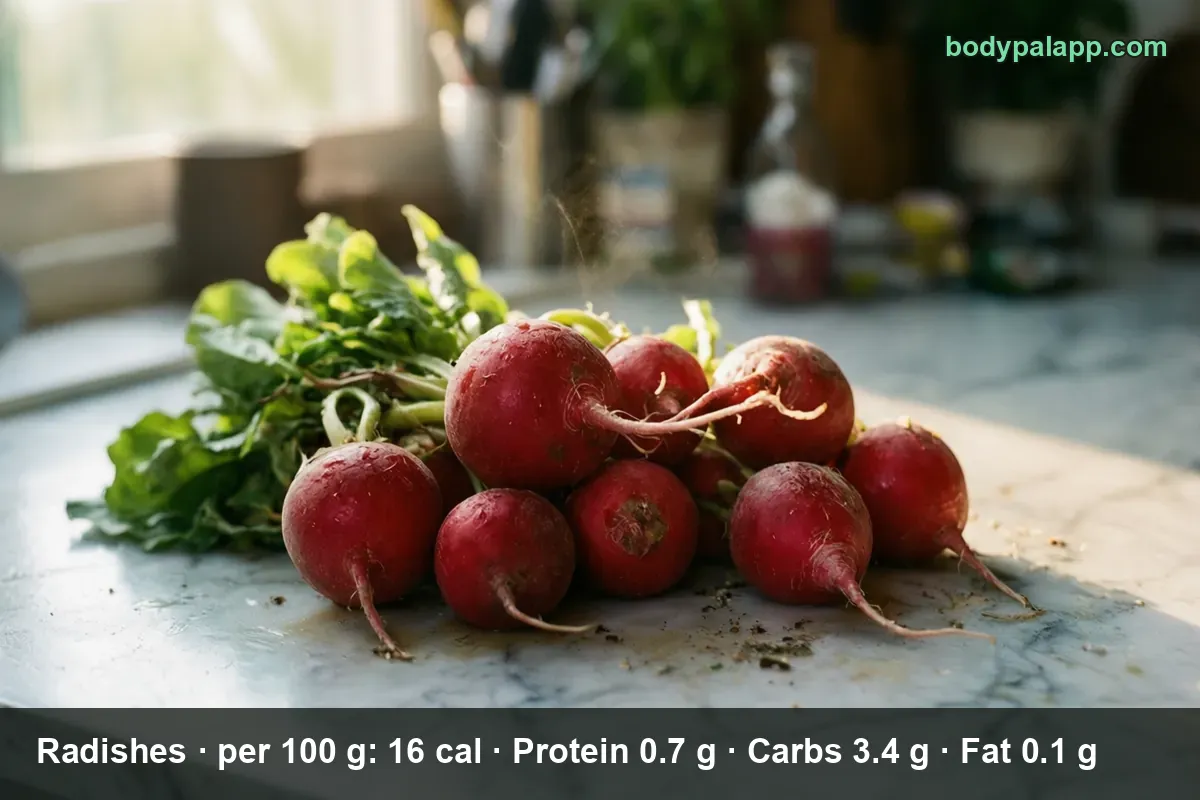
A cup of sliced raw radishes weighs 116 g and carries 19 calories. Per 100 g they run 16 calories, which parks them at the very bottom of the produce aisle. One medium radish is a single calorie. The number worth noticing is not the energy at all — it is the 1.9 g of fiber in that cup.
On this page
- Radish quick facts
- US servings, from one radish to a full cup
- Daikon, white icicle and other raw varieties
- Pickled and dried radishes change the math
- Fiber is the row that earns its keep
- How do radishes compare?
- Most popular radishes brands
- Radish FAQs
Radish quick facts
The record behind this page is SR Legacy 169276, "Radishes, raw" — the round red salad radish sold in bunches with the greens still attached. That is the vegetable most people have in hand when they look this up, so it sets every headline number here. Seven other radish records exist in USDA FoodData Central, and each of them is either a different variety (daikon, white icicle) or a different preparation (boiled, dried, pickled). Those get their own sections further down rather than being blended into an average.
One note on the label rows: SR Legacy does not measure added sugars, so that line is left out of the table below. A raw radish has none to declare in any case.
| Nutrient | Per 100 g | Per 1 cup slices (116 g) | % Daily Value |
|---|---|---|---|
| Calories | 16 | 19 | — |
| Total fat | 0.1 g | 0.1 g | 0% |
| Saturated fat | 0.03 g | 0.0 g | 0% |
| Carbohydrate | 3.4 g | 3.9 g | 1% |
| Dietary fiber | 1.6 g | 1.9 g | 7% |
| Total sugars | 1.86 g | 2.2 g | — |
| Protein | 0.68 g | 0.8 g | 2% |
| Sodium | 39 mg | 45 mg | 2% |
% Daily Value is based on a 2,000-calorie diet.
Verified nutrition data
Numbers on this page come from USDA FoodData Central, the U.S. Department of Agriculture’s food composition database, and from manufacturer labels where a branded product is named. Last verified September 2026. How we verify our data →
Cholesterol is zero, as it is in every vegetable. Potassium is the quiet win: 233 mg per 100 g, or 270 mg in the cup, which is 6% of the 4,700 mg Daily Value. Daily Values used throughout this page are the FDA reference amounts published on the Nutrition Facts label.
US servings, from one radish to a full cup
| Serving | Weight | Calories |
|---|---|---|
| 1 medium radish, 3/4 to 1 inch across | 4.5 g | 1 kcal |
| 1 large radish, 1 to 1-1/4 inches across | 9 g | 1 kcal |
| 1 oz sliced | 28.3 g | 5 kcal |
| 1/2 cup slices | 58 g | 9 kcal |
| 1 cup slices | 116 g | 19 kcal |
| Per 100 g | 100 g | 16 kcal |
The cup measures and the two whole-radish weights are USDA household measures attached to record 169276, so they are as close to official as a serving gets. The 1 oz line is our own arithmetic from the USDA 100 g figure, not a USDA serving, and it exists only because packaged produce is priced by the ounce.
Here is the practical takeaway from that table: the difference between counting radishes and ignoring them is about 19 calories on a big salad. A whole bunch of eight medium radishes is roughly 36 g, which on our own arithmetic from the USDA 16-per-100 g figure is 6 calories. If you are tracking carefully, the dressing you put on them will outweigh the radishes by a factor of ten or more.
Store-brand bagged radishes land in the same place. USDA's Branded database lists Wegmans Radishes at 18 calories per 100 g, with the 85 g label serving of three radishes at 15 calories, and Harris Teeter Radishes Ready Veggies at 16 per 100 g, or 14 for the same 85 g. Nothing about washing and bagging them moves the number.
Daikon, white icicle and other raw varieties
Daikon — the long white radish USDA files as "oriental" — is the variety people ask about most after the red one. It is very slightly sweeter and very slightly higher in calories, and it carries about half the sodium.
| Version | Per 100 g | Typical serving | Calories |
|---|---|---|---|
| Red radishes, raw (main record) | 16 kcal | 1 cup slices (116 g) | 19 kcal |
| Daikon radish, raw | 18 kcal | 1 cup slices (116 g) | 21 kcal |
| White icicle radish, raw | 14 kcal | 1/2 cup slices (50 g) | 7 kcal |
| Daikon, boiled and drained, no salt | 17 kcal | 100 g | 17 kcal |
Daikon carries 4.1 g of carbohydrate and 2.5 g of sugar per 100 g against the red radish's 3.4 g and 1.86 g, which is where its two extra calories come from. Its sodium is 21 mg per 100 g, roughly half the red radish's 39 mg.
White icicle is the lightest radish USDA publishes in raw form at 14 calories per 100 g, with the lowest carbohydrate load of the three raw records at 2.63 g and the highest protein at 1.1 g. USDA does not report total sugars for that record, so no sugar figure appears for it here.
Boiling barely registers. Drained daikon comes out at 17 calories per 100 g against 18 raw — boiling leaches a little sugar and carbohydrate into the water, 2.5 g down to 1.83 g and 4.1 g down to 3.43 g, while the fat creeps from 0.1 g to 0.24 g. What does change is salt. The same boiled daikon record cooked in salted water carries 249 mg of sodium per 100 g instead of 13 mg. The vegetable did not change; the water did.
Pickled and dried radishes change the math
This is where a 16-calorie vegetable stops being a rounding error.
| Version | Per 100 g | Typical serving | Calories |
|---|---|---|---|
| Hawaiian style pickled radishes | 28 kcal | 1 cup (150 g) | 42 kcal |
| Pickled radishes, FNDDS | 34 kcal | 100 g | 34 kcal |
| Dried daikon radish | 271 kcal | 1 cup (116 g) | 314 kcal |
Dried daikon is the same vegetable with the water pulled out, and the numbers move by a factor of about 17: 271 calories per 100 g against 16 raw. A cup of it is 314 calories, 63.37 g of carbohydrate per 100 g, and 23.9 g of fiber — that cup alone is 27.7 g of fiber, or 99% of the Daily Value. It behaves like a dried fruit, not like a salad vegetable, and it should be logged that way.
Pickling adds fewer calories than people expect and far more sodium than they expect. The FNDDS pickled record is 34 calories per 100 g, mostly because the brine carries sugar: 6.41 g per 100 g against 1.86 g raw, about three and a half times as much. Sodium is the real jump — 977 mg per 100 g against 39 mg, roughly twenty-five times. The Hawaiian style record is milder in the jar at 789 mg per 100 g, but a full 150 g cup of it still delivers 1,184 mg of sodium, 51% of the 2,300 mg Daily Value, in a side dish nobody thinks to count.
Fiber is the row that earns its keep
A cup of sliced radishes gives 1.9 g of fiber for 19 calories. That ratio — one gram of fiber for every ten calories — is rare. Most foods that hit 28 g of fiber in a day bring several hundred calories along with them.
The tradeoff cuts the other way too, and it is worth being honest about it: 7% of the fiber Daily Value per cup means you would need roughly fourteen cups to get there on radishes alone, which nobody is doing. Radishes are a topping, not a fiber strategy. The MyPlate vegetable guidance treats them as one contributor to a daily vegetable total, and that is the right frame — they add bulk, crunch and water to a plate for almost nothing on the calorie side.
If you are watching sodium, note that the raw vegetable at 39 mg per 100 g and the pickled version at 977 mg are two completely different foods on that row. The jar is the variable, not the radish.
How do radishes compare?
| Vegetable | Per 100 g | US serving | Calories |
|---|---|---|---|
| Radishes, raw | 16 kcal | 1 cup slices, 116 g | 19 kcal |
| Nopales, raw | 16 kcal | 1 cup sliced, 86 g | 14 kcal |
| Chinese cabbage (pe-tsai), raw | 16 kcal | 1 cup shredded, 76 g | 12 kcal |
| Summer squash, raw | 16 kcal | 1 cup sliced, 113 g | 18 kcal |
Our take: all four of these land on exactly 16 calories per 100 g, so the only thing separating them on a plate is how much a cup of each actually weighs. Radishes pack denser into a measuring cup than shredded cabbage or sliced nopales, which is why the radish cup reads highest here at 19 calories. That is a measuring artifact, not a nutritional difference. For weight loss, pick whichever one you will actually eat — at this density the choice does not matter. Protein is the one row where radishes trail: 0.68 g per 100 g against 1.32 g for nopales and 1.21 g for summer squash.
Most popular radishes brands in the United States
Ranked by how widely each product appears among foods sold in the United States, from the BodyPal food database of over 3.3 million products. Calories are the figures printed on each Nutrition Facts label, checked against USDA FoodData Central.
| Product | Calories (per 100 g) |
|---|---|
| Wegmans Radishes | 18 cal |
| Harris Teeter Radishes Ready Veggies | 16 cal |
Brand popularity: BodyPal food database. Nutrition: manufacturer labels / USDA FoodData Central.
Radish FAQs
How many calories are in one radish?
One medium radish, 3/4 to 1 inch across, weighs 4.5 g and is 1 calorie. A large radish at 9 g is also about 1 calorie. USDA lists raw radishes at 16 calories per 100 g, so even a bunch of eight comes to roughly 6 calories total.
How many calories in a cup of sliced radishes?
A 1-cup serving of sliced raw radishes weighs 116 g and is 19 calories. Half a cup, 58 g, is 9 calories. That cup also carries 3.9 g of carbohydrate, 1.9 g of fiber, 0.8 g of protein and 270 mg of potassium, all from USDA record 169276.
Are radishes keto friendly?
A cup of slices has 3.9 g of carbohydrate and 1.9 g of fiber, which leaves about 2 g of net carbs by our own subtraction. Per 100 g the figures are 3.4 g carbohydrate and 1.6 g fiber. Few vegetables give you that much crunch for so little.
How many carbs do radishes have?
Raw radishes have 3.4 g of carbohydrate per 100 g, of which 1.6 g is fiber and 1.86 g is naturally occurring sugar. A cup of slices at 116 g comes to 3.9 g of carbohydrate, just 1% of the 275 g Daily Value. White icicle radishes are lower still at 2.63 g.
Are radishes good for weight loss?
At 16 calories per 100 g they are among the lightest vegetables USDA publishes, and a full cup of slices costs 19 calories while adding 1.9 g of fiber. They work best as volume — bulking out a salad or a bowl so the plate looks full without the count moving much.
How many calories in daikon radish?
Raw daikon is 18 calories per 100 g, so a cup of slices at 116 g is 21 calories — two more than red radishes. Boiled and drained daikon is 17 per 100 g. Dried daikon is a different story entirely at 271 calories per 100 g.
Are pickled radishes high in sodium?
Yes, and by a wide margin: 977 mg of sodium per 100 g in USDA's FNDDS pickled radish record, against 39 mg for raw, about twenty-five times as much. Hawaiian style pickled radishes are 789 mg per 100 g, and a 150 g cup delivers 1,184 mg, which is 51% of the 2,300 mg Daily Value.
How much potassium is in radishes?
Raw radishes have 233 mg of potassium per 100 g, and a cup of slices at 116 g provides 270 mg, or 6% of the 4,700 mg Daily Value. That is a modest contribution on its own, but it arrives for 19 calories, which is the cheapest potassium on most salad plates.
Similar foods
- Radish — 19 cal per cup
- Cos Lettuce — 8 cal per cup shredded
- Cucumber — 45 cal per whole cucumber
- English Cucumber — 45 cal per whole cucumber
- Lettuce Leaves — 5 cal per cup shredded
- Romaine Lettuce — 8 cal per cup
Count it without the math
Point the camera at the plate and BodyPal counts the radishes for you, cup or bunch.


This table assumes you know your daily total. If you do not, the daily calorie calculator works it out from five numbers.