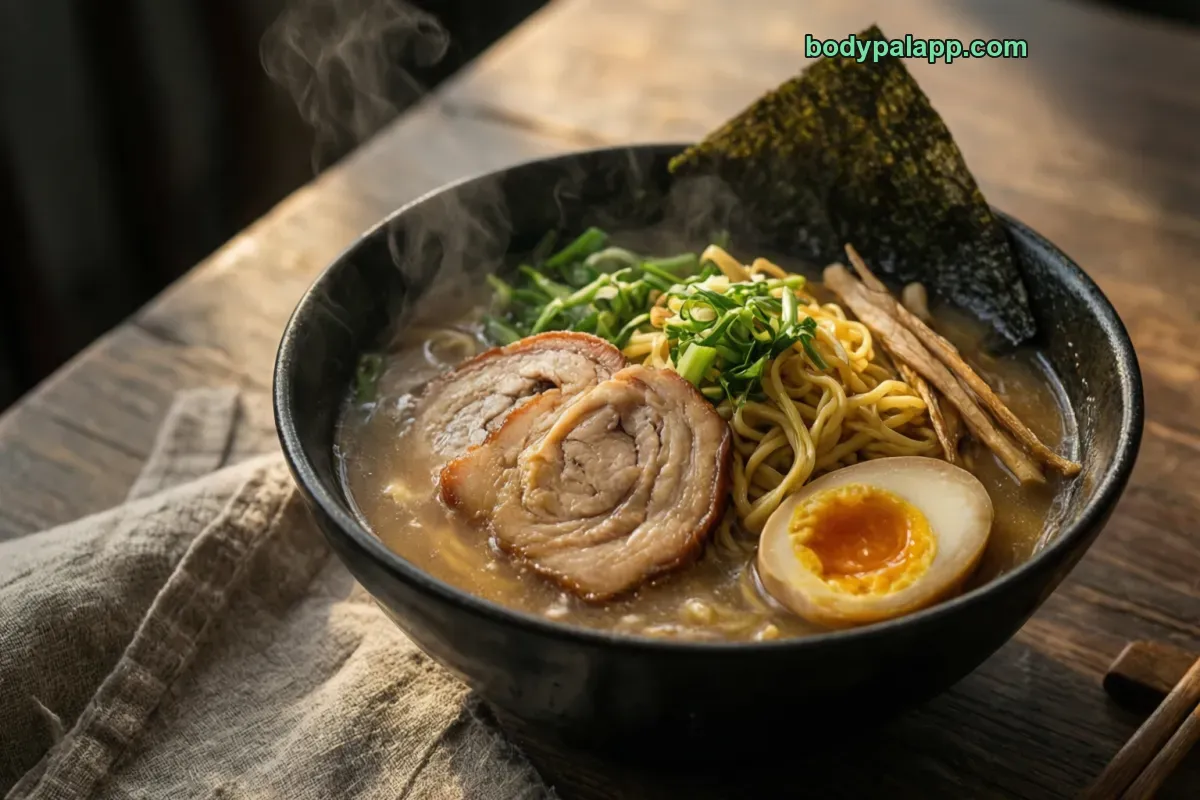
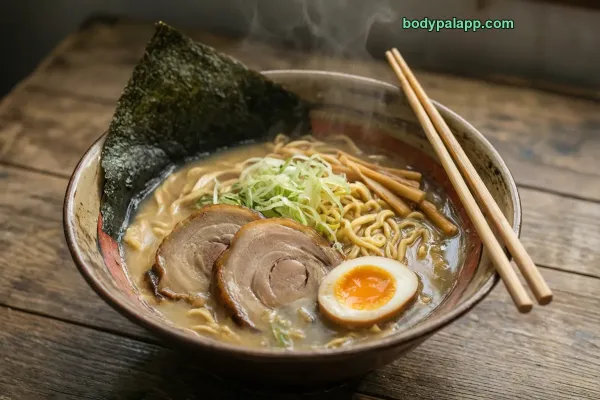
Ramen soup calories come to 162 for 1 cup (245 g) and 66 per 100 g, prepared with water. The number to notice is not calories but sodium: that one cup carries 691 mg, 30% of the daily value, while protein stays at just 3.7 g.
162kcal
1 cup · 245 g, prepared with water
9%protein
3.7 gProtein
22 gCarbs
6.5 gFat
How to burn off 162 kcal
—Walking, brisk
—Jogging
—Cycling, moderate
—Swimming
Skip the math. BodyPal counts these calories from your steps and workouts automatically.
Nutrition facts
Prepared with water · per 245 g
Calories
162 kcal
Protein
3.7 g
Carbohydrate
22 g
Fat
6.5 g
Saturated fat
3 g
Cholesterol
0 mg
Sodium
691 mg
Potassium
66 mg
Iron
1.5 mg
Source: USDA FoodData Central
🛡️
Verified nutrition data
Numbers on this page come from USDA FoodData Central, the U.S. Department of Agriculture’s food composition database, and from manufacturer labels where a branded product is named. Last verified September 2026. How we verify our data →
Ramen soup: calories, protein and sodium by serving
Percent of daily value uses the FDA reference of 2,000 kcal a day.
Serving
kcal
Protein
Carbs
Fat
Sodium
% DV kcal
1 cup (245 g)
162
3.7 g
22.1 g
6.5 g
691 mg
8%
Individual container (440 g)
290
6.7 g
39.8 g
11.6 g
1,241 mg
15%
Dry block (81 g)
356
8.2 g
48.8 g
14.2 g
1,503 mg
18%
100 g
66
1.5 g
9 g
2.6 g
282 mg
3%
3 × 1 cup (245 g)
485
11.2 g
2,073 mg
5 × 1 cup (245 g)
809
18.7 g
3,455 mg
A full container is a 290-calorie meal
One cup (245 g) of ramen soup made with water lands at 162 calories, about 8% of the daily value. Most people do not stop at a cup, though. The individual container holds 440 g and comes to 290 calories, or 15% of the daily value, which is closer to a light meal than a side dish.
The dry block is the other way to read the label. An 81 g block counts 356 calories before any water goes in, 18% of the daily value, and you eat all of it if you finish the noodles and the seasoned broth. Water adds weight but no energy, which is why the prepared soup sits at only 66 calories per 100 g.
Seconds add up fast. Two cups come to 323 calories, three cups to 485, and five cups, a big shared pot, to 809. If you are counting, measure your usual bowl once so you know which of these rows you are really eating. A deep noodle bowl often holds far more than a measured cup.
Carbs and fat carry nearly all the calories
The calorie split is 55% carbs, 36% fat and only 9% protein. Carbs lead, but fat is far from a minor player. Per 100 g that means 9 g of carbs, 2.6 g of fat and 1.5 g of protein, and in a full container those become 39.8 g of carbs and 11.6 g of fat.
The fat share is high for a soup that looks like broth and noodles. Of the 2.6 g of fat per 100 g, 1.2 g is saturated, close to half. A cup brings 6.5 g of fat and the dry block 14.2 g, so the noodles do most of the caloric work.
Fiber and sugar barely register: 0.4 g of fiber and 0.3 g of sugars per 100 g, or 1 g of fiber and 0.7 g of sugars in a whole cup. Sugar is a non-issue here. The low fiber is the bigger gap, because the bowl offers little bulk beyond the noodles themselves.
Sodium is the row to watch
Calories are moderate here; salt is not. One cup carries 691 mg of sodium, 30% of the daily value, while supplying only 8% of the daily calories. Per 100 g the soup has 282 mg of sodium against just 66 calories, a lopsided ratio for any food. That makes sodium, not calories, the number that should decide how often ramen soup lands on your table.
Scale it up and the numbers get serious. The individual container holds 1,241 mg, 54% of the daily value, and the dry block with its seasoning lists 1,503 mg, or 65%. Two cups reach 1,382 mg, three cups 2,073 mg, and five cups hit 3,455 mg, well past a full day's value.
The other minerals do not offset it. Potassium is low at 27 mg per 100 g, and cholesterol is 0. If you watch sodium, the easy levers are the seasoning packet and the broth: use part of the packet, and leave some of the liquid in the bowl rather than drinking it all.
Add protein to turn it into a meal
With 6.7 g of protein in a full container, only 13% of the daily value, ramen soup alone is thin on the macro that makes a meal feel complete. The fix is simple and cheap. Crack an egg into the hot broth, add leftover chicken or tofu, or stir in frozen edamame. Any of these lifts the protein share well above the 9% it starts with.
Vegetables help too. Spinach, bok choy, scallions, mushrooms or a handful of frozen mixed vegetables add bulk for few calories and bring some of the fiber the noodles lack. Each addition changes the totals, so log them separately rather than guessing.
On a day that already included a salty lunch, a ramen soup dinner pushes sodium higher still, so lean on fresher, less processed foods for the rest of the day. Packaged options such as Mike's Mighty Good or Immi vary by flavor, so check the label of the one you buy. BodyPal can log the bowl from a photo, add-ins included.
How does ramen soup compare?
This table sets ramen soup against ramen noodles, a ramen bowl and mushroom soup, per 100 g and per usual serving.
Verdict: For the lightest bowl pick mushroom soup at 97 calories per cup, and treat a 374-calorie package of ramen noodles as a full meal rather than a snack. For staying full the ramen bowl wins: 311 calories per cup buys 7.1 g of protein per 100 g, far more than this soup offers.
Most popular ramen soup brands in the United States
3Mike's Mighty Good Fried Garlic Chicken Ramen Soup63 g381 kcal
4Mike's Mighty Good Spicy Pork Tonkotsu Ramen Soup70 g386 kcal
5Mike's Mighty Good Vegetarian Kimchi Ramen Soup64 g375 kcal
6Mike's Mighty Good Vegetarian Vegetable Ramen Soup54 g370 kcal
7Mike's Mighty Good Chicken Flavor Ramen Soup48 g438 kcal
Packaged ramen is labeled per dry package weight, so those numbers read far higher than the prepared soup above, which is mostly water. Source: manufacturer labels / USDA FoodData Central.
Ramen soup FAQs
How many calories are in a cup of ramen soup?
A cup of prepared ramen soup (245 g) is 162 calories. A full 440 g individual container is 290 calories.
Is ramen soup good for weight loss?
A cup is 162 calories with 6.5 g fat and 22.1 g carbs, and a full container is 290 calories. The dry noodle block on its own is 356 calories per 81 g package.
Ramen soup vs ramen noodles: which has more calories?
Prepared ramen soup is 66 calories per 100 g because most of it is broth, while the dry noodle block is 440 calories per 100 g.
How much protein and sodium are in ramen soup?
A cup has 3.7 g protein and 691 mg sodium. The dry noodle block adds up to 1,855 mg sodium per 100 g.
How many calories are in a whole container of ramen soup?
An individual container of ramen soup (440 g) has 290 calories, 15% of the daily value. It also brings 6.7 g of protein, 39.8 g of carbs, 11.6 g of fat and 1,241 mg of sodium.
How much does a serving of ramen soup weigh?
A cup of prepared ramen soup weighs 245 g and an individual container 440 g. A dry noodle block weighs 81 g before cooking, so weigh the soup as served if you log by grams.
How many kcal does ramen soup have per 100 g?
Prepared ramen soup has 66 kcal per 100 g, with 1.5 g protein, 9 g carbs, 2.6 g fat and 282 mg sodium. Dry ramen noodles, by comparison, run 440 kcal per 100 g before water is added.
How many calories are in a block of instant noodles?
A dry instant ramen block of 81 g has 356 calories, 18% of the daily value, with 8.2 g protein, 48.8 g carbs and 14.2 g fat. Its sodium is 1,503 mg, or 65% of the daily value.
What is the nutrition breakdown of a cup of ramen soup?
A cup of ramen soup (245 g) has 162 calories, 22.1 g of carbs, 6.5 g of fat, 3.7 g of protein, 1 g of fiber and 0.7 g of sugars. Carbs supply 55% of the calories and fat 36%.