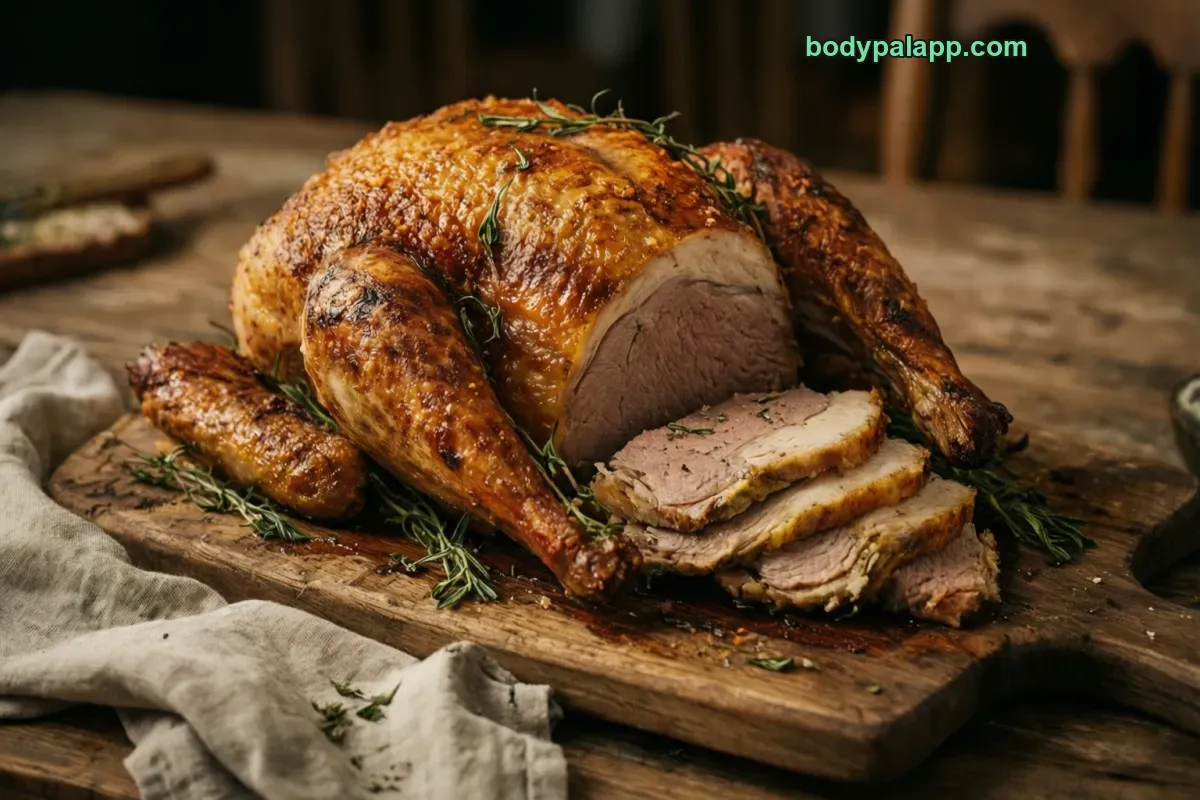
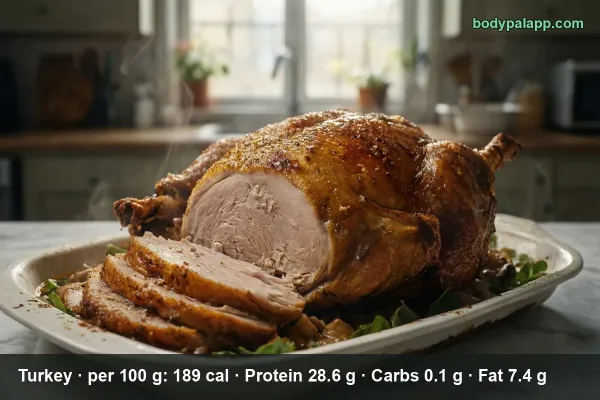
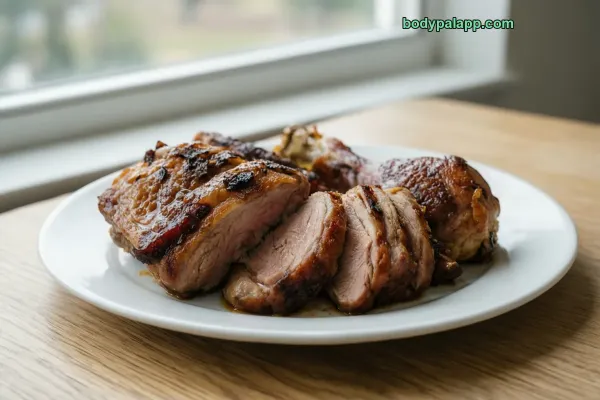
Roast turkey calories come to 146 for a 3 oz portion (85 g) and 172 per 100 g, with the meat and skin roasted together. The number to notice is protein: 24 g in that one portion, or 48% of the daily value, while carbs and sugar both sit at 0.
146kcal
1 3 oz portion · 85 g, roasted, meat and skin
69%protein
24 gProtein
0 gCarbs
4.9 gFat
How to burn off 146 kcal
—Walking, brisk
—Jogging
—Cycling, moderate
—Swimming
Skip the math. BodyPal counts these calories from your steps and workouts automatically.
Nutrition facts
Roasted, meat and skin · per 85 g
Calories
146 kcal
Protein
24 g
Carbohydrate
0 g
Fat
4.9 g
Saturated fat
1.4 g
Cholesterol
89 mg
Sodium
56 mg
Potassium
213 mg
Iron
1.7 mg
Source: USDA FoodData Central
🛡️
Verified nutrition data
Numbers on this page come from USDA FoodData Central, the U.S. Department of Agriculture’s food composition database, and from manufacturer labels where a branded product is named. Last verified October 2026. How we verify our data →
Roast turkey: calories, protein and sodium by serving
Percent of daily value uses the FDA reference of 2,000 kcal a day.
Serving
kcal
Protein
Carbs
Fat
Sodium
% DV kcal
3 oz portion (85 g)
146
24 g
0 g
4.9 g
56 mg
7%
Yield of 1 lb bird (229 g)
394
64.7 g
0 g
13.1 g
151 mg
20%
100 g
172
28.3 g
0 g
5.7 g
66 mg
9%
3 × 3 oz portion (85 g)
439
72.1 g
168 mg
5 × 3 oz portion (85 g)
731
120.1 g
281 mg
One 3 oz portion is 146 calories; two make 292
The 3 oz portion (85 g) is the standard dinner and deli serving, and it lands at 146 calories, 7% of the daily value. Holiday plates rarely stop there. Two portions (170 g) come to 292 calories and 48 g of protein. Three portions (255 g) reach 439 calories.
The yield of a 1 lb bird, 229 g of edible meat and skin, carries 394 calories and 64.7 g of protein. That is 20% of the daily calorie value and 129% of the protein value in a single sitting. Five portions (425 g), the kind of total a long meal with seconds can reach, add up to 731 calories.
Because turkey has no carbs, the total climbs in a straight line with weight. Weigh one typical plate once and you will know your usual portion for the rest of the season. If weighing feels like a chore, BodyPal can log the plate from a photo.
Protein supplies 69% of the calories
Per 100 g, roast turkey has 28.3 g of protein, 5.7 g of fat and 0 g of carbohydrate. Protein supplies 69% of the calories and fat the other 31%. Nothing comes from sugar or starch.
That split explains why turkey keeps its lean reputation even with the skin left on. The fat is modest: a 3 oz portion holds 4.9 g in total, and only 1.7 g per 100 g is saturated, against a daily value of 20 g. Most red meats cannot match that.
For anyone tracking protein, the trade is a good one. A 100 g serving covers 57% of the 50 g daily value for 172 calories. Few foods on a typical dinner table deliver that much protein for so few calories.
Sodium is low; cholesterol is the row to check
Plain roasted turkey is a low-sodium food. It has 66 mg per 100 g and 56 mg in a 3 oz portion, which is 2% of the 2300 mg daily value. Even the full yield of a 1 lb bird stays at 151 mg, or 7%.
The salt on a turkey plate usually comes from somewhere else: brine, gravy, stuffing and deli processing. The roasted meat itself barely registers. If you watch sodium, the sides and the seasoning decide your total, not the bird.
Cholesterol is the number that stands out. There are 105 mg per 100 g, against a daily value of 300 mg, so a large plate takes a real share of it. Potassium adds 250 mg per 100 g toward a 4700 mg daily value, a modest but useful contribution.
Turkey brings the protein; the plate must bring the rest
Roast turkey has 0 g of fiber and 0 g of carbs, so everything else on the plate has to supply them. Roasted vegetables, green beans, a salad or a baked sweet potato fill the gap without much extra fat. Gravy and buttery stuffing are where a lean plate quietly turns heavy.
Leftovers follow the same logic. A turkey sandwich gets its carbs from the bread and its extra calories from mayo and cheese, not from the meat. Keep the turkey portion steady and adjust the add-ons to fit your day.
Packaged products such as Jennie-O Dinner Roast Turkey Breast, Organic Valley Organic Roast Turkey Breast or Skinnygirl Herb Encrusted Roast Turkey Breast are breast meat, often seasoned. The figures on this page are for roasted meat and skin, so read those labels for their own calories and sodium.
How does roast turkey compare?
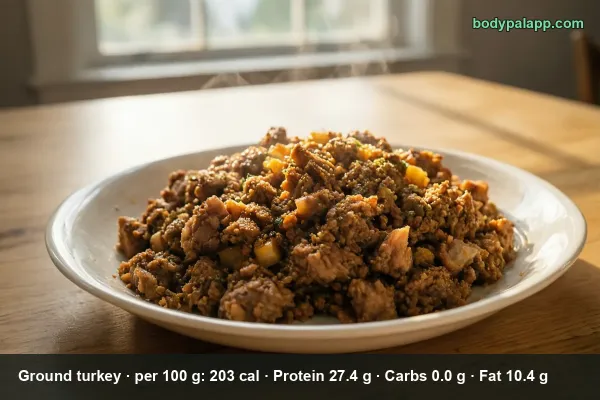
Here is roast turkey next to turkey, turkey dark meat and ground turkey, compared per 100 g and per usual serving.
Verdict: For the fewest calories pick roast turkey at 172 per 100 g or dark meat at 173, which are effectively tied, and skip ground turkey at 203 with 10.4 g of fat. If sodium matters, roast turkey wins outright with 66 mg per 100 g against 103 to 104 mg for turkey and dark meat.
Most popular roast turkey brands in the United States
Ranked by popularity in the BodyPal database
# Productkcal / 100 g
1Organic Valley Organic Roast Turkey Breast2 oz · 56 g107 kcal
2Jennie-O Dinner Roast Turkey Breast2 oz · 56 g125 kcal
3Jennie-O Savory Roast Turkey Breast Tenderloins4 oz · 112 g89 kcal
4Skinnygirl Herb Encrusted Roast Turkey Breast57 g105 kcal
Packaged roast turkey breast is skinless white meat, so its label reads lower than the meat-and-skin number above. Source: manufacturer labels / USDA FoodData Central.
Roast turkey FAQs
How many calories are in roast turkey?
A 3 oz portion of roast turkey with skin has 146 calories, and 100 g has 172.
Is roast turkey good for weight loss?
Roast turkey has 172 calories per 100 g with 28.3 g of protein, 5.7 g of fat and 0 g of carbs, so most of its calories come from protein.
Roast turkey vs ground turkey: which has fewer calories?
Roast turkey has 172 calories per 100 g versus 203 for cooked ground turkey, with 28.3 g and 27.4 g of protein.
How much protein is in roast turkey?
A 3 oz portion has 24.0 g of protein and 4.9 g of fat. Per 100 g it has 28.3 g of protein.
How many calories are in a roast turkey dinner?
The turkey itself is 146 calories per 3 oz portion, or 292 for two portions. Gravy, stuffing, potatoes and rolls add their own calories, so log each side separately to get a real total for the plate.
Does roast turkey have any carbs or sugar?
Roast turkey has 0 g of carbohydrate and 0 g of sugar per 100 g. Its calories come 69% from protein and 31% from fat, which makes it an easy fit for low-carb eating.
Is roast turkey high in sodium?
A 3 oz portion of plain roast turkey has 56 mg of sodium, just 2% of the daily value, and 100 g has 66 mg. Brined birds, gravy and deli turkey can carry far more, so check those separately.
How many calories are in the meat from a 1 lb turkey?
A 1 lb fryer-roaster yields 229 g of meat and skin with 394 calories and 64.7 g of protein. That is 20% of the daily calorie value and 129% of the protein value.
Is roast turkey leaner than turkey dark meat?
Only slightly. Roast turkey has 172 calories and 5.7 g of fat per 100 g, while turkey dark meat has 173 calories and 6 g of fat. Roast turkey is lower in sodium, 66 mg versus 104 mg.