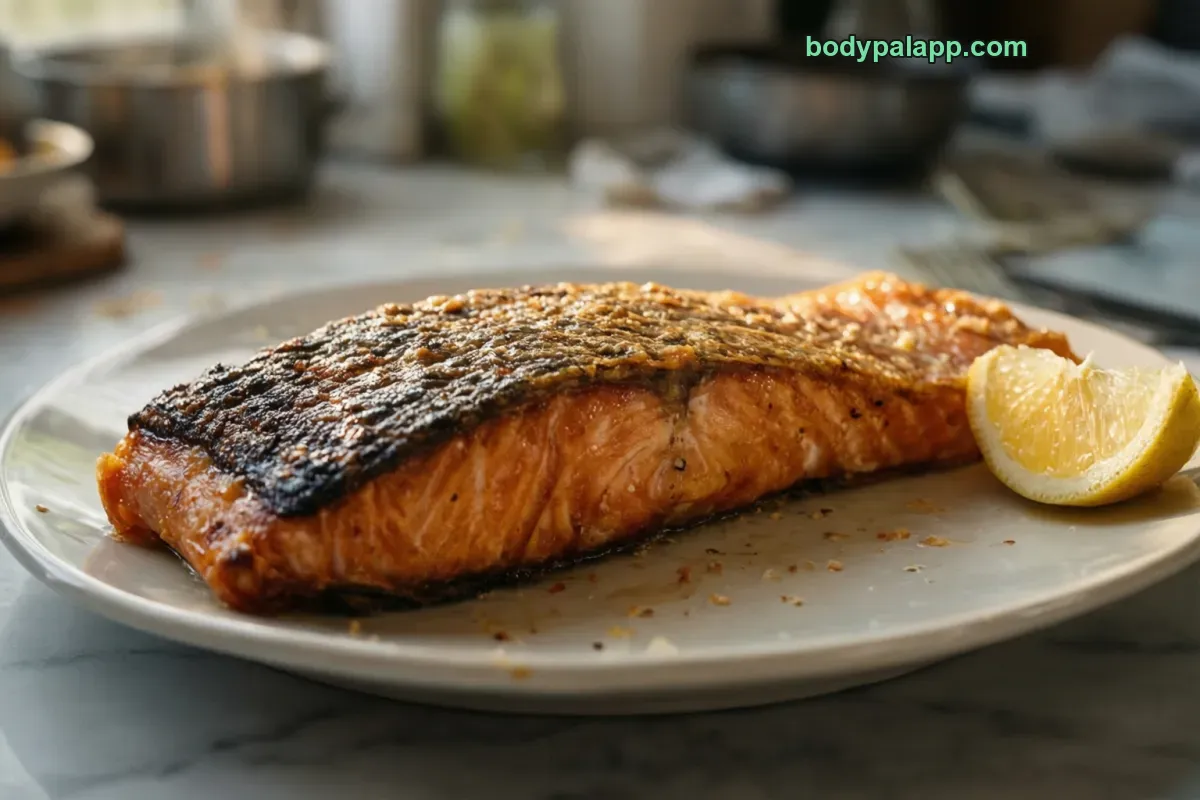
Salmon fillet with skin calories come to 367 for one 178 g fillet and 206 per 100 g, based on USDA's row for Atlantic farmed salmon cooked with dry heat. The thing to notice is the fat: it supplies 56% of the calories, protein covers the other 44%, and there are no carbs at all.
367kcal
1 fillet · 178 g, Atlantic farmed, baked
44%protein
39 gProtein
0 gCarbs
22 gFat
How to burn off 367 kcal
—Walking, brisk
—Jogging
—Cycling, moderate
—Swimming
Skip the math. BodyPal counts these calories from your steps and workouts automatically.
Nutrition facts
Atlantic farmed, baked · per 178 g
Calories
367 kcal
Protein
39 g
Carbohydrate
0 g
Fat
22 g
Saturated fat
4.3 g
Cholesterol
112 mg
Sodium
109 mg
Potassium
684 mg
Iron
0.6 mg
Source: USDA FoodData Central
🛡️
Verified nutrition data
Numbers on this page come from USDA FoodData Central, the U.S. Department of Agriculture’s food composition database, and from manufacturer labels where a branded product is named. Last verified September 2026. How we verify our data →
Salmon fillet with skin: calories, protein and sodium by serving
Percent of daily value uses the FDA reference of 2,000 kcal a day.
Serving
kcal
Protein
Carbs
Fat
Sodium
% DV kcal
1 fillet (178 g)
367
39.3 g
0 g
22 g
109 mg
18%
3 oz portion (85 g)
175
18.8 g
0 g
10.5 g
52 mg
9%
4 oz portion (113 g)
233
25 g
0 g
14 g
69 mg
12%
100 g
206
22.1 g
0 g
12.4 g
61 mg
10%
3 × 1 fillet (178 g)
1,100
118 g
326 mg
5 × 1 fillet (178 g)
1,833
196.7 g
543 mg
A 3 oz portion is a 175-calorie serving
The USDA-sized fillet weighs 178 g and lands at 367 calories, 18% of the daily value for energy. Fillets in stores and restaurants vary a lot in size, so the weight tells you more than the word "fillet" does. A 3 oz portion (85 g) is 175 calories, and a 4 oz portion (113 g) comes to 233.
Totals climb quickly when you cook for more than one. Two fillets (356 g) add up to 733 calories, three come to 1,100, and five reach 1,833. That last number is a full sheet pan of baked salmon, so it pays to portion the fish onto plates instead of serving straight from the tray.
If you track intake, the 3 oz size makes a handy reference point: it carries about half the calories of a whole fillet. Weigh the cooked fish once or twice and your eye gets calibrated fast. BodyPal can also log a salmon fillet from a photo when you would rather not reach for the scale.
Fat supplies 56% of the calories
Salmon is often filed under lean protein, but the calorie split says otherwise. Per 100 g you get 22.1 g of protein and 12.4 g of fat, and because fat is so energy dense, it ends up providing 56% of the calories against 44% from protein. Carbs, sugars and fiber all sit at 0.
That fat is mostly not the saturated kind. Saturated fat is 2.4 g per 100 g, measured against a daily value of 20 g. A full fillet carries 22 g of total fat, which is a real share of the day, so budget for it if you also cook with butter or oil.
The protein side is generous. One fillet delivers 39.3 g of protein, 79% of the daily value, while a 3 oz portion gives 18.8 g, or 38%. Few foods hand you that much protein with zero carbohydrate attached.
Plain salmon is low in sodium; seasoning is not
Baked salmon on its own is a low-sodium food. A 100 g serving has 61 mg, and a whole fillet has 109 mg, just 5% of the daily value. A 3 oz portion is 52 mg, or 2%.
Those figures describe unseasoned fish. Soy glazes, teriyaki sauce, seasoning blends and a heavy hand with the salt shaker can push the sodium far past what the fish itself brings. If you watch sodium, season with lemon, herbs and pepper and keep salty sauces on the side.
Cholesterol is 63 mg per 100 g against a daily value of 300 mg, a moderate number for animal protein. Potassium is a quiet plus at 384 mg per 100 g. Neither one is the main story, but both are worth a glance if you track more than calories.
Zero carbs leaves room on the plate
Because salmon brings no carbs and no fiber, what you serve with it shapes the meal. Roasted or steamed vegetables add fiber and volume for few calories. A scoop of rice, potatoes or whole grains rounds it into a fuller dinner if you need the energy.
Portion size is the lever that matters most. A 4 oz portion at 233 calories still gives 25 g of protein, half the daily value, which leaves plenty of room for sides. A whole fillet at 367 calories suits a bigger appetite or a post-workout meal.
Watch the extras, not the fish. Butter basting, creamy dill sauces and oily marinades can add as much as the salmon itself. If you like the skin crisp, a hot oven or a dry pan gets it there without much added fat.
How does salmon fillet with skin compare?
Here is how salmon with the skin on stacks up against skinless salmon fillet, salmon skin and skinless chicken breast, per 100 g and per usual serving.
Verdict: In our data all three salmon rows match at 206 calories and 22.1 g of protein per 100 g, so skin on or off is a texture choice rather than a calorie decision. For the leanest protein pick chicken breast at 176 calories and 29.6 g of protein per 100 g; for staying full with more fat on the plate stay with salmon, which also has far less sodium than the chicken's 353 mg.
Salmon fillet with skin FAQs
How many calories are in one salmon fillet with skin?
About 367 calories in a cooked fillet with skin (178 g), or 175 in a 3 oz portion (85 g).
Is salmon good for weight loss?
A cooked fillet (178 g) has 367 calories with 39.3 g protein, 22.0 g fat and 0 g carbs.
Is farmed or wild salmon higher in calories?
Raw farmed Atlantic salmon has 208 calories per 100 g, while raw wild Atlantic salmon has 142.
How much protein is in a salmon fillet?
A cooked fillet with skin (178 g) has 39.3 g protein, and a 3 oz portion has 18.8 g.
How many calories are in 3 oz of baked salmon with skin?
A 3 oz portion (85 g) has 175 calories, about 9% of the daily value. It also delivers 18.8 g of protein and 10.5 g of fat, with no carbs.
How many calories are in 4 oz of salmon with the skin on?
A 4 oz portion (113 g) comes to 233 calories. That serving gives 25 g of protein, half the daily value, plus 14 g of fat and 69 mg of sodium.
How much fat is in a salmon fillet with skin?
One 178 g fillet holds 22 g of fat. Per 100 g it is 12.4 g of fat, of which 2.4 g is saturated, and fat supplies 56% of the calories.
Does salmon with skin have any carbs?
No. Baked salmon has 0 g of carbs, 0 g of sugars and 0 g of fiber per 100 g. All of its 206 calories per 100 g come from protein and fat.
How much sodium is in a salmon fillet with skin?
Plain baked salmon has 109 mg of sodium per 178 g fillet, 5% of the daily value, and 61 mg per 100 g. Sauces and salty seasonings add more.