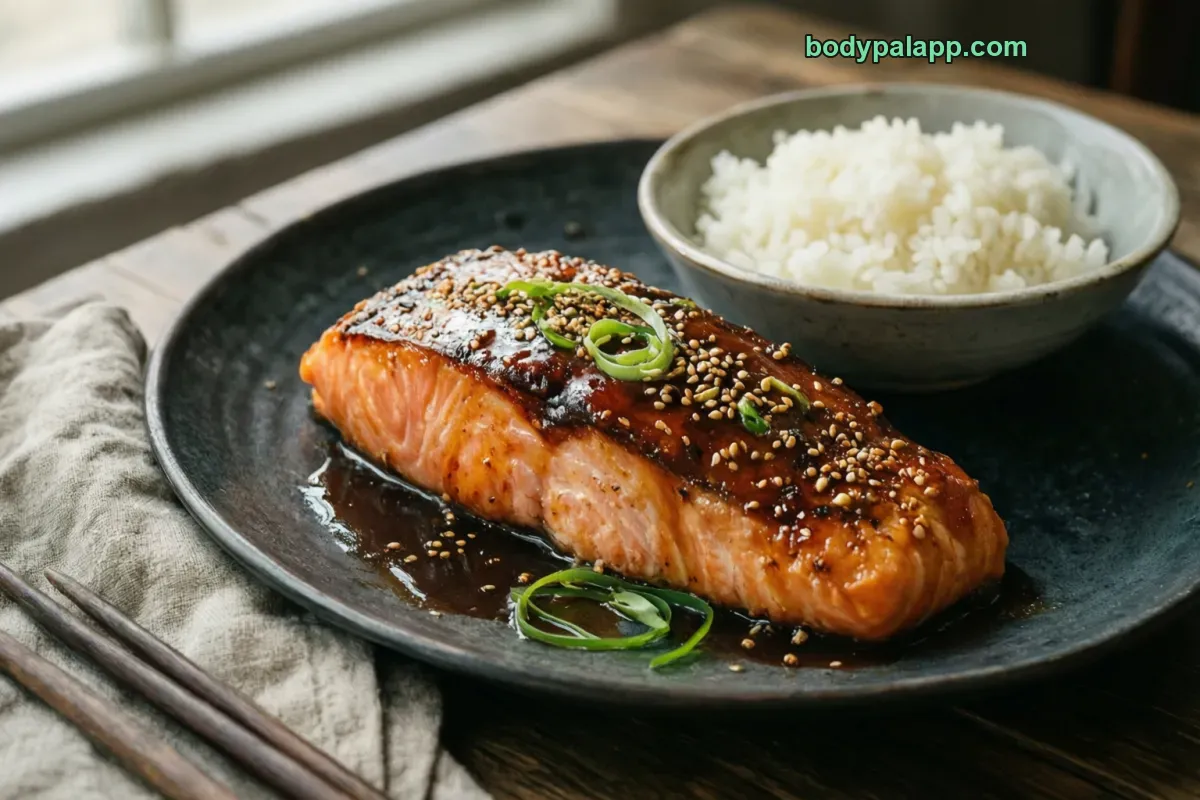
Salmon teriyaki calories come to 219 for one 170 g fillet and 129 per 100 g. Protein carries the plate: 52% of the calories come from it, and one fillet delivers 28 g. The catch is the glaze, which brings 10 g of sugar and 500 mg of sodium to every fillet.
219kcal
1 fillet · 170 g, packaged, per label
52%protein
28 gProtein
12 gCarbs
6 gFat
How to burn off 219 kcal
—Walking, brisk
—Jogging
—Cycling, moderate
—Swimming
Skip the math. BodyPal counts these calories from your steps and workouts automatically.
Nutrition facts
Packaged, per label · per 170 g
Calories
219 kcal
Protein
28 g
Carbohydrate
12 g
Fat
6 g
Saturated fat
1.5 g
Cholesterol
100 mg
Sodium
500 mg
Potassium
580 mg
Source: USDA FoodData Central
🛡️
Verified nutrition data
Numbers on this page come from USDA FoodData Central, the U.S. Department of Agriculture’s food composition database, and from manufacturer labels where a branded product is named. Last verified September 2026. How we verify our data →
Salmon teriyaki: calories, protein and sodium by serving
Percent of daily value uses the FDA reference of 2,000 kcal a day.
Serving
kcal
Protein
Carbs
Fat
Sodium
% DV kcal
1 fillet (170 g)
219
28 g
12 g
6 g
500 mg
11%
Burger (113 g)
130
16 g
6 g
5 g
280 mg
6%
100 g
129
16.5 g
7.1 g
3.5 g
294 mg
6%
3 × 1 fillet (170 g)
658
84 g
1,499 mg
5 × 1 fillet (170 g)
1,097
140 g
2,499 mg
One fillet is a 219-calorie main
The default serving here is a single 170 g fillet, and at 219 calories it covers about 11% of the daily value for energy. That is a modest number for the center of a dinner plate. It also brings 28 g of protein, which is 56% of the daily value in one piece of fish.
Portions move the total in a straight line. Two fillets (340 g) land at 439 calories and 56 g of protein. Three fillets (510 g) reach 658 calories, and a five-fillet family tray (850 g) adds up to 1,097. If you are cooking for a household, divide the tray honestly; it is easy to plate one and a half fillets without noticing.
Smaller formats exist too. A salmon teriyaki burger patty of 113 g comes in at 130 calories with 16 g of protein, 5 g of fat and 2 g of fiber, so it is a lighter option than a full fillet. Per 100 g, the fillet values are 129 calories and 16.5 g of protein, a handy reference when your piece is cut larger or smaller than the label.
Protein is over half the calories
The calorie split is clear: 52% from protein, 25% from fat and 22% from carbohydrates. Very few glazed dishes lean this hard toward protein. The fish does the heavy lifting, and the sauce fills in the rest.
Per 100 g you get 16.5 g of protein, 3.5 g of fat and 7.1 g of carbohydrates. Of those carbs, 5.9 g are sugars, which tells you nearly all of the carbohydrate comes from the sweet teriyaki glaze rather than from the salmon itself. Plain salmon has no carbs; the sauce is what puts them on the label.
Fat stays light. Saturated fat is just 0.9 g per 100 g, and a full fillet carries about 6 g of total fat. These values come from a packaged teriyaki ginger keta salmon, a leaner species, so a fattier farmed fillet with a homemade glaze could read higher on the fat line.
Sodium and sugar are the rows to watch
Teriyaki sauce is built on soy sauce and sugar, and the label shows it. One fillet carries 500 mg of sodium, which is 22% of the daily value. Per 100 g the figure is 294 mg, or 13% of the daily value.
Stack fillets and sodium climbs faster than you might expect. Two fillets bring 1,000 mg, three bring 1,499 mg, and a five-fillet tray hits 2,499 mg, more than a full day's daily value. If you watch sodium, keep the rest of the meal low in salty sides and skip extra sauce at the table.
Sugar follows the same logic: 10 g per fillet and 5.9 g per 100 g, all riding in the glaze. On the plus side, the fillet brings 341 mg of potassium per 100 g, while cholesterol sits at 59 mg per 100 g.
Build the plate around fiber
The fillet has 0 g of fiber, so the rest of the plate has to supply it. Steamed broccoli, bok choy, green beans or a crunchy cabbage slaw add volume and fiber without many calories. A simple cucumber salad with rice vinegar adds crunch without salting the plate further.
Rice is the classic partner, and it is where a 219-calorie fillet can quietly turn into a much bigger dinner. Measure the rice instead of eyeballing it, or split the plate so vegetables take half. Brown rice brings more fiber than white if that matters to you.
Because the protein is already high, you do not need a second protein source on the plate. Spoon any leftover glaze over the vegetables sparingly, since that is where the extra sugar and sodium sit. BodyPal can log the meal from a photo, which helps when the portion of rice on the side is hard to guess.
How does salmon teriyaki compare?
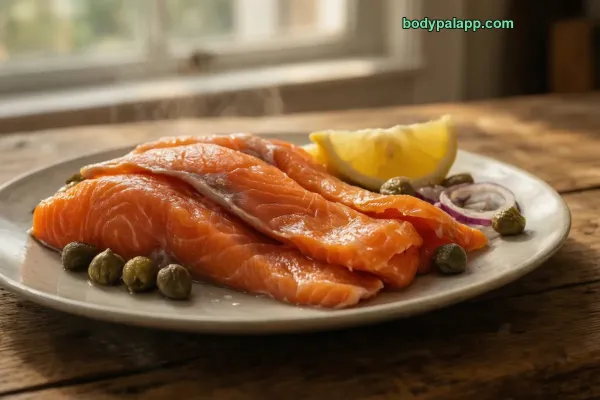
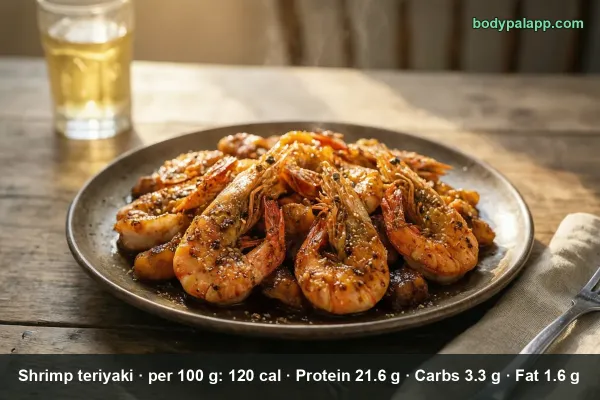
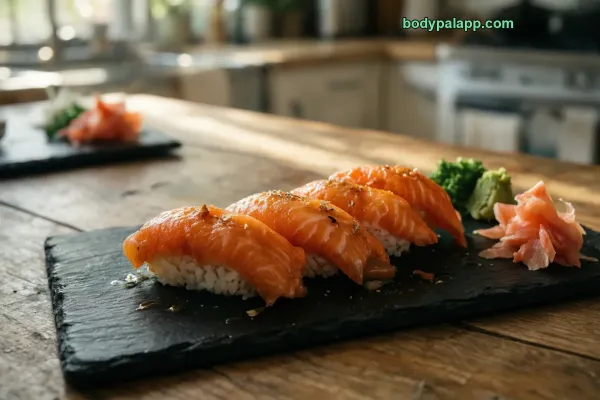
Here is how salmon teriyaki stacks up against smoked salmon, shrimp teriyaki and salmon sushi, per 100 g and per usual serving.
Verdict: For the fewest calories with the most protein, shrimp teriyaki wins at 120 calories and 21.6 g of protein per 100 g, though it carries 581 mg of sodium. If sodium is your main concern, salmon teriyaki at 294 mg per 100 g is the better pick over smoked salmon at 672 mg.
Most popular salmon teriyaki brands in the United States