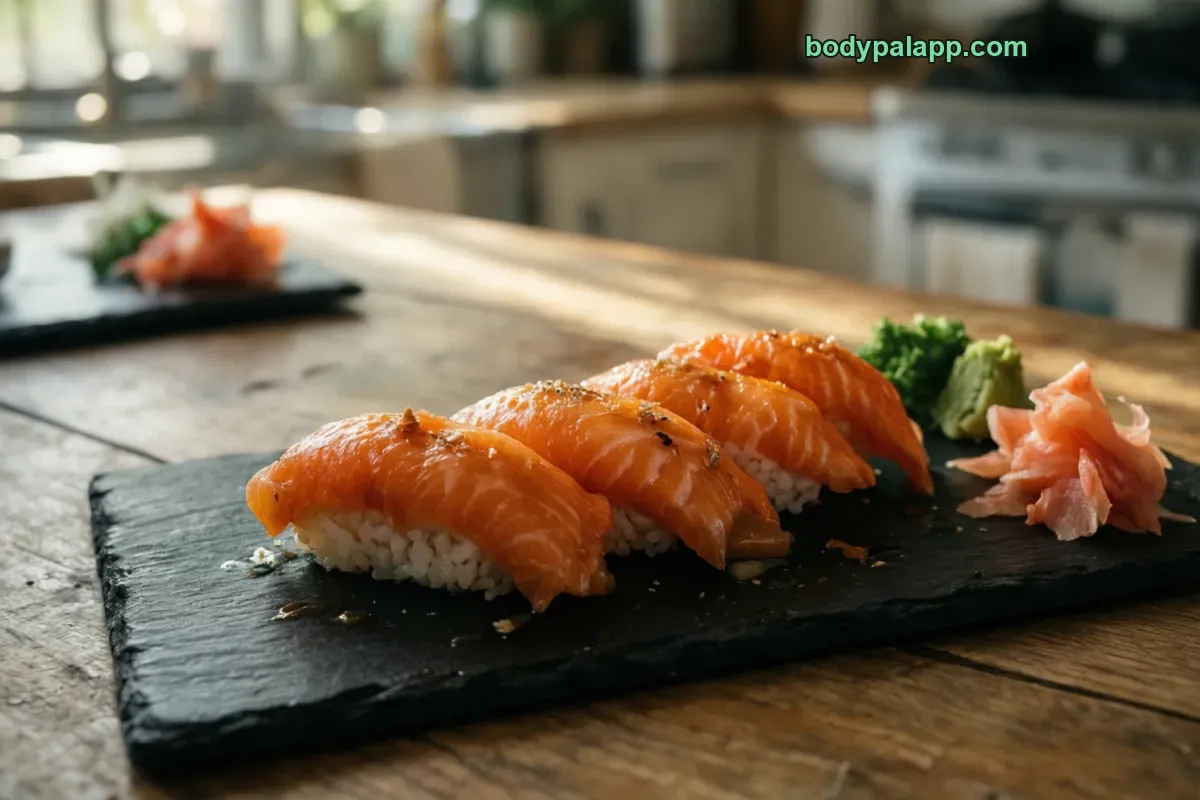
Salmon sushi calories come to 37 for one 35 g piece of nigiri and 107 per 100 g. The thing to notice is how quickly pieces add up: a 6-piece order lands at 225 calories and 666 mg of sodium, which is 29% of the daily value before you reach for the soy sauce.
37kcal
1 piece · 35 g, nigiri, salmon over rice
34%protein
3.1 gProtein
5 gCarbs
0.6 gFat
How to burn off 37 kcal
—Walking, brisk
—Jogging
—Cycling, moderate
—Swimming
Skip the math. BodyPal counts these calories from your steps and workouts automatically.
Nutrition facts
Nigiri, salmon over rice · per 35 g
Calories
37 kcal
Protein
3.1 g
Carbohydrate
4.7 g
Fat
0.6 g
Saturated fat
0.1 g
Cholesterol
6 mg
Sodium
111 mg
Potassium
47 mg
Iron
0.1 mg
Source: USDA FoodData Central
🛡️
Verified nutrition data
Numbers on this page come from USDA FoodData Central, the U.S. Department of Agriculture’s food composition database, and from manufacturer labels where a branded product is named. Last verified September 2026. How we verify our data →
Salmon sushi: calories, protein and sodium by serving
Percent of daily value uses the FDA reference of 2,000 kcal a day.
Serving
kcal
Protein
Carbs
Fat
Sodium
% DV kcal
1 piece (35 g)
37
3.1 g
4.7 g
0.6 g
111 mg
2%
6 pieces (210 g)
225
18.7 g
28.1 g
3.7 g
666 mg
11%
Roll piece (30 g)
31
2.1 g
4.6 g
0.4 g
105 mg
2%
100 g
107
8.9 g
13.4 g
1.7 g
317 mg
5%
3 × 1 piece (35 g)
112
9.4 g
333 mg
5 × 1 piece (35 g)
187
15.6 g
555 mg
Six pieces make a 225-calorie plate
One piece of salmon nigiri weighs about 35 g and carries 37 calories. That is light enough that almost nobody stops at one. Two pieces come to 75 calories, three reach 112, and five land at 187.
A standard 6-piece order weighs 210 g and totals 225 calories, about 11% of the daily value for calories. It also brings 18.7 g of protein, which covers 37% of the protein daily value. For a plate that small, that is a fair return, and it explains why nigiri works as a light lunch rather than a heavy one.
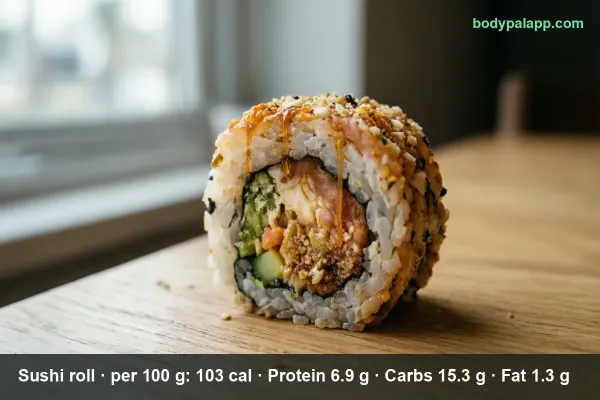
A roll piece is a different unit. At 30 g it holds 31 calories and only 2.1 g of protein, because the fish is a thin strip wrapped in more rice. If you count by pieces, nigiri and maki are close. If you count by protein, nigiri wins every bite, with 3.1 g per piece against 2.1 g.
Rice supplies half the calories
Per 100 g, salmon sushi has 13.4 g of carbs, 8.9 g of protein and 1.7 g of fat. In calorie terms that splits into 51% carbs, 34% protein and 15% fat. The rice, not the fish, is the main fuel.
That makes nigiri leaner than its fatty-fish reputation suggests. Saturated fat is only 0.3 g per 100 g, and sugars sit at 0.8 g. Fiber is low as well, at 0.6 g per 100 g, so a sushi plate does little for that row on its own.
Protein is the strong point. About a third of the calories coming from protein is a solid share for a rice-based dish, and it is why six pieces deliver 18.7 g. If you want more protein per calorie, the fish without rice does that better, as the comparison table below shows.
Sodium is the row to watch
At 317 mg per 100 g, sodium is the number on this page that grows fastest with portion size. One piece has 111 mg, or 5% of the daily value. A 6-piece order has 666 mg, which is 29% of the daily value, and that figure does not include any dipping sauce.
The other rows are quieter. Cholesterol stays modest at 18 mg per 100 g, and potassium adds 133 mg. Neither shifts the picture much. Sodium is the one row where a regular sushi habit shows up clearly.
Soy sauce stacks on top of the numbers here, so the real total at the table is higher. If you watch sodium, dip the fish side lightly instead of soaking the rice, skip salty sides, and treat the 666 mg from a full order as most of that meal's share.
Pair nigiri with vegetables, not more rice
At 225 calories, a 6-piece order is closer to a snack than a full dinner for many people. The easy way to fill the gap is a second roll, which adds mostly rice and more sodium. A side of vegetables or a salad adds volume and some fiber, the row nigiri barely touches.
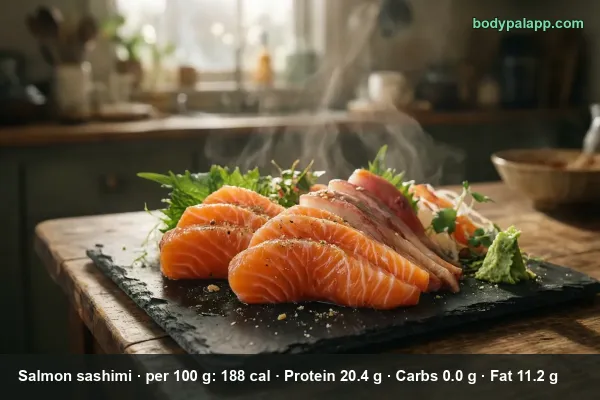
If you want a bigger protein hit without much rice, mix in a few slices of salmon sashimi. It carries 20.4 g of protein per 100 g against 8.9 g for nigiri, though it also brings 188 calories against 107. Combining the two gives a plate with more protein and fewer carbs than nigiri alone.
Store-bought packs such as the Mai Salmon Sushi Set or the Mai Salmon Sushi Sampler follow the same logic: count the pieces first, then check the sodium. BodyPal can log a sushi plate from a photo, which helps when the piece count gets fuzzy at a shared table.
How does salmon sushi compare?
Here is how salmon nigiri stacks up against a salmon roll, a generic sushi roll and salmon sashimi, per 100 g and per usual serving.
Verdict: For the fewest calories, salmon nigiri at 107 per 100 g and the rolls at 103 are essentially tied, so pick nigiri for its extra protein and lower sodium. For staying full, salmon sashimi wins with 20.4 g of protein per 100 g and no rice, but it costs about 1.8 times the calories.
Most popular salmon sushi brands in the United States
5SushiC Philadelphia Smoked Salmon Roll10 pieces · 203 g177 kcal
Packaged sushi sets read higher per 100 g than plain nigiri because they add cream cheese, avocado and sauces. Source: manufacturer labels / USDA FoodData Central.
Salmon sushi FAQs
How many calories are in one piece of salmon sushi?
One piece of salmon nigiri (35 g) is about 37 calories, with 3.1 g protein and 4.7 g carbs.
Is salmon sushi good for weight loss?
Salmon sushi is 107 calories per 100 g, so a six-piece serving (210 g) is 225 calories and 18.7 g protein. Most of the 13.4 g carbs per 100 g come from the seasoned rice.
Salmon sushi or salmon sashimi: which has fewer calories?
Salmon sushi is 107 calories per 100 g and salmon sashimi 188, because sashimi is pure fish while sushi is mostly rice.
How much protein is in salmon sushi?
8.9 g of protein per 100 g, which works out to 3.1 g in one 35 g piece and 18.7 g in a six-piece serving.
How many calories are in a 6-piece order of salmon sushi?
A 6-piece order of salmon nigiri (210 g) has 225 calories. That is 11% of the daily value, with 18.7 g of protein and 666 mg of sodium. Five pieces come to 187 calories.
What are the nutrition facts for salmon sushi per 100 g?
Per 100 g, salmon sushi has 107 calories, 8.9 g of protein, 13.4 g of carbs and 1.7 g of fat. It also carries 317 mg of sodium, 18 mg of cholesterol and 0.6 g of fiber.
How many carbs are in salmon sushi?
One piece of salmon nigiri has 4.7 g of carbs, and a 6-piece order has 28.1 g. Carbs supply 51% of the calories, nearly all of it from the rice under the fish.
How much sodium is in salmon sushi?
One piece has 111 mg of sodium, 5% of the daily value. Six pieces reach 666 mg, or 29% of the daily value, and that is before any soy sauce.
Does a salmon roll piece have fewer calories than a nigiri piece?
Yes, slightly. A 30 g roll piece has 31 calories versus 37 for a 35 g nigiri piece. The roll piece also has less protein, 2.1 g against 3.1 g.