Skim milk calories come to 83 for 1 cup (245 g) and 34 per 100 g. The number to notice is protein: 8.3 g per cup, which is 17% of the daily value, while fat barely registers at 0.2 g. Protein supplies 40% of the calories, a high share for something you pour.
83kcal
1 cup · 245 g, fat free, fortified
40%protein
8.3 gProtein
12 gCarbs
0.2 gFat
How to burn off 83 kcal
—Walking, brisk
—Jogging
—Cycling, moderate
—Swimming
Skip the math. BodyPal counts these calories from your steps and workouts automatically.
Nutrition facts
Fat free, fortified · per 245 g
Calories
83 kcal
Protein
8.3 g
Carbohydrate
12.2 g
Fat
0.2 g
Saturated fat
0.1 g
Cholesterol
5 mg
Sodium
103 mg
Potassium
382 mg
Iron
0.1 mg
Source: USDA FoodData Central
🛡️
Verified nutrition data
Numbers on this page come from USDA FoodData Central, the U.S. Department of Agriculture’s food composition database, and from manufacturer labels where a branded product is named. Last verified September 2026. How we verify our data →
Skim milk: calories, protein and sodium by serving
Percent of daily value uses the FDA reference of 2,000 kcal a day.
Serving
kcal
Protein
Carbs
Fat
Sodium
% DV kcal
1 cup (245 g)
83
8.3 g
12.2 g
0.2 g
103 mg
4%
100 g
34
3.4 g
5 g
0.1 g
42 mg
2%
1 quart (980 g)
333
33 g
48.6 g
0.8 g
412 mg
17%
3 × 1 cup (245 g)
250
24.8 g
309 mg
5 × 1 cup (245 g)
417
41.3 g
515 mg
One cup is an 83-calorie pour
The standard serving is 1 cup (245 g), and it lands at 83 calories with 8.3 g protein. That is 4% of a 2000-calorie daily value, small enough that a glass with breakfast barely moves the day's total. The catch with milk is that almost nobody measures it.
Pours add up quietly. Two cups come to 167 calories, three cups to 250, and five cups reach 417. If you go through a quart in a day across coffee, cereal and a shake, that is 333 calories and 33 g protein, or 17% of the daily calorie value and 66% of the protein value.
The upside is that protein scales right along with the calories. Three cups deliver 24.8 g protein, and five cups deliver 41.3 g. The ratio never slips as the glass gets bigger, so a second cup is a fair trade if you are chasing protein. If you are counting calories tightly, measure the cup once so you know what your usual pour really holds.
Protein carries 40% of the calories
Strip the fat out of milk and what remains is protein and carbs. The calorie split is 40% protein, 58% carbs and 2% fat. Per 100 g that works out to 3.4 g protein, 5 g carbs and 0.1 g fat, all for 34 calories.
That 2% fat share is the defining feature. The product is fat free and fortified, and the per-cup fat of 0.2 g backs up the label. Saturated fat sits at 0.1 g per 100 g and cholesterol at 2 mg, both close enough to zero that they will not shape a day's numbers.
The carbs are the bigger slice, and nearly all of them show up on the sugars line: 5.1 g sugars next to 5 g carbs per 100 g. Fiber is 0 g. So skim milk is a lean protein source that comes with a real dose of sugar. It is not a pure protein drink, and it is not a sugar drink either. It sits in between, and that is exactly why it is useful.
Sugar, not sodium, is the row to read
A cup of skim milk lists 12.5 g sugars. That is the figure most people miss, because plain milk does not taste especially sweet. Scale up to a quart and the sugars line reaches 49.9 g, which is worth knowing if milk is your main drink through the day.
Sodium is modest by comparison. One cup has 103 mg, just 4% of the daily value. A full quart climbs to 412 mg, or 18%, and even five cups stop at 515 mg. If you watch sodium, milk is rarely the item that pushes you over; the salty foods around it are the ones to check.
Potassium is the quieter plus at 156 mg per 100 g. This card covers plain skim milk with added vitamin A and vitamin D, so flavored versions will read differently, usually with more sugar on the label. If you track sugar closely, log milk by the cup rather than guessing, since the sugars total follows the pour exactly as the calories do.
A lean base that works best with company
Because it brings protein with almost no fat, skim milk is easy to build around. Pour it over oats or cereal, blend it into a smoothie with fruit, or use it in coffee where a fat-free splash keeps the cup light.
On its own, a glass is a thin snack. Skim milk has 0 g fiber and only 0.2 g fat per cup, so if you want something more substantial, add food that brings those rows: a handful of nuts, toast with peanut butter, or a piece of fruit. The milk then supplies the protein while the rest of the plate does the other work.
If you already drink 2 percent milk or regular milk, switching the same cup to skim is about the simplest calorie cut in the fridge. You keep nearly the same protein and lose most of the fat. BodyPal can log a glass of milk or a bowl of cereal from a photo, which helps when the pour is the part you never measure.
How does skim milk compare?
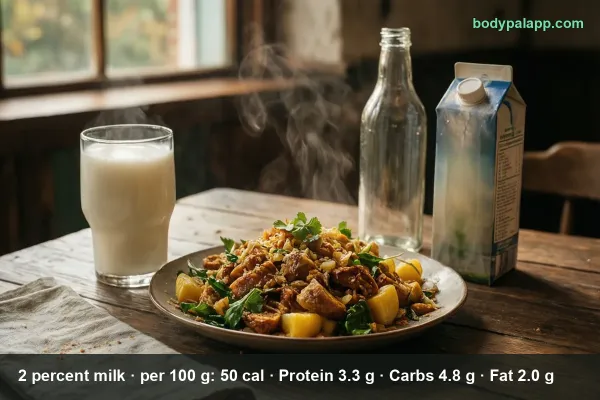
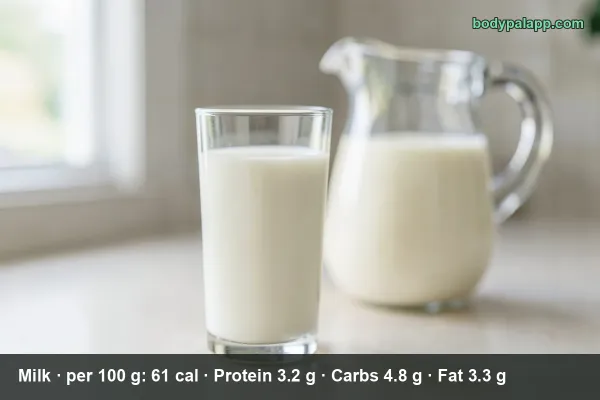
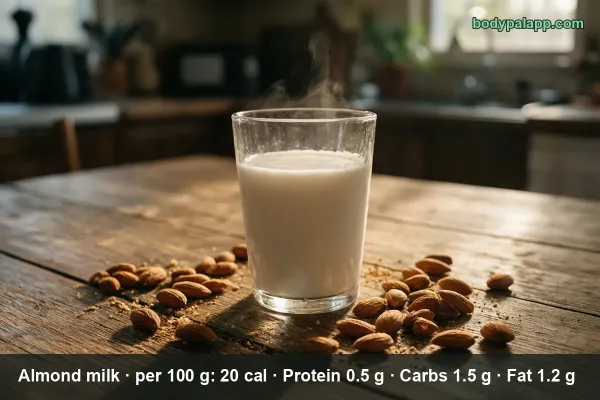
Here is how skim milk stacks up against 2 percent milk, regular milk and almond milk, per 100 g and per usual serving.
Verdict: For the fewest calories almond milk wins at 20 per 100 g, but with just 0.5 g protein it is a light pour rather than a food. For protein per calorie skim is the pick, since 2 percent milk and regular milk carry similar protein at 3.3 g and 3.2 g yet run 1.5 and 1.8 times the calories.
Skim milk FAQs
How many calories are in a cup of skim milk?
A 245 g cup has 83 calories. Skim milk is 34 calories per 100 g.
Is skim milk good for weight loss?
A cup is 83 calories with 8.3 g of protein and only 0.2 g of fat. At 34 calories per 100 g it is the lightest cow's milk, against 50 per 100 g for 2% milk.
Skim milk vs 2% milk: how many calories is the difference?
Skim milk has 34 calories per 100 g and 2% milk has 50, so a 245 g cup of skim milk is 83 calories.
How much protein is in skim milk?
3.4 g per 100 g, which is 8.3 g in a 245 g cup. The same cup also gives about 299 mg of calcium.
What are the macros in skim milk?
One cup (245 g) of skim milk has 8.3 g protein, 12.2 g carbs and 0.2 g fat for 83 calories. By calories, that is 40% protein, 58% carbs and 2% fat.
How many carbs are in skim milk?
Skim milk has 12.2 g carbs per cup and 5 g per 100 g. Nearly all of it appears as sugars, at 12.5 g per cup, and there is 0 g fiber.
What are the full nutrition facts for skim milk per 100 g?
Per 100 g, skim milk has 34 calories, 3.4 g protein, 5 g carbs, 5.1 g sugars and 0.1 g fat. It also lists 42 mg sodium, 2 mg cholesterol and 156 mg potassium.
How many calories are in a splash of skim milk?
Fewer than 34, since that is the count for a full 100 g and a splash in coffee is only a small part of that. A full cup is 83 calories, so a splash barely registers.
How do the calories in skim milk compare with regular milk?
Skim milk has 34 calories per 100 g, while regular milk has 61. Protein is close, at 3.4 g versus 3.2 g, so the gap comes almost entirely from fat.