
How many calories are in almond milk?
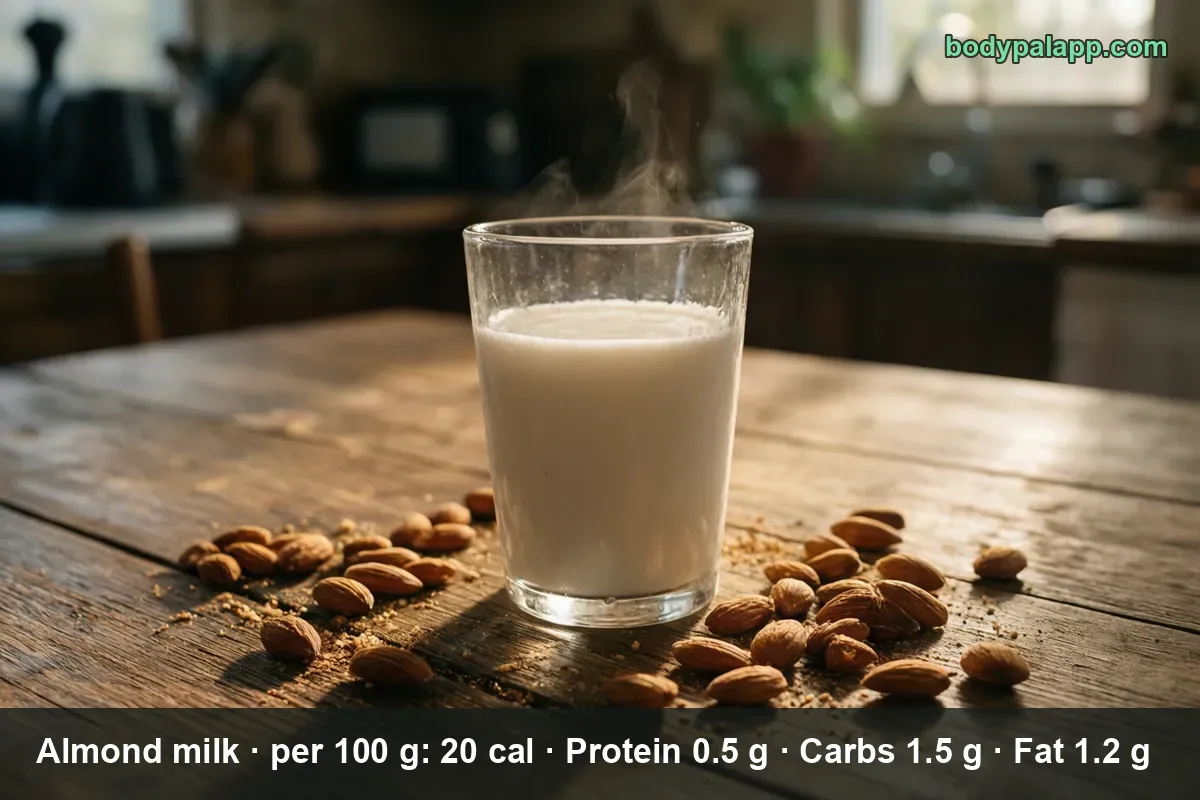
A 1-cup (244 g) pour of almond milk is 49 calories. Per 100 g it is 20 calories, which makes it the lightest of the plant milks USDA lists beside it - coconut, soy and oat all cost more per cup. What you buy matters more than what you pour: unsweetened is 37 a cup, chocolate 105.
On this page
- Almond milk quick facts
- US servings from a splash to a 16-ounce cup
- Unsweetened vs sweetened vs chocolate
- Shelf-stable vs refrigerated and almond milk yogurt
- Sodium is the row that surprises people
- How does almond milk compare?
- Most popular almond milk brands
- FAQ
Almond milk quick facts
The row on this page is FNDDS 2705410, "Almond milk, NFS" - the generic card USDA uses when a survey respondent says "almond milk" and nothing more. It sits between the sweetened and unsweetened cartons on purpose, and it comes with a 1-cup household measure, which is what most people actually pour over cereal or into coffee. If your carton says unsweetened on the front, use the lower number further down the page instead.
| Nutrient | Per 100 g | Per 1 cup (244 g) | % Daily Value |
|---|---|---|---|
| Calories | 20 | 49 | — |
| Total fat | 1.21 g | 3.0 g | 4% |
| Saturated fat | 0.1 g | 0.2 g | 1% |
| Carbohydrate | 1.53 g | 3.7 g | 1% |
| Dietary fiber | 0 g | 0 g | 0% |
| Total sugars | 1.2 g | 2.9 g | — |
| Protein | 0.54 g | 1.3 g | 3% |
| Sodium | 59 mg | 144 mg | 6% |
% Daily Value is based on a 2,000-calorie diet.
Verified nutrition data
Numbers on this page come from USDA FoodData Central, the U.S. Department of Agriculture’s food composition database, and from manufacturer labels where a branded product is named. Last verified September 2026. How we verify our data →
Two rows you would see on a carton are missing here: added sugars and trans fat. This FNDDS release does not publish either value for almond milk, so rather than guess them, they stay off the table. Cholesterol is zero, as it is in every plant milk, and a cup carries 76 mg of potassium - 2% of the Daily Value, which is not a number to plan around.
Worth knowing before the tables below: almond milk has next to no fiber in the USDA records. The almonds are pressed and strained out, and what stays in the carton is mostly water with a little fat and, depending on the brand, sugar.
US servings from a splash to a 16-ounce cup
| Serving | Weight | Calories |
|---|---|---|
| 1 fl oz, a splash in coffee | 30.5 g | 6 kcal |
| 1 oz by weight | 28 g | 6 kcal |
| 1/2 cup | 122 g | 24 kcal |
| 1 cup | 244 g | 49 kcal |
| 16 fl oz, coffee-shop cup | 488 g | 98 kcal |
| Per 100 g | 100 g | 20 kcal |
Only the 1-cup and 1 fl oz lines are USDA household measures. The half cup, the ounce by weight and the 16 fl oz cup are our own arithmetic from the USDA 100 g figure, not USDA servings.
That last line is the trap, and it has nothing to do with almonds. People check "a cup" and then drink out of a 16-ounce tumbler, which is two cups - 488 g and 98 calories. A splash in coffee is genuinely trivial at 6 calories, so the milk in your morning cup is almost never the thing to fix. A daily 16-ounce glass, on the other hand, is close to 700 calories a week.
Brand labels sit well above the generic USDA card, because most of the popular cartons are sweetened or enriched. In USDA's Branded database, a Silk almond milk lists 90 calories per 8 fl oz and a Blue Diamond one 101, while the lightest vanilla row in the same set is 29 per cup. The spread across six popular cartons runs 29 to 101 calories per label serving - which is why the front of the box beats any generic number.
Unsweetened vs sweetened vs chocolate
| Version | Per 100 g | Cup | Calories |
|---|---|---|---|
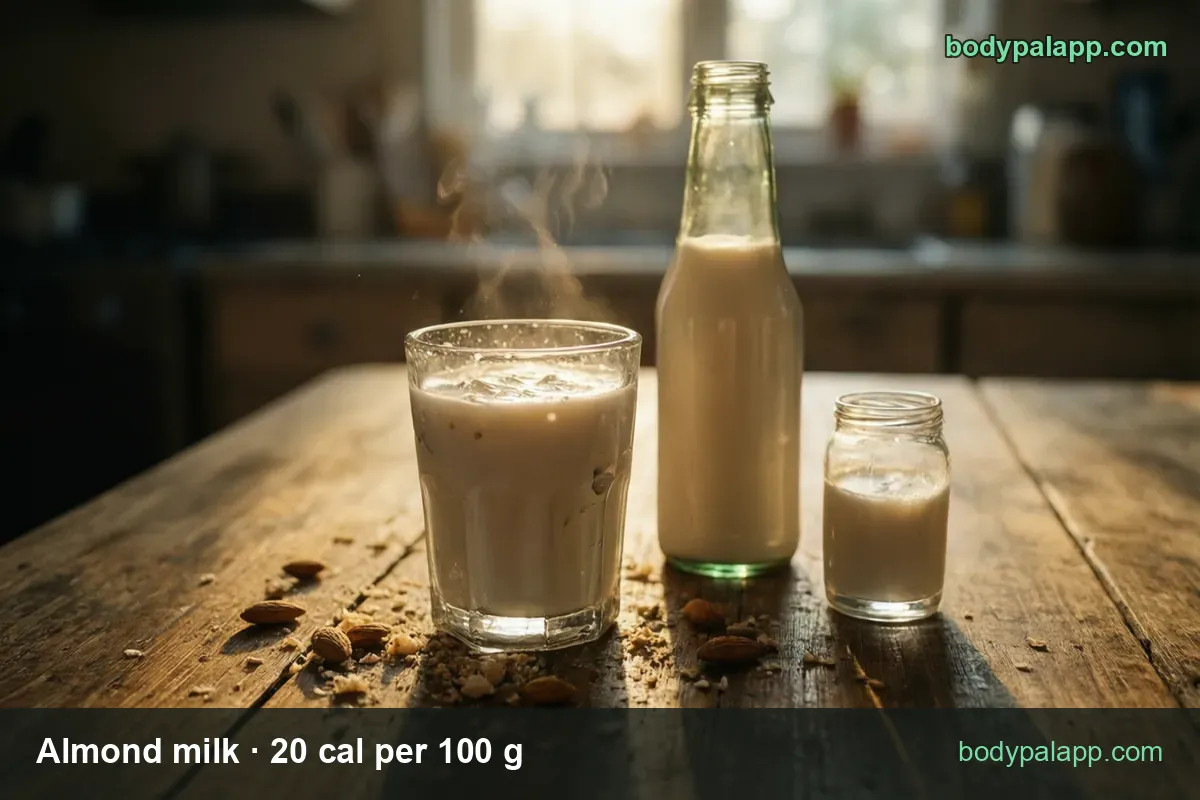
| Unsweetened | 15 kcal | 244 g | 37 kcal |
| Generic, NFS | 20 kcal | 244 g | 49 kcal |
| Sweetened | 30 kcal | 244 g | 73 kcal |
| Vanilla sweetened, ready-to-drink | 38 kcal | 240 g | 91 kcal |
| Chocolate | 43 kcal | 244 g | 105 kcal |
Sugar is the whole story. The fat barely moves across these records - 1.22 g per 100 g unsweetened against 1.18 g sweetened - while carbohydrate goes from 0.34 g to 4.31 g per 100 g. That is why the sweetened cup is nearly double the unsweetened one, 73 against 37, and why chocolate almond milk at 105 calories a cup is almost three times the unsweetened pour.
Chocolate almond milk deserves its own warning. A cup carries 18.2 g of carbohydrate, 17.0 g of it sugars. It is a lighter chocolate drink than most, but it is a sweet drink, not a milk substitute you pour freely.
Shelf-stable vs refrigerated and almond milk yogurt
| Record | Per 100 g | Typical amount | Calories |
|---|---|---|---|
| Unsweetened, shelf stable (SR Legacy) | 15 kcal | 1 cup, 240 g | 36 kcal |
| Unsweetened plain, shelf stable (Foundation) | 14.6 kcal | 1 cup, 244 g | 36 kcal |
| Unsweetened plain, refrigerated (Foundation) | 19.3 kcal | 1 cup, 244 g | 47 kcal |
| Almond milk yogurt | 128 kcal | 1 container, 5.3 oz (150 g) | 192 kcal |
Here is something no label will tell you. USDA's laboratory analyses put refrigerated unsweetened almond milk at 19.3 calories per 100 g and the shelf-stable version at 14.6 - a third more calories for two cartons wearing the same "unsweetened plain" description. The refrigerated samples were simply richer: 1.56 g of fat per 100 g against 1.22 g. Both round to a small number on a cup, 47 against 36, but if you drink two or three glasses a day it is worth knowing which aisle your carton came from. All the cup figures in this table are our own arithmetic from the USDA 100 g values.
Almond milk yogurt is a different food entirely, not a thick version of the drink. One 5.3 oz container is 192 calories - roughly four cups of the milk it is named after.
Sodium is the row that surprises people
A cup of almond milk carries 144 mg of sodium, 6% of the 2,300 mg Daily Value set by the FDA. That is about a sixteenth of a teaspoon of table salt. It sounds like nothing, and for one cup it is - but a drink with 49 calories delivering 6% of a day's sodium is an unusual ratio, and the unsweetened cartons are no lower at 60 mg per 100 g. Salt is in the recipe for flavor, not by accident.
The protein row runs the other way. A cup gives 1.3 g, 3% of the 50 g Daily Value, and unsweetened is the same. Almond milk is a beverage, not a protein source, and swapping dairy for it in a smoothie or a bowl of oatmeal quietly removes several grams of protein from the meal. Soy milk keeps them: 8.7 g on the same cup.
It matters for how the government counts it, too. MyPlate counts calcium-fortified soy beverages in the Dairy Group; other plant milks, almond included, are not counted there. If you are watching calories, almond milk is the easy win. If you are trying to replace what dairy contributed to your day, it is the one plant milk that replaces the least.
How does almond milk compare?
| Milk | Per 100 g | US serving | Calories |
|---|---|---|---|
| Almond milk | 20 kcal | 1 cup, 244 g | 49 kcal |
| Coconut milk beverage | 31 kcal | 1 cup, 244 g | 76 kcal |
| Soy milk, unsweetened | 38 kcal | 1 cup, 244 g | 93 kcal |
| Oat milk | 45 kcal | 1 cup, 244 g | 110 kcal |
Our take: for calorie counting, almond milk wins outright - it is the lightest of the four per 100 g and per cup, and swapping a daily glass of oat milk for it saves 61 calories with no effort. For anything you want to feel full on, pick soy. It costs 44 more calories a cup than almond milk and returns 8.7 g of protein against 1.3 g, which is the better trade at breakfast. Coconut milk beverage sits in the middle and earns its 76 calories with neither protein nor a calorie advantage. Our rule: almond in coffee and cereal, soy in the smoothie.
Most popular almond milk brands in the United States
Ranked by how widely each product appears among foods sold in the United States, from the BodyPal food database of over 3.3 million products. Calories are the figures printed on each Nutrition Facts label, checked against USDA FoodData Central.
| Product | Calories (per 100 g) |
|---|---|
| Silk Almond Milk | 38 cal |
| Silk Almond Milk Vanilla | 12 cal |
| Silk Almond Milk & Cashewmilk | 27 cal |
| Silk Almond Milk Protein + Fiber | 42 cal |
| Blue Diamond Almond Milk | 42 cal |
| Califia Farms Pure Almond Milk Vanilla | 21 cal |
Brand popularity: BodyPal food database. Nutrition: manufacturer labels / USDA FoodData Central.
Almond milk FAQs
How many calories are in a cup of almond milk?
49 calories for a 1-cup (244 g) pour of the generic USDA card, which averages sweetened and unsweetened cartons. Per 100 g that is 20 calories. A 16 fl oz coffee-shop size is 488 g and 98 calories, our own arithmetic from the same 100 g figure.
How many calories are in unsweetened almond milk?
37 calories a cup, from the USDA unsweetened record at 15 calories per 100 g. That is 12 fewer than the generic card, and 0.8 g of carbohydrate instead of 3.7 g. Fat barely moves: 1.22 g per 100 g against 1.21 g in the generic row.
How much protein is in almond milk?
1.3 g per cup, which is 3% of the 50 g Daily Value. Almond milk is not a protein drink: soy milk on the same 1-cup measure gives 8.7 g, nearly seven times as much. If you swap dairy for almonds in a smoothie, the protein has to come from somewhere else.
How many carbs are in almond milk?
3.7 g per cup on the generic card, with 2.9 g of that being sugars. Unsweetened is 0.8 g, sweetened 10.5 g and chocolate 18.2 g. Fiber is zero on the FNDDS almond milk records, so total and net carbohydrate are the same number here.
Does almond milk have sugar?
2.9 g of total sugars per cup on the generic card, 9.7 g on the sweetened record and none at all on the unsweetened one. USDA does not publish added sugars for these entries, so the label on your own carton is the only place to see how much of it was poured in.
Is almond milk keto friendly?
3.7 g of carbohydrate a cup, and only 0.8 g if the carton says unsweetened, so almond milk fits most low-carb patterns comfortably. Sweetened is 10.5 g a cup and chocolate 18.2 g, which is where a keto plan usually breaks. Check the front of the carton, not the aisle.
Almond milk vs oat milk - which has fewer calories?
Almond milk, by a wide margin: 49 calories a cup against 110 for oat milk, both measured at 244 g in the USDA files. Per 100 g it is 20 against 45. Oat milk carries 5.37 g of carbohydrate per 100 g to almond milk's 1.53 g, and that is most of the gap.
How much sodium is in almond milk?
144 mg per cup, 6% of the 2,300 mg Daily Value, or about a sixteenth of a teaspoon of table salt. That is more than most people expect from a 49-calorie drink, because salt is part of the recipe. Unsweetened is no lower, at 60 mg per 100 g.
Similar foods
- Skim Milk — 83 cal per cup
- Skim Milk (Nonfat Milk) — 83 cal per cup
- Kefir — 104 cal per cup
- Oat Milk — 110 cal per cup
- Egg Beater — 29 cal per 1/4 cup
- 2% Milk — 122 cal per cup
Count it without the math
Point the camera at the glass and BodyPal counts it for you, sweetened or not.


How long does it take to burn off almond milk?
A 1-cup (244 g) serving is 49 kcal. Enter your weight and the amount you ate to see how long it takes you to burn that off:
lb
| Activity | Time to burn 49 kcal |
|---|---|
| Walking, brisk | 10 min |
| Cycling, moderate | 6 min |
| Swimming, moderate | 7 min |
| Jogging | 6 min |
| Weight training, moderate | 11 min |
Times are for a 155 lb adult at a steady pace; change the weight to see yours. The amount is set to the portion in the text (244 g); change it to what you actually ate. BodyPal works this out from your steps automatically.
Want the bigger picture? Calculate your daily calorie needs — your maintenance figure, a target for losing or gaining, and the date you get there.