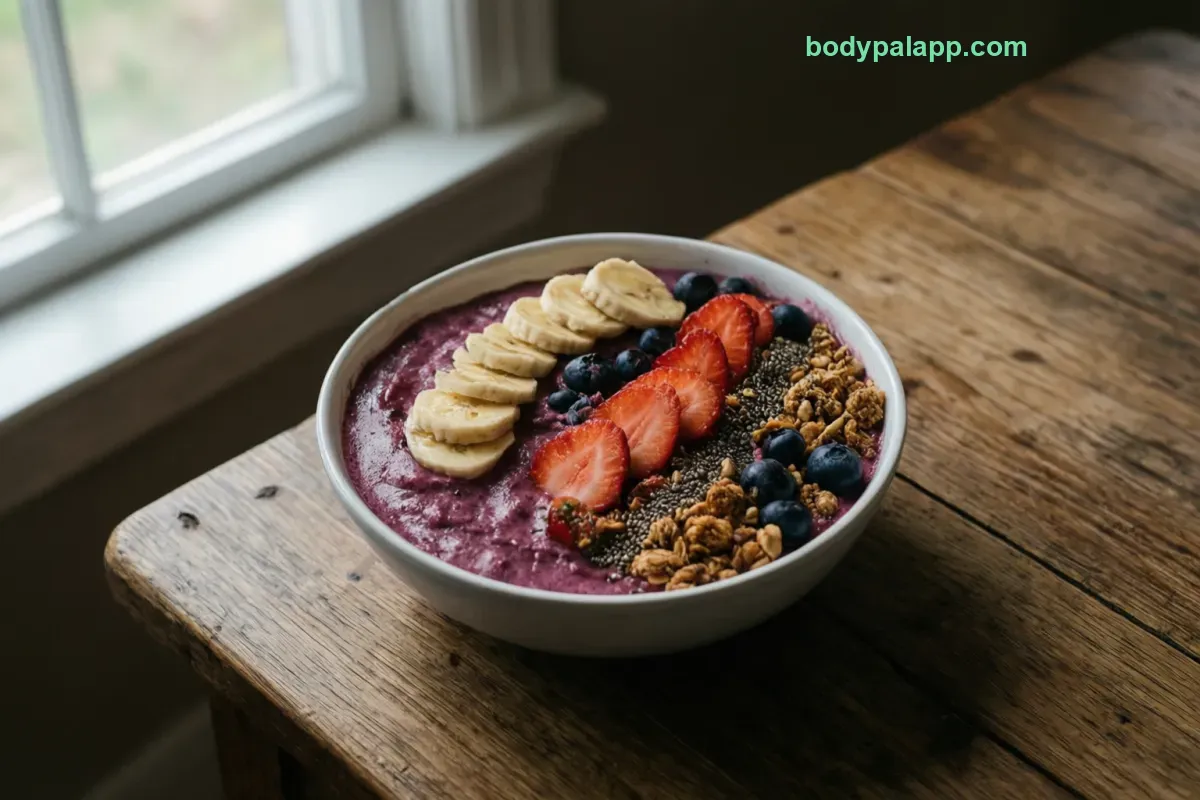
Smoothie bowl calories come to 214 for one 324 g bowl of blended fruit with no toppings, and 66 per 100 g. Carbs supply 71% of those calories and the bowl holds 28.9 g of sugar, so the size of the bowl and what you pile on top decide the total far more than the fruit base does.
214kcal
1 bowl · 324 g, blended fruit, no toppings
14%protein
7.5 gProtein
39 gCarbs
3.6 gFat
How to burn off 214 kcal
—Walking, brisk
—Jogging
—Cycling, moderate
—Swimming
Skip the math. BodyPal counts these calories from your steps and workouts automatically.
Nutrition facts
Blended fruit, no toppings · per 324 g
Calories
214 kcal
Protein
7.5 g
Carbohydrate
39 g
Fat
3.6 g
Saturated fat
1.9 g
Cholesterol
13 mg
Sodium
91 mg
Potassium
564 mg
Iron
0.6 mg
Source: USDA FoodData Central
🛡️
Verified nutrition data
Numbers on this page come from USDA FoodData Central, the U.S. Department of Agriculture’s food composition database, and from manufacturer labels where a branded product is named. Last verified September 2026. How we verify our data →
Smoothie bowl: calories, protein and sodium by serving
Percent of daily value uses the FDA reference of 2,000 kcal a day.
Serving
kcal
Protein
Carbs
Fat
Sodium
% DV kcal
1 bowl (324 g)
214
7.5 g
38.8 g
3.6 g
91 mg
11%
1 cup (216 g)
143
5 g
25.9 g
2.4 g
60 mg
7%
Light blend (324 g)
172
8.5 g
31.5 g
2 g
100 mg
9%
100 g
66
2.3 g
12 g
1.1 g
28 mg
3%
3 × 1 bowl (324 g)
642
22.6 g
272 mg
5 × 1 bowl (324 g)
1,069
37.6 g
454 mg
A cup is 143 calories, a full bowl is 214
The plain base is light by volume. One cup (216 g) comes to 143 calories, 7% of a daily value of 2000 calories, while a full 324 g bowl reaches 214, or 11%. That gap is the difference between a snack and a small breakfast, and it comes entirely from how much you pour.
Scale it up and the numbers climb in a straight line. Two bowls (648 g) land at 428 calories, three bowls (972 g) at 642, and five bowls (1,620 g) at 1,069. Nobody eats five in one sitting, but those multiples are useful if you blend a big batch for the week and want to log each serving honestly.
Remember that these figures describe blended fruit with no toppings. Granola, nut butter, coconut flakes and seeds are what turn a cafe bowl into a much heavier meal, and none of them are counted here. If you build your own, weigh the base once, note it, and add each topping as its own entry. BodyPal can also log the bowl from a photo if you would rather skip the scale.
Carbs make up 71% of every calorie
Per 100 g, a smoothie bowl carries 12 g of carbs, 2.3 g of protein and 1.1 g of fat. In calorie terms that splits into 71% carbs, 14% protein and 15% fat. This is a fruit dish first and foremost, and the macro profile says so plainly.
Across the full 324 g bowl that means 38.8 g of carbs, 7.5 g of protein and 3.6 g of fat. The fat is low, and saturated fat sits at just 0.6 g per 100 g, so the base is not where richness comes from. Any creaminess in a cafe bowl usually traces back to yogurt, nut butter or coconut, which shift the split toward fat quickly.
The upside of a carb-heavy base is that it is easy to steer. Because fat and protein start low, a single addition changes the profile noticeably. The downside is that on its own the bowl digests fast and may not hold you for long, which matters more than the calorie count if you eat it as breakfast.
Sugar is the row to watch, not sodium
Sodium is a non-issue here: 91 mg per bowl, only 4% of the 2300 mg daily value. Cholesterol is negligible at 4 mg per 100 g. The number that deserves attention is sugar, at 8.9 g per 100 g and 28.9 g in a full bowl.
That sugar comes from the blended fruit, and it arrives with only 3.6 g of fiber per bowl against a daily value of 28 g. Blending keeps the fiber in the bowl, unlike juice, but the ratio still leans heavily toward sugar. Potassium is a quiet plus at 174 mg per 100 g.
The light blend option shows how much the recipe matters. The same 324 g of a lighter mix comes to 172 calories with 24.2 g of sugar and 8.5 g of protein, versus 214 calories and 28.9 g of sugar for the standard bowl. Its fat drops to 2 g and fiber sits at 3.2 g. If you blend at home, leaning on lower-sugar fruit and a protein base moves you toward that lighter profile.
Protein is the missing piece of the bowl
A standard bowl gives you 7.5 g of protein, 15% of the 50 g daily value. That is modest for something people often eat as a whole meal. The light blend nudges it to 8.5 g, or 17%, which helps but does not change the picture much.
The simplest fix is to pair the bowl with a protein source rather than more fruit. Greek yogurt blended into the base, a scoop of protein powder, or eggs on the side all lift the protein without piling on sugar. Seeds and nuts add some protein too, though they bring fat and calories along with it, so measure them.
Think of the plain base as a 214-calorie starting point and decide what role the bowl plays in your day. As a snack, a cup at 143 calories is plenty. As breakfast, the full bowl plus a protein addition is a more balanced plate than the bowl buried under granola and honey. Either way, log the toppings separately so the total stays accurate.
How does smoothie bowl compare?
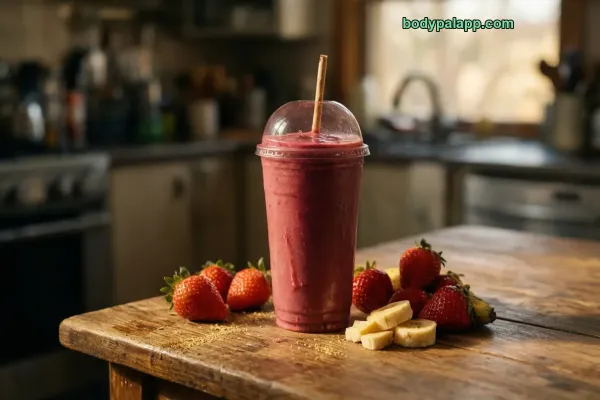
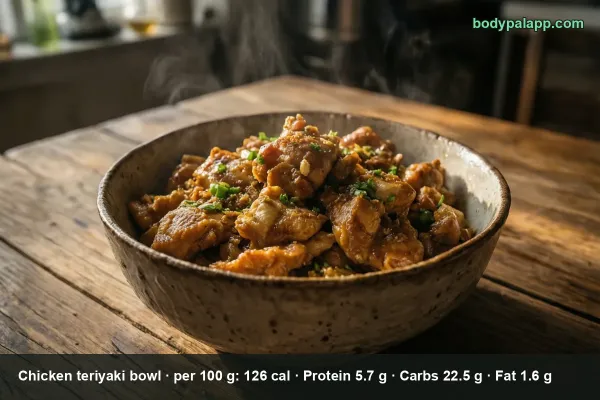
Here is how a smoothie bowl stacks up against a Smoothie King smoothie, a chicken teriyaki bowl and a ramen bowl, per 100 g and per usual serving.
Verdict: Per 100 g the smoothie bowl and a Smoothie King smoothie are almost identical at 65 for the smoothie, but a 20 oz portion runs to 369 calories, so the bowl is the lighter way to get blended fruit. For staying full pick the ramen bowl at 7.1 g protein per 100 g or the chicken teriyaki bowl at 5.7 g, and accept that both carry 333 mg of sodium per 100 g.
Most popular smoothie bowl brands in the United States
Frozen bowls and dry cups are labeled before blending or before liquid is added, so their per 100 g numbers read higher than a ready blended bowl. Source: manufacturer labels / USDA FoodData Central.
Smoothie bowl FAQs
How many calories are in a smoothie bowl?
A 324 g smoothie bowl is about 214 calories, and a smaller 216 g cup is 143. Per 100 g a blended fruit smoothie is 66 calories.
Is a smoothie bowl good for weight loss?
One 324 g bowl is 214 calories with 7.5 g protein and 38.8 g carbs, of which 28.9 g is sugar. A light blend of the same size is 172 calories.
Smoothie bowl vs Smoothie King smoothie: which is lighter?
Per 100 g they are close: 66 calories for a blended fruit smoothie bowl against 65 for a Smoothie King smoothie.
How much protein is in a smoothie bowl?
A 324 g bowl has 7.5 g protein and 3.6 g fat. Per 100 g that is 2.32 g protein and 1.1 g fat.
How many calories are in a cup of smoothie bowl?
One cup (216 g) of smoothie bowl base has 143 calories, 7% of the daily value. It also brings 5 g of protein, 25.9 g of carbs and 19.2 g of sugar before any toppings.
How much sugar is in a smoothie bowl?
A 324 g smoothie bowl contains 28.9 g of sugar, or 8.9 g per 100 g. It comes from the blended fruit, alongside 3.6 g of fiber. Toppings like honey or granola add more.
Is a light blend smoothie bowl lower in calories?
Yes. A light blend bowl of 324 g has 172 calories versus 214 for the standard bowl. It also has less sugar at 24.2 g and slightly more protein at 8.5 g.
How much sodium is in a smoothie bowl?
A full smoothie bowl has 91 mg of sodium, just 4% of the daily value. Per 100 g it is 28 mg, so sodium is rarely a concern with a plain fruit base.
How many calories are in two smoothie bowls?
Two smoothie bowls (648 g) come to 428 calories with 15 g of protein and 181 mg of sodium. That assumes plain blended fruit with no toppings added.