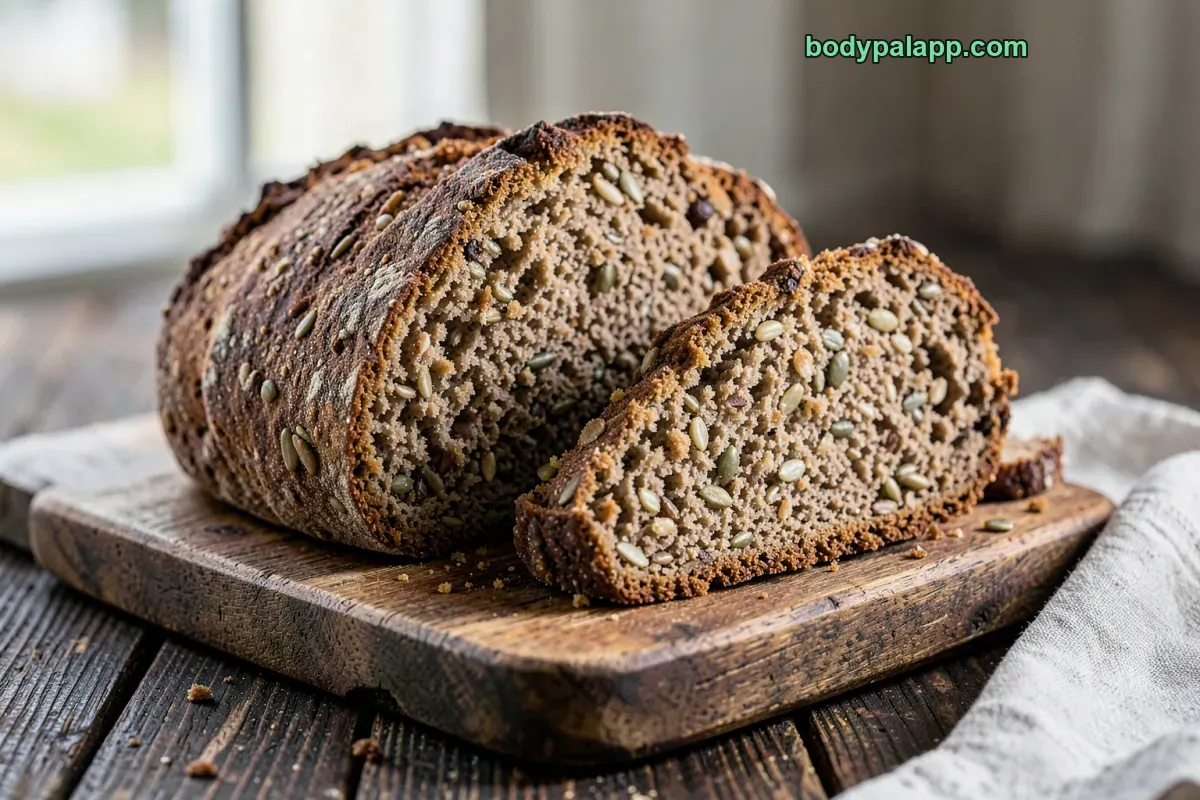
Spelt bread calories come to 90 for one 30 g slice and 300 per 100 g, based on a packaged organic loaf's label. The detail worth noticing is fat: 11.7 g per 100 g puts about a third of the calories in fat, more than toast bread or milk bread, while each slice still brings 2 g of fiber.
90kcal
1 slice · 30 g, packaged, per label
12%protein
3 gProtein
14 gCarbs
3.5 gFat
How to burn off 90 kcal
—Walking, brisk
—Jogging
—Cycling, moderate
—Swimming
Skip the math. BodyPal counts these calories from your steps and workouts automatically.
Nutrition facts
Packaged, per label · per 30 g
Calories
90 kcal
Protein
3 g
Carbohydrate
14 g
Fat
3.5 g
Saturated fat
0 g
Cholesterol
5 mg
Sodium
125 mg
Source: USDA FoodData Central
🛡️
Verified nutrition data
Numbers on this page come from USDA FoodData Central, the U.S. Department of Agriculture’s food composition database, and from manufacturer labels where a branded product is named. Last verified September 2026. How we verify our data →
Spelt bread: calories, protein and sodium by serving
Percent of daily value uses the FDA reference of 2,000 kcal a day.
Serving
kcal
Protein
Carbs
Fat
Sodium
% DV kcal
1 slice (30 g)
90
3 g
14 g
3.5 g
125 mg
5%
100 g
300
10 g
46.7 g
11.7 g
417 mg
15%
3 × 1 slice (30 g)
270
9 g
375 mg
5 × 1 slice (30 g)
450
15 g
626 mg
Two slices make a 180-calorie sandwich base
A single 30 g slice lists 90 calories, 3 g of protein and 14 g of carbs. That is 5% of a 2000-calorie daily value, small enough to treat as a side rather than a meal. Most people do not stop at one, though.
Two slices, the usual sandwich, weigh 60 g and add up to 180 calories with 6 g of protein. Three slices reach 270 calories and 375 mg of sodium. Five slices, the kind of total that builds up with toast at breakfast and a sandwich at lunch, land at 450 calories, 15 g of protein and 626 mg of sodium.
The fillings often matter more than the bread. At 90 calories a slice, butter, cheese or deli meat can easily outweigh the bread underneath. If you count calories, log the slices and the toppings separately so the total stays honest.
A third of the calories come from fat
The calorie split is 56% carbs, 32% fat and 12% protein. Carbs lead, as they do in any bread, with 46.7 g per 100 g. The fat share is what sets this loaf apart.
At 11.7 g of fat per 100 g, this spelt bread carries far more fat than toast bread at 3.9 g or milk bread at 5.7 g. That reflects this particular recipe, and spelt loaves vary by brand, so read the label of the one you buy. The label lists 0 g of saturated fat, so the fat here is not the saturated kind.
Protein is 10 g per 100 g, or 3 g per slice, which is 6% of the daily value. That is close to toast bread at 10.4 g and well ahead of soda bread at 6.5 g. Bread alone will not cover much protein, so the filling has to do that job.
Fiber works in its favor, sugar deserves a glance
Each slice gives 2 g of fiber, and 100 g gives 6.7 g. Against a 28 g daily value, that is a modest but useful contribution, and it grows with every slice you eat. It is one of the better reasons to choose a whole grain loaf like this one.
Sugar is the number to check. The label lists 10 g per 100 g, or 3 g per slice. That is not much on its own, but several slices topped with jam or honey add up quickly.
Sodium sits at 125 mg per slice, 5% of the 2300 mg daily value. Per 100 g it is 417 mg, lower than soda bread at 445 mg and toast bread at 495 mg. If you watch sodium, the cheese or cured meat on top is usually the bigger concern.
Build the plate around the slice
Because one slice brings 90 calories and only 3 g of protein, spelt bread works best as the base, not the meal. Pair it with eggs, beans, tuna or cottage cheese to lift the protein. Vegetables on top add volume for very few calories.
Brands differ more than the word spelt suggests. Rudi's Organic Spelt Bread, Dave's Killer Bread Organic Spelt Bread and Berlin Natural Bakery Sprouted Biblical Spelt Bread all sit on the shelf, and some loaves blend in other grains, as Mestemacher Organic Rye & Spelt Bread does. Check the slice weight on your package, since not every slice is 30 g.
For tracking, BodyPal can log a slice from a photo. The daily total then follows the number of slices you actually eat, which is where most of the swing comes from.
How does spelt bread compare?
Here is spelt bread next to soda bread, toast bread and milk bread, per 100 g and per usual serving.
Verdict: For the fewest calories per slice pick toast bread at 73 for a 25 g slice or spelt bread at 90 for 30 g, and be wary of soda bread's thick 74 g slice at 223. For more protein with less sodium, spelt bread is the stronger pick, with 10 g of protein and 417 mg of sodium per 100 g.
Most popular spelt bread brands in the United States
How many calories are in one slice of spelt bread?
A 30 g slice of spelt bread has 90 calories, so two slices have 180.
Is spelt bread good for weight loss?
One 30 g slice has 90 calories, 3 g of protein and 2 g of fiber. Per 100 g it has 300 calories, close to toast bread at 293.
Spelt bread vs Irish soda bread: which has fewer calories?
They are almost equal: spelt bread has 300 calories per 100 g and Irish soda bread 301.
How much protein is in spelt bread?
Spelt bread has 10 g of protein per 100 g, or 3 g per 30 g slice, along with 14 g of carbs and 3.5 g of fat.
Is spelt bread fattening?
Not on its own. One 30 g slice has 90 calories, 5% of a 2000-calorie daily value. Fat makes up 32% of its calories, more than toast bread or milk bread, so slice count and toppings decide how it fits your day.
How many calories are in 100 g of spelt bread?
There are 300 calories in 100 g of spelt bread, with 10 g of protein, 46.7 g of carbs, 11.7 g of fat and 6.7 g of fiber. Sodium comes to 417 mg.
What are the nutrition facts for one slice of spelt bread?
One 30 g slice has 90 calories, 3 g of protein, 14 g of carbs, 3.5 g of fat, 2 g of fiber, 3 g of sugars and 125 mg of sodium, based on a packaged organic loaf's label.
How many calories does Dinkelbrot have?
Dinkelbrot is German for spelt bread, and this loaf has 300 calories per 100 g and 90 per 30 g slice. Bakery recipes vary, so a denser or seeded Dinkelbrot can differ from these label values.