
How many calories are in spring mix?
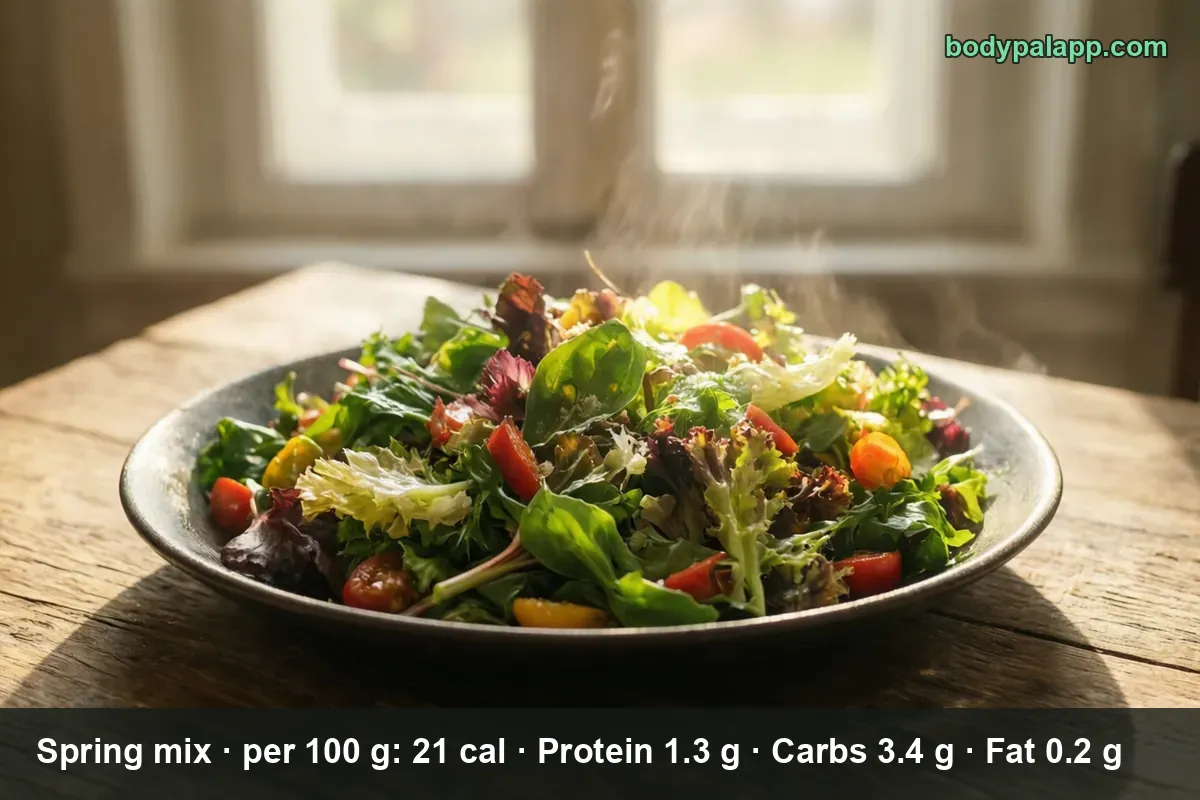
Two cups of spring mix, the amount that covers a dinner plate, is 15 calories. Per 100 g the leaves run 21 calories, the same as romaine. A whole 5-ounce clamshell, 142 g of baby greens, comes to 30. Nothing you put on top of it will be that cheap.
On this page
- Spring mix quick facts
- US servings, from one ounce to the whole bag
- Organic, 50/50 and the single leaves inside
- Potassium beats fiber on this label
- How does spring mix compare?
- Most popular spring mix brands
- FAQ
Spring mix quick facts
Spring mix has no record of its own in USDA's Foundation or legacy tables, because it is a blend rather than a single crop. The line that matches what you buy is FNDDS 2709792, "Mixed salad greens, raw" — assorted baby leaves, raw, no dressing. It is also the only entry with real household measures attached, which is what makes the cup math below possible.
The bagged brands sit right around it, between 20 and 29 calories per 100 g, so the USDA line is a fair center for the whole category rather than an outlier.
| Nutrient | Per 100 g | Per 2 cups (70 g) | % Daily Value |
|---|---|---|---|
| Calories | 21 | 15 | — |
| Total fat | 0.21 g | 0.1 g | 0% |
| Saturated fat | 0.03 g | 0.0 g | 0% |
| Carbohydrate | 3.43 g | 2.4 g | 1% |
| Dietary fiber | 1.4 g | 1.0 g | 3% |
| Total sugars | 0.97 g | 0.7 g | — |
| Protein | 1.31 g | 0.9 g | 2% |
| Sodium | 41 mg | 29 mg | 1% |
% Daily Value is based on a 2,000-calorie diet.
Verified nutrition data
Numbers on this page come from USDA FoodData Central, the U.S. Department of Agriculture’s food composition database, and from manufacturer labels where a branded product is named. Last verified September 2026. How we verify our data →
Two rows are missing on purpose. This FNDDS edition publishes no added sugars and no trans fat figure for raw greens, and raw leaves have neither anyway. Cholesterol is 0 mg, as it is for every plant food. Potassium is the interesting one: 316 mg per 100 g, which works out to 221 mg in a 2-cup plate, or 5% of the FDA Daily Value of 4,700 mg.
US servings, from one ounce to the whole bag
| Serving | Weight | Calories |
|---|---|---|
| 1 oz | 28 g | 6 kcal |
| 1 cup, loosely packed | 35 g | 7 kcal |
| 2 cups, a plated salad | 70 g | 15 kcal |
| 3 cups, the bag label serving | 105 g | 22 kcal |
| 5 oz clamshell, whole package | 142 g | 30 kcal |
| Per 100 g | 100 g | 21 kcal |
The 1-cup and 2-cup lines are USDA household measures attached to the record itself. The 1 oz, 3-cup and 5-ounce package rows are our own arithmetic from the USDA 100 g figure, not USDA servings — 105 g and 142 g scaled straight off 21 calories per 100 g.
That gap between the cup on the record and the cup on the bag is the one thing worth knowing here. USDA weighs a loose cup of mixed greens at 35 g. Most bag labels call 3 cups 85 g, which is about 28 g a cup. Fill the same bowl and you get 22 calories by USDA math and 20 by the label. Nobody needs to worry about the 2-calorie difference, but it explains why two apps can disagree about an identical salad.
Eating the entire clamshell is the more useful stunt. A 5-ounce package is 30 calories, which is less than a single tablespoon of most vinaigrettes. On this page the leaves are the cheap part and the dressing is the meal.
Organic, 50/50 and the single leaves inside
| Version | Per 100 g | Typical serving | Calories |
|---|---|---|---|
| Mixed salad greens, raw (USDA baseline) | 21 kcal | 2 cups (70 g) | 15 kcal |
| Organic spring mix, bagged | 29 kcal | 2 cups (85 g) | 25 kcal |
| 50/50 spinach and spring mix | 29 kcal | 2 cups (85 g) | 25 kcal |
| Arugula alone | 25 kcal | 2 cups (70 g) | 18 kcal |
| Radicchio alone | 23 kcal | 2 cups (70 g) | 16 kcal |
| Mixed greens salad with vegetables, no dressing | 24 kcal | 2 cups (70 g) | 17 kcal |
Organic changes nothing about the plant and everything about the label serving. The organic bagged records come in at 29 calories per 100 g and count 2 cups as 85 g rather than 70 g, which is why the serving reads 25 instead of 15. That is a packaging decision, not a nutritional one.
The 50/50 blend, half baby spinach and half spring mix, lands on the identical 29 calories per 100 g. Spinach is not the heavy ingredient people assume it is.
Pulling the mix apart is more revealing. Arugula, the peppery leaf, is the highest of the single leaves at 25 calories per 100 g, and it carries 2.58 g of protein against 1.31 g for the mix. Radicchio, the bitter red leaf, sits at 23. Once tomatoes and carrots are tossed in and it becomes an assembled undressed salad, the number is 24 per 100 g, or 17 for a 2-cup bowl. Every road leads back to roughly the same place.
Store brands behave the same way. Dole, Signature Farms and Taylor Farms all publish 24 calories per 100 g with an 85 g serving, giving 20 calories per bowl, while one bagged label counts 2.5 cups as only 50 g and prints 10. Read the gram weight, not the cup count.
Potassium beats fiber on this label
Salad greens get sold as fiber. The numbers do not really support it. A 2-cup plate delivers 1.0 g of fiber, which is 3% of the 28 g Daily Value — you would need about one and a half 5-ounce clamshells to reach 10% of a day's fiber. If fiber is the goal, beans and whole grains do in one spoonful what a salad bowl does in ten.
Potassium is the row that actually earns its place. The same 70 g carries 221 mg, 5% of the Daily Value, and it arrives for 15 calories. Per calorie, that is one of the densest potassium deliveries in the vegetable aisle. Sodium is a non-issue at 29 mg, about 1% of the 2,300 mg limit, which is roughly one-eightieth of a teaspoon of table salt.
The Dietary Guidelines and MyPlate both count 2 cups of raw leafy greens as one cup-equivalent of vegetables, and most adults are told to aim for 2 to 3 cups of vegetables a day. So a single plate of spring mix covers about a third to a half of that target for 15 calories. That is the honest case for it: volume and produce credit, not fiber.
How does spring mix compare?
| Green | Per 100 g | US serving | Calories |
|---|---|---|---|
| Spring mix | 21 kcal | 2 cups, 70 g | 15 kcal |
| Romaine lettuce | 21 kcal | 2 cups, 70 g | 15 kcal |
| Arugula | 25 kcal | 2 cups, 70 g | 18 kcal |
| Undressed salad with tomatoes and carrots | 24 kcal | 2 cups, 70 g | 17 kcal |
Our take: on calories these four are the same food. Spring mix and romaine are identical at 21 per 100 g, and the widest gap in the table is 3 calories a bowl — smaller than the error in eyeballing how much you poured. Protein is the only real separator, and arugula wins it at 2.58 g per 100 g against 1.31 g for the mix and 0.98 g for romaine. Choose spring mix when you want a bowl that tastes like something without a dressing carrying the flavor; choose romaine when you want crunch that holds up under a heavy dressing. Plain Boston lettuce is technically the lightest of the family at 18 calories per 100 g, and nobody has ever lost weight because of it.
Most popular spring mix brands in the United States
Ranked by how widely each product appears among foods sold in the United States, from the BodyPal food database of over 3.3 million products. Calories are the figures printed on each Nutrition Facts label, checked against USDA FoodData Central.
| Product | Calories (per 100 g) |
|---|---|
| Earthbound Farm Organic Spring Mix | 29 cal |
| Earthbound Farm Organic 50/50 Spinach + Spring Mix | 29 cal |
| Attitude Fraiche Spring Mix | 20 cal |
| Dole Spring Mix | 24 cal |
| Signature Farms Spring Mix | 24 cal |
| Taylor Farms Baby Spring Mix | 24 cal |
Brand popularity: BodyPal food database. Nutrition: manufacturer labels / USDA FoodData Central.
Spring mix FAQs
How many calories are in spring mix?
21 calories per 100 g, which makes a 2-cup plated serving of 70 g worth 15 calories. The USDA record is "Mixed salad greens, raw," measured with no dressing. Bagged supermarket versions range from 20 to 29 calories per 100 g, so the spread across brands is tiny.
How many calories in 2 cups of spring mix?
15 calories. USDA weighs 2 loosely packed cups of mixed salad greens at 70 g, and at 21 calories per 100 g that comes to 15. Bag labels often count a cup as lighter, around 28 g, so the same bowl can be printed as 20 calories on the package.
How many calories in a whole bag of spring mix?
About 30 calories for a 5-ounce clamshell, which is 142 g. That figure is our own arithmetic from the USDA 100 g value rather than a USDA serving. Eating the entire package costs you less than one tablespoon of vinaigrette, so the topping is what actually decides the total.
Is spring mix healthier than romaine?
They are identical on calories: both are 21 per 100 g and 15 for a 2-cup serving. Spring mix carries more protein, 1.31 g per 100 g against 0.98 g for romaine, and more variety of leaf. Romaine holds its crunch better under dressing. Neither choice moves a daily total.
How much protein is in spring mix?
1.31 g per 100 g, so a 2-cup serving gives 0.9 g, about 2% of the 50 g Daily Value. Arugula on its own is the strongest leaf in the blend at 2.58 g per 100 g. Salad greens are not a protein source; the chicken or beans you add are.
How much fiber is in spring mix?
1.4 g per 100 g, which is 1.0 g in a 2-cup plate, or 3% of the 28 g Daily Value. Even a whole 5-ounce bag lands near 2 g. Greens add bulk and water to a meal, but beans, oats and whole grains do the real fiber work.
How much potassium is in spring mix?
316 mg per 100 g, so a 2-cup serving delivers 221 mg, about 5% of the 4,700 mg Daily Value. That is the best row on this label: more percentage points than the fiber, the protein or the carbohydrate, and it costs only 15 calories to collect.
Is spring mix good for weight loss?
At 15 calories for 2 cups it is about as cheap as food gets, and 2 cups of raw greens counts as one cup-equivalent of vegetables toward the Dietary Guidelines target. The catch is what goes on top: a typical dressing pour runs several times the calories of the entire bag.
Similar foods
- Popsicle — 40 cal per single stick
- Waffle cone — 556 cal per Waffle cone with 2 scoops
- Nachos — 663 cal per order
- Cannoli — 227 cal per cannoli
- Fries — 452 cal per medium fast food order
- Onion Rings — 282 cal for 8 rings
Count it without the math
Point the camera at the bowl and BodyPal counts the greens and everything you piled on them.


One food is easy to picture; a whole day is harder. See how many calories you need a day and what a deficit actually looks like.