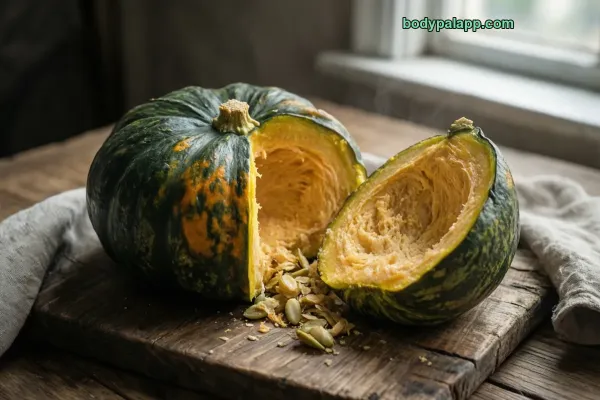
Spaghetti squash calories come to 42 for 1 cup (155 g) cooked and 27 per 100 g. Carbs supply 84% of those calories, yet a cup holds only 10 g of them. The real story is volume: you can pile a plate high before the total moves much, and the sauce usually decides the final count.
42kcal
1 cup · 155 g, cooked, unsalted
9%protein
1 gProtein
10 gCarbs
0.4 gFat
How to burn off 42 kcal
—Walking, brisk
—Jogging
—Cycling, moderate
—Swimming
Skip the math. BodyPal counts these calories from your steps and workouts automatically.
Nutrition facts
Cooked, unsalted · per 155 g
Calories
42 kcal
Protein
1 g
Carbohydrate
10 g
Fat
0.4 g
Saturated fat
0.1 g
Cholesterol
0 mg
Sodium
28 mg
Potassium
181 mg
Iron
0.5 mg
Source: USDA FoodData Central
🛡️
Verified nutrition data
Numbers on this page come from USDA FoodData Central, the U.S. Department of Agriculture’s food composition database, and from manufacturer labels where a branded product is named. Last verified September 2026. How we verify our data →
Spaghetti squash: calories, protein and sodium by serving
Percent of daily value uses the FDA reference of 2,000 kcal a day.
Serving
kcal
Protein
Carbs
Fat
Sodium
% DV kcal
1 cup (155 g)
42
1 g
10 g
0.4 g
28 mg
2%
Raw cubes (101 g)
31
0.6 g
7 g
0.6 g
17 mg
2%
100 g
27
0.7 g
6.5 g
0.3 g
18 mg
1%
3 × 1 cup (155 g)
126
3.1 g
84 mg
5 × 1 cup (155 g)
209
5.1 g
140 mg
A cup is 42 calories, and three cups is still 126
The standard measure is 1 cup of cooked strands, which weighs 155 g and carries 42 calories. That is 2% of a 2000-calorie daily value. Few foods let you fill a bowl this full for so little, which is exactly why people reach for it as a noodle stand-in.
Portions scale cleanly because the squash is mostly water with a little carbohydrate. Two cups (310 g) come to 84 calories with 2 g of protein. Three cups (465 g) reach 126 calories. Even 5 cups, a full 775 g of squash, total only 209 calories and 140 mg of sodium. A generous dinner portion and a modest one differ by a few dozen calories, not hundreds.
Raw squash reads a little differently, so log the form you actually weigh. A 101 g portion of raw cubes lists 31 calories, 7 g of carbs and 0.6 g of fat. The 27 per 100 g figure applies to squash that is cooked, drained and unsalted. If you weigh strands after roasting, use the cooked numbers; if you weigh the raw flesh before cooking, use the raw row.
Carbs are 84% of the calories, but there are few of them
Per 100 g, cooked spaghetti squash has 6.5 g of carbs, 0.7 g of protein and 0.3 g of fat. By calories, carbs account for 84%, protein 9% and fat 8%. Those shares sound carb-heavy until you look at the grams behind them.
One cup delivers 10 g of carbs, a small slice of a 275 g daily value. Of those, 2.2 g are fiber and 3.9 g are sugars, all from the squash itself since this row is for squash cooked without additions. Per 100 g that works out to 1.4 g of fiber and 2.5 g of sugars. If you track net carbs or sugar, the cup is easy to fit in.
Protein is the weak spot. At 1 g per cup, or 2% of the daily value, the squash will not anchor a meal on its own. Fat is close to nothing at 0.4 g per cup, with 0.1 g of saturated fat per 100 g. That means whatever you add, from oil to cheese to meat sauce, will usually outweigh the squash on calories.
Sodium stays low until you season it
Unsalted spaghetti squash has 18 mg of sodium per 100 g and 28 mg per cup. That is 1% of the 2300 mg daily value. Cholesterol is 0. On its own, this is one of the quietest rows on any nutrition label.
The catch is that almost nobody eats it plain. Salt in the cooking water, a jarred marinara, grated hard cheese or a salty pesto can each add far more sodium than the squash carries. If you watch sodium, season at the table where you can see how much goes on, and check the label of any sauce you pour over it.
Potassium is the mineral the squash does contribute, at 117 mg per 100 g. Against a 4700 mg daily value it is a modest amount, not a headline. Treat spaghetti squash as a low-calorie base rather than a mineral source, and let the rest of the plate do the heavier nutritional lifting.
Add protein and a measured sauce to make it a meal
Because a cup brings 42 calories and just 1 g of protein, spaghetti squash works best as the base layer. Top it with a protein such as chicken, turkey meatballs, shrimp, beans or eggs, and the bowl starts to hold you over. A side of greens or roasted vegetables adds bulk without changing the picture much.
Sauce is where the calories hide. A spoonful of olive oil or a handful of cheese can match or beat the squash itself, so measure toppings the first few times you make it. Tomato-based sauces tend to stay lighter than cream or butter sauces, though jarred versions vary, so read the label.
Ready-made options like Green Giant Spaghetti Squash Veggie Spirals or whole squash from Wegmans or L&M Family Farms make prep faster; check each package for its own values. If you log meals, record the squash and the toppings as separate items so you can see which one moves the total. BodyPal can also log the dish from a photo.
How does spaghetti squash compare?
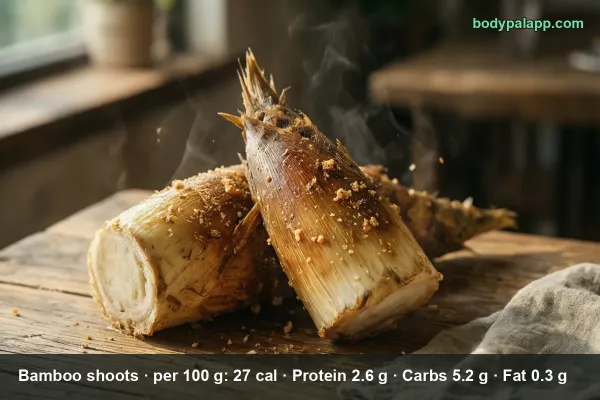
Here is how cooked spaghetti squash stacks up against acorn squash, pumpkin and bamboo shoot, per 100 g and per usual serving.
Verdict: For the fewest calories per 100 g pick pumpkin at 20, but as a noodle swap spaghetti squash wins on volume at 42 per cup versus 115 for a cup of acorn squash, which runs 2.1 times as dense. If you want a bit more protein for the same 27 calories per 100 g, bamboo shoot gives 2.6 g against 0.7 g.
Most popular spaghetti squash brands in the United States
3L&M Family Farms Spaghetti Squash1 cup · 155 g27 kcal
Fresh and frozen packs are labeled per raw or uncooked weight, so they read 29 calories per 100 g against 27 for the cooked squash above. Source: manufacturer labels / USDA FoodData Central.
Spaghetti squash FAQs
How many calories are in a cup of spaghetti squash?
One cup of cooked spaghetti squash (155 g) is 42 calories, which works out to 27 calories per 100 g.
Is spaghetti squash good for weight loss?
A cup is 42 calories with 10.0 g carbs and 2.2 g fiber, so even a two-cup plate stays at 84 calories.
Spaghetti squash vs bamboo shoots: which has fewer calories?
They are the same at 27 calories per 100 g. A 155 g cup of cooked spaghetti squash is 42 calories.
How many carbs are in spaghetti squash?
A cup of cooked spaghetti squash has 10.0 g carbs, including 3.9 g sugars and 2.2 g fiber. Per 100 g that is 6.5 g carbs.
How many calories are in 100 g of spaghetti squash?
Cooked, unsalted spaghetti squash has 27 calories per 100 g. The same weight brings 6.5 g of carbs, 0.7 g of protein and 0.3 g of fat, so almost all of its energy comes from carbohydrate.
What counts as a serving of spaghetti squash?
A typical serving is 1 cup of cooked strands, which weighs 155 g and has 42 calories. That cup holds 10 g of carbs, 2.2 g of fiber and 1 g of protein.
What are the nutrition facts for spaghetti squash per 100 g?
Per 100 g cooked, spaghetti squash has 27 calories, 6.5 g of carbs, 1.4 g of fiber, 2.5 g of sugars, 0.7 g of protein, 0.3 g of fat and 0 mg of cholesterol.
What is the nutritional value of spaghetti squash beyond calories?
Per 100 g it has 117 mg of potassium and just 18 mg of sodium when cooked without salt. A cup carries 28 mg of sodium, only 1% of the daily value.
How many calories are in raw spaghetti squash?
A 101 g portion of raw spaghetti squash cubes has 31 calories, with 7 g of carbs, 0.6 g of protein and 1.5 g of fiber. Use the cooked figures if you weigh the squash after cooking.