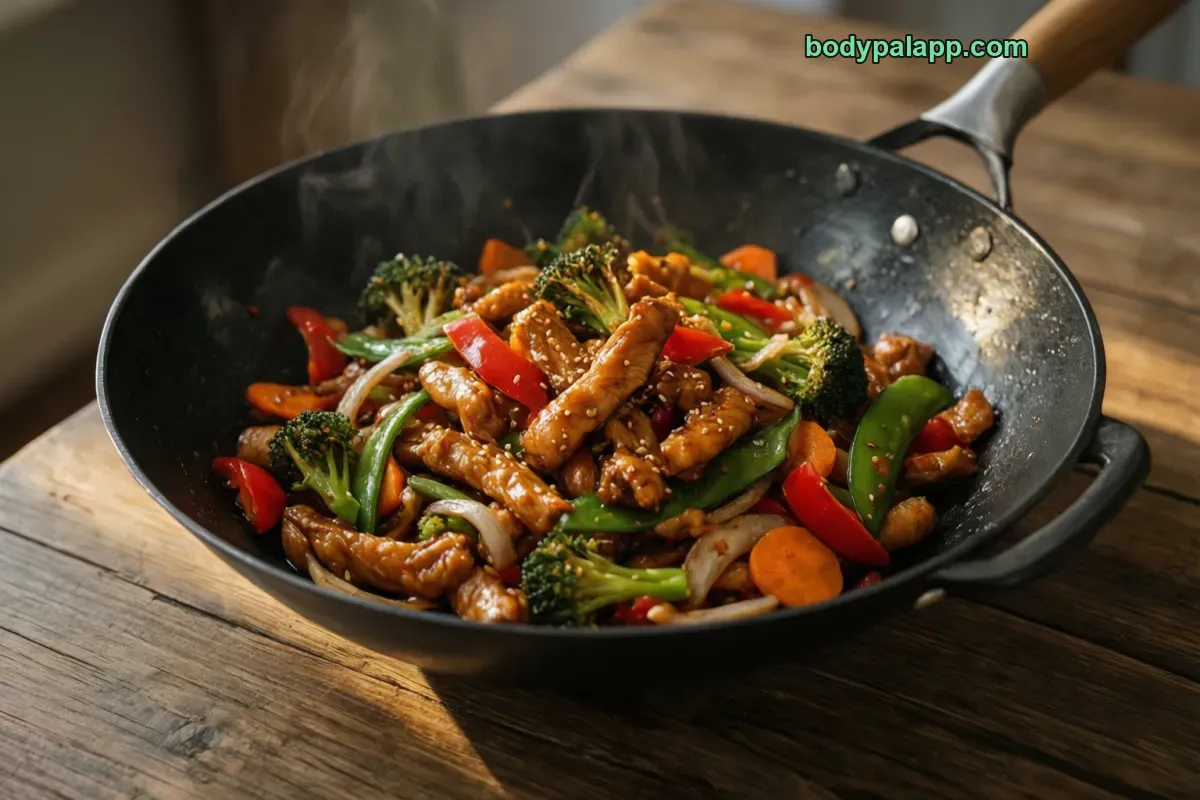
Stir fry calories come to 94 for a 1 cup (132 g) serving of vegetables cooked with fat added, or 71 per 100 g. The number to notice is the oil: the same cup made with no added fat lands at 64, so the pan decides roughly a third of the total.
94kcal
1 cup · 132 g, cooked, fat added
11%protein
2.7 gProtein
13 gCarbs
3.7 gFat
How to burn off 94 kcal
—Walking, brisk
—Jogging
—Cycling, moderate
—Swimming
Skip the math. BodyPal counts these calories from your steps and workouts automatically.
Nutrition facts
Cooked, fat added · per 132 g
Calories
94 kcal
Protein
2.7 g
Carbohydrate
12.7 g
Fat
3.7 g
Saturated fat
0.9 g
Cholesterol
3 mg
Sodium
193 mg
Potassium
322 mg
Iron
1.3 mg
Source: USDA FoodData Central
🛡️
Verified nutrition data
Numbers on this page come from USDA FoodData Central, the U.S. Department of Agriculture’s food composition database, and from manufacturer labels where a branded product is named. Last verified September 2026. How we verify our data →
Stir fry: calories, protein and sodium by serving
Percent of daily value uses the FDA reference of 2,000 kcal a day.
Serving
kcal
Protein
Carbs
Fat
Sodium
% DV kcal
1 cup (132 g)
94
2.7 g
12.7 g
3.7 g
193 mg
5%
No added fat (127 g)
64
2.6 g
12.6 g
0.4 g
179 mg
3%
3 oz portion (85 g)
60
1.7 g
8.2 g
2.4 g
124 mg
3%
100 g
71
2 g
9.7 g
2.8 g
146 mg
4%
3 × 1 cup (132 g)
281
8 g
578 mg
5 × 1 cup (132 g)
469
13.3 g
964 mg
One cup is 94 calories, but plates are rarely one cup
The USDA reference serving is 1 cup (132 g) of cooked stir fry vegetables, worth 94 calories, 2.7 g protein and 12.7 g carbs. That covers about 5% of the daily calorie value. A smaller 3 oz portion (85 g) drops to 60 calories, a sensible size when the vegetables sit beside rice or a main dish.
Stir fry rarely stays at one cup, though. A plate scooped straight from the wok often holds two or three. Two cups bring 187 calories, three cups 281, and a generous five-cup helping reaches 469. That spread is why eyeballing the portion matters more here than memorizing the per-cup number.
Protein does not keep pace as the plate grows. Five cups still carry only 13.3 g, so a vegetable stir fry needs chicken, tofu, shrimp or egg in the pan to work as a full meal. Those additions are not part of these numbers. Log them as separate items so the total stays honest.
Fat supplies over a third of the calories
Carbs make up 53% of the calories in cooked stir fry vegetables, fat 35% and protein just 11%. Per 100 g that works out to 9.7 g carbs, 2.8 g fat and 2 g protein. The fat line looks small in grams. It is dense in calories, so it punches well above its weight.
Put the two USDA rows side by side. A cup cooked with fat added has 3.7 g fat, while the no-added-fat version (127 g) has 0.4 g. Protein (2.7 vs 2.6 g), carbs (12.7 vs 12.6 g) and fiber (3.7 g in both) barely move. Nearly the whole gap between 94 and 64 calories is the oil.
That makes the oil bottle the real dial on this dish. If you are counting, measure the oil instead of pouring by feel, or use the no-added-fat row as your baseline and log the oil on its own. The vegetables themselves are the cheap part of the total.
Sodium stays modest until the plate gets big
A cup of stir fry vegetables has 193 mg sodium, 8% of the daily value based on 2300 mg. Per 100 g it is 146 mg. On a single serving that is unremarkable, and the no-added-fat cup sits close behind at 179 mg.
Scale the plate and the picture shifts. Two cups carry 385 mg, three cups 578 mg and five cups 964 mg. These figures describe the vegetables as USDA lists them. Any sauce you pour into the wok is not in this row, so if you watch sodium, count the sauce as its own entry and taste before adding more.
The rows worth a second look are the good ones. Each cup brings 3.7 g fiber, the same number as its fat grams, along with 4.7 g sugars. Saturated fat stays low at 0.7 g per 100 g, cholesterol is 2 mg, and potassium reaches 244 mg per 100 g.
Treat stir fry as the base, not the whole meal
Cooked vegetables with a little oil give you volume, 3.7 g fiber per cup and only about 5% of daily calories. What they lack is protein, at 11% of the calories and roughly 2.7 g a cup. Pairing the pan with a protein source closes that gap without much fuss.
Rice and noodles are the other lever. They usually sit under the vegetables and can easily outweigh them on the plate, so portion the starch on purpose and let the vegetables fill the rest. If you start from a bagged mix such as Key Food Stir Fry Vegetables, check its label, and remember that the oil and sauce you add are extra.
Logging a mixed plate by hand is fiddly, because every component varies from night to night. BodyPal can log a stir fry from a photo, and you can then adjust the cups, oil and protein to match what you actually cooked.
How does stir fry compare?
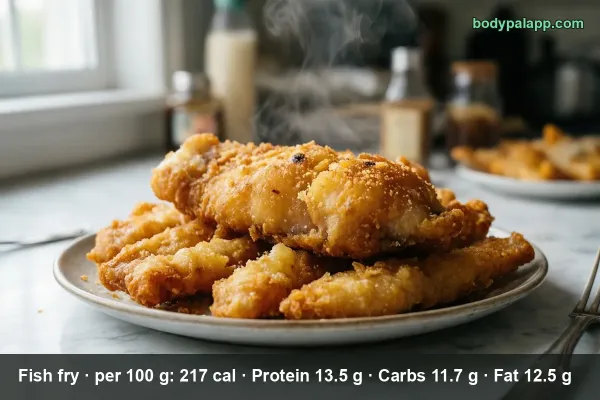
Here is how stir fry stacks up against fish fry and two fast-food fries, per 100 g and per usual serving.
Verdict: For weight loss, stir fry wins clearly at 71 calories per 100 g, against 217 for fish fry, 301 for Wendy's medium fry and 323 for McDonald's small fry. Fish fry is the pick if you want protein, with 13.5 g per 100 g, but it costs about 3.1 times the calories.
Most popular stir fry brands in the United States
Ranked by popularity in the BodyPal database
# Productkcal / 100 g
1Key Food Stir Fry Vegetables0.75 cup · 85 g35 kcal
This is a raw frozen vegetable mix sold to make stir fry, not yet cooked with oil, so it reads lower than the cooked-with-fat number above. Source: manufacturer labels / USDA FoodData Central.
Stir fry FAQs
How many calories are in a stir fry?
A 1 cup (132 g) serving of stir fry vegetables cooked with oil is about 94 calories. Made without added fat, the same cup is about 64 calories.
Is stir fry good for weight loss?
Stir fry vegetables are 71 calories per 100 g cooked with oil, or 50 calories per 100 g with no added fat, with 2.8 g of fiber per 100 g.
Stir fry vs fish fry: which has fewer calories?
Stir fry vegetables are 71 calories per 100 g cooked with oil, far below fish fry at 217 calories per 100 g.
How much fiber is in stir fry vegetables?
A 132 g cup has about 3.7 g of fiber and 2.7 g of protein, from 2.8 g fiber and 2.0 g protein per 100 g.
How many calories are in 1 cup of stir fry vegetables?
One cup (132 g) of stir fry vegetables cooked with fat added has 94 calories. Made with no added fat, a cup (127 g) comes to 64. Either way the cup carries 3.7 g fiber.
What are the nutrition facts for stir fry?
Per 100 g, stir fry vegetables cooked with fat added have 71 calories, 2 g protein, 9.7 g carbs, 2.8 g fat, 2.8 g fiber, 3.5 g sugars and 146 mg sodium. Carbs supply 53% of the calories.
How many calories are in homemade stir fry?
A homemade vegetable stir fry cooked in oil lands near 94 calories per cup, or 71 per 100 g, before any meat, tofu, rice or sauce. Cooked with no added fat, the cup drops to 64.
How many calories do stir fried vegetables have without oil?
Stir fried vegetables with no added fat have 64 calories in a 127 g serving, with just 0.4 g fat. The version cooked with fat added has 94 calories per cup, so the oil accounts for most of the difference.
How many calories are in a big plate of vegetable stir fry?
Two cups of vegetable stir fry have 187 calories and three cups have 281. A large five-cup plate reaches 469 calories with 964 mg sodium, before any protein, rice or sauce is added.