
How many calories are in a Thomas' English muffin?
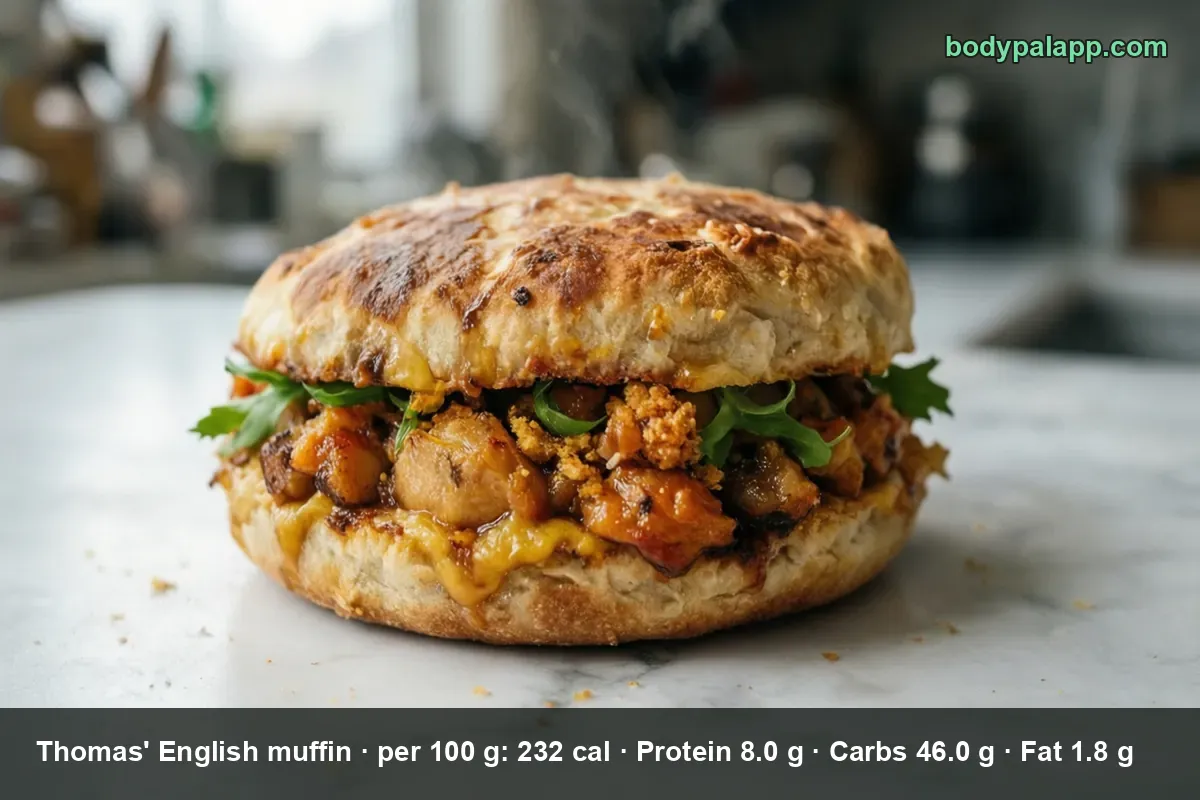
One Thomas' English muffin weighs 57 g and carries 132 calories. Per 100 g it runs 232 calories, but the number that matters here is the piece: the muffin arrives pre-portioned, so you never have to guess where a slice ends. Split it and each half is 66 calories, fillings not counted.
On this page
- Thomas English muffin quick facts
- US servings from half a muffin to two
- Every Thomas variety by the muffin
- Sodium is the row to watch
- How does an English muffin compare
- Most popular thomas' english muffins brands
- FAQ
Thomas English muffin quick facts
USDA's laboratory data set carries one record for the brand itself: SR Legacy 167515, "George Weston Bakeries, Thomas English Muffins". Its serving is 57 g, which is one whole muffin, top and bottom together. That is the food a person actually holds, so it is the number this page leads with.
The record lands at 232 calories per 100 g. The package label for Thomas' Original says 130 calories per 57 g muffin, which works out to 228 per 100 g. The two-calorie-per-muffin gap is a rounding artifact, not a disagreement: labels round to the nearest 10 calories, laboratory records do not. Either way you are logging roughly 130.
| Nutrient | Per 100 g | Per 1 muffin (57 g) | % Daily Value |
|---|---|---|---|
| Calories | 232 | 132 | — |
| Total fat | 1.8 g | 1.0 g | 1% |
| Saturated fat | 0.31 g | 0.2 g | 1% |
| Carbohydrate | 46 g | 26.2 g | 10% |
| Protein | 8 g | 4.6 g | 9% |
| Sodium | 345 mg | 197 mg | 9% |
% Daily Value is based on a 2,000-calorie diet.
Verified nutrition data
Numbers on this page come from USDA FoodData Central, the U.S. Department of Agriculture’s food composition database, and from manufacturer labels where a branded product is named. Last verified September 2026. How we verify our data →
Five rows you would expect on a label are missing here, and they are missing on purpose. USDA does not publish dietary fiber, total sugars, added sugars, cholesterol or potassium for this record, so rather than borrow those figures from a different food we leave them out. If your tracker demands a fiber value, take it from the package in front of you, because it varies by variety far more than the calories do.
What is left tells a clean story. An English muffin is nearly fat-free bread: 1.0 g of total fat and 0.2 g of saturated fat per muffin, both 1% of the Daily Value. Almost all of the 132 calories come from the 26.2 g of carbohydrate. Butter, cream cheese or a fried egg will outweigh the muffin itself within a single tablespoon or two.
US servings from half a muffin to two
| Serving | Weight | Calories |
|---|---|---|
| Half a muffin, one toasted side | 28.5 g | 66 kcal |
| 1 oz | 28 g | 66 kcal |
| One whole muffin, USDA serving | 57 g | 132 kcal |
| Two muffins | 114 g | 264 kcal |
| Per 100 g | 100 g | 232 kcal |
Only the 57 g row is a USDA household measure. The half, the ounce and the two-muffin row are our own arithmetic scaled from the USDA 100 g figure, not USDA servings. They are easy to trust, though, because a muffin splits along a fork line into two near-identical halves rather than into arbitrary slices.
The half-muffin row is the one people get wrong. An open-faced breakfast, one half with peanut butter or an egg, starts at 66 calories of bread, not 132. On the other side, anyone eating two muffins with coffee has already spent 264 calories before a single topping, which is more than most people budget for breakfast bread. One ounce and one half land on the same 66 because 28 g and 28.5 g are, for logging purposes, the same piece of bread.
Every Thomas variety by the muffin
| Variety | Per 100 g | Muffin | Calories |
|---|---|---|---|
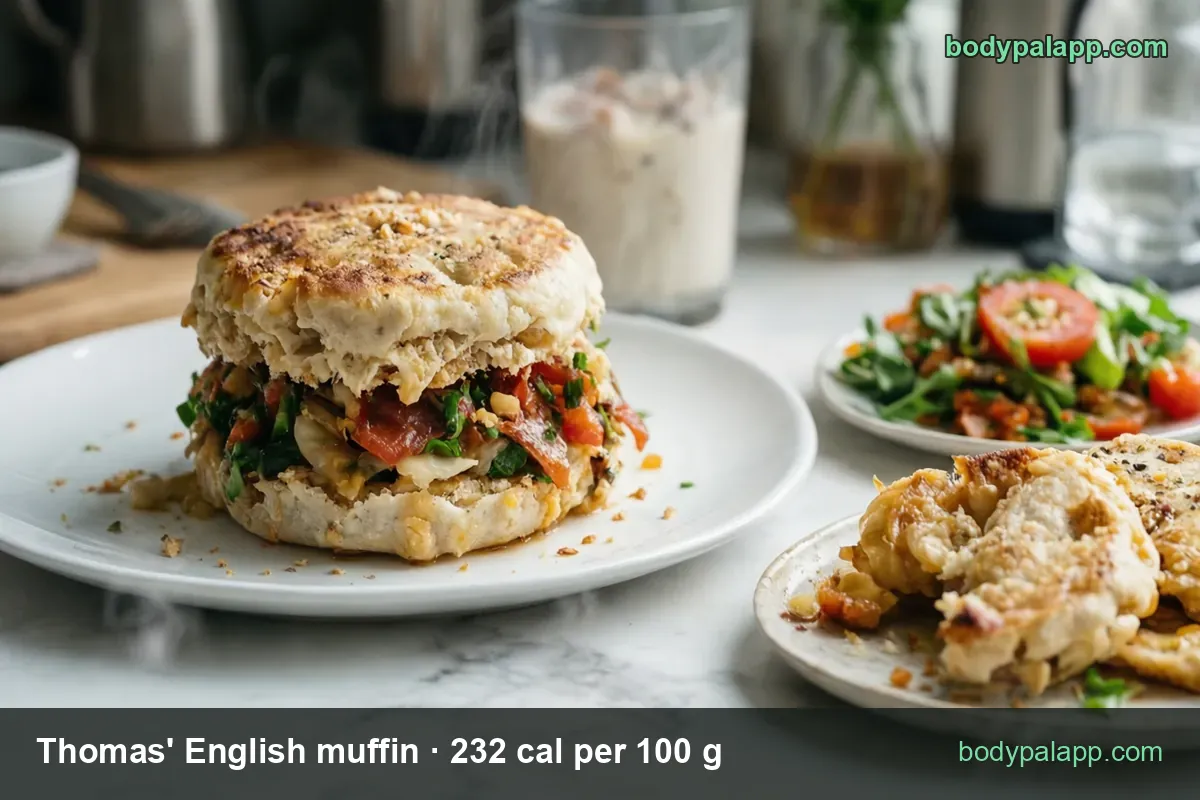
| Original | 228 kcal | 1 muffin, 57 g | 130 kcal |
| Honey Wheat | 228 kcal | 1 muffin, 57 g | 130 kcal |
| Light Multi-Grain | 175 kcal | 1 muffin, 57 g | 100 kcal |
| Sourdough | 246 kcal | 1 muffin, 57 g | 140 kcal |
| Cinnamon Raisin | 246 kcal | 1 muffin, 61 g | 150 kcal |
| Blueberry | 262 kcal | 1 muffin, 61 g | 160 kcal |
Light Multi-Grain is the only variety under 200 calories per 100 g, at 175, and the only one that comes in at a round 100 per muffin. That is 30 calories below Original at the identical 57 g. The muffin is not smaller; the recipe is lighter. Over a five-morning work week the swap is 150 calories, which is roughly one extra muffin's worth of nothing.
The pair worth studying is Sourdough and Cinnamon Raisin. Both sit at 246 calories per 100 g, yet one is 140 per muffin and the other 150. Nothing changed in the recipe density; the raisin muffin is simply baked at 61 g instead of 57 g. Blueberry is on the same 61 g piece and the densest recipe of the six at 262, which is how it reaches 160 per muffin, 60 more than Light Multi-Grain.
Original and Honey Wheat are interchangeable at 228 and 130. If you like the taste of the wheat version, there is no calorie cost to switching. Also worth knowing before you log: Original also ships in a larger 61 g format sold at 150 calories, so check the muffin count and net weight on the bag rather than assuming every Thomas' muffin is 57 g.
Sodium is the row to watch
Fat is 1% of the Daily Value, saturated fat 1%. Sodium is 197 mg, or 9% DV, on a food most people think of as plain bread. Two muffins put you at 394 mg, 17% of the day, and that is before cheese, ham, butter or a slice of bacon, each of which can add more sodium than the bread underneath it. The FDA sets the Daily Value at 2,300 mg and explains the label math on its Daily Value page.
For context, 197 mg is about a twelfth of a teaspoon of table salt. That is not alarming on its own. It becomes worth noticing when the muffin is a daily habit and the fillings are cured meat and processed cheese, because the bread is quietly carrying a tenth of the day before the sandwich starts.
Protein is the other row people misjudge. At 4.6 g per muffin, 9% DV, an English muffin contributes real protein for a bread, but it is not a protein food. MyPlate counts a whole muffin as two ounce-equivalents of grains, a third to a quarter of the daily grain target for most adults. If you want the breakfast to hold, the egg or the yogurt does that work, not the muffin.
One practical note about logging rather than about the lab: the easiest mistake to make with an English muffin is entering a whole muffin when only a half was eaten. That single mistake doubles the bread line of your morning.
How does an English muffin compare
| Bread | Per 100 g | US serving | Calories |
|---|---|---|---|
| Thomas' English muffin | 232 kcal | one muffin, 57 g | 132 kcal |
| English muffin, plain, enriched | 235 kcal | 1 oz, 28 g | 67 kcal |
| Muffins, English, mixed-grain | 235 kcal | 1 oz, 28 g | 67 kcal |
| Bread, oat bran | 236 kcal | 1 oz, 28 g | 67 kcal |
Our take: by weight these four breads are effectively the same food, spread across 4 calories per 100 g, and no shopping decision should be made on that spread. The branded Thomas' row is the lightest of the four at 232, but only just. What separates them is protein, where oat bran bread leads at 10.4 g per 100 g against 8 g for the muffin, and the mixed-grain muffin sits between at 9.1 g. So: if you are counting calories, pick the bread you like and control the piece size, because the piece is doing all the work. If you want the breakfast to carry you to lunch, the oat bran or mixed-grain option earns its place, and the sandwich fillings matter more than any of it.
Most popular thomas' english muffins brands in the United States
Ranked by how widely each product appears among foods sold in the United States, from the BodyPal food database of over 3.3 million products. Calories are the figures printed on each Nutrition Facts label, checked against USDA FoodData Central.
| Product | Calories (per 100 g) |
|---|---|
| Thomas' Cinnamon Raisin English Muffins | 246 cal |
| Thomas' Light Multi-Grain English Muffins | 175 cal |
| Thomas' Original English Muffins | 228 cal |
| Thomas' Sourdough English Muffins | 246 cal |
| Thomas' Blueberry English Muffins | 262 cal |
| Thomas' Honey Wheat English Muffins | 228 cal |
Brand popularity: BodyPal food database. Nutrition: manufacturer labels / USDA FoodData Central.
Thomas English muffin FAQs
How many calories are in a Thomas' English muffin?
132 calories for one whole 57 g muffin, both halves together, at 232 calories per 100 g. The package label rounds this to 130. Almost all of it is carbohydrate, 26.2 g, with only 1.0 g of fat in the whole muffin.
How many calories in half an English muffin?
66 calories for one half, 28.5 g, which is our own arithmetic scaled from the USDA 100 g figure rather than a USDA serving. An open-faced breakfast on one toasted half therefore starts at 66 calories of bread, and whatever you spread on top is usually the bigger number.
Are Thomas' Light Multi-Grain English muffins really 100 calories?
Yes, 100 calories per 57 g muffin, from 175 calories per 100 g. It is the only variety under 200 per 100 g. The muffin is the same size as the Original, which is 130, so the 30-calorie saving comes from the recipe rather than a smaller piece.
How many calories in a Thomas' cinnamon raisin English muffin?
150 calories per muffin, because that variety is baked at 61 g instead of 57 g, at 246 calories per 100 g. Sourdough shares the identical 246 density but is a 57 g muffin, so it comes in at 140. The extra 10 calories are extra dough, not extra raisins.
How much sodium is in an English muffin?
197 mg in one 57 g muffin, which is 9% of the 2,300 mg Daily Value, or about a twelfth of a teaspoon of table salt. Two muffins reach 394 mg, 17% of the day, before any cheese or cured meat goes between them.
How much protein is in an English muffin?
4.6 g per 57 g muffin, 9% of the Daily Value, from 8 g per 100 g. That is respectable for a bread but not enough to make breakfast filling on its own. The mixed-grain style is slightly higher at 9.1 g per 100 g, and oat bran bread higher still at 10.4 g.
Does toasting an English muffin change the calories?
No, 132 calories before toasting and 132 after. Toasting drives off water, so a toasted muffin weighs slightly less while carrying the same energy, which nudges the calories per gram up without changing what you ate. Log the muffin, not the toasted weight, and skip the recalculation.
Is an English muffin healthier than toast?
By weight they are near-identical: 232 calories per 100 g for the muffin against 236 for oat bran bread. The muffin's advantage is portion control, since 57 g is fixed, while bread slices vary. The bread's advantage is protein, 10.4 g per 100 g against 8 g.
Similar foods
- Pillsbury Buttermilk Biscuits, Baked — 151 cal per biscuit
- Apple Pie — 296 cal per slice (1/8 of 9" pie)
- English Muffin — 129 cal per muffin
- Chicken Salad Croissant — 443 cal per croissant sandwich
- Corn Tortilla — 105 cal for 2 tortillas
- 6 Inch Corn Tortilla — 52 cal per tortilla
Count it without the math
Point the camera at the plate and BodyPal counts the muffin and everything you put between the halves.


How long does it take to burn off 132 kcal of Thomas' English muffin?
One muffin (57 g) is 132 kcal. Enter your weight and the amount you ate to see how long it takes you to burn that off:
lb
| Activity | Time to burn 132 kcal |
|---|---|
| Walking, brisk | 26 min |
| Cycling, moderate | 16 min |
| Swimming, moderate | 19 min |
| Jogging | 16 min |
| Weight training, moderate | 29 min |
Times are for a 155 lb adult at a steady pace; change the weight to see yours. The amount is set to the portion in the text (57 g); change it to what you actually ate. BodyPal works this out from your steps automatically.
One food is easy to picture; a whole day is harder. See how many calories you need a day and what a deficit actually looks like.