
How many calories are in a chicken salad croissant?
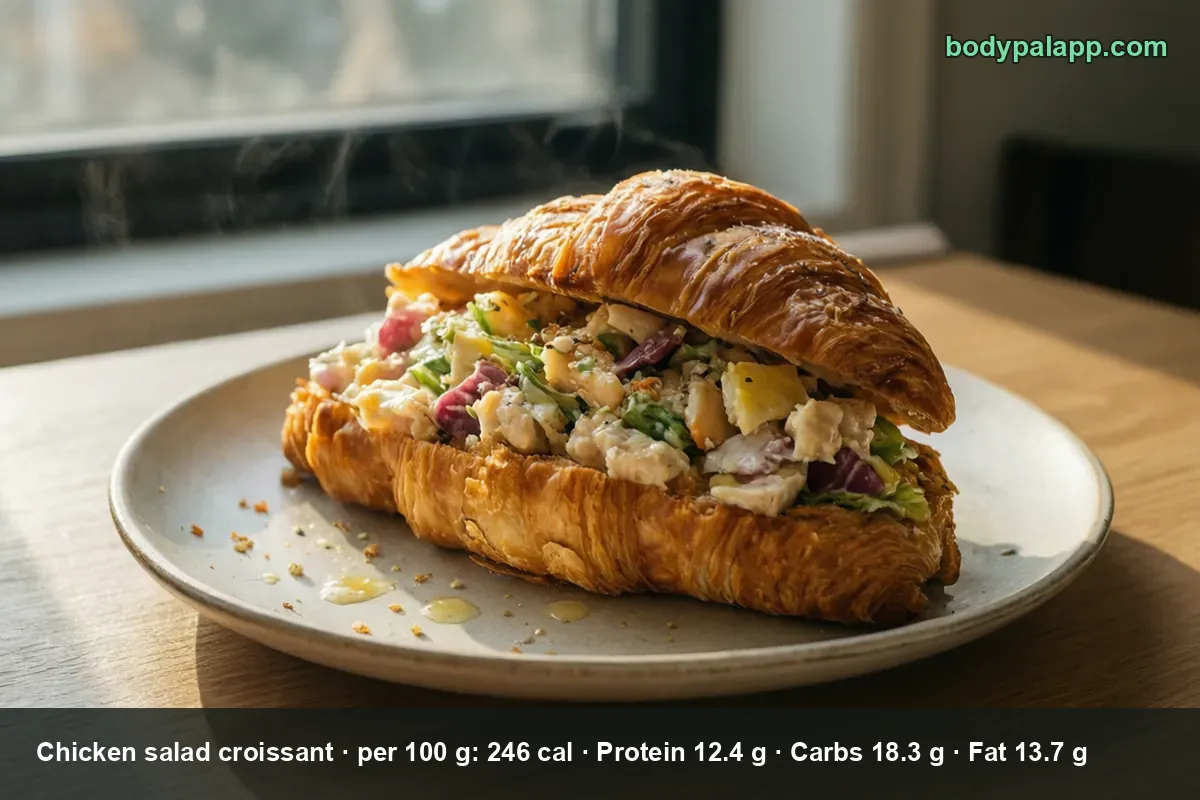
A deli-style chicken salad croissant weighs about 180 g and carries 443 calories. Per 100 g the assembled sandwich runs 246 calories, which is lighter than the bare pastry holding it, because creamy chicken salad is mostly water and protein. Fat lands at 24.7 g and sodium at 851 mg.
On this page
- Chicken salad croissant quick facts
- Serving sizes, from one ounce to a large deli pack
- Wheat bread, wraps and the bare croissant
- Sodium outruns the fat on this label
- How does a chicken salad croissant compare?
- Most popular chicken salad croissant brands
- FAQ
Chicken salad croissant quick facts
USDA has no composed record called "chicken salad on croissant." The closest complete entry is FNDDS 2706990, "Chicken salad sandwich on white" — the same mayo-bound chicken filling, the same sandwich build, a soft white-flour carrier. It is the row used here, and it lines up well with what is printed on refrigerated deli packs: fifteen US chicken salad croissant labels mostly sit between 212 and 247 calories per 100 g, with the USDA figure of 246 near the top of that band and a few richer store versions running to 313.
The buttery pastry does push fat higher than plain white bread would, so treat the fat and saturated fat rows below as a floor rather than a ceiling if your croissant is a big flaky bakery one.
| Nutrient | Per 100 g | Per 1 sandwich (180 g) | % Daily Value |
|---|---|---|---|
| Calories | 246 | 443 | 22% |
| Total fat | 13.7 g | 24.7 g | 32% |
| Saturated fat | 2.43 g | 4.4 g | 22% |
| Carbohydrate | 18.32 g | 33.0 g | 12% |
| Dietary fiber | 1 g | 1.8 g | 6% |
| Total sugars | 3.18 g | 5.7 g | — |
| Protein | 12.42 g | 22.4 g | 45% |
| Sodium | 473 mg | 851 mg | 37% |
% Daily Value is based on a 2,000-calorie diet.
Verified nutrition data
Numbers on this page come from USDA FoodData Central, the U.S. Department of Agriculture’s food composition database, and from manufacturer labels where a branded product is named. Last verified September 2026. How we verify our data →
Two rows you would see on a store label are missing here: added sugars and trans fat. FNDDS does not measure either for this record, so rather than guess, they stay off the table. Cholesterol and potassium are measured — 79 mg cholesterol per sandwich (26% DV) and 319 mg potassium (7% DV), the potassium coming mostly from the chicken.
Serving sizes, from one ounce to a large deli pack
| Serving | Weight | Calories |
|---|---|---|
| 1 oz | 28.35 g | 70 kcal |
| Half a croissant, slider size | 90 g | 221 kcal |
| One regular sandwich | 180 g | 443 kcal |
| One large deli sandwich | 270 g | 664 kcal |
| Per 100 g | 100 g | 246 kcal |
The 90 g, 180 g and 270 g weights are USDA household measures for this record, so the miniature, regular and large lines are the ones to trust when you are logging. The 1 oz row is our own arithmetic from the USDA 100 g figure, not a USDA serving — it exists because people weigh food in ounces, not because anyone eats an ounce of sandwich.
That ounce is also where the counting goes wrong. Seventy calories reads harmless, and then the refrigerated case hands you a pack weighing 163 to 221 g. Store labels for those run from 411 to 600 calories, six to nine times the ounce number. Weigh the whole thing once and you never have to think about it again.
Wheat bread, wraps and the bare croissant
| Version | Per 100 g | Typical portion | Calories |
|---|---|---|---|
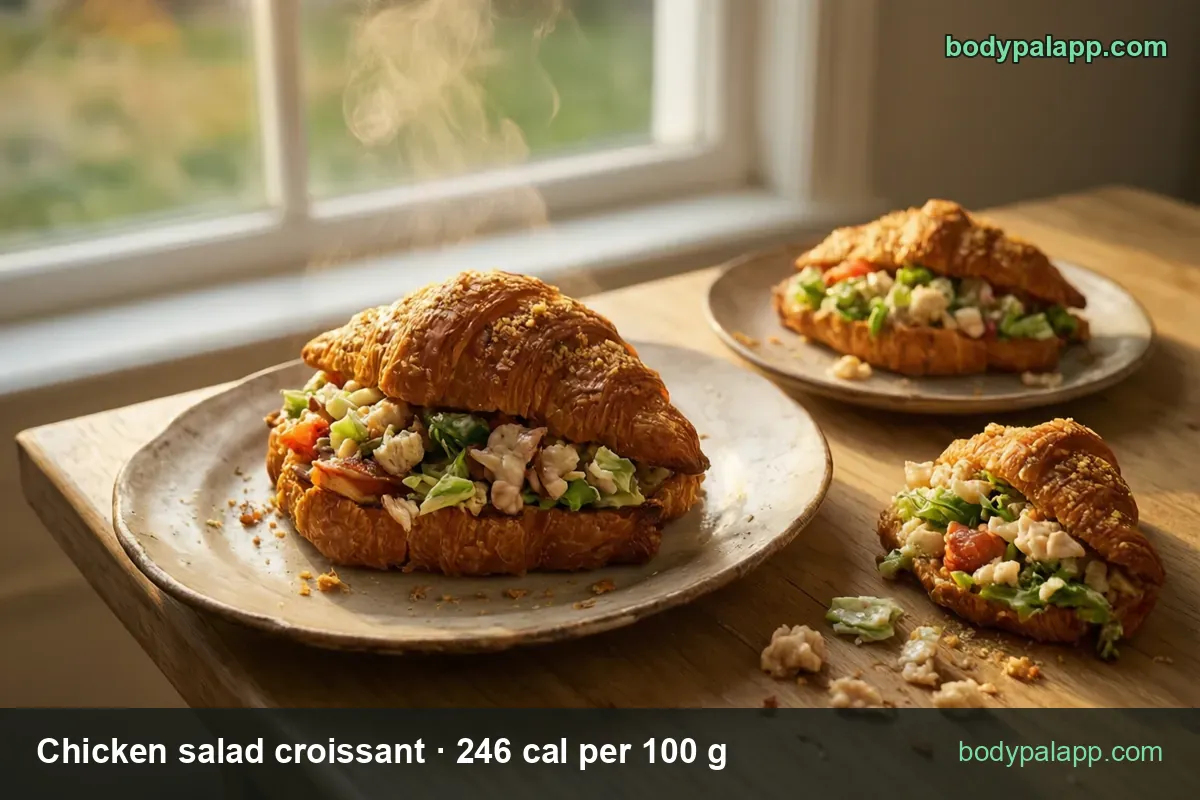
| Chicken salad croissant (main row) | 246 kcal | 1 regular sandwich, 180 g | 443 kcal |
| Mini chicken salad croissant | 246 kcal | 1 slider, 90 g | 221 kcal |
| Chicken salad on wheat bread | 245 kcal | 1 regular sandwich, 180 g | 441 kcal |
| Chicken salad wrap | 269 kcal | 100 g | 269 kcal |
| Plain butter croissant, no filling | 406 kcal | 1 medium croissant, 57 g | 231 kcal |
| Cheese croissant, no filling | 414 kcal | 1 croissant, 57 g | 236 kcal |
Swapping the croissant for wheat bread saves two calories. That is the whole story: 441 against 443, close enough to be noise. What it does change is fiber, since the wheat record carries 2.1 g per 100 g against 1 g for the white version — about 3.8 g in a 180 g sandwich by our own arithmetic from the USDA 100 g figure, against 1.8 g. If you are chasing the 28 g fiber Daily Value, the bread is worth switching. If you are chasing calories, it is not.
The wrap is the quiet upgrade in the wrong direction. At 269 calories per 100 g it tops both sandwiches, and its sodium is 603 mg per 100 g against 473 mg — the tortilla is denser and saltier than it looks.
Then there is the pastry on its own. A plain butter croissant is 406 calories per 100 g, and a cheese croissant 414, both far above the 246 of the finished sandwich. Nothing was subtracted; wet, protein-heavy chicken salad simply dilutes the pastry. A medium 57 g croissant is 231 calories before anything goes inside it, which is more than half of the 443 total.
Grocery brands cluster tight around the USDA number. Taylor Farms lists 236 calories per 100 g and Grab & Go 243, both inside a few percent of 246, while Market District runs 300 and Hannaford 313 — richer dressing, more of it, or a bigger croissant relative to the filling. Those two are the ones worth reading the panel on.
Sodium outruns the fat on this label
Look at the Daily Value column again. Sodium is 37%, higher than total fat at 32% and much higher than saturated fat at 22%. For a sandwich that people log as a fat problem, salt is the bigger number — 851 mg in one, roughly a third of a teaspoon of table salt, against the 2,300 mg limit the FDA uses for the Nutrition Facts label. Add a bag of chips and a soda and lunch alone is close to half the day. If you are watching sodium, the plain croissant sandwich beats the wrap on this row, and half a sandwich with a side salad beats both.
The number worth keeping is protein: 22.4 g per sandwich, 45% of the Daily Value, from a single item. That is the chicken doing the work, and it is why this sandwich holds better than a pastry of the same calories. MyPlate counts poultry in the protein foods group, and 22 g in one hand-held lunch is a solid share of it.
How does a chicken salad croissant compare?
| Sandwich or pastry | Per 100 g | US serving | Calories |
|---|---|---|---|
| Chicken salad croissant | 246 kcal | 1 sandwich, 180 g | 443 kcal |
| Chicken salad on wheat bread | 245 kcal | 1 sandwich, 180 g | 441 kcal |
| Plain butter croissant | 406 kcal | 1 medium, 57 g | 231 kcal |
| Cheese croissant | 414 kcal | 1 croissant, 57 g | 236 kcal |
Our take: for weight loss, order the half — 221 calories with 11.2 g of protein by our own arithmetic from the 180 g figure, and you are eating a real lunch instead of a snack. For staying full through an afternoon, the full 180 g sandwich earns its 443, because 22.4 g of protein does something a 231-calorie plain croissant never will. The two croissant rows in this table look cheap only because a bare pastry weighs 57 g; per gram they are the densest things on the page. The bread choice, white or wheat, is not where the calories are.
Most popular chicken salad croissant brands in the United States
Ranked by how widely each product appears among foods sold in the United States, from the BodyPal food database of over 3.3 million products. Calories are the figures printed on each Nutrition Facts label, checked against USDA FoodData Central.
| Product | Calories (per 100 g) |
|---|---|
| Taylor Farms Chicken Salad Croissant | 236 cal |
| Taylor Farms Chicken Salad Croissant 187 g | 235 cal |
| Grab & Go Chicken Salad Croissant | 243 cal |
| Get Fresh Foods Chicken Salad Croissant | 244 cal |
| Market District Chicken Salad Croissant | 300 cal |
| Hannaford Chicken Salad Croissant | 313 cal |
Brand popularity: BodyPal food database. Nutrition: manufacturer labels / USDA FoodData Central.
Chicken salad croissant FAQs
How many calories are in a chicken salad croissant?
443 calories in a regular 180 g sandwich, based on the USDA chicken salad sandwich record at 246 calories per 100 g. A large 270 g deli version is 664. Grocery packs weighing 163 to 221 g list 411 to 600 calories, so the weight on the label decides more than the recipe does.
How many calories in half a chicken salad croissant?
221 calories for a 90 g half, which USDA also lists as the miniature or slider size. That half still carries 11.2 g of protein and about 426 mg of sodium by our own arithmetic from the full sandwich. It is the easiest single cut on this page: same lunch, half the number.
How much protein is in a chicken salad croissant?
22.4 g of protein in a 180 g sandwich, or 45% of the Daily Value, from 12.42 g per 100 g. That is the strongest row on the label and the reason this sandwich holds better than a pastry of the same calories. Half a croissant still gives you 11.2 g.
How many carbs are in a chicken salad croissant?
33.0 g of carbohydrate in a 180 g sandwich, 12% of the Daily Value, of which 5.7 g is total sugars and 1.8 g fiber. Almost all of it is the pastry itself; the chicken salad contributes very little. A 90 g half comes to about 16.5 g of carbohydrate.
How much sodium is in a chicken salad croissant?
851 mg of sodium in one 180 g sandwich, 37% of the 2,300 mg Daily Value, or roughly a third of a teaspoon of table salt. That is a higher percentage than total fat at 32%. The wrap version is saltier still at 603 mg per 100 g against 473 mg here.
Does the croissant or the chicken salad add more calories?
The croissant: bare butter pastry runs 406 calories per 100 g against 246 for the finished sandwich, and a 57 g medium croissant is 231 calories on its own — more than half the 443 total before any filling goes in. The chicken salad actually lowers the calories per gram.
How many calories in a deli chicken salad croissant from the grocery store?
Between 411 and 600 calories per pack across six US refrigerated labels. Taylor Farms lists 411 for a 174 g sandwich, Grab & Go 510 for 210 g, and Market District 600 for 200 g. Per 100 g they range from 235 to 313, so check the pack weight before the calorie line.
Is a chicken salad croissant healthy?
It delivers 22.4 g of protein, 45% of the Daily Value, alongside 851 mg of sodium and 24.7 g of fat. If you are watching sodium, that 37% from one item is the row to weigh. Paired with fruit or a salad rather than chips, it works as a 443-calorie lunch.
Similar foods
- Eggo Frozen Toaster Waffles — 117 cal per waffle
- Pumpkin Pie — 374 cal per regular slice
- Wheat Bagel — 263 cal per regular bagel
- Wheat Bread — 91 cal per medium slice
- Apple Pie — 296 cal per slice (1/8 of 9" pie)
- Pillsbury Buttermilk Biscuits, Baked — 151 cal per biscuit
Count it without the math
Point the camera at the plate and BodyPal counts the croissant and the filling together.


How long does it take to burn off 443 kcal of chicken salad croissant?
One sandwich (180 g) is 443 kcal. Enter your weight and the amount you ate to see how long it takes you to burn that off:
lb
| Activity | Time to burn 443 kcal |
|---|---|
| Walking, brisk | 1 hr 29 min |
| Cycling, moderate | 55 min |
| Swimming, moderate | 1 hr 3 min |
| Jogging | 52 min |
| Weight training, moderate | 1 hr 38 min |
Times are for a 155 lb adult at a steady pace; change the weight to see yours. The amount is set to the portion in the text (180 g); change it to what you actually ate. BodyPal works this out from your steps automatically.
One food is easy to picture; a whole day is harder. See how many calories you need a day and what a deficit actually looks like.