
How many calories are in a slice of pumpkin pie?
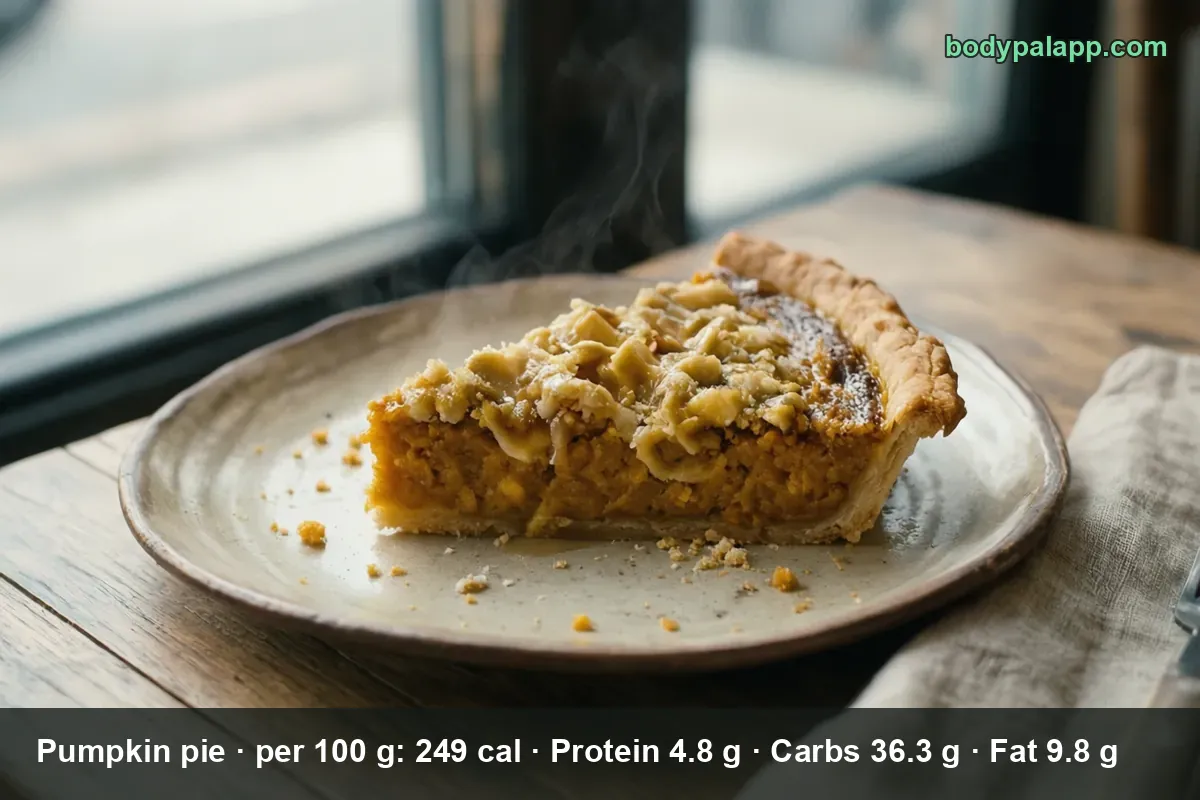
One regular slice of pumpkin pie weighs 150 g and carries 374 calories, from a base of 249 calories per 100 g. A mini slice of 75 g is 187 calories; a generous 250 g wedge is 623. The size of the cut moves the number more than the recipe does.
On this page
- Pumpkin pie quick facts
- US servings, from one ounce to a whole pie
- Store-bought, homemade and canned filling
- Saturated fat and cholesterol, not just sugar
- How does pumpkin pie compare?
- Most popular pumpkin pie brands
- Pumpkin pie FAQs
Pumpkin pie quick facts
The number most people want is for the pie as it lands on the plate, crust included. That is the generic USDA survey record FNDDS 2708011, "Pie, pumpkin", which covers a homemade Thanksgiving pie and a supermarket one alike, and is the only pumpkin pie entry that carries a full set of sugars, fiber and cholesterol along with household slice sizes of 75 g, 150 g and 250 g.
The two older SR Legacy records — commercially prepared and prepared from recipe — are real pies too, and they get their own section below. They are not averaged into the figures here; a bakery pie and a from-scratch pie differ by preparation, not by source.
| Nutrient | Per 100 g | Per 1 regular slice (150 g) | % Daily Value |
|---|---|---|---|
| Calories | 249 | 374 | — |
| Total fat | 9.78 g | 14.7 g | 19% |
| Saturated fat | 4.11 g | 6.2 g | 31% |
| Carbohydrate | 36.34 g | 54.5 g | 20% |
| Dietary fiber | 1.7 g | 2.6 g | 9% |
| Total sugars | 24.55 g | 36.8 g | — |
| Protein | 4.76 g | 7.1 g | 14% |
| Sodium | 252 mg | 378 mg | 16% |
| Cholesterol | 47 mg | 71 mg | 24% |
| Potassium | 204 mg | 306 mg | 7% |
% Daily Value is based on a 2,000-calorie diet.
Verified nutrition data
Numbers on this page come from USDA FoodData Central, the U.S. Department of Agriculture’s food composition database, and from manufacturer labels where a branded product is named. Last verified September 2026. How we verify our data →
Two label rows are missing on purpose. USDA does not publish added sugars or trans fat for this record, so neither one appears above; the total sugars figure counts the sugar from the pumpkin and the evaporated milk together with whatever went into the filling, and cannot be split.
The sodium is worth a second look. 378 mg in one slice is about a sixth of a teaspoon of table salt, which is a lot for a dessert and comes mostly from the crust.
US servings, from one ounce to a whole pie
| Serving | Weight | Calories |
|---|---|---|
| 1 oz | 28 g | 71 kcal |
| 1 mini or small slice | 75 g | 187 kcal |
| 1 regular slice | 150 g | 374 kcal |
| 1 large slice, or 1 cup | 250 g | 623 kcal |
| 1 whole 8-9 inch pie | 1200 g | 2988 kcal |
| Per 100 g | 100 g | 249 kcal |
The 75 g, 150 g and 250 g weights are USDA household portions for this record, so those three calorie figures come straight from the source. The 1 oz row and the whole-pie row are our own arithmetic from the USDA 100 g figure, not USDA servings — a 1,200 g pie is a typical 8-9 inch bake, and yours may run a few ounces either way.
Here is the trap that catches people. A mini slice and a large slice are the same pie, and they are 3.3 times apart: 187 calories against 623, a gap of 436. Nobody weighs a wedge, so the honest move is to count the pie, divide by the number of cuts, and log that. A 1,200 g pie cut into eight is 150 g a person; cut into six, it is 200 g, or 498 calories a slice.
Store-bought, homemade and canned filling
| Version | Per 100 g | Typical serving | Calories |
|---|---|---|---|
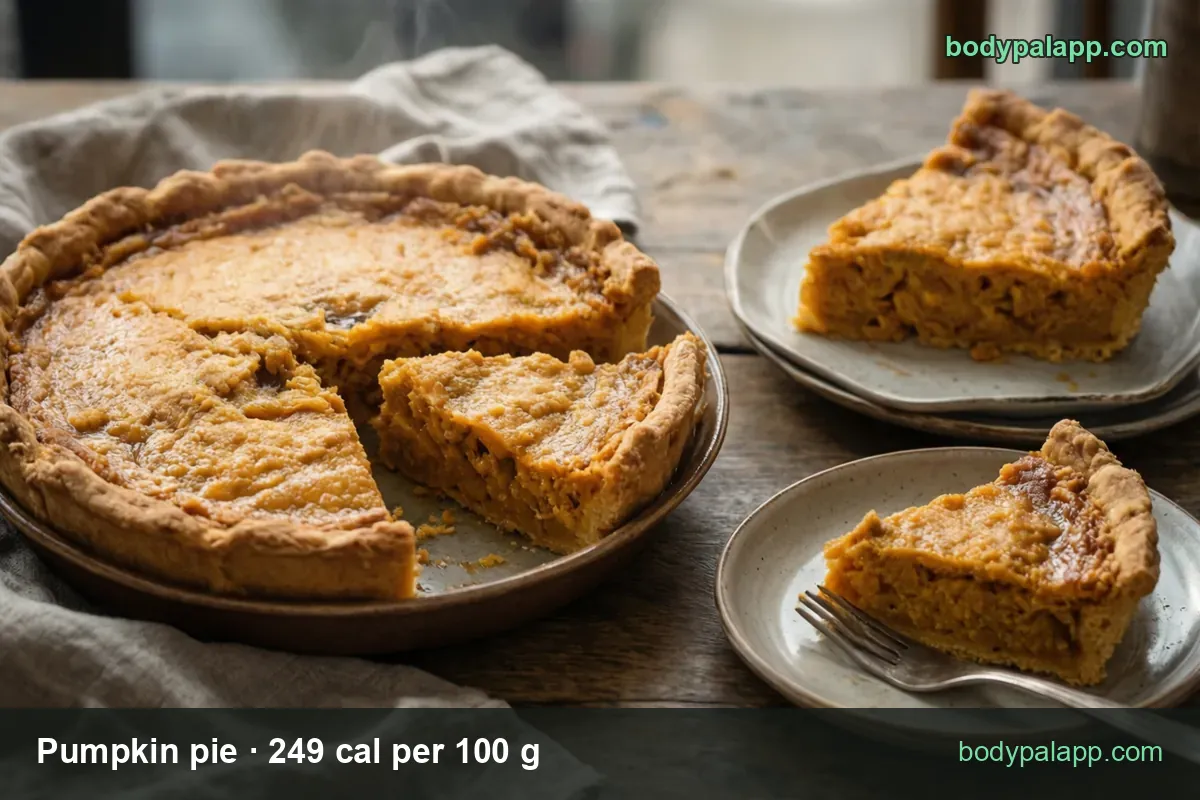
| Store-bought, commercially prepared | 243 kcal | 1 slice (133 g) | 323 kcal |
| Homemade, prepared from recipe | 204 kcal | 1 piece, 1/8 of a 9-inch pie (155 g) | 316 kcal |
| Canned pumpkin pie mix, filling only | 104 kcal | 1 cup (270 g) | 281 kcal |
| Pumpkin pie spice | 342 kcal | 1 tsp (1.7 g) | 6 kcal |
A from-scratch pie is the lightest of the three real pies per gram at 204 calories per 100 g, because a homemade custard carries more milk and egg and less sweetened filling per bite. The commercial record is 243, and its saturated fat is about a third lower than the homemade figure — 1.99 g per 100 g against 3.17 g — since factory crusts lean on vegetable shortening rather than butter. USDA does not list sugars or fiber for the from-recipe entry, so this page leaves them out for that pie rather than borrowing them from another one.
Canned pumpkin pie mix is the filling alone, already sweetened, at 104 calories per 100 g. It is the closest thing USDA offers to a crustless pie, and it shows how much of a slice is pastry: per gram, the filling is about 42% of the finished pie.
Branded pies scatter widely. Claim Jumper is 281 calories per 100 g and 360 for a 1/8 pie slice of 128 g, while a Whole Foods Market pie is 154 per 100 g and 160 for its 104 g slice, and a 4-inch Mo Pie personal pie is 190 calories for the whole 142 g thing. Top to bottom that is more than double per gram, so the box beats any generic estimate when you have one in front of you.
The spice is a rounding error. A teaspoon of pumpkin pie spice is 6 calories, whatever the jar's aroma suggests.
Saturated fat and cholesterol, not just sugar
Most pumpkin pie guilt lands on the sugar, but the rows that move fastest against the FDA Daily Values are fat and cholesterol. One regular slice is 31% DV saturated fat and 24% DV cholesterol, against only 20% DV carbohydrate. That is the butter crust and the egg custard talking.
The Dietary Guidelines for Americans put saturated fat under 10% of daily calories, which is about 22 g on a 2,000-calorie day. A single slice covers over a quarter of that before the turkey and gravy show up. If saturated fat is the number you watch, the mini slice at 3.1 g is the easier trade.
On sugar, be careful how you score it. The 36.8 g in a slice is total sugars, and total sugars carry no Daily Value; USDA does not publish added sugars for this record, so it would be wrong to read that figure against the 50 g added-sugars limit. Some of it is the pumpkin and the milk.
Fiber is the pleasant surprise: 2.6 g a slice, 9% DV, more than most desserts manage, and a reminder that pumpkin is a vegetable, even here. It is not enough to make the pie a fiber source — MyPlate counts pie as a dessert, not a vegetable serving — but it is real.
How does pumpkin pie compare?
| Version | Per 100 g | US serving | Calories |
|---|---|---|---|
| Pumpkin pie, generic | 249 kcal | 1 regular slice, 150 g | 374 kcal |
| Store-bought pumpkin pie | 243 kcal | 1 slice, 133 g | 323 kcal |
| Homemade pumpkin pie | 204 kcal | 1 piece, 155 g | 316 kcal |
| Canned pumpkin pie mix | 104 kcal | 1 cup, 270 g | 281 kcal |
Our take: bake it yourself if the calories matter. Of the three actual pies, homemade is the lightest per gram at 204, yet the store-bought slice ends up only 7 calories ahead of it on the plate because the bakery cut is 22 g smaller. That is the whole lesson in one line — how the pie was made is worth a few dozen calories, how it was cut is worth hundreds. For the smallest real dessert, ask for the thin slice and skip the second one; for the biggest drop with no willpower involved, serve the filling warm in a bowl at 281 calories a cup and leave the crust in the pan.
Most popular pumpkin pie brands in the United States
Ranked by how widely each product appears among foods sold in the United States, from the BodyPal food database of over 3.3 million products. Calories are the figures printed on each Nutrition Facts label, checked against USDA FoodData Central.
| Product | Calories (per 100 g) |
|---|---|
| Claim Jumper Pumpkin Pie | 281 cal |
| Bonert's Slice of Pie Pumpkin Pie | 244 cal |
| The Maine Pie Co. Pumpkin Pie | 239 cal |
| Willamette Valley Pie Co. Pumpkin Pie | 203 cal |
| Whole Foods Market Pumpkin Pie | 154 cal |
| Mo Pie 4" Pumpkin Pie | 134 cal |
Brand popularity: BodyPal food database. Nutrition: manufacturer labels / USDA FoodData Central.
Pumpkin pie FAQs
How many calories are in a slice of pumpkin pie?
A regular 150 g slice is 374 calories, based on the USDA generic figure of 249 calories per 100 g. A small 75 g wedge is 187, and a large 250 g cut is 623. The width of the slice, not the recipe, decides most of the difference.
How many calories in homemade pumpkin pie?
USDA's from-recipe pumpkin pie is 204 calories per 100 g, so one eighth of a 9-inch pie at 155 g comes to 316 calories. That is 58 fewer than the generic 150 g slice, mostly because a homemade custard carries more milk and egg per gram and less sweetened filling.
How much sugar is in pumpkin pie?
A 150 g slice carries 36.8 g of total sugars, from a base of 24.55 g per 100 g. Total sugars have no Daily Value, and USDA does not publish added sugars for this record, so that figure cannot be scored against the 50 g added-sugars limit.
How many carbs are in a slice of pumpkin pie?
A regular 150 g slice has 54.5 g of carbohydrate, 20% of the Daily Value, and 2.6 g of that is fiber. Per 100 g the pie runs 36.34 g of carbohydrate. A mini 75 g slice halves it to 27.3 g, which is the easiest lever you have.
How many calories in store-bought pumpkin pie?
USDA's commercially prepared pumpkin pie is 243 calories per 100 g, so a 133 g bakery slice is 323 calories. Branded pies range much wider: Claim Jumper is 281 per 100 g, Whole Foods Market 154. Read the box, because the slice size printed on it varies too.
How many calories in pumpkin pie without crust?
USDA publishes no baked crustless pumpkin pie, so there is no exact figure. The closest record is canned pumpkin pie mix at 104 calories per 100 g, or 281 for a 1 cup (270 g) serving. Per gram that is about 42% of the finished pie, crust included.
Does pumpkin pie have protein?
Some: 7.1 g in a 150 g slice, 14% of the Daily Value, from the egg and evaporated milk in the custard. Per 100 g that is 4.76 g. It is dessert-level protein rather than a protein food, and 6.2 g of saturated fat comes along with it.
How many calories in a mini pumpkin pie?
A 75 g mini slice is 187 calories, exactly half a regular slice. Whole 4-inch personal pies land close: one branded 142 g pie is 190 calories, because it runs lighter per gram at 134. Two mini slices put you right back at a full slice.
Similar foods
- Eggo Frozen Toaster Waffles — 117 cal per waffle
- Wheat Bagel — 263 cal per regular bagel
- Chicken Salad Croissant — 443 cal per croissant sandwich
- Wheat Bread — 91 cal per medium slice
- Angel Food Cake — 154 cal per slice
- Bread Bun — 148 cal per bun
Count it without the math
Point the camera at the plate and BodyPal counts the slice for you, crust and all.


How long does it take to burn off pumpkin pie?
One regular slice (150 g) is 374 kcal. Enter your weight and the amount you ate to see how long it takes you to burn that off:
lb
| Activity | Time to burn 374 kcal |
|---|---|
| Walking, brisk | 1 hr 15 min |
| Cycling, moderate | 47 min |
| Swimming, moderate | 53 min |
| Jogging | 44 min |
| Weight training, moderate | 1 hr 23 min |
Times are for a 155 lb adult at a steady pace; change the weight to see yours. The amount is set to the portion in the text (150 g); change it to what you actually ate. BodyPal works this out from your steps automatically.
Want the bigger picture? Calculate your daily calorie needs — your maintenance figure, a target for losing or gaining, and the date you get there.