
How Many Calories in a Slice of Wheat Bread?
One medium slice of wheat bread weighs 36 g and carries 91 calories. Per 100 g the loaf runs 254 calories, with 12.3 g of protein and 6 g of fiber. Cut thinner and a slice drops to 61; cut thick and it climbs to 109, from the same bag.
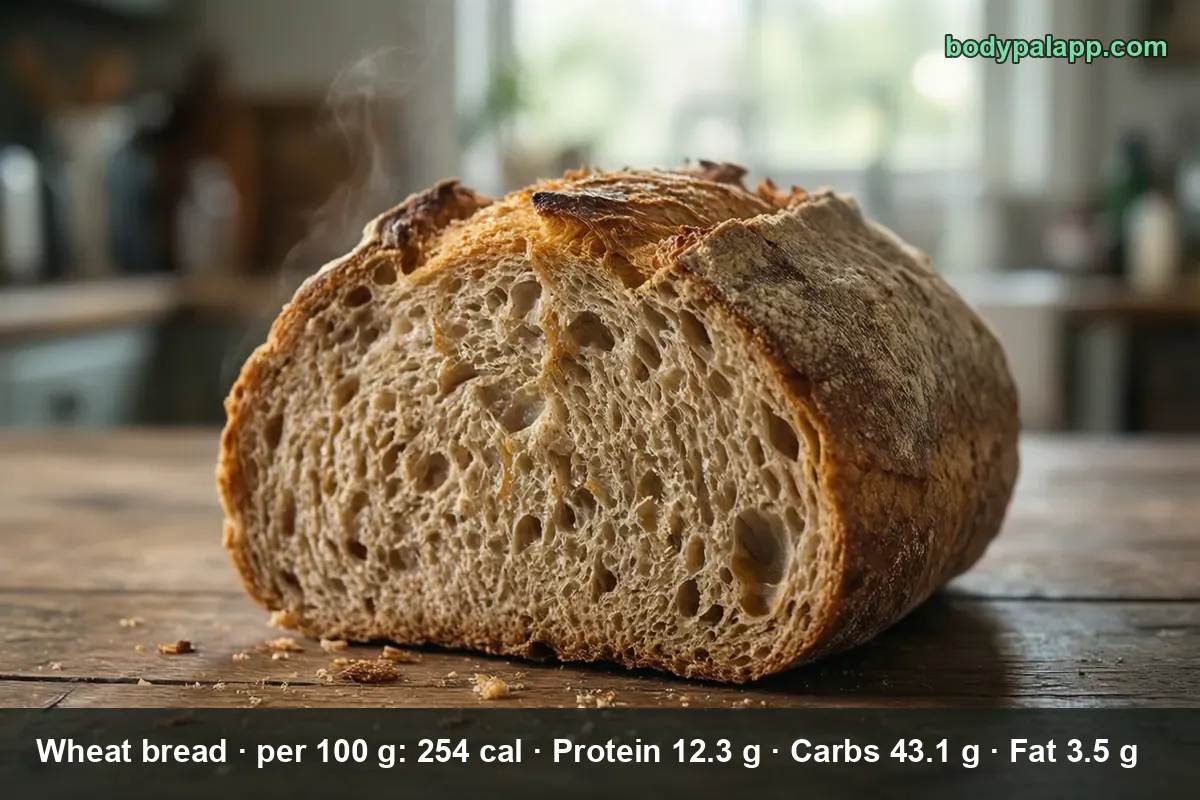
A bakery loaf like the one above is its own USDA record, denser than the sliced supermarket kind, and it gets its own numbers further down.
On this page
- Wheat bread quick facts
- Slice sizes, from thin to a two-slice sandwich
- Toasted, bakery, pita and other wheat breads
- Fiber and sodium are the two rows to read
- How does wheat bread compare?
- Most popular wheat bread brands
- Wheat bread FAQs
Wheat bread quick facts
The row behind every number here is FNDDS 2707709, "Bread, whole wheat" — the finished, sliced loaf that sits in the bread box. It is the only whole wheat record that carries both a full sugar figure and household portions measured by the slice, which is how anybody actually eats bread.
Two other USDA records describe the same food and land within a rounding error: Foundation 335240 is the newer lab edition at 254 calories and 450 mg of sodium, and SR Legacy 172688 is the older one at 252 calories and 455 mg. The small spread is the batch of bread that got analyzed, not a disagreement about what wheat bread is.
| Nutrient | Per 100 g | Per 1 medium slice (36 g) | % Daily Value |
|---|---|---|---|
| Calories | 254 | 91 | — |
| Total fat | 3.55 g | 1.3 g | 2% |
| Saturated fat | 0.73 g | 0.3 g | 1% |
| Carbohydrate | 43.1 g | 15.5 g | 6% |
| Dietary fiber | 6 g | 2.2 g | 8% |
| Total sugars | 4.41 g | 1.6 g | — |
| Protein | 12.3 g | 4.4 g | 9% |
| Sodium | 430 mg | 155 mg | 7% |
% Daily Value is based on a 2,000-calorie diet.
Verified nutrition data
Numbers on this page come from USDA FoodData Central, the U.S. Department of Agriculture’s food composition database, and from manufacturer labels where a branded product is named. Last verified September 2026. How we verify our data →
Two label lines are missing on purpose. USDA does not publish added sugars or trans fat for this generic bread record, so those rows are gone rather than guessed; the bag in your kitchen will list both. Cholesterol is 0 mg, as it is in any bread made without butter or eggs, and a slice carries about 90 mg of potassium, 2% of the Daily Value.
Slice sizes, from thin to a two-slice sandwich
Bread is one of the few foods where the portion is decided by a knife, not by you. USDA measures three standard slices, and the gap between the smallest and the largest is bigger than most people expect.
| Serving | Weight | Calories |
|---|---|---|
| 1 thin or small slice | 24 g | 61 kcal |
| 1 medium or regular slice | 36 g | 91 kcal |
| 1 large or thick slice | 43 g | 109 kcal |
| 2 medium slices, one sandwich | 72 g | 183 kcal |
| 1 oz | 28 g | 72 kcal |
| Per 100 g | 100 g | 254 kcal |
The three single slices are USDA household measures, taken straight from the record. The two-slice sandwich and the 1 oz line are our own arithmetic from the USDA 100 g figure, not USDA servings — but they are the two portions people log most.
Forty-eight calories separate the thin slice from the thick one. Doubled across two slices, that is the gap between a 122-calorie sandwich and a 218-calorie one before anything goes inside it, and no label change gets you there. Store brands make the same point: the slice weight printed on the bag runs from about 26 g to 47 g, so one brand's slice is 60 calories and another's is 120. Great Value 100% Whole Wheat lists 100 calories for a 40 g slice; Sara Lee Honey Wheat lists 70 for a 26 g slice. Same shelf, same aisle, and half again the energy per piece.
Toasted, bakery, pita and other wheat breads
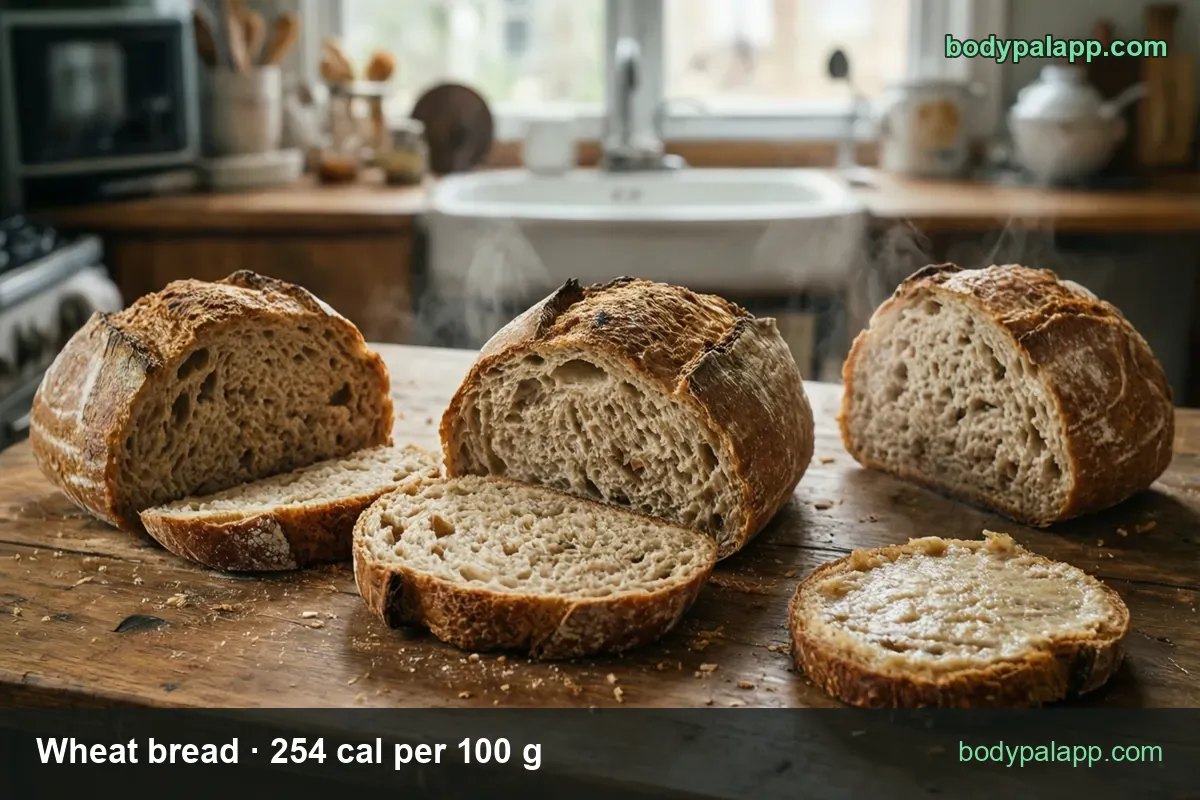
"Wheat bread" covers a wide shelf. Here is where each version lands, each from its own USDA record.
| Version | Per 100 g | Typical piece | Calories |
|---|---|---|---|
| Toasted wheat bread | 279 kcal | 1 oz (28 g) | 79 kcal |
| Bakery or homemade wheat loaf | 267 kcal | 1 medium slice (44 g) | 118 kcal |
| Whole wheat pita | 262 kcal | 1 medium pita (57 g) | 149 kcal |
| Whole wheat French or Vienna | 239 kcal | 1 medium slice (64 g) | 153 kcal |
| White bread with a whole wheat swirl | 260 kcal | 1 oz (28 g) | 74 kcal |
| Wheat bread with raisins | 290 kcal | 1 oz (28 g) | 82 kcal |
The toasted row looks like a penalty and is not one. Toasting drives off water, so what is left weighs less and tests higher per gram. Ounce for ounce that is 79 calories against 72, and the difference is missing water, not added energy — the slice that went into the toaster comes out with the same calories it had.
The bakery loaf is the real upgrade in energy. At 267 per 100 g and a chunkier 44 g slice, it lands at 118 calories a slice, and it brings 607 mg of sodium per 100 g against 430 in the packaged loaf — nearly half again as much salt. The white loaf with a whole wheat swirl is the quiet disappointment: it reads brown, but at 4.2 g of fiber per 100 g it carries 30% less than the real thing. And the raisin version pushes total sugars to 19.48 g per 100 g, more than four times the 4.41 g in plain wheat bread, because dried fruit is sugar with a skin on it.
Whole wheat pita is the one worth a second look. It has less than half the fat of sliced bread, 1.71 g per 100 g against 3.55 g, and it holds a filling that would fall out of a sandwich.
Fiber and sodium are the two rows to read
Fiber is where wheat bread earns its shelf space. Two slices give 4.3 g, 15% of the FDA Daily Value of 28 g, from a lunch component most people do not count as a fiber source at all. Add 8.9 g of protein across those two slices, 18% of the Daily Value, and the bread is doing more work than the turkey in some sandwiches.
Sodium is the row that surprises people. A sandwich's two slices carry 310 mg before a single ingredient goes between them — 13% of the 2,300 mg Daily Value, roughly an eighth of a teaspoon of table salt, from something nobody tastes as salty. Deli meat, cheese and mustard all pile on top of that. If you are watching sodium, the bread is the first place to look, not the last.
For the whole grains angle, the Dietary Guidelines for Americans suggest making at least half your grains whole grains, and the MyPlate grains group counts one regular slice of bread as one ounce-equivalent. Two slices of genuine whole wheat cover two of the roughly six ounce-equivalents a day an adult on 2,000 calories is pointed toward.
How does wheat bread compare?
| Bread | Per 100 g | US serving | Calories |
|---|---|---|---|
| Wheat bread, sliced | 254 kcal | 1 medium slice, 36 g | 91 kcal |
| Bakery whole wheat loaf | 267 kcal | 1 medium slice, 44 g | 118 kcal |
| Whole wheat pita | 262 kcal | 1 medium pita, 57 g | 149 kcal |
| Whole wheat French or Vienna | 239 kcal | 1 medium slice, 64 g | 153 kcal |
Our take: the French or Vienna loaf is the lightest of the four per 100 g at 239 calories, and the heaviest thing on the table per serving at 153, because its slices are cut 64 g thick. That flip is the whole lesson of this page — density barely moves between wheat breads, while the piece size moves by a factor of two and a half. For counting calories, the packaged sliced loaf wins on control: it is portioned for you, and 91 calories is a number you can log without a scale. For staying full through the afternoon, the pita is the pick, with the most carbohydrate per 100 g and only 1.71 g of fat, wrapped around a filling instead of stacked with one.
Most popular wheat bread brands in the United States
Ranked by how widely each product appears among foods sold in the United States, from the BodyPal food database of over 3.3 million products. Calories are the figures printed on each Nutrition Facts label, checked against USDA FoodData Central.
| Product | Calories (per 100 g) |
|---|---|
| Great Value 100% Whole Wheat Bread | 250 cal |
| Shoppers Value 100% Whole Wheat Bread | 214 cal |
| Nature's Own Honey Wheat Bread | 255 cal |
| Nature's Own 100% Whole Wheat Bread | 231 cal |
| Sara Lee Honey Wheat Bread | 269 cal |
| Nature's Harvest Honey Wheat Bread | 250 cal |
Brand popularity: BodyPal food database. Nutrition: manufacturer labels / USDA FoodData Central.
Wheat bread FAQs
How many calories are in a slice of wheat bread?
91 calories for a medium 36 g slice, at 254 calories per 100 g. A thin 24 g slice is 61 and a thick 43 g slice is 109, so check the slice weight on your bag before you log it. Store slices range from about 26 g to 47 g.
How many calories in 2 slices of wheat bread?
183 calories for two medium slices, 72 g of bread, which is our own arithmetic from the USDA 100 g figure rather than a USDA serving. Those two slices also bring 31.0 g of carbohydrate, 8.9 g of protein and 4.3 g of fiber, before any filling goes in.
Is wheat bread the same as whole wheat bread?
Not always, and the fiber shows it. Genuine whole wheat carries 6 g of fiber per 100 g. A white loaf with a whole wheat swirl looks similar on the shelf but holds 4.2 g, about 30% less, at a near-identical 260 calories per 100 g. Read the first ingredient.
How much fiber is in wheat bread?
2.2 g in a medium slice and 6 g per 100 g, so two slices give 4.3 g. That is 15% of the FDA Daily Value of 28 g from one sandwich's bread alone, which is more than most people credit bread with. The bakery loaf runs slightly higher at 6.8 g per 100 g.
How many carbs are in wheat bread?
15.5 g per medium slice and 43.1 g per 100 g, of which 4.41 g per 100 g is total sugars and 6 g is fiber. A two-slice sandwich comes to 31.0 g of carbohydrate. Whole wheat pita is the carb-dense option at 55.89 g per 100 g.
Does toasting wheat bread change the calories?
USDA lists toasted wheat bread at 279 calories per 100 g against 254 untoasted, which works out to 79 calories an ounce versus 72. The gap is evaporated water, not energy. The slice you put in the toaster comes out lighter and just as caloric as it went in.
How much sodium is in wheat bread?
155 mg in a medium slice and 430 mg per 100 g, so a two-slice sandwich starts at 310 mg, about 13% of the 2,300 mg Daily Value. Bakery loaves are saltier at 607 mg per 100 g. Bread is a bigger sodium source than its taste suggests.
Is wheat bread good for weight loss?
At 91 calories a slice with 2.2 g of fiber and 4.4 g of protein, it fits most calorie targets easily. The catch is slice size, not the bread: switching from a 43 g slice to a 24 g one saves 48 calories per slice, or 96 across a sandwich, with no change in what you buy.
Similar foods
- Angel Food Cake — 154 cal per slice
- Wheat Bagel — 263 cal per regular bagel
- Bread Bun — 148 cal per bun
- Ciabatta — 75 cal per slice
- Focaccia Bread — 148 cal per piece
- Pumpkin Pie — 374 cal per regular slice
Count it without the math
Point the camera at the plate and BodyPal counts the bread for you, slice size and all.


How long does it take to burn off wheat bread?
One medium slice (36 g) is 91 kcal. Enter your weight and the amount you ate to see how long it takes you to burn that off:
lb
| Activity | Time to burn 91 kcal |
|---|---|
| Walking, brisk | 18 min |
| Cycling, moderate | 11 min |
| Swimming, moderate | 13 min |
| Jogging | 11 min |
| Weight training, moderate | 20 min |
Times are for a 155 lb adult at a steady pace; change the weight to see yours. The amount is set to the portion in the text (36 g); change it to what you actually ate. BodyPal works this out from your steps automatically.
Burning it off is one side of it. The other is knowing your number: work out how many calories you need a day, with macros and a goal date.