
How many calories are in ciabatta?
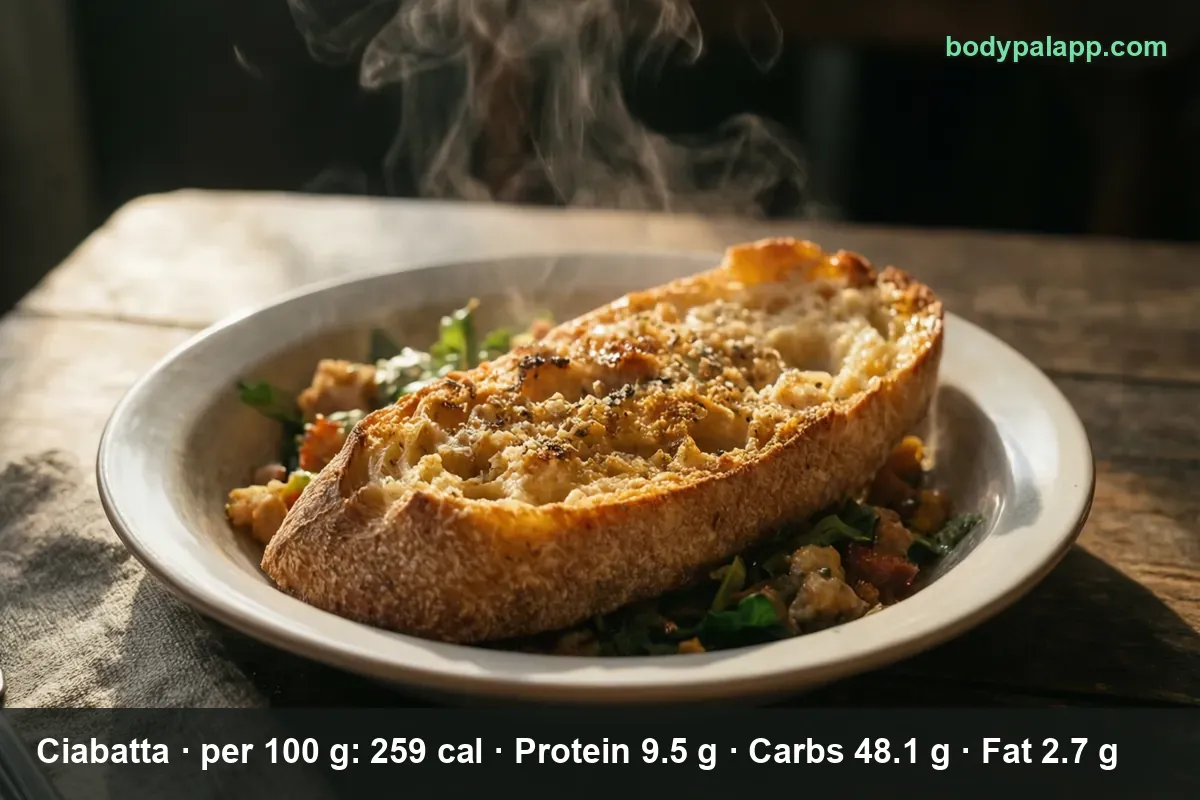
A standard slice of ciabatta weighs 29 g and carries 75 calories. Per 100 g the bread runs 259 calories, which is ordinary white-bread territory. The number that surprises people is the roll: one 85 g ciabatta roll is 220 calories before anything goes inside it.
On this page
- Ciabatta quick facts
- US servings from one ounce to a whole roll
- Toasted ciabatta rolls and buns
- Sodium is the row to watch
- How does ciabatta compare?
- Most popular ciabatta brands
- FAQ
Ciabatta quick facts
USDA has no generic entry called ciabatta. It has the profile instead: ciabatta is a lean Italian white bread built from flour, water, yeast and salt, which is exactly what the SR Legacy record 174913, "Bread, Italian" describes, right down to its household slice and ounce measures. The branded ciabatta labels sit around it in a tight band, from 212 to 281 calories per 100 g for loaves and rolls, with a median near 246, so the generic record is a fair middle rather than an optimistic one.
The table below is that record. The slice column is the USDA household serving of 29 g, the size a machine-cut supermarket loaf gives you.
| Nutrient | Per 100 g | Per 1 slice (29 g) | % Daily Value |
|---|---|---|---|
| Calories | 259 | 75 | — |
| Total fat | 2.73 g | 0.8 g | 1% |
| Saturated fat | 0.54 g | 0.2 g | 1% |
| Carbohydrate | 48.11 g | 14.0 g | 5% |
| Dietary fiber | 2.1 g | 0.6 g | 2% |
| Total sugars | 4.69 g | 1.4 g | — |
| Protein | 9.49 g | 2.8 g | 6% |
| Sodium | 618 mg | 179 mg | 8% |
% Daily Value is based on a 2,000-calorie diet.
Verified nutrition data
Numbers on this page come from USDA FoodData Central, the U.S. Department of Agriculture’s food composition database, and from manufacturer labels where a branded product is named. Last verified September 2026. How we verify our data →
There is no added sugars row here, because the SR Legacy edition of this record does not carry that nutrient at all; classic ciabatta dough has no sugar added to it anyway, and the 4.69 g of total sugars per 100 g comes from the flour itself. Cholesterol is 0 mg, and potassium is 124 mg per 100 g, which works out to 36 mg in a slice, about 1% of the Daily Value. The FDA Daily Value reference is what those percentages are measured against.
US servings from one ounce to a whole roll
Ciabatta is cut by hand more often than most breads, and that is where the calorie math goes sideways. A thin sandwich slice and a thick soup-dunking slab can differ by half a loaf's worth over a week.
| Serving | Weight | Calories |
|---|---|---|
| 1 oz | 28 g | 73 kcal |
| One slice, machine-cut | 29 g | 75 kcal |
| One thick hand-cut slice | 43 g | 111 kcal |
| 1/9 of a loaf | 50 g | 130 kcal |
| One ciabatta roll | 85 g | 220 kcal |
| Per 100 g | 100 g | 259 kcal |
Only the 29 g slice and the ounce are USDA household measures. The thick slice, the ninth of a loaf and the 85 g roll are our own arithmetic from the USDA 100 g figure, not USDA servings, scaled straight from 259 calories per 100 g.
That roll line is the one worth memorizing. At 220 calories it is nearly three machine-cut slices, and it is the form most Americans actually buy ciabatta in, split for a sandwich. Fill it with turkey and cheese and the bread alone is already the size of a light snack.
Toasted ciabatta rolls and buns
| Version | Per 100 g | Typical piece | Calories |
|---|---|---|---|
| Ciabatta slice, plain | 259 kcal | 1 slice (29 g) | 75 kcal |
| Toasted ciabatta | 285 kcal | 1 thick slice (39 g) | 111 kcal |
| Store ciabatta roll | 224 kcal | 1 roll (85 g) | 190 kcal |
| Ciabatta bun | 321 kcal | 1 bun (28 g) | 90 kcal |
| Loaf portion, store label | 240 kcal | 1/9 loaf (50 g) | 120 kcal |
| Italian bread, FNDDS record | 259 kcal | 1 medium slice (31 g) | 80 kcal |
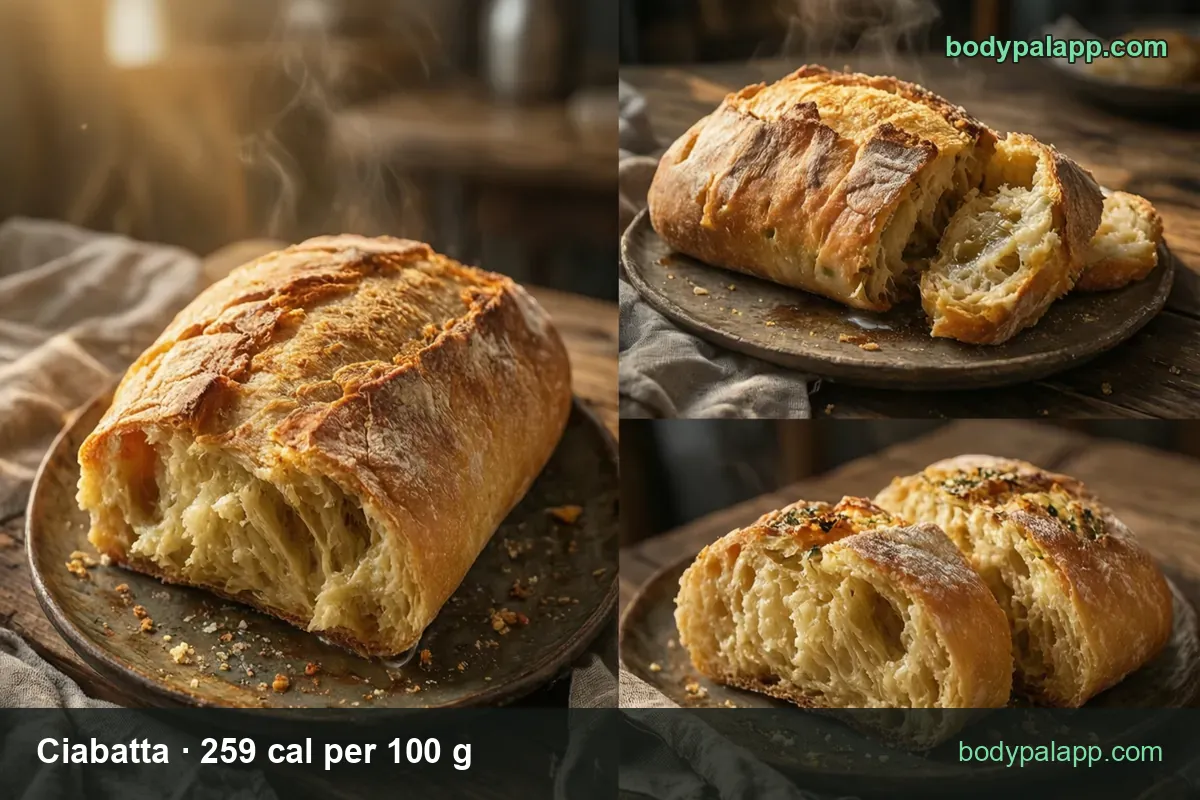
The toasted record reads 285 calories per 100 g, about 10% above the untoasted 259, and that gap fools people every time. Toasting does not add anything. It drives off water, so what is left is denser per gram while the slice in your hand gets lighter. The calories you eat stay put; the butter you spread is the part that moves them.
Buns are the real outlier. Walmart's ciabatta buns run 321 calories per 100 g because they carry 5.36 g of fat per 100 g, against 0.89 g at Balthazar Bakery and a declared 0 g at Izzio. That is a 51% spread between the leanest and richest ciabatta on the shelf, wider than the gap between white bread and rye.
Store labels also disagree with the generic record on portion size, which is worth a glance before you log anything. Nature's Promise ciabatta loaf calls 1/9 of a loaf, 50 g, one serving at 120 calories, while the same 50 g of the USDA generic record comes to 130. La Brea Bakery uses a 2 oz slice, 57 g, at 160 calories, and Izzio prices its ciabattini at 3 oz, 85 g, for 180. Same bread, four different definitions of "one."
Sodium is the row to watch
Ciabatta is not a fatty bread. A slice carries 0.8 g of fat and 0.2 g of saturated fat, both 1% of the Daily Value, and the roll only reaches 2.3 g of fat. Salt is the number that earns attention.
At 618 mg of sodium per 100 g, a 29 g slice delivers 179 mg, 8% of the 2,300 mg Daily Value, for less than 4% of a 2,000-calorie day. Scale that to an 85 g roll and you get about 525 mg, 23% of the day's sodium in a piece of bread that supplies 11% of the day's calories. In salt terms that roll is a little under a quarter teaspoon of table salt, none of which you can taste.
The Dietary Guidelines for Americans call out grain foods as a quiet, steady source of sodium precisely because bread does not register as salty. If you are managing blood pressure, the practical move is not to abandon bread but to notice which form you buy: two slices cost 358 mg, one roll costs 525 mg, and the sandwich you build on it will add its own.
On the other side of the ledger, protein is better than white sandwich bread usually gets credit for. The roll holds about 8.1 g, 16% of the Daily Value, and 40.9 g of carbohydrate. Fiber stays thin at 2.1 g per 100 g, which is where the MyPlate grains guidance points you toward whole grains for at least half your daily grain servings.
How does ciabatta compare?
| Bread | Per 100 g | US serving | Calories |
|---|---|---|---|
| Ciabatta (Italian bread) | 259 kcal | 1 oz (28 g) | 73 kcal |
| Rye bread | 259 kcal | 1 oz (28 g) | 73 kcal |
| White with whole wheat swirl | 260 kcal | 1 oz (28 g) | 74 kcal |
| Whole wheat pita | 262 kcal | 1 oz (28 g) | 74 kcal |
Those ounce figures are our own arithmetic from each record's 100 g value rather than USDA servings, which is what makes them comparable in the first place.
Our take: the type of bread barely matters here. All four land within 3 calories of each other per 100 g, a difference you could not measure at home with a decent kitchen scale. What separates them is what the bread is cut into. Rye and swirl bread arrive as flat 28 g slices; ciabatta arrives as an 85 g roll, and that single fact makes it a 220-calorie choice instead of a 75-calorie one. If you want the airy crumb and a lighter log, buy the loaf and slice it yourself. If you want the sandwich, buy the roll and count it as one.
Most popular ciabatta brands in the United States
Ranked by how widely each product appears among foods sold in the United States, from the BodyPal food database of over 3.3 million products. Calories are the figures printed on each Nutrition Facts label, checked against USDA FoodData Central.
| Product | Calories (per 100 g) |
|---|---|
| Nature's Promise Ciabatta Loaf | 240 cal |
| Nature's Promise Ciabatta Rolls | 244 cal |
| Izzio Ciabattini Italian Ciabatta Rolls | 212 cal |
| La Brea Bakery Ciabatta Loaf | 281 cal |
| Balthazar Bakery Ciabatta | 268 cal |
| The Bakery Ciabatta Buns | 321 cal |
Brand popularity: BodyPal food database. Nutrition: manufacturer labels / USDA FoodData Central.
Ciabatta FAQs
How many calories are in a slice of ciabatta?
A 29 g slice is 75 calories, based on the USDA Italian bread record at 259 calories per 100 g. Bakery ciabatta is cut by hand, so a generous 43 g slice lands at 111 calories instead. Weigh two or three slices once and you will know your own loaf.
How many calories are in a ciabatta roll?
One 85 g ciabatta roll is about 220 calories, our own arithmetic from the USDA 100 g figure rather than a USDA serving. Store rolls vary: a lean Izzio ciabattini at 212 calories per 100 g gives 180 for the same weight, and a Walmart ciabatta bun runs 321 per 100 g.
Does toasting ciabatta add calories?
No — toasted Italian bread reads 285 calories per 100 g against 259 untoasted, but that 10 percent gap is water leaving the crumb, not food arriving. The slice on your plate weighs less after toasting, so its calories barely move. Butter or oil on top is what actually adds them.
How much sodium is in ciabatta bread?
618 mg per 100 g, which is 179 mg in a 29 g slice, 8 percent of the 2,300 mg Daily Value. An 85 g roll carries about 525 mg, or 23 percent, for only 220 calories. Bread never tastes salty, which is exactly why the number surprises people.
How many carbs are in ciabatta?
48.11 g per 100 g, so a 29 g slice holds 14.0 g and an 85 g roll about 40.9 g, 15 percent of the 275 g Daily Value. Fiber is thin at 2.1 g per 100 g, which is 0.6 g per slice, 2 percent of the 28 g Daily Value.
Is ciabatta good for weight loss?
At 75 calories a slice it fits most days; the roll at 220 is the one to plan for. If you are watching calories, one 29 g slice beside soup costs about a third of what the roll costs. Ciabatta is airy, so it looks bigger than it weighs.
How big is one serving of ciabatta?
USDA lists one slice at 29 g, 75 calories. Store labels choose differently: Nature's Promise calls 1/9 of a loaf, 50 g, a serving at 120 calories, while La Brea uses 2 oz, 57 g, at 160. A bakery roll of 85 g is closer to what most people eat.
Is ciabatta bread vegan?
Classic ciabatta is flour, water, yeast and salt, and the USDA record lists 0 mg cholesterol per 100 g. Enriched rolls and buns are where it changes: the Walmart ciabatta buns declare 5.36 g of fat per 100 g against 0.89 g at Balthazar. Read the ingredient list on the bag.
Similar foods
- Bread Bun — 148 cal per bun
- Focaccia Bread — 148 cal per piece
- Rye Bread — 83 cal per slice
- Angel Food Cake — 154 cal per slice
- Bagel — 277 cal per bagel
- Bagel Thin — 150 cal per thin
Count it without the math
Point the camera at the board and BodyPal counts the ciabatta for you, slice or roll.


How long does it take to burn off ciabatta?
One slice (29 g) is 75 kcal. Enter your weight and the amount you ate to see how long it takes you to burn that off:
lb
| Activity | Time to burn 75 kcal |
|---|---|
| Walking, brisk | 15 min |
| Cycling, moderate | 9 min |
| Swimming, moderate | 11 min |
| Jogging | 9 min |
| Weight training, moderate | 17 min |
Times are for a 155 lb adult at a steady pace; change the weight to see yours. The amount is set to the portion in the text (29 g); change it to what you actually ate. BodyPal works this out from your steps automatically.
This table assumes you know your daily total. If you do not, the daily calorie calculator works it out from five numbers.