
How many calories are in rye bread?
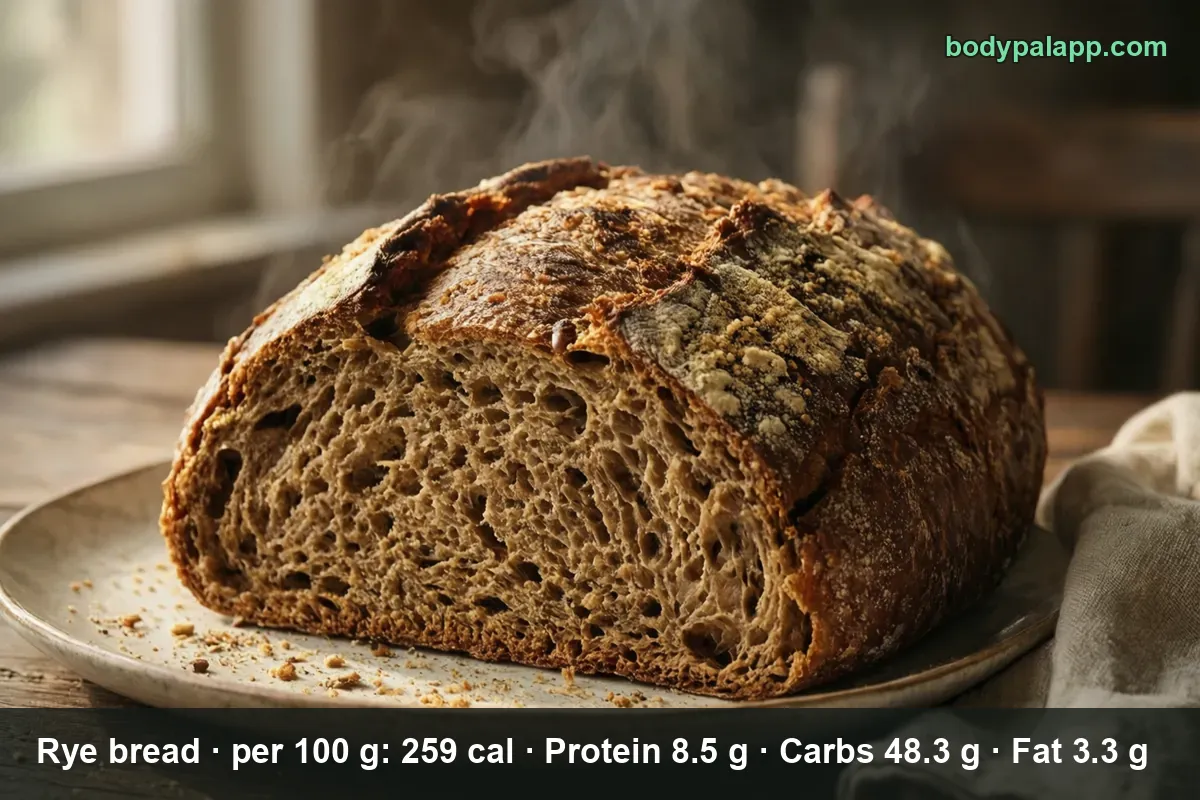
A regular slice of rye bread weighs 32 g and carries 83 calories. Per 100 g the loaf runs 259 calories — the same as Italian bread and one calorie under white with a whole wheat swirl. Rye doesn't win on calories. The fiber and the salt are where it separates itself.
On this page
- Rye bread quick facts
- US servings, from a snack slice to a sandwich
- Toasted, marble and reduced-calorie rye
- Sodium is the row to watch, not calories
- How does rye bread compare?
- Most popular rye bread brands
- FAQ
Rye bread quick facts
The numbers below come from SR Legacy 172684, "Bread, rye", which is the plain rye loaf you buy sliced at the deli counter or in a bag. USDA also keeps a newer FNDDS edition of the same bread, and the two agree on everything except sodium, where FNDDS lists 570 mg per 100 g instead of 603 mg. The SR Legacy record wins here for a simple reason: it is the one that carries real US household measures, including a per-ounce weight and three slice sizes, so the arithmetic in this article is USDA's rather than ours.
One caution before the table. This record is rye bread, not rye whole grain bread. Most supermarket rye in the US is built mostly on refined wheat flour with rye added for flavor and color, which is why the fiber sits at 5.8 g per 100 g rather than the double-digit number a true whole rye loaf would show.
| Nutrient | Per 100 g | Per 1 regular slice (32 g) | % Daily Value |
|---|---|---|---|
| Calories | 259 | 83 | — |
| Total fat | 3.3 g | 1.1 g | 1% |
| Saturated fat | 0.63 g | 0.2 g | 1% |
| Carbohydrate | 48.3 g | 15.5 g | 6% |
| Dietary fiber | 5.8 g | 1.9 g | 7% |
| Total sugars | 3.85 g | 1.2 g | — |
| Protein | 8.5 g | 2.7 g | 5% |
| Sodium | 603 mg | 193 mg | 8% |
| Cholesterol | 0 mg | 0 mg | 0% |
| Potassium | 166 mg | 53 mg | 1% |
% Daily Value is based on a 2,000-calorie diet.
Verified nutrition data
Numbers on this page come from USDA FoodData Central, the U.S. Department of Agriculture’s food composition database, and from manufacturer labels where a branded product is named. Last verified September 2026. How we verify our data →
Two rows you would see on a bag of rye at the store are missing above: added sugars and trans fat. USDA does not publish either value for this rye bread record, so rather than guess we leave them out. Total sugars are listed instead, and they have no Daily Value of their own — 3.85 g per 100 g in a bread this size is mostly what the yeast didn't finish, plus whatever molasses the baker used for color.
The cholesterol row is a flat zero, which is normal for a lean bread dough, and the potassium is small enough that a slice covers 1% of the FDA Daily Value. Neither one is a reason to pick or skip this bread.
US servings, from a snack slice to a sandwich
Rye is sold in wildly different thicknesses, and that is where most people miscount. A deli-cut Jewish rye slice and a cocktail rye round can differ by a factor of six in weight while both being called "a slice."
| Serving | Weight | Calories |
|---|---|---|
| 1 slice, snack or cocktail size | 7 g | 18 kcal |
| 1 slice, thin | 25 g | 65 kcal |
| 1 slice, regular | 32 g | 83 kcal |
| 1 oz | 28.35 g | 73 kcal |
| 2 slices, regular | 64 g | 166 kcal |
| Per 100 g | 100 g | 259 kcal |
The three slice sizes and the ounce are USDA household measures attached to the rye bread record itself. The two-slice line is our own arithmetic from the same 100 g figure, not a USDA serving, because a sandwich is the unit people actually log — 64 g of bread and 166 calories before a single thing goes between them.
That two-slice base matters more than it looks. A turkey sandwich people describe as "light" starts at 166 calories from the bread alone, which is roughly a third of a 450-calorie lunch spent before the filling. If you build sandwiches often and calories are tight, cutting to one slice and going open-faced saves 83 calories with no change to what's on top.
Store-brand loaves land close to the USDA record but not on it. Across the rye loaves in USDA's Branded database, the per-100 g figures run from 222 for a light cocktail rye up to 281 for a Jewish rye, and the label serving on a single slice usually reads 80 to 100 calories depending on whether the bakery cuts at 30 g, 32 g or 40 g. If your bag lists a number, use the bag; if it doesn't, 83 for a regular slice is the right default.
Toasted, marble and reduced-calorie rye
| Version | Per 100 g | Typical slice | Calories |
|---|---|---|---|
| Plain rye, baseline | 259 kcal | 1 regular slice, 32 g | 83 kcal |
| Toasted rye | 284 kcal | 1 slice after toasting, 24 g | 68 kcal |
| Rye, thick or deli slice | 259 kcal | 1 large slice, 43 g | 111 kcal |
| Toasted rye, thick slice | 285 kcal | 1 large slice, 39 g | 111 kcal |
| Marble rye and pumpernickel | 259 kcal | 1 medium slice, 32 g | 83 kcal |
| Marble rye, toasted | 285 kcal | 1 medium slice, 29 g | 83 kcal |
| Reduced-calorie rye | 203 kcal | 1 oz, 28.35 g | 58 kcal |
Toasting looks like it adds calories and doesn't. Toasted rye reads 284 calories per 100 g against 259 for the untoasted loaf, a 10% jump that exists only because the heat drove off water and left the same solids in less weight. The slice shrinks with it, from 32 g to 24 g, so the piece of toast on your plate is 68 calories, not 83. Toasting a slice of rye is one of the few kitchen steps that genuinely subtracts, and it subtracts about 15.
The small gap between 284 and 285 in the table above is not a disagreement about toast. It is two USDA editions of the same food — the SR Legacy record for toasted rye rounds to 284, while the FNDDS record used for the thick-slice weights rounds to 285. Nothing in the bread changed.
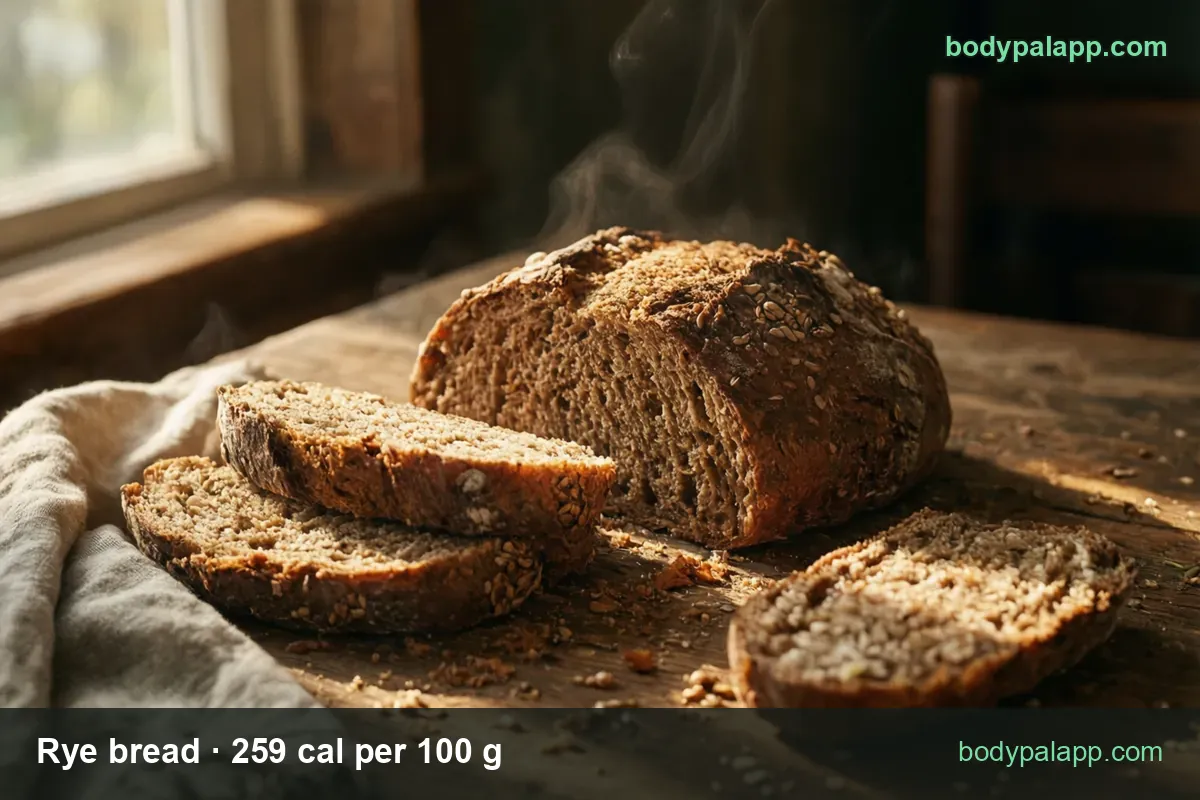
Marble rye is a color story, not a calorie story. USDA files marble rye and pumpernickel in one record and gives it numbers identical to plain rye down to the decimal: 259 calories per 100 g, 8.5 g of protein, 5.8 g of fiber. The dark swirl is rye dough darkened with cocoa, coffee or molasses and folded through the light dough, and at the weights involved it doesn't move the total. If you have been choosing marble over plain rye for nutritional reasons, the USDA record says you have been choosing on looks.
Reduced-calorie rye is the one real change. At 203 calories per 100 g it is about 22% lighter than the standard loaf, and the reason is visible in the fiber row: 12 g per 100 g against 5.8 g, more than double. Added fiber displaces starch, which is why the carbohydrate falls from 48.3 g to 40.5 g and the sodium drops to 513 mg. An ounce of it is 58 calories. It is the only version in this table that changes the math on a sandwich instead of just changing the slice weight.
Sodium is the row to watch, not calories
Rye bread is not a salty food in the way pretzels or deli meat are, but bread is where most Americans quietly pick up sodium. One regular slice carries 193 mg, or 8% of the 2,300 mg Daily Value. Two slices reach 386 mg — 17% of the day's limit, or roughly a sixth of a teaspoon of table salt — before anything is put between them.
Set that against the fiber and the trade becomes clear. Those same two slices deliver 3.7 g of fiber, 13% of the 28 g Daily Value. Sodium is arriving faster than fiber is, 17% against 13%, which is the opposite of the reason most people reach for rye. The Dietary Guidelines for Americans put the sodium ceiling at 2,300 mg a day for adults, and a sandwich, a slice of toast at breakfast and a piece with soup will use about a third of it on bread alone.
None of that makes rye a bad choice. It makes it a bread to count rather than to assume. If you're watching sodium, the reduced-calorie rye at 513 mg per 100 g and the FNDDS reading of plain rye at 570 mg are both meaningfully below 603 mg, and toasting concentrates the sodium rather than removing it, 664 mg per 100 g, though the toasted slice itself lands lower simply because it weighs less.
Where rye holds up is on the grain side. MyPlate asks that at least half of daily grains be whole grains, and a rye loaf baked with a real proportion of whole rye flour counts toward that in a way white bread does not. The USDA record for generic rye bread can't tell you what proportion your particular loaf uses — the ingredient list on the bag can, and "whole rye flour" or "rye meal" listed first is the signal worth looking for.
How does rye bread compare?
| Bread | Per 100 g | US serving | Calories |
|---|---|---|---|
| Rye bread | 259 kcal | 1 oz, 28.35 g | 73 kcal |
| Italian bread | 259 kcal | 1 oz, 28.35 g | 73 kcal |
| White with whole wheat swirl | 260 kcal | 1 oz, 28.35 g | 74 kcal |
| Whole wheat pita | 262 kcal | 1 oz, 28.35 g | 74 kcal |
Our take: on calories these four breads are the same food. They fit inside a three-calorie band per 100 g and a single calorie per ounce, so swapping rye for pita or for a swirled white loaf changes nothing you could measure at the end of a week. Rye is also the lowest-protein bread of the four at 8.5 g per 100 g, behind Italian at 9.49 g, whole wheat pita at 9.8 g and the swirl loaf at 10.86 g. Choose rye because you like the sour, dense crumb and because it holds a sandwich together better than soft white does — not because it saves calories, which it doesn't. The one swap in this article that actually moves a number is going from standard rye to reduced-calorie rye, and that is worth 56 calories per 100 g and double the fiber.
Most popular rye bread brands in the United States
Ranked by how widely each product appears among foods sold in the United States, from the BodyPal food database of over 3.3 million products. Calories are the figures printed on each Nutrition Facts label, checked against USDA FoodData Central.
| Product | Calories (per 100 g) |
|---|---|
| Oroweat Jewish Rye Bread | 281 cal |
| Arnold Seedless Jewish Rye Bread | 267 cal |
| Pepperidge Farm Seeded Jewish Rye Bread | 250 cal |
| Golden Home Light Cocktail Rye Bread | 222 cal |
| Russo's Bakery Rye Bread | 267 cal |
| Montana's Sweetheart Deli Rye Bread | 250 cal |
Brand popularity: BodyPal food database. Nutrition: manufacturer labels / USDA FoodData Central.
Rye bread FAQs
How many calories are in a slice of rye bread?
A regular 32 g slice is 83 calories, based on USDA's rye bread record at 259 calories per 100 g. A thin slice at 25 g is 65, a deli-style thick slice at 43 g is 111, and a cocktail or snack-size slice at 7 g is only 18.
How many calories are in two slices of rye bread?
Two regular slices weigh 64 g and come to 166 calories, the base of a sandwich before anything goes inside. They also carry 386 mg of sodium, 17% of the Daily Value, and 3.7 g of fiber, 13%. The salt arrives faster than the fiber does.
Does toasting rye bread change the calories?
Toasting a 32 g slice takes it from 83 calories to 68, though on paper it looks the other way. Toasted rye is 284 calories per 100 g against 259 raw, because heat drives off water and concentrates what's left. The slice shrinks from 32 g to 24 g, which is where the drop comes from.
How many carbs are in rye bread?
A regular slice holds 15.5 g of total carbohydrate, 6% of the Daily Value, of which 1.9 g is fiber and 1.2 g is sugar. Per 100 g that's 48.3 g of carbohydrate. Two slices put a sandwich at 31 g before the filling.
How much fiber does rye bread have?
5.8 g per 100 g, which works out to 1.9 g in a regular slice, or 7% of the 28 g Daily Value. Reduced-calorie rye is the outlier: USDA lists it at 12 g per 100 g, more than double, because added fiber replaces some of the starch.
How much sodium is in rye bread?
603 mg per 100 g, or 193 mg in a regular slice, which is 8% of the 2,300 mg Daily Value. Two slices reach 386 mg, roughly a sixth of a teaspoon of table salt, and that is before mustard, deli meat or cheese. Reduced-calorie rye is lower at 513 mg per 100 g.
Is marble rye the same as pumpernickel?
Not quite, but USDA files them together and gives them identical numbers to plain rye: 259 calories per 100 g, 83 in a 32 g slice. Marble rye is rye dough swirled with darker pumpernickel dough, so the color changes and the calories don't. Toasted, a 29 g slice is still 83.
Is rye bread good for weight loss?
At 83 calories a slice it fits most plans, but it is not a low-calorie bread: 259 per 100 g sits right in the middle of the loaf aisle. If calories are the constraint, reduced-calorie rye at 203 per 100 g and 58 calories an ounce is the better pick, with more than double the fiber.
Similar foods
- Bread Bun — 148 cal per bun
- Ciabatta — 75 cal per slice
- Focaccia Bread — 148 cal per piece
- Angel Food Cake — 154 cal per slice
- Bagel — 277 cal per bagel
- Bagel Thin — 150 cal per thin
Count it without the math
Point the camera at the plate and BodyPal counts the slices for you, thin, regular or deli-cut.


How long does it take to burn off rye bread?
One regular slice (32 g) is 83 kcal. Enter your weight and the amount you ate to see how long it takes you to burn that off:
lb
| Activity | Time to burn 83 kcal |
|---|---|
| Walking, brisk | 17 min |
| Cycling, moderate | 10 min |
| Swimming, moderate | 12 min |
| Jogging | 10 min |
| Weight training, moderate | 18 min |
Times are for a 155 lb adult at a steady pace; change the weight to see yours. The amount is set to the portion in the text (32 g); change it to what you actually ate. BodyPal works this out from your steps automatically.
Want the bigger picture? Calculate your daily calorie needs — your maintenance figure, a target for losing or gaining, and the date you get there.