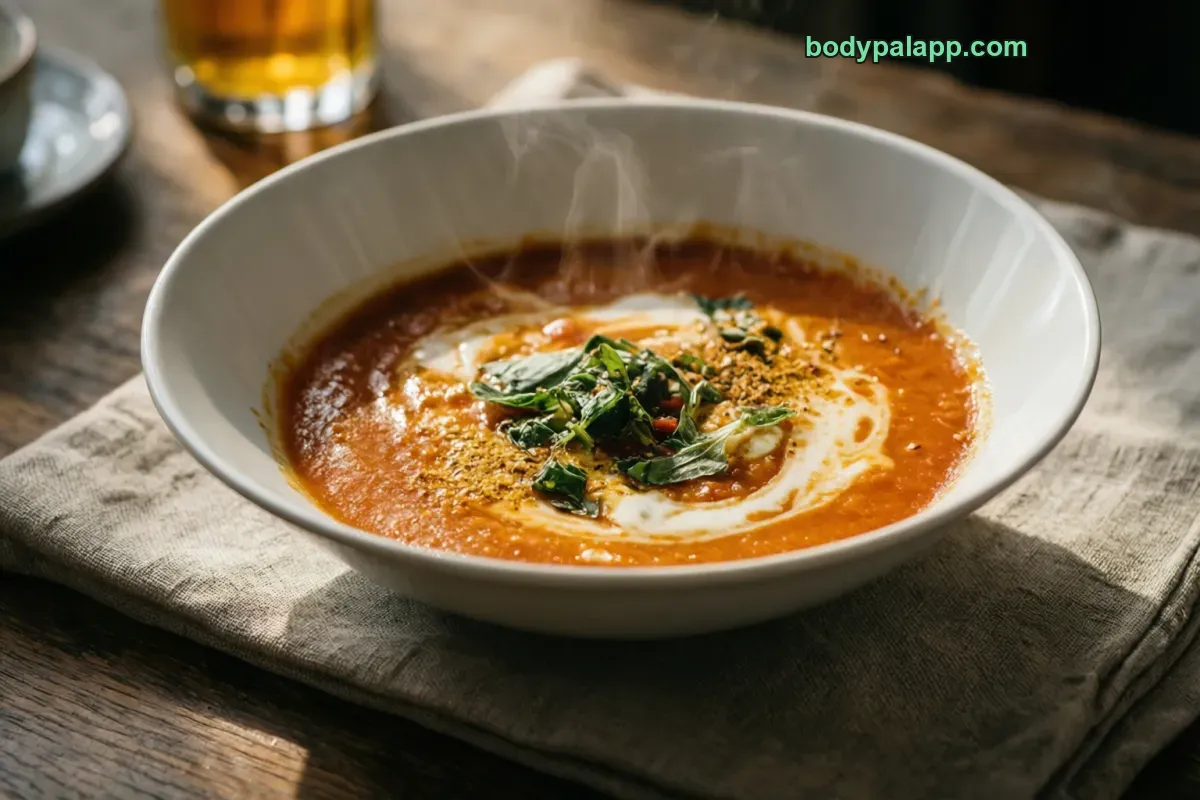
Tomato bisque calories come to 198 for 1 cup (251 g) made with milk, or 79 per 100 g. The number that stands out is not calories but sodium: that one cup carries 1,109 mg, 48 percent of the daily value, while protein stays modest at 6.3 g.
198kcal
1 cup · 251 g, canned, prepared with milk
12%protein
6.3 gProtein
29 gCarbs
6.6 gFat
How to burn off 198 kcal
—Walking, brisk
—Jogging
—Cycling, moderate
—Swimming
Skip the math. BodyPal counts these calories from your steps and workouts automatically.
Nutrition facts
Canned, prepared with milk · per 251 g
Calories
198 kcal
Protein
6.3 g
Carbohydrate
29 g
Fat
6.6 g
Saturated fat
3.1 g
Cholesterol
23 mg
Sodium
1109 mg
Potassium
605 mg
Iron
0.9 mg
Source: USDA FoodData Central
🛡️
Verified nutrition data
Numbers on this page come from USDA FoodData Central, the U.S. Department of Agriculture’s food composition database, and from manufacturer labels where a branded product is named. Last verified September 2026. How we verify our data →
Tomato bisque: calories, protein and sodium by serving
Percent of daily value uses the FDA reference of 2,000 kcal a day.
Serving
kcal
Protein
Carbs
Fat
Sodium
% DV kcal
1 cup (251 g)
198
6.3 g
29.4 g
6.6 g
1,109 mg
10%
With water (247 g)
124
2.3 g
23.7 g
2.5 g
1,047 mg
6%
100 g
79
2.5 g
11.7 g
2.6 g
442 mg
4%
3 × 1 cup (251 g)
595
18.9 g
3,328 mg
5 × 1 cup (251 g)
991
31.5 g
5,547 mg
Milk or water decides the bowl
Canned bisque is condensed, so the liquid you stir in sets the final count. Made with an equal volume of milk, 1 cup (251 g) lands at 198 calories with 6.3 g protein and 6.6 g fat. Made with water, 1 cup (247 g) drops to 124 calories, 2.3 g protein and 2.5 g fat.
That gap is almost all milk. Carbs barely move, 29.4 g versus 23.7 g, and sodium stays high either way at 1,109 mg and 1,047 mg. Water saves calories and protein together. It does not save salt.
If you want a lighter bowl, water is the easy lever. If you want the soup to hold you longer, milk is worth it: protein goes from 5 to 13 percent of the daily value per cup. Ready-to-serve cartons skip this choice, so read the label for the version you actually buy.
A second bowl nearly doubles everything
One cup at 198 calories is a light lunch on paper, about 10 percent of the daily value for calories. Soup bowls rarely hold exactly a cup, though. Two cups (502 g) come to 397 calories, and three cups (753 g) reach 595.
Sodium climbs faster than you notice. Two cups bring 2,219 mg, already close to the 2300 mg daily value, and three cups hit 3,328 mg. A full pot of 5 cups (1,255 g), the kind you might split over a weekend, totals 991 calories and 5,547 mg sodium.
Protein scales too, from 12.6 g at two cups to 18.9 g at three, which is still modest for that many calories. Measure your usual bowl once with a cup measure and you will know your real portion. BodyPal can also log the soup from a photo of the bowl.
Carbs make up more than half the calories
Per 100 g, the milk version has 79 calories from 11.7 g carbs, 2.6 g fat and 2.5 g protein. In calorie terms that is 58 percent carbs, 29 percent fat and 12 percent protein. Fiber barely registers at 0.2 g per 100 g, or 0.5 g per cup.
Fat is moderate, not heavy. Saturated fat is 1.3 g per 100 g, about half of the total fat, which fits a soup thinned with milk. Cholesterol is low at 9 mg per 100 g.
The weak spot is protein. With 6.3 g per cup, bisque will not carry a meal on its own. It works best as the starter or the side, with something more filling doing the heavy lifting on the plate.
Sodium is the row to watch
At 442 mg per 100 g, sodium is the defining number on this label. One cup with milk delivers 1,109 mg, 48 percent of the daily value; with water it is 1,047 mg, or 46 percent. Calories, by comparison, are only 10 percent of the daily value in that same cup.
That mismatch shapes the rest of the meal. If you watch sodium, pair the bowl with lower-salt foods such as fresh vegetables, plain fruit or an unsalted protein, rather than a cheese sandwich and chips. Potassium is 241 mg per 100 g, a small offset rather than a fix.
Labels from Campbell's, Pacific Foods, Imagine and Amy's are not identical. Compare the sodium line on the can or carton before you settle on a favorite, because that row moves your day more than the calorie line does.
How does tomato bisque compare?
Here is tomato bisque next to tomato soup, lobster bisque and corn chowder, per 100 g and per usual serving.
Verdict: For weight loss pick plain tomato soup: 83 calories per cup against 198, with 263 mg sodium per 100 g instead of 442. If you want something creamy, lobster bisque at 75 calories per 100 g is close on calories and lower in sodium, while corn chowder at 99 is the heaviest of the group.
Most popular tomato bisque brands in the United States
Ranked by popularity in the BodyPal database
# Productkcal / 100 g
1Imagine Organic Tomato Bisque Soup1 cup · 245 g33 kcal
2Campbell's Zesty Tomato Bisque Soup1 cup · 240 ml46 kcal
6Amy's Organic Chunky Tomato Bisque1 can · 411 g34 kcal
7Zoup! Tomato Bisque1 jar · 454 g59 kcal
8Boulder Organic Tomato Bisque8 oz · 227 g53 kcal
Ready-to-serve cartons and jars are already diluted, so they read lower than the condensed cans, which are labeled before you add milk or water. Source: manufacturer labels / USDA FoodData Central.
Tomato bisque FAQs
How many calories are in a cup of tomato bisque?
A cup prepared with milk (251 g) is 198 calories. Prepared with an equal volume of water, the same cup is 124 calories.
Is tomato bisque good for weight loss?
One cup with milk is 198 calories, with 6.6 g fat and 29.4 g carbs. The water version brings the same cup down to 124 calories.
Tomato bisque vs tomato soup: which has fewer calories?
Tomato bisque prepared with milk is 79 calories per 100 g, against 34 for tomato soup, so a cup of bisque is the higher of the two.
How much protein is in tomato bisque?
A cup made with milk has 6.3 g protein (2.5 g per 100 g). Made with water, a cup has 2.3 g.
How much sodium is in a cup of tomato bisque?
A cup (251 g) made with milk has 1,109 mg sodium, 48 percent of the daily value. Made with water it is 1,047 mg, or 46 percent, so the liquid barely changes the salt.
How many calories are in tomato bisque made with water?
1 cup (247 g) made with water has 124 calories, with 2.3 g protein and 2.5 g fat. Using milk raises the cup to 198 calories and 6.3 g protein.
How many calories are in 100 g of tomato bisque?
100 g of tomato bisque made with milk has 79 calories, with 11.7 g carbs, 2.6 g fat and 2.5 g protein. Sodium is 442 mg in that same 100 g.
How many calories are in two cups of tomato bisque?
Two cups (502 g) made with milk come to 397 calories and 12.6 g protein. Sodium reaches 2,219 mg, close to the full 2300 mg daily value.
Is tomato bisque high in fat?
Not especially. A cup made with milk has 6.6 g fat, and 100 g has 2.6 g, about 29 percent of calories. Saturated fat is 1.3 g per 100 g.