Tomato juice calories come to 41 for a 1 cup (243 g) glass of canned juice with salt, and 17 per 100 g. That is one of the lightest drinks you can pour. The number to notice is not the calories but the sodium: 615 mg per cup, or 27% of the daily value.
41kcal
1 cup · 243 g, canned, with salt
17%protein
2.1 gProtein
9 gCarbs
0.7 gFat
How to burn off 41 kcal
—Walking, brisk
—Jogging
—Cycling, moderate
—Swimming
Skip the math. BodyPal counts these calories from your steps and workouts automatically.
Nutrition facts
Canned, with salt · per 243 g
Calories
41 kcal
Protein
2.1 g
Carbohydrate
8.6 g
Fat
0.7 g
Saturated fat
0 g
Cholesterol
0 mg
Sodium
615 mg
Potassium
527 mg
Iron
0.9 mg
Source: USDA FoodData Central
🛡️
Verified nutrition data
Numbers on this page come from USDA FoodData Central, the U.S. Department of Agriculture’s food composition database, and from manufacturer labels where a branded product is named. Last verified September 2026. How we verify our data →
Tomato juice: calories, protein and sodium by serving
Percent of daily value uses the FDA reference of 2,000 kcal a day.
Serving
kcal
Protein
Carbs
Fat
Sodium
% DV kcal
1 cup (243 g)
41
2.1 g
8.6 g
0.7 g
615 mg
2%
6 fl oz (182 g)
31
1.5 g
6.4 g
0.5 g
460 mg
2%
No salt added (243 g)
41
2.1 g
8.6 g
0.7 g
24 mg
2%
100 g
17
0.9 g
3.5 g
0.3 g
253 mg
1%
3 × 1 cup (243 g)
124
6.2 g
1,844 mg
5 × 1 cup (243 g)
207
10.3 g
3,074 mg
A cup is 41 calories, five cups only 207
Portions barely move the calorie total here. A 6 fl oz (182 g) can, the size many people grab from a multipack, comes to 31 calories. A full 1 cup (243 g) glass is 41, which is 2% of a 2000-calorie daily value. Even at 100 g you are looking at 17 calories and 1% of the day.
Scale it up and the energy still stays small. Two cups (486 g) land at 83 calories, three cups (729 g) at 124, and five cups (1,215 g) at 207. Few drinks let you pour more than a liter and stay near the calorie count of a single snack bar.
So the portion question for tomato juice is really a sodium question. The same five cups that add only 207 calories also carry 3,074 mg of sodium. If you drink it by the glass, calories are an afterthought. If you drink it by the bottle, read the next section first.
Carbs supply 70% of the calories
Tomato juice is mostly water, so the few calories it has come largely from carbohydrate. Carbs make up 70% of the energy, protein 17% and fat 13%. Per 100 g that works out to 3.5 g of carbs, 0.9 g of protein and 0.3 g of fat, with 0 g of saturated fat and 0 mg of cholesterol.
A cup gives you 8.6 g of carbs, and 6.3 g of that is sugar from the tomatoes themselves. Fiber is modest at 1 g per cup, or 0.4 g per 100 g. Protein reaches 2.1 g per cup, which is 4% of the daily value, so do not count on this glass to keep you full on its own.
The upside of that profile is predictability. There is no fat to speak of and the sugar is lower than in most fruit juices, so a glass slots into nearly any eating plan without crowding out other foods. Potassium shows up too, at 217 mg per 100 g.
Sodium is the row to watch
The standard canned juice with salt added carries 253 mg of sodium per 100 g. That turns into 460 mg for a 6 fl oz can (20% of the daily value) and 615 mg for a cup (27%). For a drink with 41 calories, that is a lot of salt per sip.
It stacks quickly. Two cups bring 1,230 mg, three cups 1,844 mg, and five cups 3,074 mg, which is more than a full day's daily value from juice alone. If you pair a glass with a salty breakfast or a deli sandwich, the sodium row climbs faster than the calorie row ever will.
The fix is simple and costs nothing in calories. The no salt added version has the same 41 calories, 8.6 g of carbs and 6.3 g of sugar per cup, but only 24 mg of sodium, or 1% of the daily value. Campbell's sells a low sodium 100% tomato juice, and organic lines such as R.W. Knudsen are worth checking on the label too.
A low-calorie glass that needs company
Because a cup has only 2.1 g of protein and 1 g of fiber, tomato juice works best as a side, not a meal. Next to eggs, yogurt or a bowl of beans, it adds volume and savory flavor for very few calories. On its own, it is closer to a drink than a snack.
It also makes a sensible swap when you want something with taste that is not sweet. At 17 calories per 100 g it sits well below orange juice, and the sugar is lower too. If sodium is on your radar, buy the no salt added carton and season the rest of the plate as usual.
Logging it is quick: BodyPal can log tomato juice from a photo, and you can pick the cup, the 6 fl oz can or the no salt added option so the sodium number matches what is actually in your glass.
How does tomato juice compare?
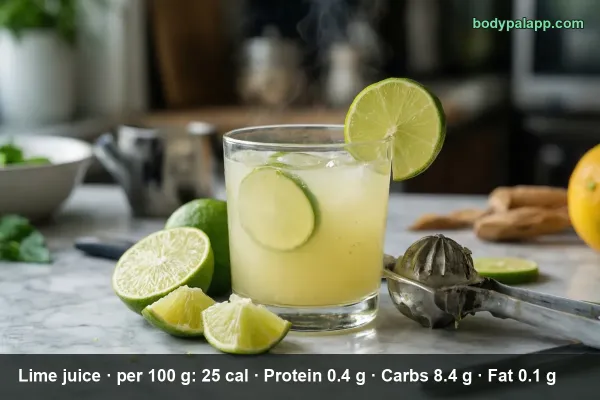
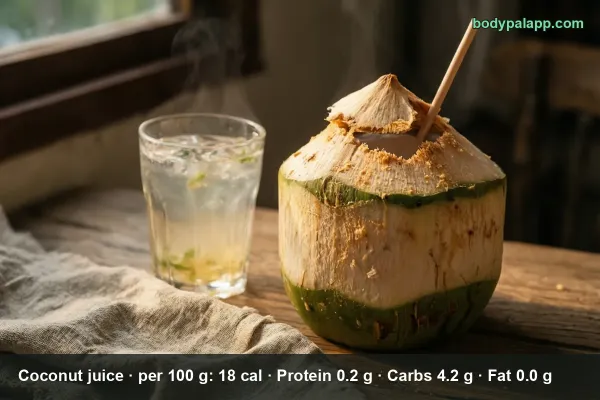
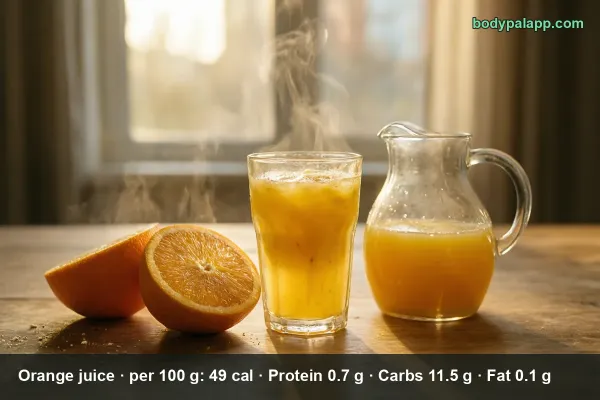
Here is how tomato juice stacks up against lime, coconut and orange juice, per 100 g and per usual serving.
Verdict: For the fewest calories, tomato juice at 17 per 100 g edges out coconut juice at 18 and beats orange juice at 49, which has about 2.9 times as much energy. If you watch sodium, orange juice at 2 mg or coconut juice at 26 mg per 100 g is the cleaner pick over salted tomato juice at 253 mg.
Most popular tomato juice brands in the United States
Ranked by popularity in the BodyPal database
# Productkcal / 100 g
1Campbell's Tomato Juice, 12 oz Bottle354 ml20 kcal
4R.W. Knudsen Family Organic Tomato Juice From Concentrate8 fl oz · 240 ml19 kcal
Bottled labels read 18 to 21 calories per 100 g, a little above the plain canned USDA row used for the numbers above. Source: manufacturer labels / USDA FoodData Central.
Tomato juice FAQs
How many calories are in a glass of tomato juice?
A full cup (243 g) is 41 calories. A smaller 6 fl oz glass (182 g) is 31 calories.
Is tomato juice good for weight loss?
It is light for a drink at 17 calories per 100 g, so a cup is 41 calories with 8.6 g carbs, 2.1 g protein and 0.7 g fat.
Tomato juice vs orange juice: which has fewer calories?
Tomato juice has 17 calories per 100 g against 49 for orange juice, so cup for cup (243 g) that is 41 calories versus about 119.
How much sodium is in tomato juice?
Canned tomato juice with salt added has 253 mg of sodium per 100 g, about 615 mg in a cup. The no salt added version has 10 mg per 100 g at the same 17 calories.
How many calories are in 100 g of tomato juice?
There are 17 calories in 100 g of canned tomato juice with salt. That amount also has 3.5 g of carbs, 0.9 g of protein, 0.3 g of fat and 253 mg of sodium.
What does the tomato juice nutrition label show per cup?
A 1 cup (243 g) serving shows 41 calories, 8.6 g of carbs, 6.3 g of sugars, 1 g of fiber, 2.1 g of protein and 0.7 g of fat. Sodium is 615 mg, or 27% of the daily value.
Does no salt added tomato juice have fewer calories?
No, it has the same 41 calories per cup. The difference is sodium: 24 mg in the no salt added version versus 615 mg in the regular canned juice with salt.
How much sugar is in tomato juice?
A cup of tomato juice has 6.3 g of sugars, and a 6 fl oz can has 4.7 g. Per 100 g it is 2.6 g, which comes from the tomatoes themselves in this USDA row.
How many carbs are in tomato juice?
A cup has 8.6 g of carbohydrate, and carbs supply 70% of the calories. Per 100 g there are 3.5 g of carbs, with 0.4 g of fiber.