
How many calories are in coconut juice?
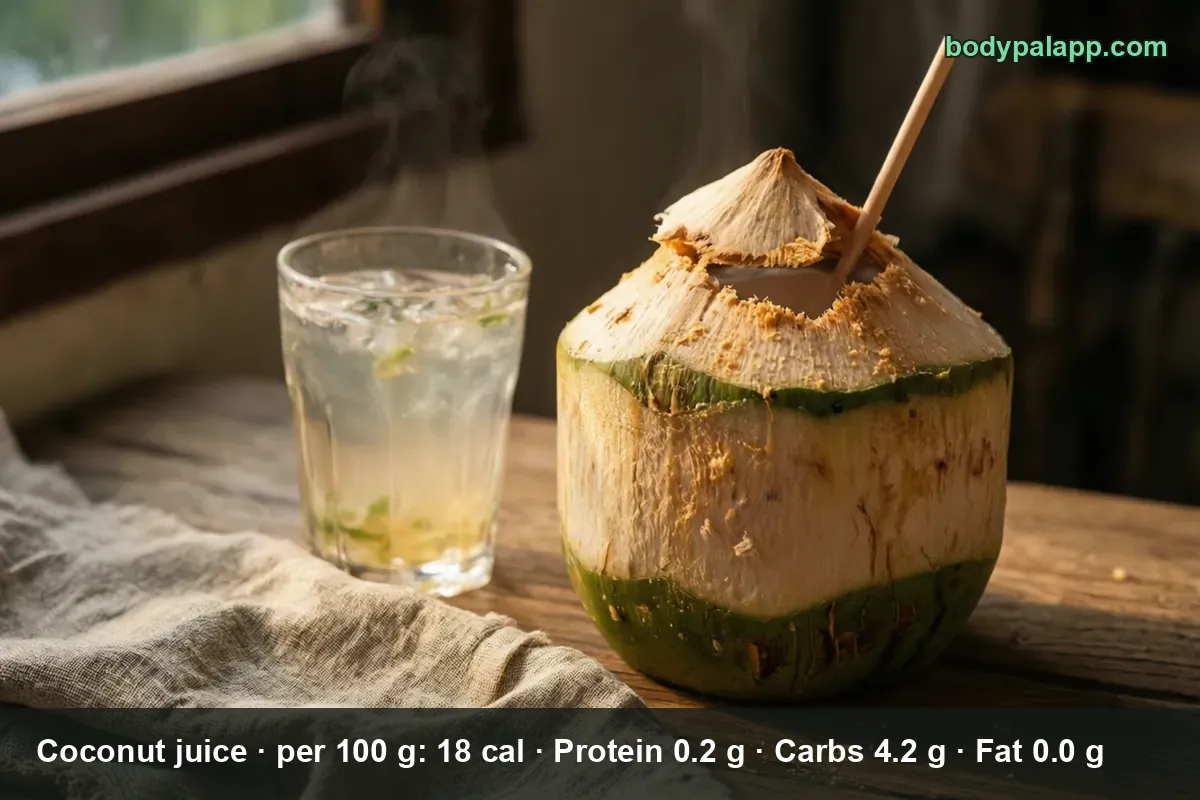
The water drained from one coconut weighs 206 g and carries 37 calories. Per 100 g, unsweetened coconut juice runs 18 calories, which makes it one of the lightest things you can pour into a glass. A full 8 fl oz cup is 43. Sweetened bottles and canned juice with pulp are a different drink entirely.
On this page
- Coconut juice quick facts
- US servings, from one ounce to a whole coconut
- Sweetened, canned and straight from the nut
- Coconut juice is not coconut milk
- Potassium is the row that matters
- How does coconut juice compare?
- Most popular coconut juice brands
- FAQ
Coconut juice quick facts
The record behind this page is FNDDS 2707572, "Coconut water, unsweetened". It is the entry that carries real household measures for the drink people actually pour — one coconut yields 206 g, a cup is 240 g — and it matches both the liquid sipped straight from a young nut and the plain, unsweetened stuff sold on tap or in a carton. Its numbers are identical to the older SR Legacy record 174831, the ready-to-drink line, because one is the source of the other.
Sweetened bottles and the canned "young coconut juice with pulp" you find in the Asian grocery aisle sit further down this page. They are the same fruit and a very different calorie count.
| Nutrient | Per 100 g | Per 1 coconut (206 g) | % Daily Value |
|---|---|---|---|
| Calories | 18 | 37 | — |
| Total fat | 0 g | 0 g | 0% |
| Saturated fat | 0 g | 0 g | 0% |
| Carbohydrate | 4.24 g | 8.7 g | 3% |
| Dietary fiber | 0 g | 0 g | 0% |
| Total sugars | 3.92 g | 8.1 g | — |
| Protein | 0.22 g | 0.5 g | 1% |
| Sodium | 26 mg | 54 mg | 2% |
| Cholesterol | 0 mg | 0 mg | 0% |
| Potassium | 165 mg | 340 mg | 7% |
% Daily Value is based on a 2,000-calorie diet.
Verified nutrition data
Numbers on this page come from USDA FoodData Central, the U.S. Department of Agriculture’s food composition database, and from manufacturer labels where a branded product is named. Last verified September 2026. How we verify our data →
Two rows are missing on purpose. Added sugars and trans fat are not published in this record, so there is nothing honest to print: unsweetened coconut water has no sugar added to it, and its fat is zero either way. Every gram of sugar in the table is the fruit's own. If you want the FDA's Daily Value reference to check the percentages against, it is the same 2,000-calorie basis used on every US label.
US servings, from one ounce to a whole coconut
| Serving | Weight | Calories |
|---|---|---|
| 1 fl oz, over ice | 23 g | 4 kcal |
| 1 fl oz poured, no ice | 30 g | 5 kcal |
| 1 oz | 28 g | 5 kcal |
| The water from one coconut | 206 g | 37 kcal |
| 1 cup, 8 fl oz | 240 g | 43 kcal |
| Per 100 g | 100 g | 18 kcal |
The coconut, the cup and both fluid-ounce lines are USDA household measures for this record. The 1 oz row is our own arithmetic from the USDA 100 g figure, not a USDA serving, and it exists because kitchen scales weigh in ounces while glasses fill in fluid ounces.
That difference matters more here than with most drinks. A fluid ounce with ice in the glass weighs 23 g, the same pour without ice weighs 30 g, and an ounce on a scale is 28 g. Three units, three weights, a spread of about 1 calorie. At 18 calories per 100 g the errors are too small to chase, which is the practical takeaway: log the glass, not the gram.
Sweetened, canned and straight from the nut
| Version | Per 100 g | Typical serving | Calories |
|---|---|---|---|
| Coconut water, ready-to-drink | 18 kcal | 1 cup (240 g) | 43 kcal |
| Straight from the young coconut | 19 kcal | 1 cup (240 g, our arithmetic) | 46 kcal |
| Coconut water, sweetened | 37 kcal | 1 can (360 g) | 133 kcal |
| Coconut milk beverage, carton | 31 kcal | 1 cup (244 g) | 76 kcal |
| Coconut milk, canned | 197 kcal | 1 oz (28 g, our arithmetic) | 56 kcal |
| Coconut milk for cooking | 230 kcal | 1 fl oz (30 g) | 69 kcal |
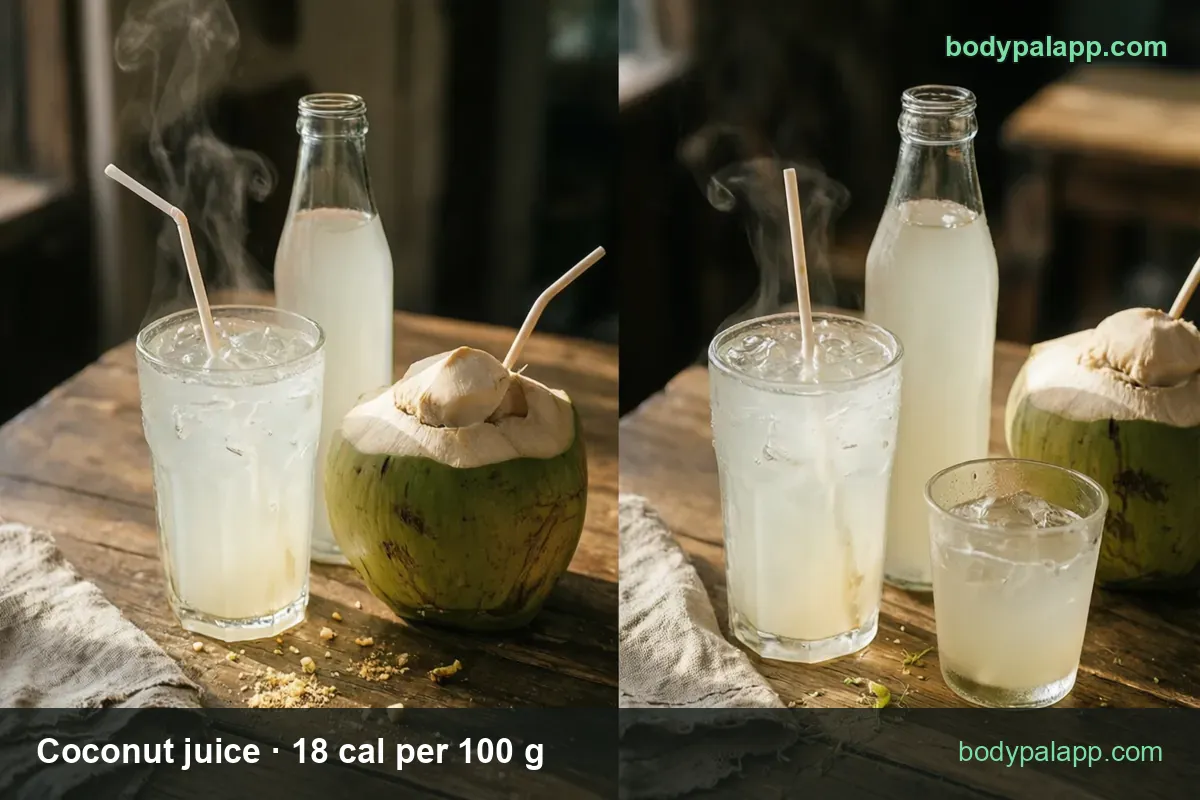
Sweetening is the single biggest lever. At 37 calories per 100 g, sweetened coconut water is more than double the unsweetened figure, so a 360 g bottle lands at 133 calories where the plain version of the same bottle would be 65.
Canned "young coconut juice with pulp" is not coconut water with bits in it — it is a sugared drink with strips of coconut meat. The USDA branded records put Wei-Chuan's version at 43 calories per 100 g, which is 151 for the 350 ml can, and TASCO's at 32, or 80 per 250 ml. FOCO's plain coconut juice is 33 per 100 g, 79 for a 240 ml serving, and the roasted version is 42, or 101. Sun Tropics is the light one on that shelf at 21 per 100 g, 50 for 240 ml. So a single can can be anything from about 50 to about 151 calories depending on the label, and none of them match the 43 you would get from a cup of the unsweetened drink.
The liquid drained straight from a young nut has its own record at 19 calories per 100 g, a hair above the bottled figure. What changes is not the calories but the minerals: it carries 105 mg of sodium per 100 g against 26 mg in the bottled unsweetened version, along with a little pulp — 1.1 g of fiber and 0.72 g of protein per 100 g.
Coconut juice is not coconut milk
This is the mix-up that wrecks a food diary. Coconut juice is the water inside the shell; coconut milk is the fat pressed out of the grated meat, and the gap is enormous.
The carton drink sold as coconut milk beverage is watered down to 31 calories per 100 g, so a cup is 76. The canned coconut milk you cook curry with is 197 calories per 100 g, and the cooking-strength USDA record runs to 230 — a single fluid ounce is 69 calories, more than a whole cup of coconut juice. Saturated fat is where it shows: canned coconut milk carries 18.91 g per 100 g, cooking coconut milk 21.14 g, and coconut juice a flat zero.
Put plainly: one fluid ounce of coconut milk for cooking outweighs eight fluid ounces of coconut juice by 26 calories.
Potassium is the row that matters
The electrolyte people buy coconut juice for is potassium, not sodium. The water from one coconut delivers 340 mg of potassium, 7% of the Daily Value, against 54 mg of sodium, or 2%. That sodium figure is worth about a fortieth of a teaspoon of table salt, so this is not a salty drink by US label standards.
Potassium is one of the four nutrients the Dietary Guidelines flag as under-consumed in the US, and the NIH Office of Dietary Supplements potassium fact sheet puts the adult Daily Value at 4,700 mg. Three cups of coconut juice would still leave you around a quarter of the way there. It is a contributor, not a solution, and MyPlate's guidance on drinks still puts plain water first for everyday hydration.
The other surprise in the table is protein: 0.5 g in a whole coconut's worth of water, 1% of the Daily Value. Coconut juice is essentially sugar water with minerals, and its 8.1 g of sugar per coconut is all naturally occurring.
How does coconut juice compare?
| Drink | Per 100 g | US serving | Calories |
|---|---|---|---|
| Coconut juice, unsweetened | 18 kcal | one coconut, 206 g | 37 kcal |
| Coconut water, sweetened | 37 kcal | 1 can, 360 g | 133 kcal |
| Coconut milk beverage | 31 kcal | 1 cup, 244 g | 76 kcal |
| Coconut milk, used in cooking | 230 kcal | 1 fl oz, 30 g | 69 kcal |
Our take: if you are counting calories, unsweetened coconut juice is the pick and it barely registers — a cup at 43 calories costs less than most people's splash of creamer. Buy it plain and the label reads like water with potassium in it. Buy it sweetened, or canned with pulp, and you have at least doubled the number for a drink that tastes only slightly sweeter. And if the recipe calls for coconut milk, measure it: at 230 calories per 100 g it belongs in the fat column of your day, not the drinks column.
Most popular coconut juice brands in the United States
Ranked by how widely each product appears among foods sold in the United States, from the BodyPal food database of over 3.3 million products. Calories are the figures printed on each Nutrition Facts label, checked against USDA FoodData Central.
| Product | Calories (per 100 g) |
|---|---|
| FOCO Coconut Juice | 33 cal |
| FOCO Roasted Coconut Juice | 42 cal |
| TASCO Young Coconut Juice with Pulp | 32 cal |
| Wei-Chuan Young Coconut Juice with Pulp | 43 cal |
| Sun Tropics Coconut Juice | 21 cal |
| Faraon Coconut Juice with Pulp | 36 cal |
Brand popularity: BodyPal food database. Nutrition: manufacturer labels / USDA FoodData Central.
Coconut juice FAQs
How many calories are in coconut juice?
37 calories for the water drained from one coconut, 206 g, and 18 calories per 100 g. An 8 fl oz cup is 43 calories. That figure is for the unsweetened drink; sweetened bottles run 37 calories per 100 g, more than double, and canned juice with pulp is higher still.
Is coconut juice the same as coconut water?
In USDA terms, yes: unsweetened coconut juice and coconut water share the same record at 18 calories per 100 g. On US grocery shelves the label "coconut juice" is more often used for sweetened canned drinks with pulp, which run 32 to 43 calories per 100 g. Check the ingredients, not the front.
How many calories in a can of coconut juice with pulp?
About 80 to 151 calories, depending on the brand and can size. Wei-Chuan's 350 ml can of young coconut juice with pulp is 151 calories at 43 per 100 g; TASCO's 250 ml can is 80 at 32 per 100 g. The strips of coconut meat and the added sugar do the work.
Does coconut juice have added sugar?
Not in the unsweetened version: its 3.92 g of sugar per 100 g is the fruit's own, and 8.1 g in a whole coconut's worth. USDA does not publish an added sugars figure for this record. The sweetened record is 8.78 g of sugar per 100 g, and the difference is sugar poured in at bottling.
How much potassium is in coconut juice?
165 mg per 100 g, so 340 mg in the water from one coconut, which is 7% of the 4,700 mg Daily Value. Sodium is 26 mg per 100 g, or 54 mg per coconut. Potassium outweighs sodium roughly six to one, which is why the drink is sold as an electrolyte option.
Coconut juice vs coconut milk calories?
18 calories per 100 g for coconut juice against 230 for the coconut milk used in cooking, roughly thirteen times as much. The carton beverage sits between them at 31 per 100 g, so a cup is 76 calories. Juice is the water inside the shell; milk is fat pressed from the grated meat.
Is coconut juice good for hydration?
A cup gives you 240 g of fluid for 43 calories, plus 396 mg of potassium and 62 mg of sodium at the 100 g rates. That is a reasonable electrolyte mix for a light drink, though MyPlate still lists plain water as the everyday first choice because it costs nothing in calories.
Is coconut juice keto friendly?
It carries 4.24 g of carbohydrate per 100 g, so a coconut's worth is 8.7 g and a cup is 10.2 g, nearly all of it sugar. On a strict daily carb limit that cup is a real line item. If you are watching carbs, a single fluid ounce over ice is 1.0 g and lets you keep the flavor.
Similar foods
- Tomato Juice — 41 cal per cup
- Almond Milk Latte — 61 cal for 12 fl oz latte
- Kombucha — 60 cal per bottle
- Kombucha Tea — 40 cal per glass (8 fl oz)
- Vitamin Water — 125 cal per bottle
- Lime juice — 11 cal per Juice of 1 lime
Count it without the math
Point the camera at the glass and BodyPal counts it for you, pulp or no pulp.


How long does it take to burn off coconut juice?
One coconut (206 g) is 37 kcal. Enter your weight and the amount you ate to see how long it takes you to burn that off:
lb
| Activity | Time to burn 37 kcal |
|---|---|
| Walking, brisk | 7 min |
| Cycling, moderate | 5 min |
| Swimming, moderate | 5 min |
| Jogging | 4 min |
| Weight training, moderate | 8 min |
Times are for a 155 lb adult at a steady pace; change the weight to see yours. The amount is set to the portion in the text (206 g); change it to what you actually ate. BodyPal works this out from your steps automatically.
Burning it off is one side of it. The other is knowing your number: work out how many calories you need a day, with macros and a goal date.