Turkey leg calories come to 1,136 for a whole roasted leg of 546 g with skin, or 208 per 100 g. The number to notice is protein: 152.2 g in one leg, supplying 56 percent of its calories. Size is the catch, because a single leg covers 57 percent of a day's calorie value.
1136kcal
1 whole leg, bone removed · 546 g, roasted, meat and skin
56%protein
152 gProtein
0 gCarbs
54 gFat
How to burn off 1136 kcal
—Walking, brisk
—Jogging
—Cycling, moderate
—Swimming
Skip the math. BodyPal counts these calories from your steps and workouts automatically.
Nutrition facts
Roasted, meat and skin · per 546 g
Calories
1136 kcal
Protein
152 g
Carbohydrate
0 g
Fat
54 g
Saturated fat
16.7 g
Cholesterol
464 mg
Sodium
420 mg
Potassium
1529 mg
Iron
12.6 mg
Source: USDA FoodData Central
🛡️
Verified nutrition data
Numbers on this page come from USDA FoodData Central, the U.S. Department of Agriculture’s food composition database, and from manufacturer labels where a branded product is named. Last verified September 2026. How we verify our data →
Turkey leg: calories, protein and sodium by serving
Percent of daily value uses the FDA reference of 2,000 kcal a day.
Serving
kcal
Protein
Carbs
Fat
Sodium
% DV kcal
Whole leg (546 g)
1,136
152.2 g
0 g
53.6 g
420 mg
57%
3 oz portion (85 g)
177
23.7 g
0 g
8.3 g
65 mg
9%
100 g
208
27.9 g
0 g
9.8 g
77 mg
10%
Raw leg (816 g)
1,175
159.4 g
0 g
54.8 g
604 mg
59%
3 × Whole leg (546 g)
3,407
456.5 g
1,261 mg
5 × Whole leg (546 g)
5,678
760.9 g
2,102 mg
A whole roasted leg is a 1,136-calorie meal
A whole roasted turkey leg with skin weighs 546 g and lands at 1,136 calories. That is 57 percent of the daily value for calories in one item, so it behaves like a full meal rather than a side of meat. Most people eat it exactly that way, and the plate around it pushes the total higher still.
The 3 oz portion (85 g) is the more practical unit if you carve the leg at home. It comes to 177 calories with 23.7 g of protein and 8.3 g of fat, roughly 9 percent of the daily calorie value. Weighing the carved meat you actually serve gives a far better log than guessing from the size of the drumstick.
Totals climb fast when legs are eaten in pairs or passed around a holiday table. Two whole legs come to 2,271 calories and 304.3 g of protein, and three reach 3,407 calories. Those are platter numbers, not plate numbers. If the total matters to you, splitting a leg with someone is the easiest lever you have.
Protein supplies 56 percent of the calories
Per 100 g, roasted turkey leg with skin has 27.9 g of protein, 9.8 g of fat and 0 g of carbohydrate. In calorie terms that splits 56 percent protein and 44 percent fat. There is no sugar and no fiber, so every calorie comes from those two macros and nothing else.
The protein figures are large by any standard. A whole leg carries 152.2 g, which is 304 percent of the daily value, and even the modest 3 oz portion covers 47 percent. If you track protein, a few ounces of leg meat does most of the work for a meal.
Fat is the other half of the story. A whole leg holds 53.6 g of fat, and saturated fat sits at 3.1 g per 100 g. These figures cover meat and skin together, so they describe the leg the way most people eat it, crisp skin included. Dark leg meat is richer than a lean cut, and the numbers show it.
Raw weight and roasted weight tell different stories
The card lists a raw leg at 816 g and 1,175 calories, against 546 g and 1,136 calories once roasted. The cooked leg is much lighter on the scale, yet the calorie totals sit close together. Roasting drives off water, so each gram of cooked meat packs more energy than a gram of raw meat.
That is why the weight you log matters. If you weigh the leg raw, use the raw row; if you weigh it after cooking, use the 208 per 100 g figure for roasted meat and skin. Applying raw values to a cooked weight makes the portion look lighter than it really is, and that error repeats every time you log it.
Protein follows the same pattern: 159.4 g in the raw leg and 152.2 g in the roasted one. Sodium reads 604 mg raw and 420 mg roasted. Plain roasting, in other words, adds no salt of its own, so anything above these figures comes from what you put on the bird.
Plain roast leg is light on sodium; seasoning is not
A whole roasted leg has 420 mg of sodium, 18 percent of the daily value, and the 3 oz portion has 65 mg, just 3 percent. For a meat this filling, that is a modest row. Cholesterol reads 85 mg per 100 g, and potassium comes in at 280 mg.
The catch is what goes on the leg. These numbers describe plain roasted turkey, so brines, rubs, smoking cures and gravy are not counted. Fair and theme-park legs are often smoked and cured, so if you watch sodium, treat the 420 mg figure as a floor rather than an estimate for those.
Because the leg has 0 g of carbohydrate and 0 g of fiber, the sides decide the rest of the meal. Vegetables, a whole grain or a salad add the fiber the meat lacks without much fuss. BodyPal can log the leg and its sides from a photo, so the full plate shows up as one entry.
How does turkey leg compare?
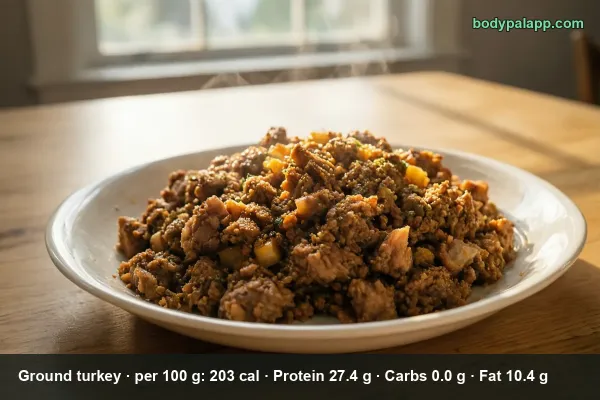
Here is how turkey leg stacks up against chicken leg quarter, ground turkey and turkey sausage, per 100 g and per usual serving.
Verdict: For the fewest calories per 100 g, chicken leg quarter wins at 184 against 208 for turkey leg, though its 258 g serving still comes to 475. For protein, turkey leg and ground turkey lead with 27.9 g and 27.4 g per 100 g, while turkey sausage trails at 19.7 g and carries 705 mg of sodium.
Turkey leg FAQs
How many calories are in a turkey leg?
A whole roasted turkey leg with the bone removed (546 g) is about 1,136 calories. A 3 oz portion of the same meat is 177 calories.
Is turkey leg good for weight loss?
A 3 oz portion has 177 calories and 23.7 g protein, while a whole 546 g leg is 1,136 calories, so the portion size decides how it fits a daily target.
Turkey leg vs ground turkey: which has more calories?
Roasted turkey leg has 208 calories per 100 g and ground turkey has 203 per 100 g, a difference of about 5 calories.
How much protein is in a turkey leg?
Roasted turkey leg has 27.9 g protein per 100 g, so a whole 546 g leg gives about 152 g protein along with 9.8 g fat per 100 g.
How many calories are in 100 g of turkey leg?
Roasted turkey leg with skin has 208 calories per 100 g. That amount also brings 27.9 g of protein, 9.8 g of fat and 0 g of carbohydrate, about 10 percent of the daily calorie value.
What are the macros of a turkey leg?
A whole roasted leg of 546 g has 152.2 g of protein, 53.6 g of fat and 0 g of carbs. By calories, that is 56 percent protein and 44 percent fat, with no sugar or fiber at all.
How much protein is in a 3 oz serving of turkey leg?
A 3 oz portion (85 g) of roasted leg meat with skin has 23.7 g of protein, 47 percent of the daily value, for 177 calories. Per 100 g, the protein figure is 27.9 g.
How much sodium is in a turkey leg?
A whole plain roasted leg has 420 mg of sodium, 18 percent of the daily value, and a 3 oz portion has 65 mg. Smoked, brined or heavily seasoned legs will run higher than these plain roasted figures.
How much protein is in a turkey leg from the fair?
A plain roasted leg of 546 g carries 152.2 g of protein, the closest reference in the data. Fair legs vary in size and are often smoked, so weigh yours and estimate with 27.9 g of protein per 100 g.