
How many calories are in turkey pastrami?
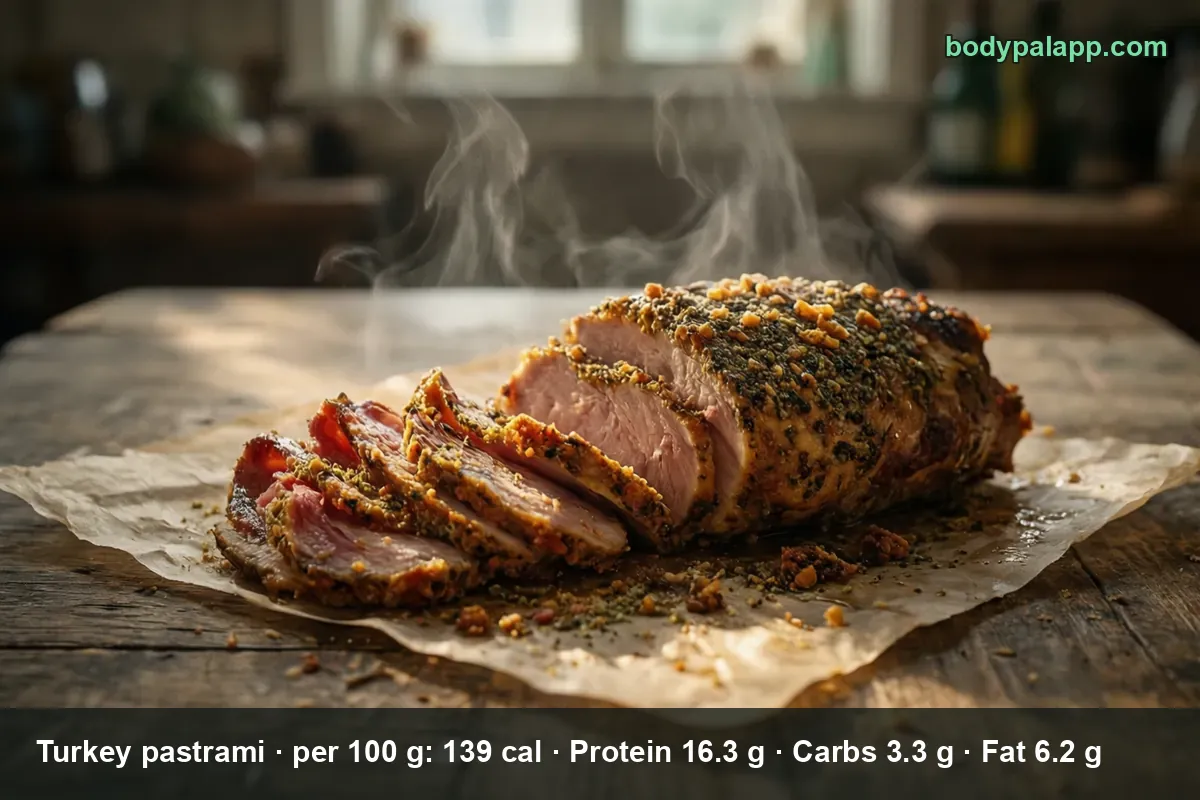
Two slices of deli turkey pastrami weigh 57 g and carry 79 calories. Per 100 g the meat runs 139 calories, with 16.3 g of protein and 6.21 g of fat. It is one of the leanest things at the deli counter by calories, and one of the saltiest by weight.
On this page
- Turkey pastrami quick facts
- US servings from one slice to an 8 oz package
- Turkey pastrami vs beef pastrami and the rest of the deli case
- Sodium is the ceiling not calories
- How does turkey pastrami compare?
- Most popular turkey pastrami brands
- FAQ
Turkey pastrami quick facts
The number people need is for the product they actually pick up: pre-sliced turkey pastrami from the deli case or a sealed 8 oz package. That is USDA SR Legacy 172927, "Pastrami, turkey", the only generic USDA record for the food, and it is the one every figure on this page is scaled from.
Store labels swing from 125 to 143 calories per 100 g depending on how much brine the maker pumps in. The USDA generic sits at 139, near the top of that band, so if your package prints a smaller number it is not a contradiction, just a leaner recipe.
| Nutrient | Per 100 g | Per 2 slices (57 g) | % Daily Value |
|---|---|---|---|
| Calories | 139 | 79 | — |
| Total fat | 6.21 g | 3.5 g | 5% |
| Saturated fat | 1.4 g | 0.8 g | 4% |
| Carbohydrate | 3.34 g | 1.9 g | 1% |
| Dietary fiber | 0.1 g | 0.1 g | 0% |
| Total sugars | 3.34 g | 1.9 g | — |
| Protein | 16.3 g | 9.3 g | 19% |
| Sodium | 1123 mg | 640 mg | 28% |
| Cholesterol | 68 mg | 39 mg | 13% |
| Potassium | 345 mg | 197 mg | 4% |
% Daily Value is based on a 2,000-calorie diet.
Verified nutrition data
Numbers on this page come from USDA FoodData Central, the U.S. Department of Agriculture’s food composition database, and from manufacturer labels where a branded product is named. Last verified September 2026. How we verify our data →
Two rows you would see on a package are missing above: added sugars and trans fat. The SR Legacy edition of this record does not publish either value, so they are left out rather than guessed. Everything else is straight from the record, with the 57 g column scaled from the 100 g figures.
One detail worth catching before you scroll: carbohydrate and total sugars are the same number, 3.34 g. Every gram of carbohydrate in turkey pastrami is sugar, and it comes from the curing brine, not from anything the bird did.
US servings from one slice to an 8 oz package
| Serving | Weight | Calories |
|---|---|---|
| 1 oz | 28 g | 39 kcal |
| 1 slice | 28.5 g | 40 kcal |
| 2 slices, a light sandwich | 57 g | 79 kcal |
| 3 oz sandwich pile | 85 g | 118 kcal |
| 1 package, 8 oz | 227 g | 316 kcal |
| Per 100 g | 100 g | 139 kcal |
The 57 g two-slice serving and the 227 g package are USDA household measures. The 1 oz line, the single slice and the 3 oz deli pile are our own arithmetic from the USDA 100 g figure, not USDA servings, which is why a slice lands at 40 calories and an ounce at 39: a generic slice weighs 28.5 g, half a gram more than an ounce.
Deli slices are also thinner than most people picture. A sandwich built the way a counter builds it takes about 3 oz of meat, five or six slices, which is 118 calories rather than the 79 you would log from a two-slice habit. The bread and the dressing will still cost you more than the pastrami does.
Brand labels line up with this. Jennie-O, Lipari Old Tyme, Empire Kosher and Castle Wood Reserve all print 70 calories per 2 oz serving; Butterball prints 80, and Foster Farms Hickory Smoked prints 40 for a single 28 g slice. None of them is far from the generic figure.
Turkey pastrami vs beef pastrami and the rest of the deli case
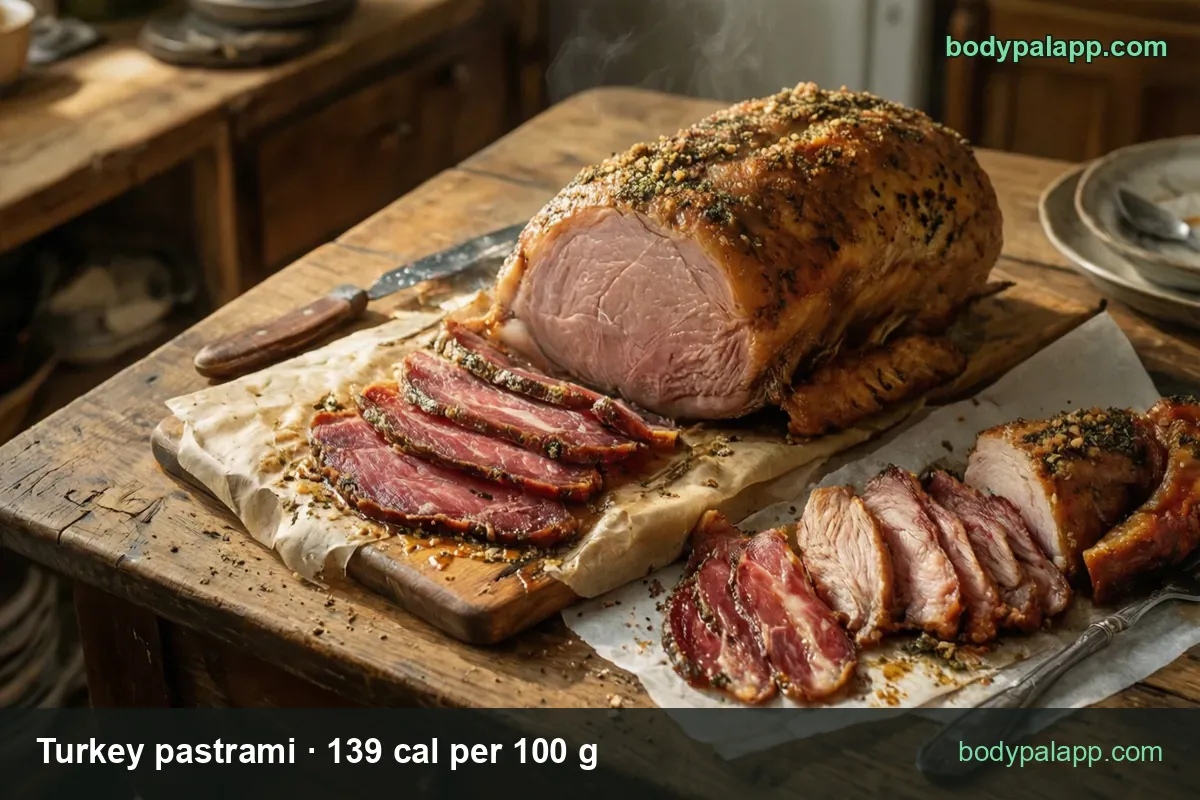
Turkey pastrami is bought as the light option. Against the rest of the case, that reputation only half holds.
| Deli meat | Per 100 g | Typical serving | Calories | Sodium per 100 g |
|---|---|---|---|---|
| Turkey pastrami | 139 kcal | 2 oz (57 g) | 79 kcal | 1123 mg |
| Beef pastrami | 147 kcal | 2 oz (57 g) | 84 kcal | 1043 mg |
| Turkey ham, extra lean | 134 kcal | 2 oz (57 g) | 76 kcal | 1035 mg |
| Oven-roasted chicken breast roll | 134 kcal | 2 oz (57 g) | 76 kcal | 1069 mg |
| Extra lean low-sodium smoked ham | 141 kcal | 2 oz (57 g) | 80 kcal | 402 mg |
| Peppered loaf | 149 kcal | 2 oz (57 g) | 85 kcal | 1350 mg |
| Chopped smoked cured beef | 133 kcal | 1 slice (28 g) | 37 kcal | 1341 mg |
Three of the six alternatives are lighter per 100 g than turkey pastrami, and none of them by more than 6 calories. The whole case fits inside a 16-calorie band, from 133 to 149 per 100 g. Choosing by calories here is choosing between numbers that a slightly thicker slice would erase.
Beef pastrami is the comparison people actually make. It is 147 calories per 100 g against turkey's 139, a gap of 8, and it carries more protein: 21.8 g per 100 g against 16.3 g. The turkey version is not even lower in fat, at 6.21 g against beef's 5.82 g. Where turkey does win is saturated fat, 1.4 g per 100 g against 2.29 g, which is 0.8 g against 1.3 g on a 2 oz serving.
Sugar is the other split. Turkey pastrami has 3.34 g per 100 g, more than nine times the 0.36 g in beef pastrami. Turkey breast takes a sweeter cure, and on a deli meat that is unusual enough to notice on the label.
If sodium is what you are managing, the extra lean low-sodium smoked ham is the only real escape in this group at 402 mg per 100 g, less than half of turkey pastrami's 1,123 mg. Peppered loaf and chopped smoked cured beef go the other way, at 1,350 mg and 1,341 mg.
Sodium is the ceiling not calories
Turkey pastrami is a cheap protein by calories and an expensive one by salt. Two slices deliver 640 mg of sodium, 28% of the FDA Daily Value of 2,300 mg, for 79 calories. That is roughly a quarter teaspoon of table salt in two thin slices.
Scale it the way a sandwich is really built and the arithmetic turns. Five slices, about 142.5 g and the pile you would pull for lunch, is 198 calories and 1,600 mg of sodium, 70% of the day, before bread, pickles, mustard or cheese. A whole 8 oz package worked out from the same 100 g figure is 316 calories and roughly 2,549 mg of sodium, which is past a full day's Daily Value.
The protein side is the reason people keep buying it anyway: 9.3 g in two slices, 19% of the Daily Value, and 37 g in the whole package. If you are watching sodium, the CDC's sodium pages are the practical starting point, and the honest move with pastrami is to weigh the meat rather than count slices. If protein per calorie is what you are after, beef pastrami or turkey ham does the same job for slightly less salt.
One correction worth making: 1,123 mg per 100 g is the USDA generic, and real packages run wider than that, from under 700 mg to over 1,400 mg per 100 g. This is one row where reading your own label genuinely changes the answer.
How does turkey pastrami compare?
| Deli meat | Per 100 g | US serving | Calories |
|---|---|---|---|
| Turkey pastrami | 139 kcal | 2 oz (57 g) | 79 kcal |
| Beef pastrami | 147 kcal | 2 oz (57 g) | 84 kcal |
| Turkey ham, extra lean | 134 kcal | 2 oz (57 g) | 76 kcal |
| Oven-roasted chicken breast roll | 134 kcal | 2 oz (57 g) | 76 kcal |
Our take: the calorie spread across these four is 8 calories on a 2 oz serving, so pick on protein and salt instead. Per 100 calories, turkey pastrami gives 11.7 g of protein, beef pastrami 14.8 g and turkey ham 14.6 g; only the chicken breast roll is lower at 10.9 g. For weight loss, turkey ham at 76 calories and 19.6 g of protein per 100 g is the better buy. For a sandwich you want to taste, beef pastrami costs you 5 extra calories per serving and hands back 3 g more protein. Turkey pastrami earns its place on flavor and on saturated fat, not on the calorie count.
Federal advice on how these fit a week of meals sits in the Dietary Guidelines for Americans, which treat cured meats as an occasional protein rather than a daily one.
Most popular turkey pastrami brands in the United States
Ranked by how widely each product appears among foods sold in the United States, from the BodyPal food database of over 3.3 million products. Calories are the figures printed on each Nutrition Facts label, checked against USDA FoodData Central.
| Product | Calories (per 100 g) |
|---|---|
| Jennie-O Turkey Pastrami | 125 cal |
| Foster Farms Turkey Pastrami Hickory Smoked | 143 cal |
| Lipari Old Tyme Turkey Pastrami | 125 cal |
| Butterball Turkey Pastrami | 143 cal |
| Empire Kosher Classic Turkey Pastrami | 125 cal |
| Castle Wood Reserve Turkey Pastrami | 125 cal |
Brand popularity: BodyPal food database. Nutrition: manufacturer labels / USDA FoodData Central.
Turkey pastrami FAQs
How many calories are in turkey pastrami?
139 calories per 100 g, which works out to 79 calories for a 57 g two-slice serving and 316 for a full 8 oz package. A single generic slice of 28.5 g is 40 calories. Store brands range from 125 to 143 calories per 100 g depending on the recipe.
How many calories are in 2 slices of turkey pastrami?
79 calories for two slices weighing 57 g together. That serving also carries 9.3 g of protein, 3.5 g of fat and 640 mg of sodium. Deli slices vary in thickness, so weighing them beats counting them: a 3 oz sandwich pile of 85 g is 118 calories.
Is turkey pastrami healthier than beef pastrami?
Only in one column: turkey pastrami is 139 calories per 100 g against beef's 147, and 1.4 g of saturated fat against 2.29 g. But beef carries 21.8 g of protein against 16.3 g, slightly less total fat at 5.82 g, and less sugar at 0.36 g against 3.34 g.
How much protein is in turkey pastrami?
16.3 g per 100 g, so 9.3 g in a 57 g two-slice serving, which is 19% of the Daily Value. A whole 8 oz package holds about 37 g. Per 100 calories that is 11.7 g of protein, less than beef pastrami's 14.8 g or turkey ham's 14.6 g.
How much sodium is in turkey pastrami?
1,123 mg per 100 g in the USDA record, so 640 mg in two slices, 28% of the 2,300 mg Daily Value. Five slices reach 1,600 mg, or 70% of a day. Packages vary widely, from under 700 mg to over 1,400 mg per 100 g, so check your own label.
Is turkey pastrami good for weight loss?
At 79 calories and 9.3 g of protein per two slices it is one of the cheaper deli proteins, so it fits a calorie target easily. Sodium is the catch, not calories. Extra lean turkey ham does much the same job at 134 calories per 100 g with 19.6 g of protein.
Does turkey pastrami have carbs or sugar?
3.34 g of carbohydrate per 100 g, and all of it is sugar, since total sugars read 3.34 g too. That is 1.9 g per two-slice serving, about 1% of the Daily Value for carbohydrate. Beef pastrami has only 0.36 g, so the sugar here comes from the turkey cure.
Is turkey pastrami processed meat?
Yes, and 1,123 mg of sodium per 100 g is the evidence: it is brined, seasoned, pressed and smoked, which is how a bird that starts near zero gets there. That processing is also what gives it the peppercorn crust and the 3.34 g of sugar. Treat it as an occasional sandwich meat rather than a daily staple.
Similar foods
- Chicken Divan — 330 cal per cup
- Pork Tenderloin — 122 cal per 3 oz
- Chicken And Dumplings — 351 cal per cup
- Ham Off The Bone — 112 cal per 3 oz portion
- Steak And Potatoes — 456 cal per meal
- Turkey Breast — 125 cal per 3 oz
Count it without the math
Point the camera at the plate and BodyPal counts the pastrami for you, slice by slice.


How long does it take to burn off turkey pastrami?
Two slices (57 g) is 79 kcal. Enter your weight and the amount you ate to see how long it takes you to burn that off:
lb
| Activity | Time to burn 79 kcal |
|---|---|
| Walking, brisk | 16 min |
| Cycling, moderate | 10 min |
| Swimming, moderate | 11 min |
| Jogging | 9 min |
| Weight training, moderate | 18 min |
Times are for a 155 lb adult at a steady pace; change the weight to see yours. The amount is set to the portion in the text (57 g); change it to what you actually ate. BodyPal works this out from your steps automatically.
Want the bigger picture? Calculate your daily calorie needs — your maintenance figure, a target for losing or gaining, and the date you get there.