
How many calories are in a turnip?
A 1-cup serving of raw turnip cubes weighs 130 g and carries 36 calories. Per 100 g the root runs 28 calories, which puts it among the lightest things you can put on a cutting board. A whole medium turnip, 122 g, comes to 34. The sodium line is the one worth reading.
On this page
- Turnip quick facts
- US servings from one ounce to a full cup
- How cooking changes the number
- Turnip greens are a different vegetable
- Sodium is the row that moves
- How does turnip compare?
- Most popular turnip brands
- Turnip FAQs
Turnip quick facts
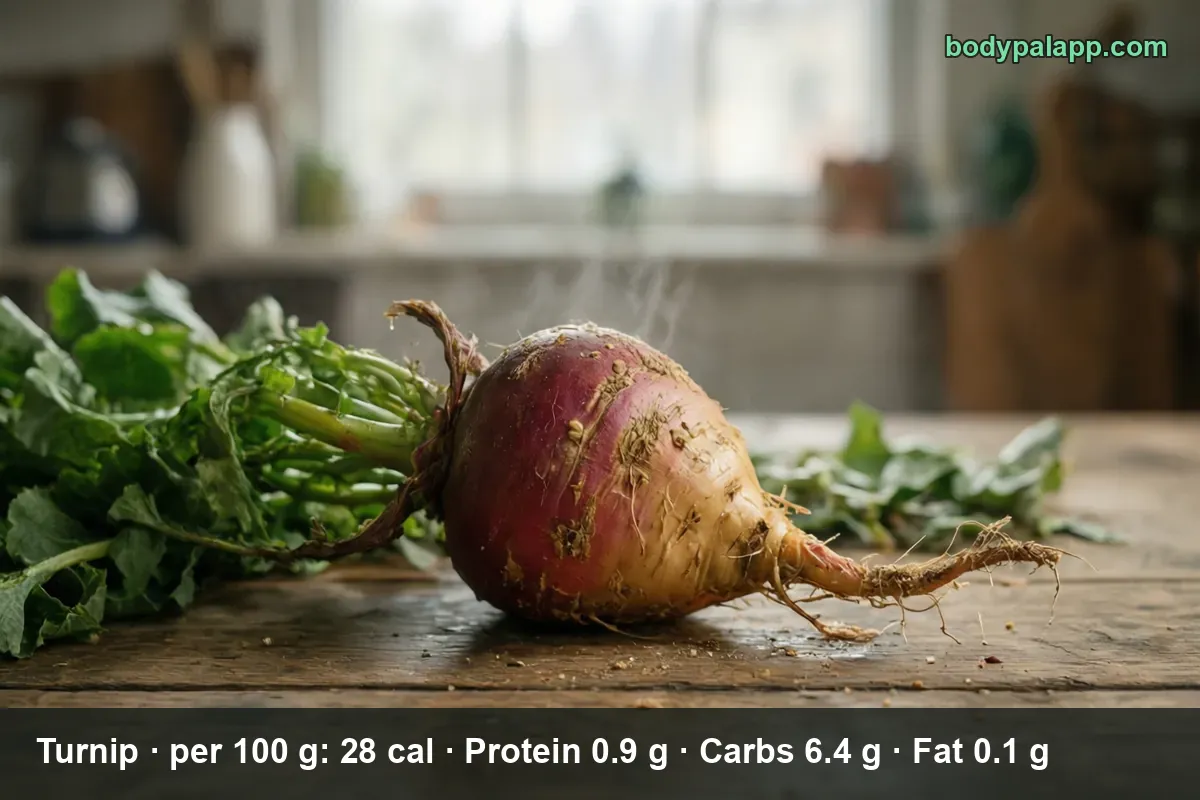
The row on this page is SR Legacy 170465, "Turnips, raw". That is the vegetable you are holding: a firm white root with a purple shoulder, bought whole, weighed before anything happens to it. USDA also carries a FNDDS entry for raw turnip that repeats the same values, so nothing is gained by switching.
Everything below scales from that record. Where a serving is not one of USDA's own household measures, the sentence says so.
| Nutrient | Per 100 g | Per 1 cup, cubes (130 g) | % Daily Value |
|---|---|---|---|
| Calories | 28 | 36 | — |
| Total fat | 0.1 g | 0.1 g | 0% |
| Saturated fat | 0.01 g | 0.0 g | 0% |
| Carbohydrate | 6.43 g | 8.4 g | 3% |
| Dietary fiber | 1.8 g | 2.3 g | 8% |
| Total sugars | 3.8 g | 4.9 g | — |
| Protein | 0.9 g | 1.2 g | 2% |
| Sodium | 67 mg | 87 mg | 4% |
% Daily Value is based on a 2,000-calorie diet.
Verified nutrition data
Numbers on this page come from USDA FoodData Central, the U.S. Department of Agriculture’s food composition database, and from manufacturer labels where a branded product is named. Last verified September 2026. How we verify our data →
There is no added sugars row here because SR Legacy does not publish that field for whole raw vegetables, and a turnip pulled out of the ground has none anyway. Cholesterol is 0 mg, as it is for every plant food. Potassium is the quiet win: 191 mg per 100 g, or 248 mg in a cup, 5% of the Daily Value the FDA sets for a nutrient most Americans fall short on.
One number surprises people every time: 67 mg of sodium per 100 g, before any salt touches the pan. Turnips take it up from the soil. It is a small figure, but it means a turnip is not a zero-sodium food the way an apple nearly is.
US servings from one ounce to a full cup
| Serving | Weight | Calories |
|---|---|---|
| 1 oz raw | 28 g | 8 kcal |
| 1 small turnip | 61 g | 17 kcal |
| 1/2 cup, cubes | 65 g | 18 kcal |
| 1 medium turnip | 122 g | 34 kcal |
| 1 cup, cubes | 130 g | 36 kcal |
| Per 100 g | 100 g | 28 kcal |
Four of those are USDA's own household measures for record 170465: the cup and half cup of cubes, the medium root and the small root. The 1 oz line is our own arithmetic from the USDA 100 g figure, not a USDA serving, and it is there because supermarket price stickers talk in ounces.
Watch the cup-versus-root trap. A cup of cubes, 130 g, weighs more than a whole medium turnip, 122 g, because cubing packs the flesh in tighter than the round shape ever could. If you log "1 turnip" when you actually filled a measuring cup with cubes, you are under by a few calories. At this calorie level that hardly matters. At the level of a starchy root, the same mistake would cost you three times as much.
Peeling changes things too. The weights above are for trimmed, ready-to-eat turnip, so a 150 g turnip fresh from the bag lands somewhere near the medium line once the skin and the woody top are off.
How cooking changes the number
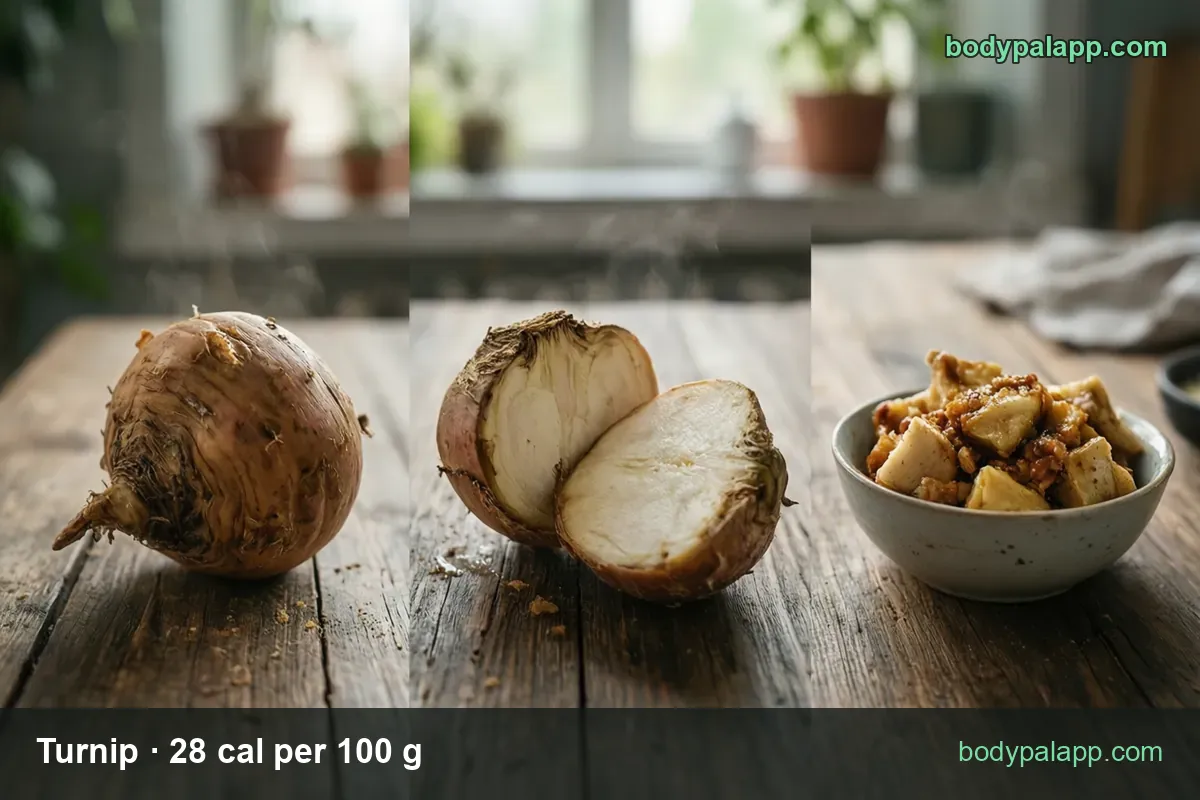
USDA keeps seven records for the turnip root and one for the greens. Here are the ones you will actually cook.
| Version | Per 100 g | Typical portion | Calories | Sodium per 100 g |
|---|---|---|---|---|
| Raw, cubed | 28 kcal | 1 cup, cubes (130 g) | 36 kcal | 67 mg |
| Boiled and drained, no salt | 22 kcal | 1 cup, cubes (156 g, our arithmetic) | 34 kcal | 16 mg |
| Boiled and drained, salted water | 22 kcal | 1 cup, cubes (156 g, our arithmetic) | 34 kcal | 286 mg |
| Cooked with fat added | 54 kcal | 1 cup, cubes (156 g, our arithmetic) | 84 kcal | 200 mg |
| Pickled | 44 kcal | 1 oz (28 g, our arithmetic) | 12 kcal | 1000 mg |
| Frozen, unprepared | 16 kcal | 1/3 package, mashed (94 g) | 15 kcal | 25 mg |
| Frozen, then boiled | 23 kcal | 1 cup, cubes (156 g, our arithmetic) | 36 kcal | 36 mg |
Boiling takes the root down to 22 calories per 100 g. That is not magic, it is water: the flesh soaks it up, some sugar leaches into the pot, and sugars fall from 3.8 g to 2.99 g per 100 g. The cooked cup weighs more than the raw cup, so the two land almost on top of each other at 34 and 36 calories. Fiber holds at 2 g per 100 g, which works out to 3.1 g in a cooked cup, 11% of the Daily Value, against 2.3 g and 8% raw. Boiled turnip is the cheaper cup on both counts.
The row that catches people out is FNDDS "Turnip, cooked" at 54 calories per 100 g. Read the fine print and it is turnip cooked the way households actually cook it, with fat in the pan: 2.84 g of fat per 100 g where the raw root has 0.1 g. That single change more than doubles the calories, and a 156 g cup comes to 84. Roasted turnip belongs here, not in the boiled row. The fat you roast it in is doing most of the counting.
Pickled turnip is the sweet one, not the light one. 8.02 g of total sugar per 100 g is more than double the raw root's 3.8 g, because the brine is sweetened, and the calories sit at 44. As a garnish on a sandwich, an ounce is 12 calories and nobody needs to worry.
Frozen turnip is the lightest record USDA publishes for this vegetable: 16 calories per 100 g unprepared, and a third of a package mashed is 15. It has been blanched, which is why it reads lower than raw. Both frozen rows also carry more protein per 100 g than the raw root, 1.04 g and 1.53 g against 0.9 g, though at this scale that is a rounding error on your day.
Readers often ask how turnip stacks up against rutabaga. USDA's record set behind this page does not include a rutabaga row, so we are leaving that comparison without a number rather than guessing at one.
Turnip greens are a different vegetable
The leafy tops get sold and logged as "turnip greens," and they are not the root. Raw greens run 32 calories per 100 g, a little above the root's 28, but the profile is a different plant part entirely: 3.2 g of fiber against 1.8 g, and 1.5 g of protein against 0.9 g. Sugars almost vanish, 0.81 g against 3.8 g.
If you bought a bunch with the leaves still attached, weigh and log them separately. Every other number on this page describes the root only. Vegetables of both kinds count toward the same MyPlate vegetable group, so there is no reason to pick one over the other on paper.
Sodium is the row that moves
Calories never move by more than a factor of four across the turnip records. Sodium swings by a factor of sixty.
Boil turnip in unsalted water and the root comes out at 16 mg of sodium per 100 g, a cup carrying 25 mg, about 1% of the Daily Value. Boil the same turnip in salted water and it reads 286 mg per 100 g, or 446 mg in a 156 g cup, which is 19% of the Daily Value and roughly a fifth of a teaspoon of table salt absorbed straight into the flesh. Same vegetable, same calories, eighteen times the sodium.
Pickled turnip goes further: 1,000 mg per 100 g, 43% of the day's sodium in a portion you would eat as a side. If you are watching blood pressure numbers, the salted-water and pickled rows are the ones to note, not the calorie column. Cooking with fat adds sodium too, 200 mg per 100 g, because seasoning comes with the butter.
None of this makes turnip a salty food. It makes the pot a salty step, and that is a choice you control.
How does turnip compare?
| Vegetable | Per 100 g | US portion | Calories | Protein per 100 g |
|---|---|---|---|---|
| Turnip, raw | 28 kcal | 1 cup, cubes (130 g) | 36 kcal | 0.9 g |
| Beets, canned, no salt added | 28 kcal | 100 g | 28 kcal | 0.8 g |
| Broccoli stalks, raw | 28 kcal | 100 g | 28 kcal | 2.98 g |
| Kale, frozen, unprepared | 28 kcal | 100 g | 28 kcal | 2.66 g |
Our take: all four are 28 calories per 100 g, so the calorie column tells you nothing here. Protein does. Broccoli stalks carry 2.98 g per 100 g and frozen kale 2.66 g, roughly three times what the turnip root gives you at 0.9 g. Turnip earns its place for texture and bulk in a mash or a roasting tray, not for what it contributes nutritionally per gram. If you want the same calories to work harder, put the greens or the broccoli stalks in the pan next to it.
Most popular turnip brands in the United States
Ranked by how widely each product appears among foods sold in the United States, from the BodyPal food database of over 3.3 million products. Calories are the figures printed on each Nutrition Facts label, checked against USDA FoodData Central.
| Product | Calories (per 100 g) |
|---|---|
| The Pick Turnip Noodles | 24 cal |
| Whole Foods Market Turnip Noodles | 24 cal |
| Sam's Fresh Foods Turnips Noodles | 24 cal |
Brand popularity: BodyPal food database. Nutrition: manufacturer labels / USDA FoodData Central.
Turnip FAQs
How many calories are in 1 cup of turnip?
36 calories in a cup of raw turnip cubes, 130 g on the scale. Per 100 g the raw root is 28 calories. A cup also gives 8.4 g of carbohydrate, 2.3 g of fiber and 1.2 g of protein, so it fills a plate for very little.
How many calories are in one turnip?
34 calories for one medium turnip of 122 g, and 17 for a small one of 61 g. Both are USDA household measures for the raw root at 28 calories per 100 g. Trim the woody top and peel the skin and the edible weight drops a little further.
How many carbs are in a turnip?
8.4 g of carbohydrate in a 1-cup serving of raw cubes, which is 3% of the Daily Value. Of that, 2.3 g is fiber and 4.9 g is naturally occurring sugar. Per 100 g the raw root holds 6.43 g of carbohydrate and 1.8 g of fiber.
Are turnips good for weight loss?
At 28 calories per 100 g, turnip is one of the cheapest ways to add bulk to a plate, and a full cup of cubes costs 36 calories with 2.3 g of fiber, 8% of the Daily Value. Boiled and drained without salt it falls to 22 per 100 g.
Is turnip healthier raw or cooked?
Boiling drops turnip to 22 calories per 100 g from 28 raw, and fiber edges up to 2 g. Sodium is the real difference: 16 mg per 100 g cooked without salt against 286 mg cooked in salted water. Raw keeps more natural sugar, 3.8 g against 2.99 g.
How many calories in roasted turnips?
54 calories per 100 g once turnip is cooked with fat, against 22 boiled and drained. That works out to 84 calories for a 156 g cup, our own arithmetic from the USDA 100 g figure. The oil does it: 2.84 g of fat per 100 g where the raw root has 0.1 g.
Do turnips have a lot of sugar?
3.8 g of total sugar per 100 g raw, or 4.9 g in a 1-cup serving, all of it naturally occurring. Pickled turnip is the outlier at 8.02 g per 100 g, more than double the raw root, because the brine is sweetened. Total sugars carry no Daily Value.
Are turnip greens more nutritious than the root?
Turnip greens run 32 calories per 100 g against 28 for the raw root, with 3.2 g of fiber and 1.5 g of protein where the root has 1.8 g and 0.9 g. They are a different part of the plant, and every other number on this page describes the root.
Similar foods
- Hearts Of Palm — 41 cal per cup
- Bamboo Shoots — 41 cal per cup sliced
- Jalapeno — 4 cal per pepper
- Spaghetti Squash — 42 cal per cup
- Spinach — 7 cal per cup
- Cherry Tomato — 13 cal per 5 tomatoes
Count it without the math
Point the camera at the cutting board and BodyPal counts the turnip for you, cubes, mash or roasting tray.


How long does it take to burn off turnip?
A 1-cup (130 g) serving of cubes is 36 kcal. Enter your weight and the amount you ate to see how long it takes you to burn that off:
lb
| Activity | Time to burn 36 kcal |
|---|---|
| Walking, brisk | 7 min |
| Cycling, moderate | 4 min |
| Swimming, moderate | 5 min |
| Jogging | 4 min |
| Weight training, moderate | 8 min |
Times are for a 155 lb adult at a steady pace; change the weight to see yours. The amount is set to the portion in the text (130 g); change it to what you actually ate. BodyPal works this out from your steps automatically.
This table assumes you know your daily total. If you do not, the daily calorie calculator works it out from five numbers.