
How many calories are in a jalapeno?
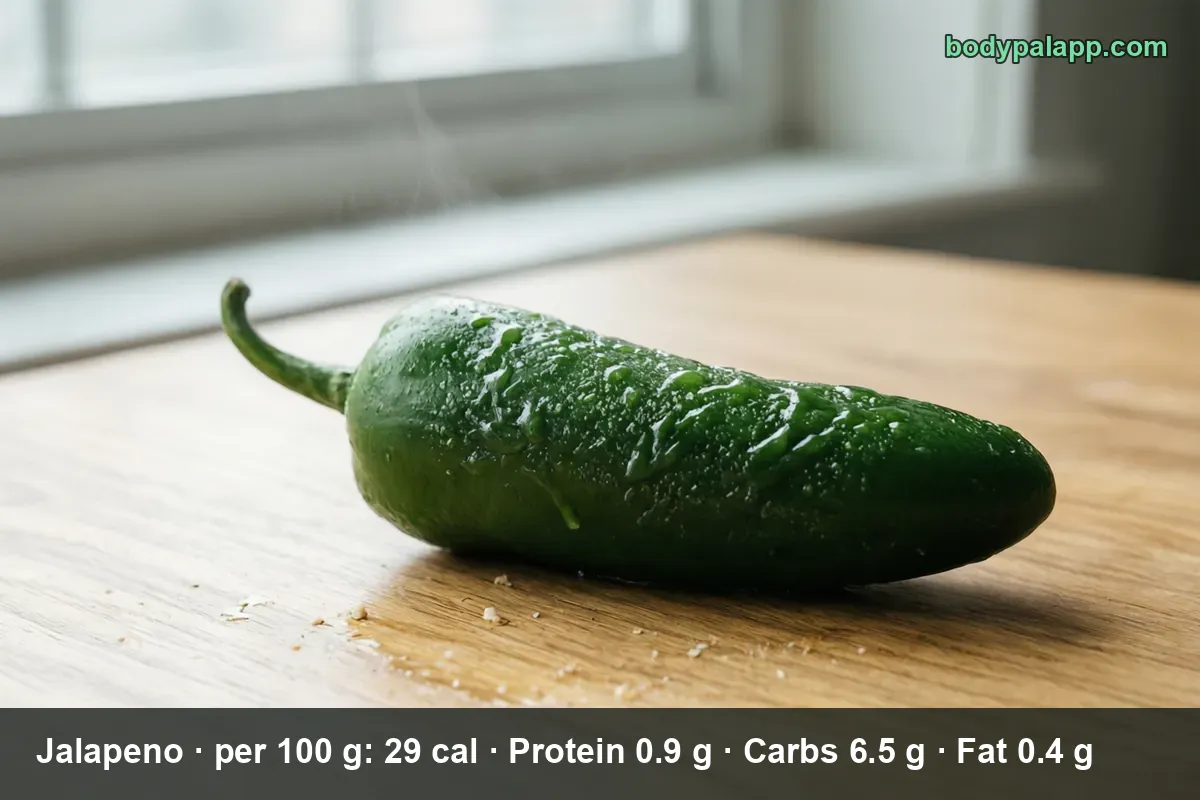
One whole jalapeno weighs about 14 g and carries just 4 calories. Per 100 g the raw pepper runs 29 calories, which sounds bigger until you notice that 100 g is roughly seven peppers. A full cup of sliced rings is 26. Heat is free — the calories only show up once the pepper gets battered or stuffed.
On this page
- Jalapeno quick facts
- US servings, from one pepper to a cup of rings
- Raw, pickled and stuffed
- Sodium is the row that moves
- How does a jalapeno compare?
- Most popular jalapeno brands
- FAQ
Jalapeno quick facts
The numbers below come from USDA SR Legacy 168576, "Peppers, jalapeno, raw". That is the record for the pepper most people are actually holding: a fresh green jalapeno off the produce shelf, stem still on, nothing pickled and nothing fried. USDA keeps separate records for the canned version and for the stuffed appetizer, and both sit further down this page with their own numbers.
The serving column uses one medium pepper at 14 g, the household size USDA lists for this record. It is small, and that is the point — a jalapeno is a seasoning by weight, not a vegetable side.
| Nutrient | Per 100 g | Per 1 pepper (14 g) | % Daily Value |
|---|---|---|---|
| Calories | 29 | 4 | — |
| Total fat | 0.37 g | 0.1 g | 0% |
| Saturated fat | 0.09 g | 0.0 g | 0% |
| Carbohydrate | 6.5 g | 0.9 g | 0% |
| Dietary fiber | 2.8 g | 0.4 g | 1% |
| Total sugars | 4.12 g | 0.6 g | — |
| Protein | 0.91 g | 0.1 g | 0% |
| Sodium | 3 mg | 0 mg | 0% |
| Cholesterol | 0 mg | 0 mg | 0% |
| Potassium | 248 mg | 35 mg | 1% |
% Daily Value is based on a 2,000-calorie diet.
Verified nutrition data
Numbers on this page come from USDA FoodData Central, the U.S. Department of Agriculture’s food composition database, and from manufacturer labels where a branded product is named. Last verified September 2026. How we verify our data →
There is no added-sugars row here because USDA does not publish added sugars for SR Legacy records, and a raw pepper has none anyway — the 4.12 g of total sugars per 100 g is the fruit's own. Those sugars are worth a second look: they make up nearly two-thirds of the pepper's 6.5 g of carbohydrate, which is why a jalapeno tastes faintly sweet under the burn. Daily Values are the FDA reference amounts explained in the Daily Value guide.
US servings, from one pepper to a cup of rings
| Serving | Weight | Calories |
|---|---|---|
| 1 pepper | 14 g | 4 kcal |
| 1 oz | 28 g | 8 kcal |
| 1/2 cup, sliced | 45 g | 13 kcal |
| 1 cup, sliced | 90 g | 26 kcal |
| Per 100 g | 100 g | 29 kcal |
One pepper, one ounce and one cup sliced are USDA household measures for this record. The half cup at 45 g is our own arithmetic from the USDA 100 g figure, not a USDA serving, and so is the "about seven peppers" it takes to reach 100 g.
The trap on this food is the unit, not the math. Recipe sites and label databases quote jalapeno per 100 g, and 100 g of jalapeno is a pile — seven whole peppers, or a heaping cup of rings. Nobody eats that. If you logged a single sliced jalapeno as 100 g you would be overstating it roughly sevenfold, and even then you would only be adding 25 calories. Weighing is barely worth the effort here; picking the right row is.
A cup of rings also brings 2.5 g of fiber and 5.9 g of carbohydrate, both scaled by us from the 100 g row. MyPlate counts peppers toward the vegetable group, and a cup of sliced jalapeno counts as a cup of vegetables the same way a cup of bell pepper does — you just will not eat it that way.
Raw, pickled and stuffed
| Version | Per 100 g | Typical piece | Calories |
|---|---|---|---|
| Raw jalapeno | 29 kcal | one pepper, 14 g | 4 kcal |
| Canned or pickled in brine | 27 kcal | one pepper, 22 g | 6 kcal |
| Jalapenos, survey average | 26 kcal | one whole, 15 g | 4 kcal |
| Stuffed jalapeno popper | 241 kcal | one popper, 25 g | 60 kcal |
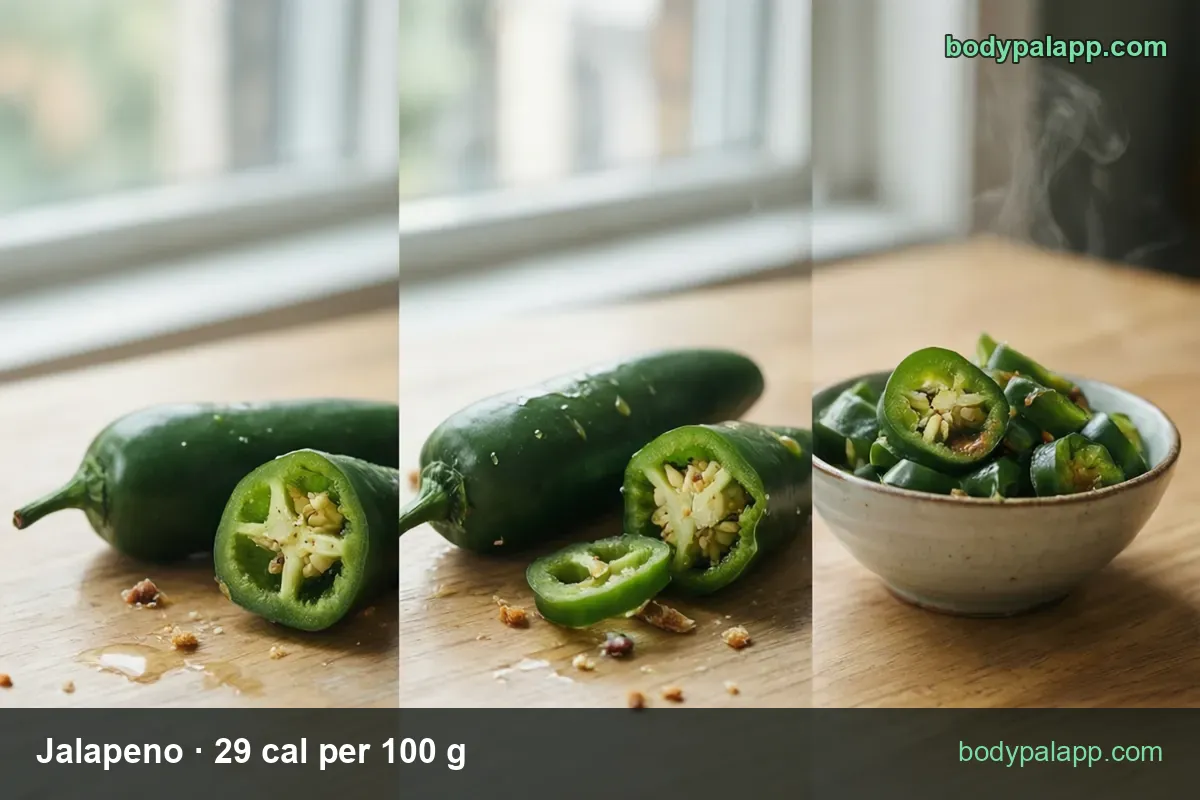
Canned jalapenos, solids and liquids, run 27 calories per 100 g — two fewer than raw. Pickling does not add calories, it adds salt, and the pickled peppers are heavier per piece because they soak up brine. Six calories for a pickled pepper against four for a raw one is a weight difference, not a processing penalty.
The FNDDS survey row for "Peppers, jalapenos" sits at 26 calories per 100 g. It is a blended profile built from what people reported eating, raw and pickled together, so it is the row to use when you genuinely do not know which kind went on the plate. When you do know, use the specific record.
Then there is the stuffed jalapeno popper at 241 calories per 100 g — more than eight times the raw pepper per gram. One 25 g popper is 60 calories, which is fifteen raw jalapenos in a single bite. Scaling the 100 g row, that popper also carries about 4.0 g of fat with 1.6 g of it saturated. The pepper is a delivery vehicle; the cheese and the breading are the food.
Jarred slices behave like the canned row. Mt. Olive and Mrs. Renfro's nacho slices both list 18 calories per 100 g, La Costena 17, Herdez 15, and Mrs. Klein's 29 — every one of them lands between 5 and 8 calories per label serving. The outlier is a sweetened style: Mt. Olive Sweet Heat Jalapeno Slices at 143 calories per 100 g, 40 calories for a 1 oz serving, because sugar rides along in the brine. If a jar of jalapenos ever reads over 100 calories per 100 g, it has been candied.
Sodium is the row that moves
Raw jalapeno holds 3 mg of sodium per 100 g. Canned holds 1,671 mg. That is the single largest change anything does to this food, and it has nothing to do with calories.
At 1,671 mg per 100 g, canned jalapenos hit 73% of the FDA Daily Value of 2,300 mg — about three-quarters of a teaspoon of table salt. Scale that to a cup of chopped canned peppers at roughly 136 g, our own arithmetic rather than a USDA serving, and you are at about 2,270 mg, essentially the whole day's reference amount from a garnish. US branded pickled slices sit in the same band, 1,464 to 1,879 mg per 100 g.
In practice nobody eats a cup of pickled jalapenos in one sitting. A tablespoon of nacho slices is closer to what lands on a plate, and that is a modest amount of sodium. But if you are already watching salt, the raw pepper is the free version and the jar is not — and the calorie count will never tell you that, because both rows read under 30.
Potassium runs the other way: 248 mg per 100 g, 35 mg in one pepper, which is 1% of the Daily Value. Jalapenos are not a potassium source at the amounts anyone eats them.
How does a jalapeno compare?
| Pepper or vegetable | Per 100 g | US serving | Calories |
|---|---|---|---|
| Jalapeno, raw | 29 kcal | 1 oz, 28 g | 8 kcal |
| Banana pepper, raw | 27 kcal | 1 oz, 28 g | 8 kcal |
| Peppers, raw, NFS | 27 kcal | 1 oz, 28 g | 8 kcal |
| Eggplant, raw | 25 kcal | 1 oz, 28 g | 7 kcal |
Our take: the jalapeno is the highest of these four per 100 g, and the gap is meaningless — four calories across the whole table, and at one ounce three of the four round to the same 8. If you are choosing a raw pepper on calories alone, stop; choose on flavor. The decisions that actually move your day's total are the jar, which brings the sodium, and the batter, which turns a 4-calorie pepper into a 60-calorie popper.
Most popular jalapeno brands in the United States
Ranked by how widely each product appears among foods sold in the United States, from the BodyPal food database of over 3.3 million products. Calories are the figures printed on each Nutrition Facts label, checked against USDA FoodData Central.
| Product | Calories (per 100 g) |
|---|---|
| Mt. Olive Jalapeno Slices | 18 cal |
| Mt. Olive Sweet Heat Jalapeno Slices | 143 cal |
| Mrs. Renfro's Nacho Sliced Jalapeno Peppers | 18 cal |
| Mrs. Klein's Sliced Jalapeno Peppers | 29 cal |
| La Costena Green Pickled Jalapeno Peppers | 17 cal |
| Herdez Whole Jalapenos | 15 cal |
Brand popularity: BodyPal food database. Nutrition: manufacturer labels / USDA FoodData Central.
Jalapeno FAQs
How many calories are in one jalapeno?
4 calories. One raw jalapeno weighs about 14 g, and at 29 calories per 100 g that lands on 4. A whole cup of sliced rings, 90 g, is still only 26. That is USDA SR Legacy 168576, the raw pepper row. The heat costs nothing — capsaicin carries no calories of its own.
How many calories in a cup of sliced jalapenos?
26 calories for a cup of sliced jalapenos, which USDA lists at 90 g. Half a cup is 13, our own arithmetic from the same 100 g figure. That cup also brings 2.5 g of fiber and 5.9 g of carbohydrate, which is a rounding error inside most daily totals.
Do pickled jalapenos have more calories than raw?
No, canned jalapenos are 27 calories per 100 g against 29 for raw, so the brine shaves a couple off rather than adding any. What changes is sodium: 3 mg per 100 g raw becomes 1,671 mg canned. Calories are not the reason to think twice about the jar.
How much sodium is in canned jalapenos?
1,671 mg per 100 g, which is 73% of the FDA Daily Value of 2,300 mg, or roughly three-quarters of a teaspoon of table salt. US branded pickled slices sit in the same band, 1,464 to 1,879 mg per 100 g. The raw pepper, by contrast, holds 3 mg.
How many carbs are in a jalapeno?
0.9 g of carbohydrate in one 14 g pepper, and 0.4 g of that is fiber. Per 100 g it is 6.5 g total with 2.8 g of fiber, leaving 3.7 g once fiber is subtracted — our own arithmetic, not a USDA field. A cup of sliced rings is 5.9 g.
How many calories in a jalapeno popper?
60 calories for one 25 g stuffed jalapeno popper, from the USDA survey record at 241 calories per 100 g. That is fifteen raw peppers in one appetizer. Scaling the same row, the cheese and breading bring about 4.0 g of fat, 1.6 g of it saturated, per popper.
Do jalapenos have sugar?
4.12 g of total sugars per 100 g, which is close to two-thirds of the pepper's 6.5 g of carbohydrate. One pepper holds 0.6 g. USDA does not publish added sugars for this SR Legacy record, and a raw pepper has none — the sugar is the fruit's own, not something added.
Is jalapeno a good source of fiber?
2.8 g of fiber per 100 g reads well, but one 14 g pepper delivers 0.4 g, which is 1% of the 28 g Daily Value. A full cup of sliced rings gets you to 2.5 g, or 9%. Jalapenos season a high-fiber plate. They do not build one.
Similar foods
- Hearts Of Palm — 41 cal per cup
- Turnip — 34 cal per medium
- Bamboo Shoots — 41 cal per cup sliced
- Red Bell Pepper — 37 cal per pepper
- Spaghetti Squash — 42 cal per cup
- Spinach — 7 cal per cup
Count it without the math
Point the camera at the plate and BodyPal counts the jalapenos for you, jar or fresh.


One food is easy to picture; a whole day is harder. See how many calories you need a day and what a deficit actually looks like.