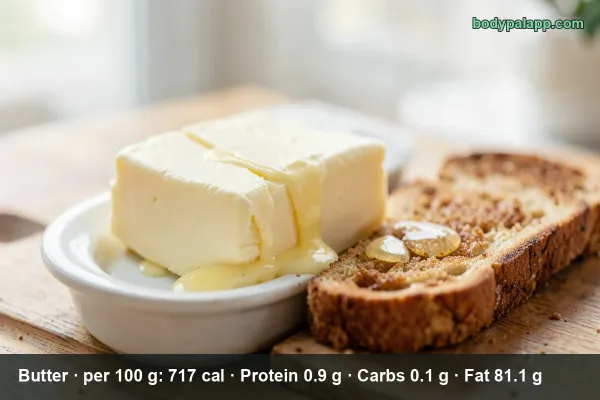
Unsalted butter calories come to 102 for one tablespoon (14.2 g) and 717 per 100 g. Every one of those calories comes from fat: the split is 100% fat, with 11.5 g in a tablespoon. Sodium barely registers at 2 mg per tablespoon, so the number that decides your total is how much you use.
102kcal
1 tablespoon · 14 g, without salt
0%protein
0.1 gProtein
0 gCarbs
11.5 gFat
How to burn off 102 kcal
—Walking, brisk
—Jogging
—Cycling, moderate
—Swimming
Skip the math. BodyPal counts these calories from your steps and workouts automatically.
Nutrition facts
Without salt · per 14 g
Calories
102 kcal
Protein
0.1 g
Carbohydrate
0 g
Fat
11.5 g
Saturated fat
7.2 g
Cholesterol
31 mg
Sodium
2 mg
Potassium
3 mg
Iron
0 mg
Source: USDA FoodData Central
🛡️
Verified nutrition data
Numbers on this page come from USDA FoodData Central, the U.S. Department of Agriculture’s food composition database, and from manufacturer labels where a branded product is named. Last verified October 2026. How we verify our data →
Unsalted butter: calories, protein and sodium by serving
Percent of daily value uses the FDA reference of 2,000 kcal a day.
Serving
kcal
Protein
Carbs
Fat
Sodium
% DV kcal
1 tablespoon (14.2 g)
102
0.1 g
0 g
11.5 g
2 mg
5%
1 pat (5 g)
36
0 g
0 g
4.1 g
1 mg
2%
1 stick (113 g)
810
1 g
0.1 g
91.7 g
12 mg
41%
100 g
717
0.9 g
0.1 g
81.1 g
11 mg
36%
3 × 1 tablespoon (14.2 g)
305
0.4 g
5 mg
5 × 1 tablespoon (14.2 g)
509
0.6 g
8 mg
A pat is 36 calories, a stick is 810
Butter portions run from tiny to enormous, and the calories follow. A pat (5 g), the kind you smear on a dinner roll, is 36 calories and 4.1 g of fat. A level tablespoon (14.2 g) is 102 calories, about 5% of the daily calorie value on the label. That is the serving most people mean, and it is easy to underestimate because a tablespoon of soft butter looks small on a knife.
The total climbs fast once you stop measuring. Two tablespoons (28 g) come to 204 calories, three (43 g) reach 305, and five (71 g) hit 509. Sauces, mashed potatoes and buttered pasta can quietly hold that much in one bowl.
A full stick (113 g) carries 810 calories and 91.7 g of fat, or 41% of a day's calorie value. You rarely eat a stick alone, but a recipe that calls for one splits those 810 calories across every slice, cookie or serving. Divide by the number of portions and you know what each one carries from the butter.
Fat supplies every calorie
Per 100 g, unsalted butter has 81.1 g of fat, 0.9 g of protein and 0.1 g of carbs. The calorie split rounds to 100% fat and 0% each for protein and carbs. There is 0 g of fiber and 0.1 g of sugar, which is why a tablespoon lists 0 g for both carbs and sugar.
That makes butter pure energy with almost nothing else attached. Put 81.1 g of fat per 100 g next to a daily fat value of 78 g and the picture is clear: 100 g of butter holds more than a full day's fat value. A single tablespoon brings 11.5 g of it.
Protein is a rounding error. Even a whole stick gives only 1 g, or 2% of the daily value. If you are building a meal for staying full, butter adds flavor and calories but not the protein or fiber that do that work, so pair it with foods that bring them.
Saturated fat is the row to watch, not sodium
Of the 81.1 g of fat in 100 g of butter, 50.5 g is saturated. The daily value for saturated fat is 20 g, so 100 g of butter carries more than twice a day's worth. If you track saturated fat, butter is the line on your log that moves it most, and measuring by the tablespoon matters more than with almost any other food.
Cholesterol is also high per gram: 215 mg per 100 g, against a daily value of 300 mg. Again, the portion decides how much of that you actually eat.
Sodium is where unsalted butter earns its name. It has 11 mg per 100 g, compared with 643 mg in salted butter. A tablespoon adds 2 mg and a stick 12 mg, which is 1% of the daily value. If you watch sodium or bake with precise salt amounts, this is the reason to choose it. Potassium is low too, at 24 mg per 100 g.
Measure it and let it carry flavor
Butter works best as a finishing touch rather than a base. A pat melted over steamed vegetables, a baked potato or toast gives the taste for 36 calories. Cooking eggs or searing fish usually needs no more than a tablespoon, at 102 calories, if you use a nonstick pan.
Because unsalted butter has almost no sodium, you control the salt yourself. Add it to the food, not the fat, and you can season to taste without guessing what the butter already brought.
Brands like Land O'Lakes, Challenge and Casco Bay sell unsalted sticks, and Land O Lakes also makes a whipped unsalted version, so check the label for its serving size before logging. If you would rather not weigh, BodyPal can log butter on your plate from a photo, which helps catch the pats and spoonfuls that never make it into a food diary.
How does unsalted butter compare?
Here is unsalted butter next to regular butter, salted butter and ghee, per 100 g and per usual serving.
Verdict: Calories are a tie with salted and regular butter at 717 per 100 g, so pick unsalted when you watch sodium: 11 mg against 643 mg. Ghee is denser at 900 per 100 g and 126 per tablespoon, about 1.3 times the calories, so for calorie control stay with unsalted butter.
Most popular unsalted butter brands in the United States
How many calories are in a tablespoon of unsalted butter?
One tablespoon (14.2 g) of unsalted butter has 102 calories. A pat (5 g) has 36 and a full stick (113 g) has 810.
Is unsalted butter good for weight loss?
Unsalted butter has 717 calories per 100 g, and one tablespoon adds 102 calories, nearly all from 11.5 g of fat.
Unsalted butter vs salted butter: which has fewer calories?
Both have 717 calories per 100 g, or 102 per tablespoon. The difference is sodium: about 2 mg per tablespoon unsalted versus 91 mg salted.
How much fat is in unsalted butter?
One tablespoon has 11.5 g of fat, of which 7.2 g is saturated. Per 100 g it has 81.1 g of fat and 0.9 g of protein.
How much sodium does unsalted butter add to a baked potato?
One tablespoon of unsalted butter adds just 2 mg of sodium, and a pat adds 1 mg. Any other sodium on the plate comes from the potato, the salt you sprinkle or other toppings, not the butter.
How many calories are in a stick of unsalted butter?
A stick of unsalted butter (113 g) has 810 calories and 91.7 g of fat. That equals 41% of the daily calorie value, so a recipe using a full stick spreads those calories across every serving.
How many calories are in a pat of unsalted butter?
A pat of unsalted butter (5 g) has 36 calories and 4.1 g of fat. It is the smallest common portion and a practical way to add butter flavor to bread or vegetables.
Does unsalted butter have fewer calories than ghee?
Yes. Unsalted butter has 717 calories per 100 g, while ghee has 900. Per tablespoon that is 102 calories for butter against 126 for ghee, because ghee is 100 g of fat per 100 g.
How much saturated fat and cholesterol is in unsalted butter?
Unsalted butter has 50.5 g of saturated fat and 215 mg of cholesterol per 100 g. The daily values are 20 g and 300 mg, so portion size decides how much of each you take in.
Does unsalted butter have carbs or sugar?
Almost none. Unsalted butter has 0.1 g of carbs and 0.1 g of sugar per 100 g, and a tablespoon lists 0 g of each. Its calories come from fat.