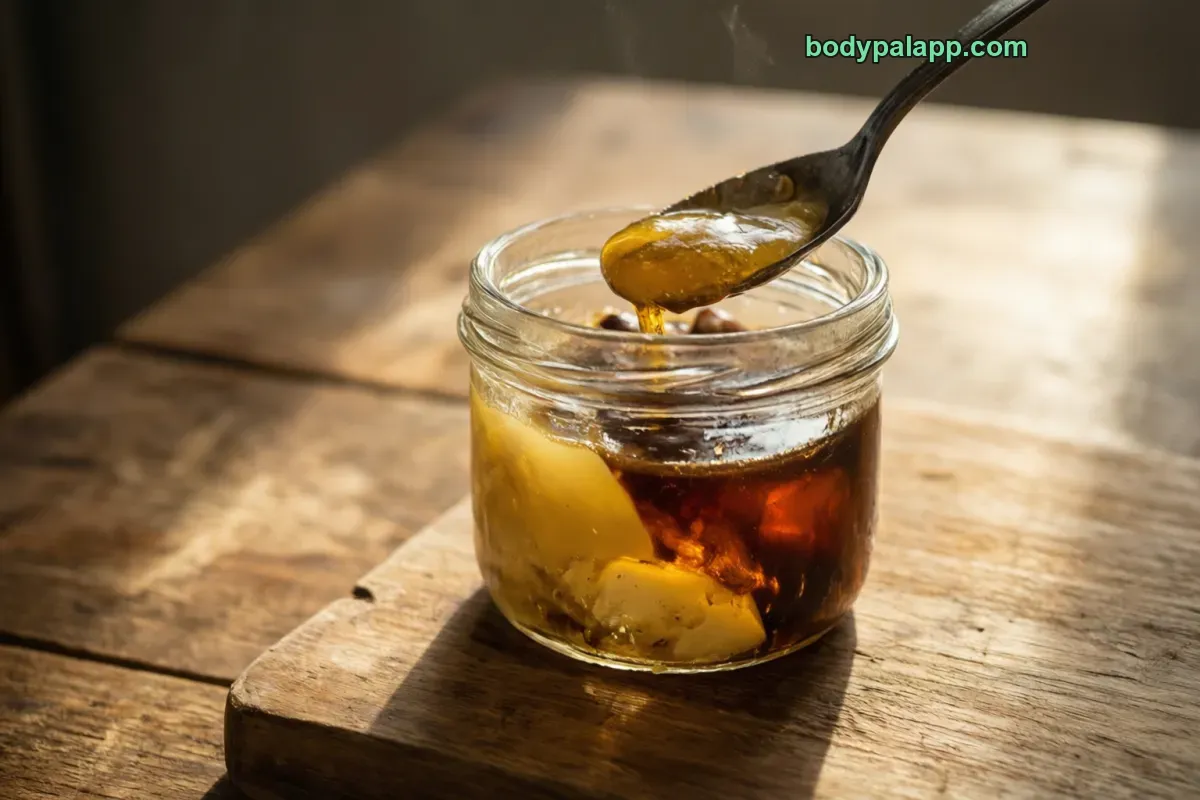
Ghee calories come to 123 for one tablespoon (14 g) and 900 per 100 g. Every one of those calories comes from fat: the calorie split is 100% fat, with 0 g protein, 0 g carbs and 0 g sugar. So the size of your spoon decides your total, not the food itself.
Skip the math. BodyPal counts these calories from your steps and workouts automatically.
Nutrition facts
Clarified, milk solids removed · per 14 g
Calories
126 kcal
Protein
0 g
Carbohydrate
0 g
Fat
14 g
Saturated fat
8.4 g
Cholesterol
42 mg
Sodium
0 mg
Iron
0 mg
Source: USDA FoodData Central
🛡️
Verified nutrition data
Numbers on this page come from USDA FoodData Central, the U.S. Department of Agriculture’s food composition database, and from manufacturer labels where a branded product is named. Last verified September 2026. How we verify our data →
Ghee: calories, protein and sodium by serving
Percent of daily value uses the FDA reference of 2,000 kcal a day.
Serving
kcal
Protein
Carbs
Fat
Sodium
% DV kcal
Tablespoon (14 g)
123
0 g
0 g
13.9 g
0 mg
6%
1 oz portion (28 g)
252
0 g
0 g
28 g
0 mg
13%
Cup (224 g)
1,962
0.6 g
0 g
222.8 g
4 mg
98%
100 g
900
0 g
0 g
100 g
0 mg
45%
3 × Tablespoon (14 g)
378
0 g
0 mg
5 × Tablespoon (14 g)
630
0 g
0 mg
One tablespoon is 123 calories, and a cup is nearly a full day
A tablespoon (14 g) of ghee holds 123 calories and 13.9 g of fat. That is 6% of the daily value for calories. It sounds modest until you notice how easily a second spoon slides into the pan.
Two tablespoons, or 28 g, reach 252 calories, the same as a 1 oz portion. Three tablespoons come to 378. Five tablespoons, 70 g, add up to 630 calories, and a generous pour into a pot of rice or dal can easily be that much. Nothing else on the label moves as you scale up: protein, carbs and sodium stay at 0.
The cup figure is the one to remember. A cup (224 g) carries 1,962 calories and 222.8 g of fat, 98% of the daily value for calories. Nobody eats a cup in one sitting. But a batch of curry or roasted vegetables that uses half the jar spreads those calories across every plate. If you cook with ghee, measure the spoon instead of eyeballing the jar.
Every calorie in ghee comes from fat
Per 100 g, ghee has 100 g of fat, 0 g protein, 0 g carbs, 0 g fiber and 0 g sugars. The calorie split reads 100% fat. Few foods are this simple, because what you measure is pure energy from fat.
That is why ghee lands at 900 calories per 100 g. It is clarified butter with the milk solids removed, so what remains is butterfat. Even a full cup shows only 0.6 g of protein, which is a trace and nothing more.
In practice, ghee brings no protein and no fiber to a meal. Treat it as a dense flavor carrier. It makes food taste richer, which is its job, but the protein and fiber a plate needs still have to come from somewhere else.
Saturated fat and cholesterol are the rows to watch
Of the 100 g of fat in 100 g of ghee, 60 g is saturated. The daily value for saturated fat used on this page is 20 g, so a few spoons take up a real share of it. Total fat follows the same pattern: the daily value is 78 g, and 100 g of ghee holds more than that.
Cholesterol is the other standout. Ghee carries 300 mg per 100 g, which matches the full 300 mg daily value. A single tablespoon is a small slice of that, but the number climbs with every spoon you add.
Sodium is a non-issue. Plain ghee lists 0 mg per tablespoon and only 4 mg in a full cup, which is 0% of the daily value. That sets it apart from salted butter, and it matters if you track sodium more closely than fat. Brands such as Organic Valley, Full Moon or Carrington Farms are worth a label check for added salt, since this page shows plain ghee.
Use ghee as a finisher, not a base
Because ghee is all fat, small and deliberate amounts work best. One tablespoon brushed over roasted vegetables or stirred into lentils carries flavor across a whole dish. Pair it with foods that bring what ghee lacks: protein from beans, eggs, chicken or fish, and fiber from vegetables and whole grains.
Removing the milk solids is why ghee handles high-heat cooking well and keeps its nutty taste. That is a cooking advantage, not a calorie one. Swapping butter for ghee does not lighten a recipe. Gram for gram, it adds more calories.
If you track intake, log ghee every time it touches the pan, because cooking fat is the line people forget most. BodyPal can log the finished dish from a photo. Add the ghee you cooked with as its own entry so it is counted.
How does ghee compare?
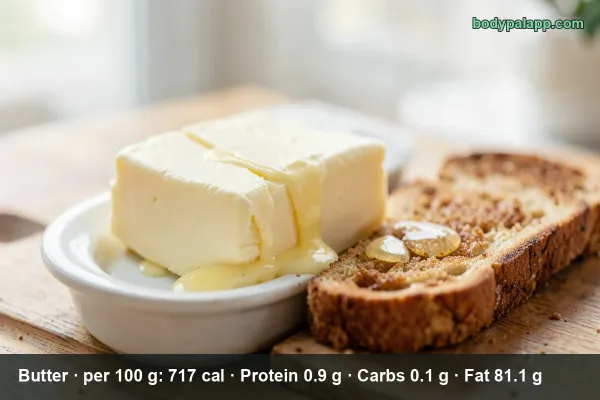
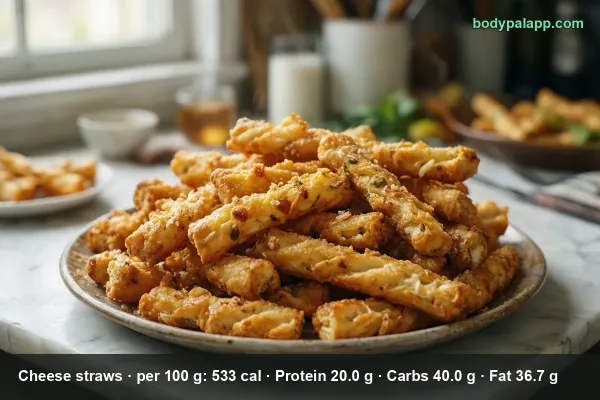
Here is how ghee stacks up against butter, a butter stick and cheese straws, per 100 g and per usual serving.
Verdict: Ghee is the most calorie-dense option here at 900 per 100 g, while butter sits at 717 and a butter stick at 743, so plain butter saves calories gram for gram. If sodium is your concern, pick ghee, since butter carries 643 mg per 100 g and the stick 524 mg.
Most popular ghee brands in the United States
Ranked by popularity in the BodyPal database
# Productkcal / 100 g
1Full Moon Ghee1 Tbsp · 14 g929 kcal
2Organic Valley Ghee Clarified Butter1 tsp · 5 g900 kcal
3Simply Ghee Original1 tsp · 5 g900 kcal
4Organic Valley Purity Farms Ghee1 tsp · 5 g900 kcal
One tablespoon of ghee (14 g) has about 123 calories, and a cup (224 g) is 1,962 calories.
Is ghee good for weight loss?
Ghee is calorie-dense at 900 calories per 100 g, and one tablespoon (14 g) adds about 123 calories with no protein or carbs.
Ghee vs butter: which has more calories?
Ghee has 900 calories per 100 g compared to 717 for butter, a difference of 183 calories per 100 g since ghee has the milk solids and water removed.
How much fat is in ghee?
One tablespoon of ghee has 14 g of fat, of which 8.4 g is saturated. Per 100 g that is 100 g fat and 60 g saturated fat.
How many calories are in 2 tablespoons of ghee?
Two tablespoons of ghee (28 g) contain 252 calories, all from fat. That equals the 1 oz portion and is 13% of the daily value for calories. Three tablespoons rise to 378.
How many calories are in a cup of ghee?
A cup of ghee (224 g) has 1,962 calories and 222.8 g of fat, which is 98% of the daily value for calories. Keep that in mind when a recipe melts a large share of the jar.
Does ghee have any carbs or protein?
Ghee has 0 g carbs and 0 g protein per tablespoon and per 100 g. A full cup shows only 0.6 g protein. Its calorie split is 100% fat, with 0 g sugar and 0 g fiber.
How much saturated fat and cholesterol does ghee contain?
Per 100 g, ghee has 60 g saturated fat and 300 mg cholesterol. The daily values used here are 20 g and 300 mg, so your portion size decides how much of each you take in.
Is ghee high in sodium?
No. Plain ghee has 0 mg sodium per tablespoon and only 4 mg in a full cup, 0% of the daily value. Butter, by comparison, lists 643 mg per 100 g.