
How many calories are in butter?
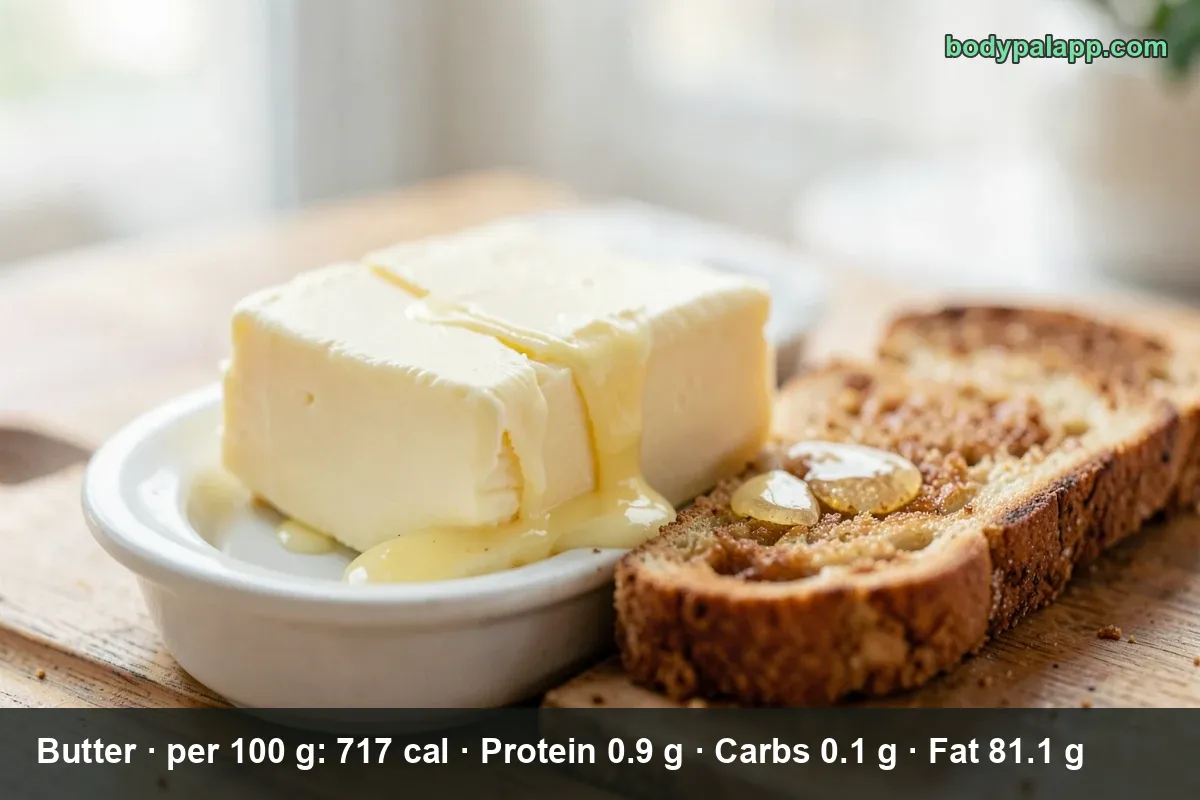
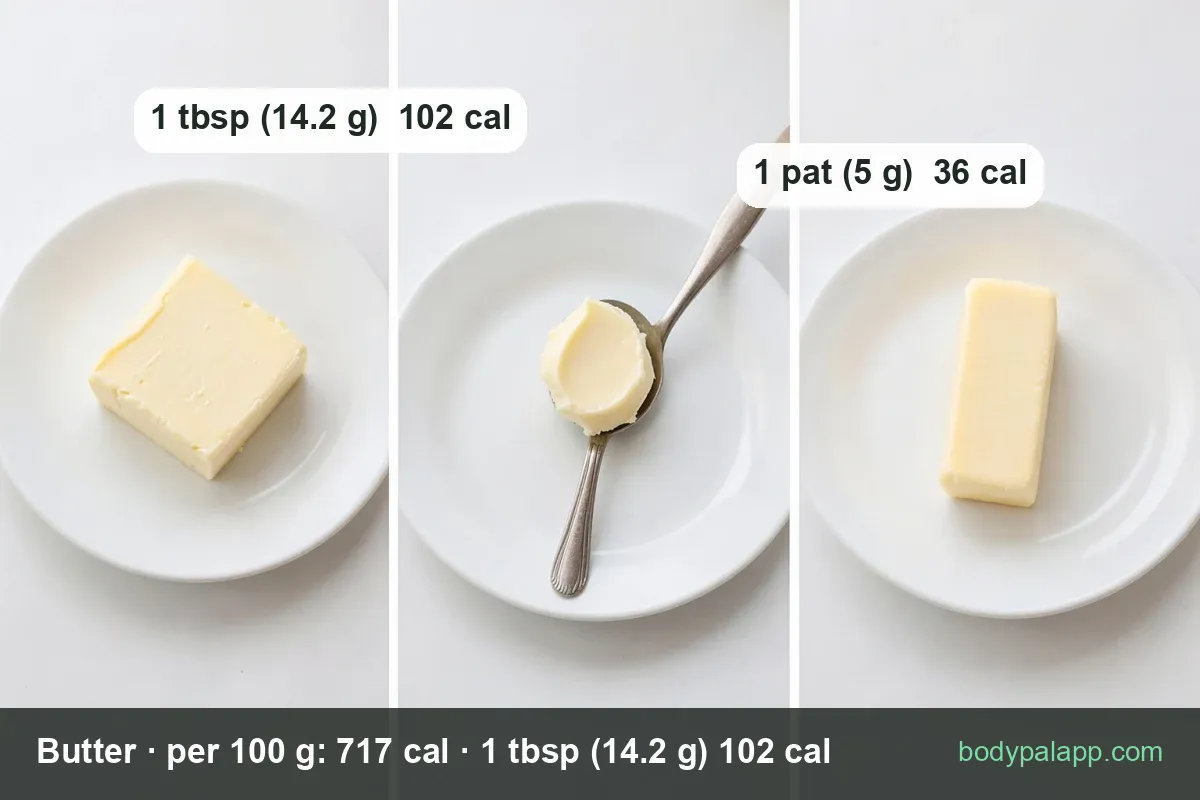
One tablespoon of salted butter weighs 14.2 g and carries 102 calories. Per 100 g butter runs 717 calories, the densest thing in most refrigerators. A thin pat is 36, a full stick 810, and a whole cup 1,628 — which is why butter is measured in tablespoons rather than scoops.
On this page
- Butter quick facts
- US servings, from a pat to a full stick
- Unsalted, whipped, light and ghee
- Saturated fat is the row that moves
- How does butter compare?
- Most popular butter brands
- FAQ
Butter quick facts
The record behind this page is SR Legacy 173410, "Butter, salted" — the block or stick you unwrap at home. It is the row with a full nutrient profile and with the household measures Americans actually use: the pat, the tablespoon, the stick, the cup. The survey row "Butter, NFS" is an average of every kind of butter people reported eating, and the Foundation entries for sticks carry no energy value at all, so neither one answers the question in your hand.
The table below is the salted stick, per 100 g and per level tablespoon.
| Nutrient | Per 100 g | Per 1 tbsp (14.2 g) | % Daily Value |
|---|---|---|---|
| Calories | 717 | 102 | — |
| Total fat | 81.11 g | 11.5 g | 15% |
| Saturated fat | 51.37 g | 7.3 g | 36% |
| Carbohydrate | 0.06 g | 0.0 g | 0% |
| Dietary fiber | 0 g | 0 g | 0% |
| Total sugars | 0.06 g | 0.0 g | — |
| Protein | 0.85 g | 0.1 g | 0% |
| Sodium | 643 mg | 91 mg | 4% |
% Daily Value is based on a 2,000-calorie diet.
Verified nutrition data
Numbers on this page come from USDA FoodData Central, the U.S. Department of Agriculture’s food composition database, and from manufacturer labels where a branded product is named. Last verified September 2026. How we verify our data →
Two rows you will see on a wrapper are missing here: USDA does not publish added sugars or trans fat for this SR Legacy record, so both are left out rather than guessed. Cholesterol and potassium are published — 215 mg and 24 mg per 100 g, which work out to 31 mg of cholesterol (10% DV) and 3 mg of potassium in a tablespoon. The 91 mg of sodium in that same spoon is a little under a twentieth of a teaspoon of table salt, which is why salted butter tastes seasoned without reading as salty.
US servings, from a pat to a full stick
| Serving | Weight | Calories |
|---|---|---|
| 1 pat (1" square, 1/3" high) | 5 g | 36 kcal |
| 1 tbsp | 14.2 g | 102 kcal |
| 1 oz | 28.3 g | 203 kcal |
| 1 stick (1/2 cup) | 113 g | 810 kcal |
| 1 cup | 227 g | 1628 kcal |
| Per 100 g | 100 g | 717 kcal |
The pat, the tablespoon, the stick and the cup are all USDA household measures for this record, with USDA's own gram weights. The 1 oz line is our own arithmetic from the USDA 100 g figure, not a USDA serving — useful only because recipes written by weight tend to speak in ounces.
The gap between the first line and the last is the whole story of logging butter. A restaurant pat is trivial: 36 calories, less than a teaspoon of olive oil. The tablespoon is where most home cooking lives, and 102 calories is roughly a slice of bread's worth of energy sitting on top of the bread. The stick is a baking unit, not an eating unit, and at 810 calories it is usually the largest single line in a cake recipe. A full cup — two sticks — reaches 1,628 calories and 116.6 g of saturated fat, which is why a pound cake divides into sixteen small slices rather than eight generous ones.
One practical habit: measure butter cold and level. A heaping tablespoon straight from a soft stick can easily run half again as heavy, and half again on 102 calories is another 50 you never wrote down.
Unsalted, whipped, light and ghee
| Version | Per 100 g | Typical serving | Calories |
|---|---|---|---|
| Salted butter (main record) | 717 kcal | 1 tbsp (14.2 g) | 102 kcal |
| Unsalted butter | 717 kcal | 1 tbsp (14.2 g) | 102 kcal |
| Whipped butter, salted | 731 kcal | 1 tbsp (9.4 g) | 69 kcal |
| Light butter | 499 kcal | 1 oz (28.3 g) | 141 kcal |
| Ghee (clarified butter) | 900 kcal | 1 oz (28.3 g) | 255 kcal |
| Butter oil, anhydrous | 876 kcal | 1 tbsp (12.8 g) | 112 kcal |
| Butter, NFS (survey average) | 743 kcal | 1 tbsp (14 g) | 104 kcal |
Unsalted changes nothing you can count. Both butters are 717 calories per 100 g with the same 81.11 g of fat. The difference is sodium — 643 mg per 100 g salted against 11 mg unsalted, which is 91 mg versus 2 mg on a tablespoon. If you are watching sodium closely, unsalted butter is the cheaper swap; if you are watching calories, it changes nothing at all.
Whipped butter is the one honest saving. It is denser on paper, 731 calories per 100 g, because the USDA record is measured by weight. But the tub spoon holds 9.4 g instead of 14.2 g, so a tablespoon is 69 calories instead of 102 — a third off, purely because nitrogen took up the space. The catch is that whipped butter spreads further, so a slice of toast often takes two spoons.
Light butter cuts the fat with water: 499 calories per 100 g, the lowest number on this page by a wide margin, and 141 calories per ounce by our own scaling from that 100 g figure. It behaves badly in a hot pan, where the water spits and the milk solids scorch.
Ghee runs the other way. Clarifying drives off the water and strains out the milk solids, leaving 900 calories and 100 g of fat per 100 g — a full 183 calories per 100 g above butter, and 255 calories per ounce on our arithmetic. Butter oil, anhydrous, is the industrial version of the same thing at 876 calories per 100 g. Neither carries meaningful sodium.
If your app or your label shows "Butter, NFS" at 743 calories per 100 g, that is USDA's survey average across all butter types, not a different product. On a tablespoon it is 104 calories against 102 — a difference small enough to ignore.
Saturated fat is the row that moves
Calories are not what makes butter worth watching; saturated fat is. A single tablespoon is 7.3 g, or 36% of the 20 g Daily Value the FDA sets. Three tablespoons across a day — one on toast, one in a pan, one on vegetables — clear the entire day's DV from butter alone, before any cheese, meat or baked goods are counted.
Scale that to a recipe and the numbers get loud. One stick holds 58 g of saturated fat, about 290% of the DV, and a cup holds 116.6 g, close to 583%. Spread across a sixteen-slice cake that stick is a reasonable 3.6 g a slice; eaten as four slices in an evening it is not. The Dietary Guidelines for Americans suggest keeping saturated fat below 10% of daily calories, which on a 2,000-calorie day is about 22 g — roughly three tablespoons of butter, with nothing left over.
Butter is also a dairy fat rather than a dairy serving. MyPlate counts it under oils and solid fats, not toward the dairy group, so it brings no calcium or protein worth logging — 0.85 g of protein per 100 g means a tablespoon contributes 0.1 g. Use it for flavor, and count it as fat.
How does butter compare?
| Butter type | Per 100 g | US serving | Calories |
|---|---|---|---|
| Butter, salted | 717 kcal | 1 tbsp (14.2 g) | 102 kcal |
| Butter, unsalted | 717 kcal | 1 tbsp (14.2 g) | 102 kcal |
| Butter, whipped, salted | 731 kcal | 1 tbsp (9.4 g) | 69 kcal |
| Butter oil, anhydrous | 876 kcal | 1 tbsp (12.8 g) | 112 kcal |
Our take: for weight loss, whipped butter is the only swap in this table that actually removes calories from the spoon — 69 against 102, and it still tastes like butter. For flavor per calorie in a hot pan, ghee wins despite being the densest record here, because you need less of it and it does not burn. Unsalted is a sodium decision, not a calorie one. And if you cook by weight rather than by spoon, none of these swaps help: at 717 to 900 calories per 100 g, every full-fat butter on this page is among the most calorie-dense things in the kitchen.
Most popular butter brands in the United States
Ranked by how widely each product appears among foods sold in the United States, from the BodyPal food database of over 3.3 million products. Calories are the figures printed on each Nutrition Facts label, checked against USDA FoodData Central.
| Product | Calories (per 100 g) |
|---|---|
| Kerrygold Pure Irish Butter (salted) | 714 cal |
| Kerrygold Pure Irish Butter Sticks | 714 cal |
| Kerrygold Unsalted Pure Irish Butter | 714 cal |
| Kerrygold Naturally Softer Pure Irish Butter | 714 cal |
| Kerrygold Garlic & Herb Butter | 643 cal |
Brand popularity: BodyPal food database. Nutrition: manufacturer labels / USDA FoodData Central.
Butter FAQs
How many calories are in 1 tablespoon of butter?
A tablespoon of salted butter is 102 calories at 14.2 g, the weight USDA uses for a level spoon off a stick. That tablespoon also carries 11.5 g of fat, 7.3 g of it saturated, and 91 mg of sodium. Butter is 717 calories per 100 g.
How many calories are in a stick of butter?
A standard 113 g stick of butter is 810 calories, half a cup of it. That is 91.7 g of fat and 58 g of saturated fat, about 290% of the Daily Value, so a stick creamed into a cake batter is usually the biggest single line in the recipe.
How many calories in a pat of butter?
A restaurant pat of butter is 36 calories at 5 g, the one-inch square, one-third-inch thick pat USDA lists. Two pats on toast is 72 calories, less than a tablespoon. Pats are the reason diner butter adds up slowly while a spoon from the tub adds up fast.
Does salted or unsalted butter have more calories?
Neither. Salted and unsalted butter are both 717 calories per 100 g and 102 per tablespoon, with identical fat. The only real difference is sodium: 643 mg per 100 g salted against 11 mg unsalted, or 91 mg versus 2 mg on a tablespoon. Bakers choose unsalted for control, not calories.
How much saturated fat is in butter?
A tablespoon carries 7.3 g of saturated fat, 36% of the 20 g Daily Value, from 51.37 g per 100 g. Three tablespoons in a day pass the full DV on butter alone. The Dietary Guidelines suggest keeping saturated fat under 10% of calories, which is where butter gets expensive.
Is whipped butter lower in calories than stick butter?
Yes, per spoon. Whipped butter is 69 calories a tablespoon against 102 for stick butter, because the tub spoon holds 9.4 g instead of 14.2 g. Per 100 g whipped is actually slightly denser at 731 calories. You are buying air, not lower fat, and it works.
Does butter have any carbs or sugar?
Almost none. Butter has 0.06 g of carbohydrate per 100 g and the same 0.06 g of total sugars, which rounds to 0.0 g on a tablespoon. There is no fiber. USDA does not publish added sugars or trans fat for this SR Legacy record, so those rows are left out.
Is ghee higher in calories than butter?
Yes. Ghee is 900 calories per 100 g against 717 for salted butter, because clarifying removes water and milk solids and leaves pure fat. An ounce of ghee is 255 calories, an ounce of butter 203, our own arithmetic from the USDA 100 g figures. Ghee also carries no sodium.
Similar foods
- Butter Packet — 36 cal per packet
- Butter Pat — 36 cal per pat
- Salted Butter — 810 cal per stick
- Butter Stick — 840 cal per stick
- Peanut Butter — 191 cal for 2 tbsp
- Ghee — 123 cal per tablespoon
Count it without the math
Point the camera at the plate and BodyPal counts the butter for you, pat or spoon.


How long does it take to burn off butter?
One tablespoon (14.2 g) is 102 kcal. Enter your weight and the amount you ate to see how long it takes you to burn that off:
lb
| Activity | Time to burn 102 kcal |
|---|---|
| Walking, brisk | 20 min |
| Cycling, moderate | 13 min |
| Swimming, moderate | 15 min |
| Jogging | 12 min |
| Weight training, moderate | 23 min |
Times are for a 155 lb adult at a steady pace; change the weight to see yours. The amount is set to the portion in the text (14.2 g); change it to what you actually ate. BodyPal works this out from your steps automatically.
Want the bigger picture? Calculate your daily calorie needs — your maintenance figure, a target for losing or gaining, and the date you get there.