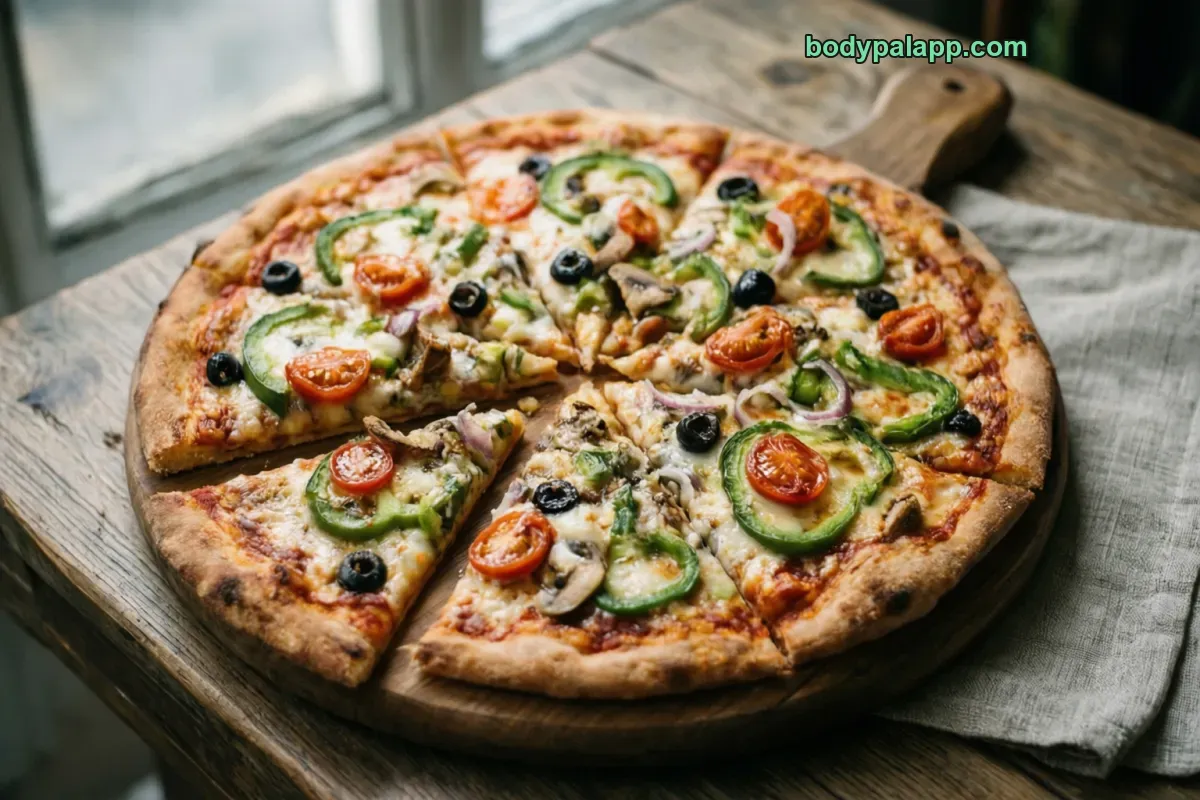
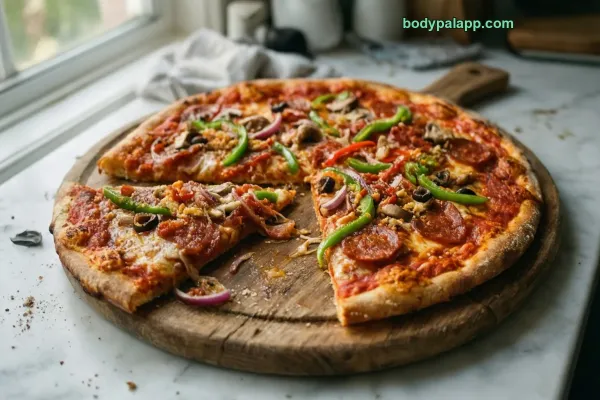
Veggie pizza calories come to 360 for one 170 g slice and 212 per 100 g, based on packaged pizza label data. The vegetables don't make it a light food. Fat supplies 40% of the calories, and one slice carries 649 mg of sodium, or 28% of the daily value.
360kcal
1 slice · 170 g, packaged, per label
10%protein
9 gProtein
44 gCarbs
16 gFat
How to burn off 360 kcal
—Walking, brisk
—Jogging
—Cycling, moderate
—Swimming
Skip the math. BodyPal counts these calories from your steps and workouts automatically.
Nutrition facts
Packaged, per label · per 170 g
Calories
360 kcal
Protein
9 g
Carbohydrate
44 g
Fat
16 g
Saturated fat
6 g
Cholesterol
31 mg
Sodium
649 mg
Source: USDA FoodData Central
🛡️
Verified nutrition data
Numbers on this page come from USDA FoodData Central, the U.S. Department of Agriculture’s food composition database, and from manufacturer labels where a branded product is named. Last verified September 2026. How we verify our data →
Veggie pizza: calories, protein and sodium by serving
Percent of daily value uses the FDA reference of 2,000 kcal a day.
Serving
kcal
Protein
Carbs
Fat
Sodium
% DV kcal
1 slice (170 g)
360
9 g
44 g
16 g
649 mg
18%
Thinner slice (90 g)
170
5 g
22 g
6 g
370 mg
9%
100 g
212
5.3 g
25.9 g
9.4 g
382 mg
11%
3 × 1 slice (170 g)
1,081
27 g
1,948 mg
5 × 1 slice (170 g)
1,802
45 g
3,247 mg
Slice size matters more than the toppings
The standard slice here weighs 170 g and lands at 360 calories, about 18% of a daily value. That is a big slice. A thinner 90 g slice from a different label comes to 170 calories, less than half as much, with 5 g of protein and 370 mg of sodium. Same food, very different numbers, so weigh or eyeball the slice before you log it.
Calories climb quickly when you go back for more. Two 170 g slices make 721 calories, three make 1,081, and five reach 1,802. That last figure is roughly what half of a large frozen pie can add up to, and most people don't notice they're eating that much.
If you want pizza without the big total, the easiest move is to eat fewer slices, not to pick different toppings. Two thin slices still come in below a single 170 g slice. If you're tracking, BodyPal can log the slice from a photo, but size is still what drives the number.
Crust and cheese supply almost 90% of the calories
Carbs provide 49% of the calories and fat provides 40%. Protein gets just 10%. Per 100 g, that means 25.9 g of carbs, 9.4 g of fat and 5.3 g of protein. Most of the carbs come from the crust, and most of the fat comes from cheese and oil. The vegetables add volume and flavor but contribute very little energy.
Protein is the weak spot. A 170 g slice has 9 g, which covers 18% of the daily value. That matches its share of daily calories, so you get no protein bonus for the calories you spend. If staying full matters to you, that's worth knowing before you call the slice a meal.
Fiber is also modest. The standard slice has 2 g, and per 100 g the figure is 1.2 g. Sugar stays low at 5 g per slice and 2.9 g per 100 g, so it isn't a sugar problem. It's a refined-crust-and-cheese food with some vegetables on top.
Sodium is the row to watch
One 170 g slice has 649 mg of sodium, which is 28% of the daily value. That is a larger share than its 18% of daily calories, so salt builds up faster than energy. Per 100 g, the figure is 382 mg, or 17% of the daily value.
Multiple slices add up fast. Two slices bring 1,299 mg, three bring 1,948 mg, and five reach 3,247 mg, which is above the 2300 mg daily value on its own. If you watch sodium, the thinner 90 g slice at 370 mg, or 16% of the daily value, is the more forgiving choice.
Saturated fat and cholesterol are less of a concern. Per 100 g there is 3.5 g of saturated fat and 18 mg of cholesterol. These numbers aren't trivial, but sodium is still the line most likely to push your daily total over.
One slice plus a protein side makes a better meal
One slice on its own is lopsided, with plenty of carbs and fat but only 9 g of protein. To make it a fuller meal, add a protein side such as grilled chicken, a bean salad or a glass of milk instead of a second slice. You get more staying power for fewer calories than a second 360-calorie slice would add.
A large green salad works too. It adds fiber, which a 2 g slice is missing, and gives you more to eat without much energy. If sodium is on your mind, use a plain dressing and skip salty extras like olives or cured meat on the side.
Brands vary, from cauliflower-crust options like Caulipower to gluten-free ones like Schar, so check the label on the box you buy. The habit stays the same either way: decide on a slice count before you start, and plate it instead of eating from the box.
How does veggie pizza compare?
Here is how veggie pizza compares with supreme, margherita and Sicilian pizza, per 100 g and per usual slice.
Verdict: For the fewest calories per bite, choose veggie pizza at 212 per 100 g, compared with 248 for supreme and 271 for margherita, and with 382 mg of sodium against 658 mg for supreme. For protein and fullness, supreme is the better pick, with 11.3 g per 100 g and 305 calories for a 123 g slice.
Most popular veggie pizza brands in the United States
A 170 g slice is about 360 calories. A thinner 90 g slice is about 170 calories.
Is veggie pizza good for weight loss?
One slice is 360 calories with 9 g protein. Per 100 g veggie pizza is 212 calories, lower than supreme pizza at 248 and margherita pizza at 271.
Veggie pizza vs supreme pizza: which has fewer calories?
Veggie pizza has 212 calories per 100 g and supreme pizza 248, a difference of 36 calories per 100 g.
How much protein is in veggie pizza?
There are 5.3 g of protein per 100 g, so a 170 g slice has about 9 g protein alongside 44 g carbs and 16 g fat.
How many calories are in a vegetarian pizza per 100 g?
Vegetarian pizza has 212 calories per 100 g, along with 25.9 g of carbs, 9.4 g of fat and 5.3 g of protein. Carbs supply 49% of the calories and fat 40%, so the crust and cheese do most of the work.
How many calories are in a thin slice of vegetable pizza?
A thinner 90 g slice of vegetable pizza has 170 calories, 5 g of protein and 370 mg of sodium. A full 170 g slice has 360 calories, so slice size makes a big difference to the total.
How many calories are in two slices of veggie pizza?
Two 170 g slices of veggie pizza add up to 721 calories, 18 g of protein and 1,299 mg of sodium. Three slices reach 1,081 calories, so the total rises quickly with each extra piece.
How much sodium is in a slice of veggie pizza?
A 170 g slice of veggie pizza has 649 mg of sodium, which is 28% of the daily value. Per 100 g it has 382 mg, and a thinner 90 g slice has 370 mg.
Is veggie pizza lower in calories than margherita pizza?
Yes, per 100 g. Veggie pizza has 212 calories per 100 g, while margherita has 271. A slice, though, is 360 for veggie and 358 for margherita, because the veggie slice weighs 170 g and the margherita slice weighs 132 g.