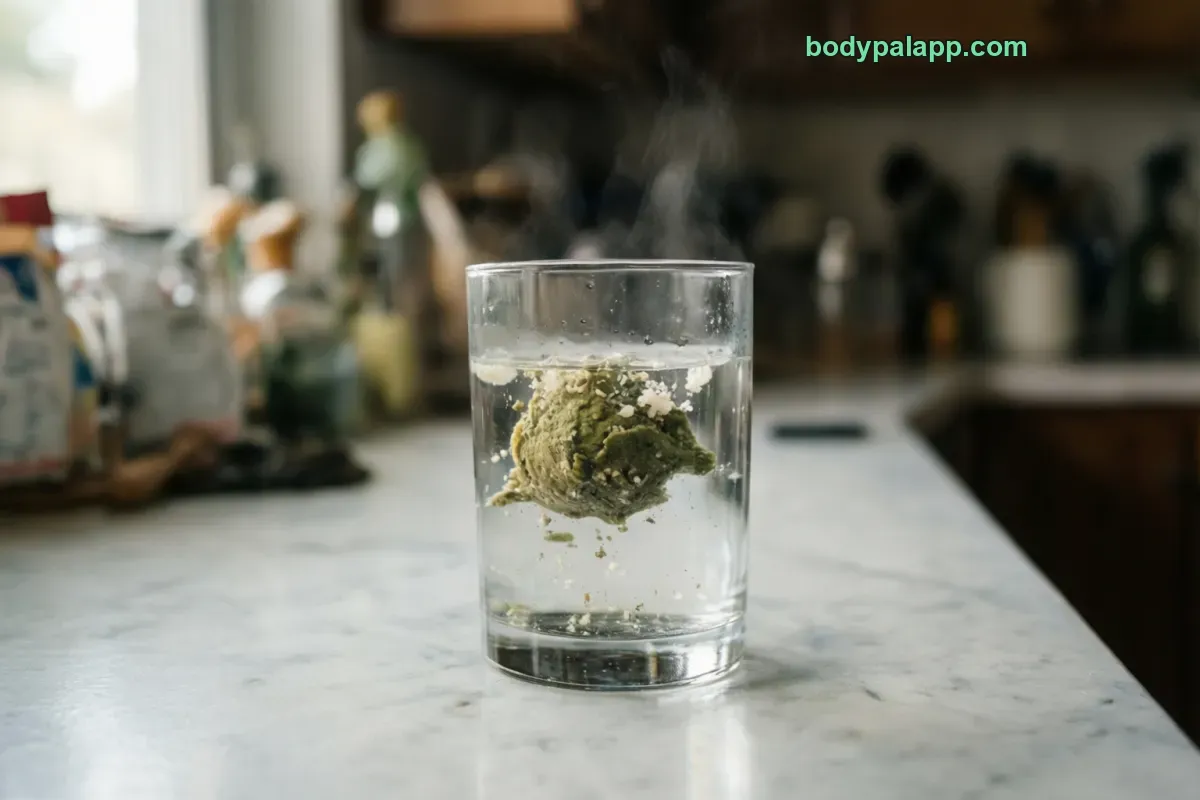
Water calories come to 0 for 1 cup (237 g) and 0 per 100 g. Plain tap water carries no protein, carbs, fat or sugar, so it never moves your calorie total. The only line on the label that changes is sodium: 4 mg per 100 g, which works out to 9 mg in a cup and 40 mg in a liter.
0kcal
1 cup · 237 g, tap, drinking
0%protein
0 gProtein
0 gCarbs
0 gFat
How to burn off 0 kcal
—Walking, brisk
—Jogging
—Cycling, moderate
—Swimming
Skip the math. BodyPal counts these calories from your steps and workouts automatically.
Nutrition facts
Tap, drinking · per 237 g
Calories
0 kcal
Protein
0 g
Carbohydrate
0 g
Fat
0 g
Saturated fat
0 g
Cholesterol
0 mg
Sodium
9 mg
Potassium
0 mg
Iron
0 mg
Source: USDA FoodData Central
🛡️
Verified nutrition data
Numbers on this page come from USDA FoodData Central, the U.S. Department of Agriculture’s food composition database, and from manufacturer labels where a branded product is named. Last verified October 2026. How we verify our data →
Water: calories, protein and sodium by serving
Percent of daily value uses the FDA reference of 2,000 kcal a day.
Serving
kcal
Protein
Carbs
Fat
Sodium
% DV kcal
1 cup (237 g)
0
0 g
0 g
0 g
9 mg
0%
1 liter (1000 g)
0
0 g
0 g
0 g
40 mg
0%
100 g
0
0 g
0 g
0 g
4 mg
0%
3 × 1 cup (237 g)
0
0 g
28 mg
5 × 1 cup (237 g)
0
0 g
47 mg
Five cups of water still add up to 0 calories
With most foods, the portion is the whole story. A bigger bowl means a bigger number. Water breaks that rule. One cup (237 g) is 0 calories, 2 cups (474 g) are 0, 3 cups (711 g) are 0, and 5 cups (1,185 g) are still 0. A full liter (1,000 g) lands at 0 as well.
That makes water the one drink you can log without measuring. You do not need to know whether your glass held one cup or nearly two. The calorie column will read the same either way, and so will protein, which sits at 0 g in every portion on this page.
What does scale is sodium, and only slowly. It climbs from 9 mg in a cup to 19 mg in 2 cups, 28 mg in 3 cups and 47 mg in 5 cups. Those are small numbers. Even the largest of them barely registers against a full day, which the sodium section below spells out in daily value terms.
There is nothing to split: no protein, carbs or fat
For most foods, the useful question is where the calories come from. Is it mostly protein, mostly fat, mostly carbs? For water, the answer is that there are none to divide. The calorie split reads 0% protein, 0% carbs and 0% fat, because per 100 g every macro is 0 g.
The same goes for the rows people check when a drink tastes sweet or rich. Sugars are 0 g, fiber is 0 g, saturated fat is 0 g and cholesterol is 0 mg. The USDA row behind these numbers is plain tap drinking water, with nothing added.
That is the real difference between water and most other drinks. Once anything goes into the glass, such as sweetener, juice, milk or flavor syrup, the macro rows start to fill in. Even a lightly sweetened bottled drink brings carbs with it. Plain water is the baseline every other beverage on your log gets measured against, and it is the only one that adds nothing.
Sodium is the only row that moves, and barely
If one number on this page deserves a look, it is sodium. Tap water in the USDA data carries 4 mg per 100 g. That is why a cup shows 9 mg and a liter shows 40 mg instead of zero.
Against the daily value, it is close to nothing. One cup is 0% of the daily value for sodium, and a full liter is 2%. Five cups add 47 mg. If you watch sodium closely, water is not where your total comes from. Sauces, bread, cheese and processed foods will move that row far more than anything you drink from the tap.
Keep in mind that this is the USDA value for tap drinking water, so it describes a typical glass rather than every faucet. Potassium reads 0 mg in the same row, so water adds no minerals to your log. If you log water mainly to track how much you drink, the sodium line will hardly change your daily numbers at all.
Water is the swap that leaves room for food
Because water has no calories, its value on a log is what it replaces. Every glass of water you choose over a sweetened drink keeps those drink calories off your total. Nothing on the food side has to change. That is the simplest trade you can make in a day of eating, and it costs no planning.
It pairs with anything. Water next to a salty meal does not add to the sodium row in any real way, and water with a sweet snack adds no sugar. If you want some flavor, black coffee stays very low per cup. Flavored and enhanced waters are a different story, so check their labels rather than assuming they match plain water.
If you track your intake, water is worth logging for the habit even though it changes nothing in the calorie column. BodyPal can log it from a photo of your glass, which keeps the entry quick. Then the numbers that do move, from meals, snacks and other drinks, carry the full weight of your daily total.
How does water compare?
Here is plain water next to black coffee and vitamin water, per 100 g and per usual serving.
Verdict: For weight loss, water at 0 calories wins outright, and black coffee at 5 per 1 cup (248 g) is close enough to treat the same way. Vitamin water is the one to count, at 125 calories per 1 bottle (567 g) and 5.5 g of carbs per 100 g, so pick plain water if you only want something to drink.
Water FAQs
How many calories are in a cup of water?
A cup of plain tap water (237 g) has 0 calories, and a full liter also has 0.
Is water good for weight loss?
Plain water adds 0 calories, 0 g sugar and 0 g fat to the day, whether it is one cup or one liter.
Water vs soda water: which has fewer calories?
Both have 0 calories per 100 g, so a cup of either adds nothing to the calorie total.
Does tap water contain sodium?
Tap water has about 4 mg of sodium per 100 g, which is about 9 mg per cup and 40 mg per liter.
How many calories are in vitamin water?
Vitamin water has 125 calories in 1 bottle (567 g), or 22 per 100 g. Those calories come from carbs, at 5.5 g per 100 g, with 0 g of protein and fat. Plain water has 0.
Does water have any sugar or carbs?
No. Plain tap water has 0 g of carbs and 0 g of sugars per 100 g, and the same 0 g in a cup or a liter. Protein, fat and fiber are also 0 g.
How much sodium is in a liter of water?
A liter of tap water has 40 mg of sodium, which is 2% of the daily value. One cup (237 g) has 9 mg, or 0% of the daily value, based on the USDA tap water row.
Water vs black coffee: which has fewer calories?
Water has fewer, with 0 calories per cup against 5 for 1 cup (248 g) of black coffee. Per 100 g it is 0 versus 2, so both barely register on a calorie log.
Does drinking 5 cups of water add any calories?
No. Five cups (1,185 g) of water come to 0 calories and 0 g of protein. The only thing that adds up is sodium, which reaches 47 mg across the 5 cups.