
How many calories are in a shot of whiskey?
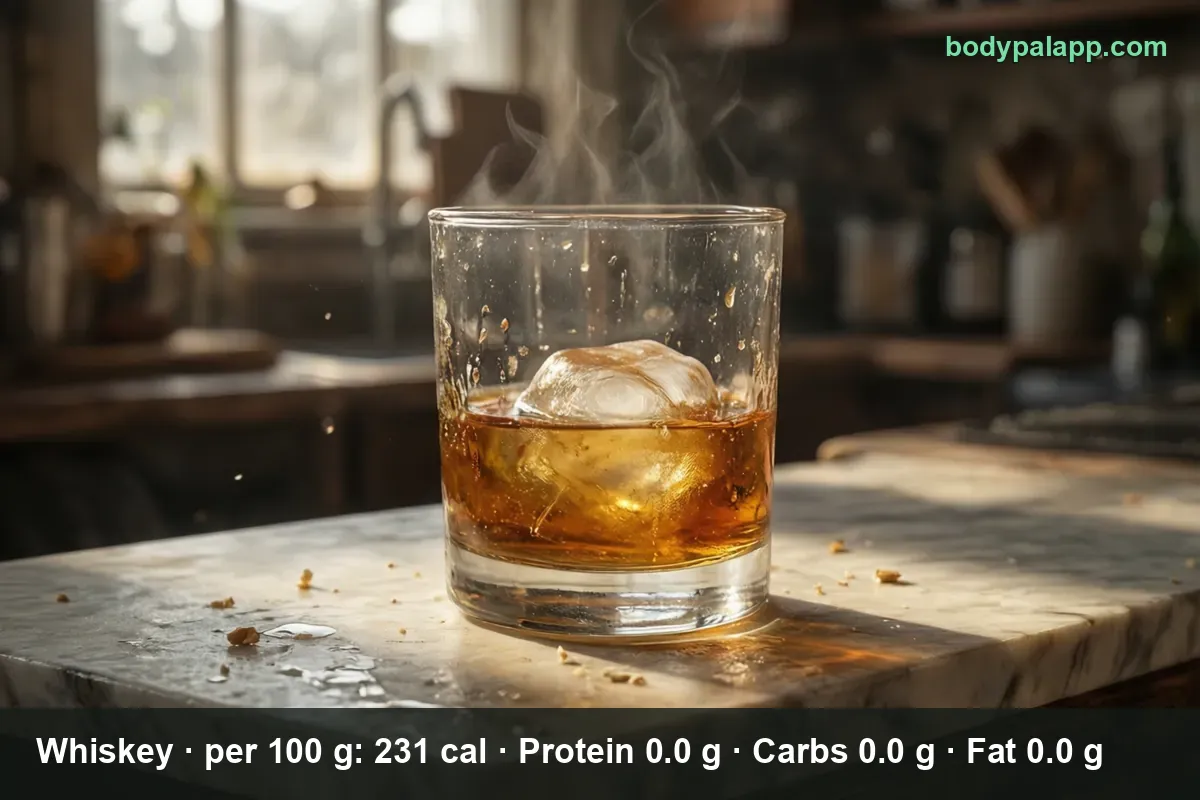
A 1.5 fl oz shot of whiskey weighs 42 g and carries 97 calories. Per 100 g the pour runs 231 calories, all of it from alcohol. There is no fat, no protein and no carbohydrate in the glass, which makes whiskey one of the simplest things you will ever log: the pour size and the proof are the whole story.
On this page
- Whiskey quick facts
- US pours from a single ounce to a double
- Proof is the calorie dial
- Mixed drinks change the math
- What whiskey has none of
- How does whiskey compare?
- Whiskey FAQs
Whiskey quick facts
The row used here is FNDDS 2710700, "Whiskey" — poured whiskey at roughly 80 proof, the strength of most bourbon, rye and blended bottles on a US back bar. It is the record that matches the glass in your hand, and it is the only plain-whiskey entry that comes with household measures attached: a shot, a jigger and a drink.
USDA also keeps SR Legacy entries for distilled spirits by proof. Those are the same liquid described a different way, and they matter once your bottle is stronger than 80 proof. They appear further down, not here, because they carry no household serving.
| Nutrient | Per 100 g | Per 1 shot (42 g) | % Daily Value |
|---|---|---|---|
| Calories | 231 | 97 | — |
| Total fat | 0 g | 0 g | 0% |
| Saturated fat | 0 g | 0 g | 0% |
| Carbohydrate | 0 g | 0 g | 0% |
| Dietary fiber | 0 g | 0 g | 0% |
| Total sugars | 0 g | 0 g | — |
| Protein | 0 g | 0 g | 0% |
| Sodium | 1 mg | 0 mg | 0% |
% Daily Value is based on a 2,000-calorie diet.
Verified nutrition data
Numbers on this page come from USDA FoodData Central, the U.S. Department of Agriculture’s food composition database, and from manufacturer labels where a branded product is named. Last verified September 2026. How we verify our data →
Two label lines are missing on purpose. Added sugars and trans fat are not published in this FNDDS release, and a distillate has neither sugar added to it nor fat in it, so there is nothing to report on either line. Cholesterol is 0 mg. Potassium is 2 mg per 100 g, which works out to 1 mg in a shot — a rounding error next to the 4,700 mg Daily Value.
US pours from a single ounce to a double
| Serving | Weight | Calories |
|---|---|---|
| 1 fl oz, neat | 28 g | 65 kcal |
| 1 shot or jigger, 1.5 fl oz | 42 g | 97 kcal |
| 1 drink, double pour | 63 g | 146 kcal |
| Per 100 g | 100 g | 231 kcal |
The fluid-ounce pour, the shot, the jigger and the double pour are all USDA household measures for this record, so those lines need no interpretation. An ounce by weight is 28.3 g rather than 28 g, and it still rounds to the same 65 calories — that conversion is our own arithmetic from the USDA 100 g figure, not a USDA serving.
Whiskey is measured by volume behind the bar and by weight in the database, and the two are close enough here that people rarely go wrong. Where they do go wrong is the free pour at home. A generous tip of the bottle is closer to the 63 g line than the 42 g one, which is 49 calories you never counted. Ice changes nothing: it melts into water, and water has no calories, so whiskey on the rocks is the same 97 as whiskey neat.
Proof is the calorie dial
Brand, mash bill, age and barrel char do nothing to the calorie count. Alcohol by volume does all of it, and proof is just alcohol by volume doubled. USDA keeps a separate record at each strength, and the spread is wide.
| Bottle strength | Per 100 g | 1 shot (42 g) | Calories |
|---|---|---|---|
| 80 proof, the standard bottle | 231 kcal | 42 g | 97 kcal |
| 86 proof | 250 kcal | 42 g | 105 kcal |
| 94 proof | 275 kcal | 42 g | 116 kcal |
| 100 proof, bottled in bond | 295 kcal | 42 g | 124 kcal |
The shot figures in that table are our own arithmetic from each USDA 100 g value, since the by-proof records carry no household serving. The gap at the ends is the part worth remembering: the same 42 g measure moves from 97 to 124 calories, about 28% more, purely because the bottle is stronger. Three bottled-in-bond pours cost 372 calories where three standard pours cost 291. Cask-strength bottles run past 100 proof, so treat 124 as a floor rather than a ceiling there.
Mixed drinks change the math
Almost nobody logs a bottle of whiskey. They log a drink, and the mixer usually costs more than the whiskey does. USDA carries a full set of poured cocktails at a 225 g drink size, which is a tall glass with ice.
| Drink | Per 100 g | Typical drink | Calories |
|---|---|---|---|
| Whiskey and soda | 59 kcal | 225 g | 133 kcal |
| Whiskey and water | 59 kcal | 225 g | 133 kcal |
| Whiskey and diet cola | 60 kcal | 225 g | 135 kcal |
| Whiskey and ginger ale | 83 kcal | 225 g | 187 kcal |
| Whiskey and cola | 89 kcal | 225 g | 200 kcal |
| Whiskey sour | 123 kcal | 225 g | 277 kcal |
The ginger ale drink is our own arithmetic from its USDA 100 g figure; the other five are USDA drink servings. Swapping regular cola for club soda saves 67 calories per glass and removes 16.8 g of sugar. Diet cola gets you almost the same saving, landing 2 calories above the soda version — a difference small enough to ignore.
The whiskey sour is the outlier. At 277 calories a glass it is close to three plain shots, and it brings 36.2 g of carbohydrate and 36.2 g of total sugars, all of it from the syrup. That is 13% of the Daily Value for carbohydrate in a drink most people think of as sour. Sodium reaches 173 mg, or 8% of the Daily Value, which is the only whiskey drink on this page where the sodium line does anything at all.
What whiskey has none of
Whiskey is the rare item where the interesting nutrition facts are the zeros. Total fat, saturated fat, carbohydrate, fiber, sugars and protein all read 0 g, so every one of the 97 calories in a shot comes from ethanol at roughly 7 calories per gram. The FDA Daily Value reference has nothing to bite on: every percentage in the quick facts table is 0%.
That has a practical edge and a practical trap. The edge is that a neat pour fits into a low-carb or low-sodium day without touching either budget, which is why bourbon shows up on keto lists. The trap is that calories with no protein, no fiber and no volume do nothing for fullness, so 97 calories of whiskey sit differently than 97 calories of a snack. Two pours before dinner are close to 200 calories that leave no impression on appetite.
For the drinking side of the question rather than the calorie side, the Dietary Guidelines for Americans put moderate drinking at two drinks or fewer per day for men and one or fewer for women, and the CDC defines one standard drink as 1.5 fl oz of 80 proof spirits — exactly the 42 g shot in the table above. Your logged shot and your counted drink are the same unit, which is convenient.
How does whiskey compare?
| Spirit | Per 100 g | US serving | Calories |
|---|---|---|---|
| Whiskey, 80 proof | 231 kcal | 1 shot, 42 g | 97 kcal |
| Distilled spirits, 80 proof | 231 kcal | 1 shot, 42 g | 97 kcal |
| Whiskey, 86 proof | 250 kcal | 1 shot, 42 g | 105 kcal |
| Distilled spirits, 100 proof | 295 kcal | 1 shot, 42 g | 124 kcal |
Serving figures for the three neighbor rows are our own arithmetic from their USDA 100 g values.
Our take: stop shopping for a lighter spirit. USDA files gin, rum, vodka and whiskey together at 80 proof because at the same strength they are the same drink nutritionally, 231 calories per 100 g and 97 a shot. If you want the calorie count down, the two levers that actually work are a standard-proof bottle instead of a bottled-in-bond one, and soda water instead of cola. Do both and a tall drink costs 133 calories instead of 200 — a 67-calorie cut, most of what you would save by skipping a second pour.
Whiskey FAQs
How many calories are in a shot of whiskey?
A 1.5 fl oz shot weighs 42 g and carries 97 calories, from the USDA FNDDS whiskey record at 231 calories per 100 g. Every one of those calories comes from alcohol: the record lists 0 g of carbohydrate, 0 g of fat and 0 g of protein. A double pour of 63 g is 146.
Does whiskey have carbs or sugar?
No — the USDA record for whiskey lists 0 g of carbohydrate and 0 g of total sugars per 100 g, and the same zeros for a 42 g shot. Distillation leaves the sugars from the grain mash behind in the still. Barrel aging adds flavor compounds, not measurable carbohydrate.
Is whiskey keto-friendly?
On carbohydrate alone, yes: 0 g per 100 g and 0 g per 42 g shot, so a neat pour adds nothing to a daily carb budget. The 97 calories still count, and mixers are where carbs appear — whiskey and Coke is 17.6 g of carbohydrate per 225 g drink.
How many calories in whiskey and Coke?
One 225 g drink is 200 calories, against 133 for the same drink built with club soda. The cola brings 16.8 g of sugar and 17.6 g of carbohydrate, so the mixer costs 67 calories more than plain soda water. Diet cola lands at 135 calories per drink.
Whiskey vs vodka — which has fewer calories?
Neither — USDA files gin, rum, vodka and whiskey at 80 proof in one record, 231 calories per 100 g, which is the same figure as the whiskey record: 97 calories a shot for both. Proof is the only lever. A 100 proof pour of either is 124 calories per 42 g.
Does 100 proof whiskey have more calories than 80 proof?
Yes, about 28% more. USDA lists 80 proof spirits at 231 calories per 100 g and 100 proof at 295, so the same 42 g shot moves from 97 to 124 calories. An 86 proof bottle sits between them at 250 per 100 g, or 105 per shot.
How many calories in a whiskey sour?
One 225 g whiskey sour is 277 calories, close to three plain shots. The sugar syrup is the reason: 36.2 g of carbohydrate and 36.2 g of total sugars per drink, or 13% of the Daily Value for carbohydrate. Sodium comes in at 173 mg, 8% of the Daily Value.
How much whiskey is one standard drink in the US?
One standard drink is 1.5 fl oz of 80 proof spirits, the same 42 g pour that carries 97 calories. CDC uses that definition for its drinking guidelines, so a shot logged neat is one drink. A 63 g double pour is 1.5 standard drinks and 146 calories.
Similar foods
- Bourbon — 97 cal for 1.5 fl oz jigger
- Cranberry Vodka — 97 cal per jigger
- Shot Of Crown Royal — 97 cal per shot
- Gin — 97 cal per shot
- Shot Of Gin — 97 cal per shot
- Jack Daniel's — 97 cal per shot
Count it without the math
Pour it, point the camera at the glass, and BodyPal logs the shot and the mixer separately.


How long does it take to burn off whiskey?
One 1.5 fl oz shot (42 g) is 97 kcal. Enter your weight and the amount you ate to see how long it takes you to burn that off:
lb
| Activity | Time to burn 97 kcal |
|---|---|
| Walking, brisk | 19 min |
| Cycling, moderate | 12 min |
| Swimming, moderate | 14 min |
| Jogging | 11 min |
| Weight training, moderate | 22 min |
Times are for a 155 lb adult at a steady pace; change the weight to see yours. The amount is set to the portion in the text (42 g); change it to what you actually ate. BodyPal works this out from your steps automatically.
Want the bigger picture? Calculate your daily calorie needs — your maintenance figure, a target for losing or gaining, and the date you get there.