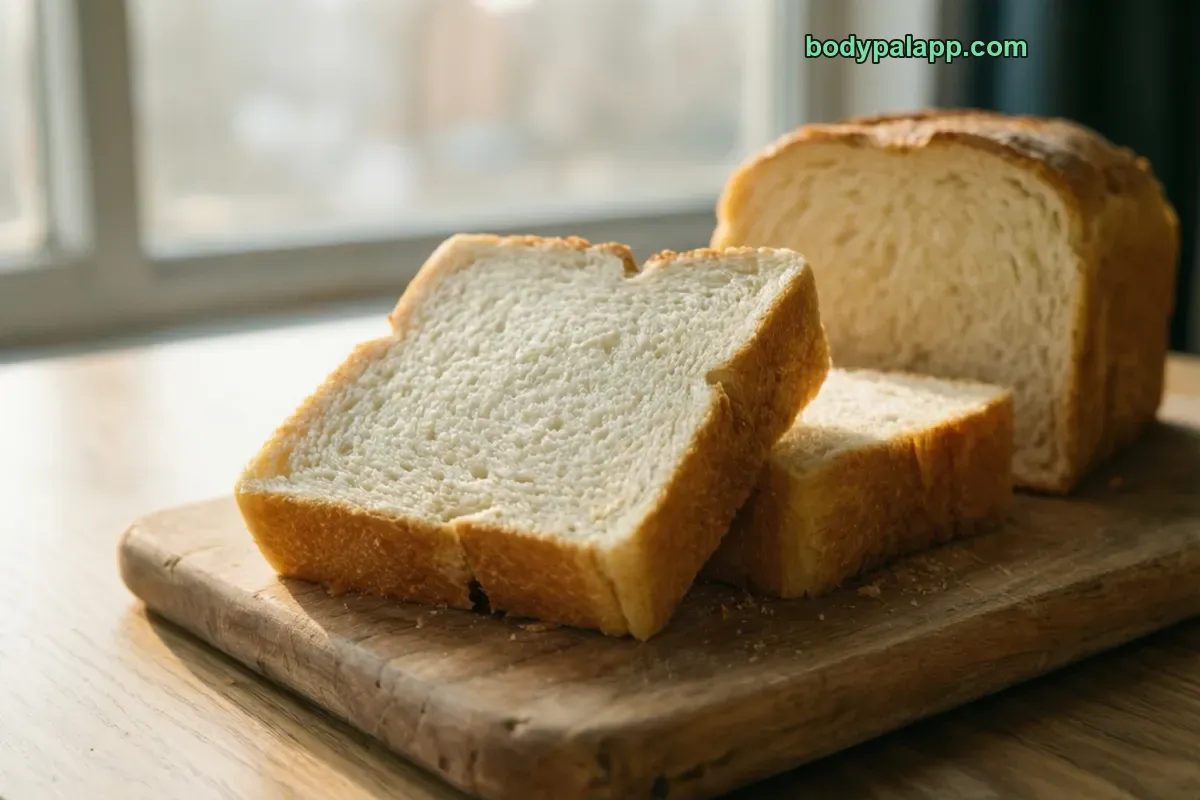
White bread calories come to 74 for one slice (27.3 g) and 270 per 100 g. Almost three quarters of those calories come from carbs, and the total climbs quickly as slices stack up: a two-slice sandwich base is already 147 calories before anything goes between the bread.
74kcal
1 slice · 27 g, commercially prepared
14%protein
2.6 gProtein
13 gCarbs
1 gFat
How to burn off 74 kcal
—Walking, brisk
—Jogging
—Cycling, moderate
—Swimming
Skip the math. BodyPal counts these calories from your steps and workouts automatically.
Nutrition facts
Commercially prepared · per 27 g
Calories
74 kcal
Protein
2.6 g
Carbohydrate
13.4 g
Fat
1 g
Saturated fat
0.2 g
Sodium
130 mg
Potassium
32 mg
Iron
0.9 mg
Source: USDA FoodData Central
🛡️
Verified nutrition data
Numbers on this page come from USDA FoodData Central, the U.S. Department of Agriculture’s food composition database, and from manufacturer labels where a branded product is named. Last verified September 2026. How we verify our data →
White bread: calories, protein and sodium by serving
Percent of daily value uses the FDA reference of 2,000 kcal a day.
Serving
kcal
Protein
Carbs
Fat
Sodium
% DV kcal
1 slice (27.3 g)
74
2.6 g
13.4 g
1 g
130 mg
4%
100 g
270
9.4 g
49.2 g
3.6 g
477 mg
14%
Reduced-calorie slice (23 g)
48
2 g
10.2 g
0.6 g
110 mg
2%
3 × 1 slice (27.3 g)
221
7.7 g
391 mg
5 × 1 slice (27.3 g)
369
12.9 g
651 mg
Two slices are a 147-calorie sandwich base
A standard commercial slice weighs 27.3 g and carries 74 calories, about 4% of the daily value. That looks small, and it is. The catch is that bread rarely gets eaten one slice at a time. Two slices for toast or a sandwich come to 147 calories, three reach 221, and five, the tally a sandwich lunch plus breakfast toast can easily hit, add up to 369.
Weight matters more than the label on the bag. If you weigh your bread instead of counting slices, use the 100 g figure: 270 calories. Bakery loaves and thick-cut bread often slice heavier than the 27.3 g standard, so weigh one slice from a new loaf before you trust the 74-calorie number.
Reduced-calorie white bread changes the math more than any portion trick. Its 23 g slice holds 48 calories and 2.2 g of fiber, against 74 calories and 0.6 g of fiber in a regular slice. If you eat bread daily and the slices add up, that swap is the easiest lever on this page.
Carbs supply 74% of the calories
Carbohydrate drives this food. Per 100 g, white bread has 49.2 g of carbs, 9.4 g of protein and 3.6 g of fat, so carbs supply 74% of the calories, protein 14% and fat 12%. Saturated fat is minor at 0.8 g per 100 g. In practice, white bread is a fast, low-fat carb.
Protein is not zero, but it is modest. One slice gives 2.6 g, which is 5% of the daily value, and two slices give 5.1 g. That counts toward your day, yet bread works better as a carrier for protein than as a source of it. Eggs, tuna, turkey, beans or peanut butter do the heavy lifting in a sandwich.
Fiber is the weak spot. A regular slice has 0.6 g and 100 g has 2.3 g, which is thin for a food eaten in this volume. The reduced-calorie slice, with 2.2 g of fiber in just 23 g, shows how much the recipe can change. Whole grain white loaves from brands like Wonder or Lewis Bake Shop are worth a label check if fiber is your goal.
Five slices bring 651 mg of sodium
Bread rarely tastes salty, yet it carries real sodium. One slice has 130 mg, 6% of the daily value, and 100 g has 477 mg, or 21%. Two slices hit 260 mg, three reach 391 mg, and five come to 651 mg before cheese, deli meat, butter or condiments go on.
If you watch sodium, the bread itself is the part people forget to count. A sandwich built on two slices starts with 260 mg already in the tally, and salty fillings stack on top of that. Toast with salted butter follows the same pattern: the bread is the quiet baseline that every topping adds to.
The reduced-calorie slice trims this a little, at 110 mg per slice, or 5% of the daily value. It is not a low-sodium food, though. If sodium is your main concern, portion size does more than switching loaves: three slices at 391 mg versus five at 651 mg is the bigger gap.
Make the bread the frame, not the meal
White bread is easy to eat quickly and in quantity. Because 74% of its calories are carbs and fiber is low, a slice does the most for you when it carries protein and vegetables instead of just butter and jam. Think of the bread as the frame and build the meal inside it.
A simple approach: decide on the number of slices first, then load the filling. Two slices with eggs, chicken or beans plus lettuce, tomato or cucumber makes a balanced plate. Toast alongside a bowl of soup or a salad works too, as long as you count the slices instead of reaching for more.
Spreads are where bread calories quietly multiply, so log them with the slice. BodyPal can log white bread and whatever is on it from a photo, which makes the toppings harder to forget.
How does white bread compare?
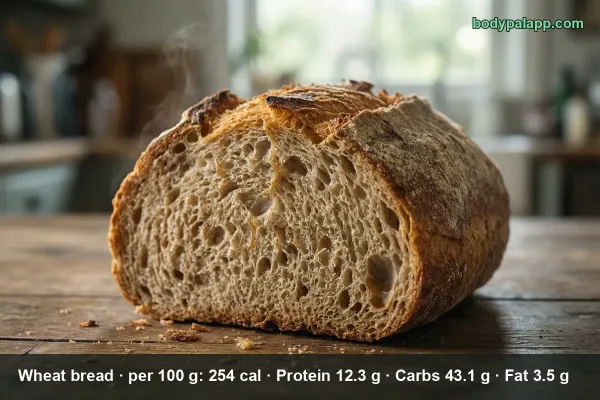
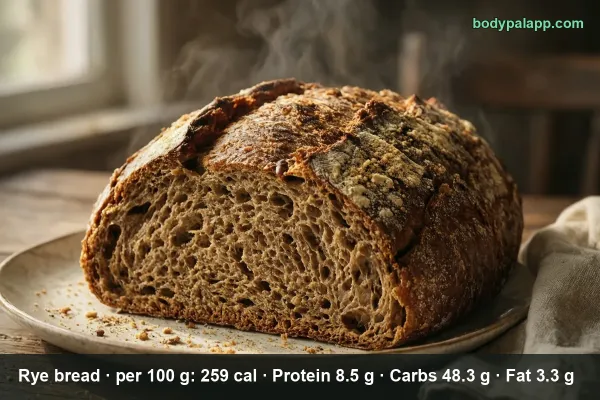
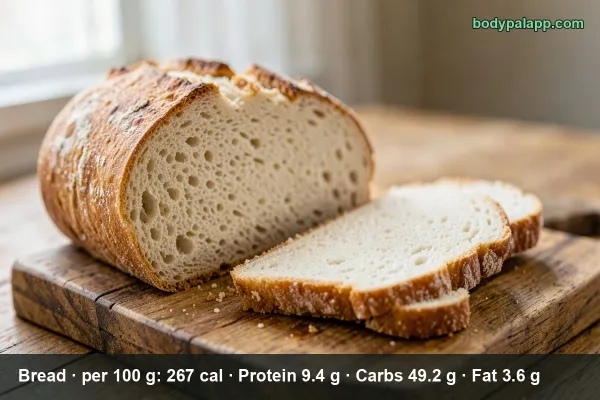
Here is how white bread stacks up against wheat bread, rye bread and generic bread, per 100 g and per usual serving.
Verdict: For the fewest calories pick wheat bread, at 254 per 100 g against 270 here, with more protein at 12.3 g. If sodium is your concern, skip rye at 603 mg; white bread at 477 mg sits in the middle and is nearly identical to generic bread at 267 calories.
Most popular white bread brands in the United States
6Aspen Mills Honey White Bread1 slice · 40 g240 kcal
7Wonder Classic White Bread2 slices · 57 g246 kcal
8Wonder Whole Grain White Bread57 g211 kcal
Label numbers cover the same ready-to-eat bread as the figure above, so the spread here comes from recipe and slice size, not from a different weight basis. Source: manufacturer labels / USDA FoodData Central.
White bread FAQs
How many calories are in a slice of white bread?
One commercially prepared slice (27.3 g) is about 74 calories. A 100 g portion of white bread is 270 calories.
Is white bread good for weight loss?
A slice is 74 calories with 2.6 g protein and 0.6 g fiber. Reduced-calorie white bread is 48 calories per 23 g slice.
White bread vs wheat bread: which has fewer calories?
White bread is 270 calories per 100 g and wheat bread is 254, so wheat bread is 16 calories lower per 100 g.
How many carbs are in white bread?
A slice has about 13.4 g of carbohydrate, and 100 g of white bread has 49.2 g.
How many calories are in 100 g of white bread?
100 g of white bread has 270 calories, with 49.2 g of carbs, 9.4 g of protein and 3.6 g of fat. That covers 14% of the daily calorie value and 21% of the daily sodium value.
How many calories are in 2 slices of white bread?
Two slices of white bread (55 g) have 147 calories, 5.1 g of protein and 260 mg of sodium. That is the base of a standard sandwich before any filling, spread or cheese goes on.
How many calories are in 5 slices of white bread?
Five slices of white bread weigh about 137 g and hold 369 calories, 12.9 g of protein and 651 mg of sodium. That is a realistic daily total if you have toast at breakfast and a sandwich at lunch.
What are the nutrition facts for white bread?
Per 100 g, white bread has 270 calories, 9.4 g of protein, 49.2 g of carbs, 3.6 g of fat, 0.8 g of saturated fat, 2.3 g of fiber, 477 mg of sodium and 117 mg of potassium.
How many calories are in one slice of maida bread?
A slice of maida bread, which is white bread made from refined wheat flour, has about 74 calories in a 27.3 g slice. It also carries 13.4 g of carbs, 2.6 g of protein and 130 mg of sodium.