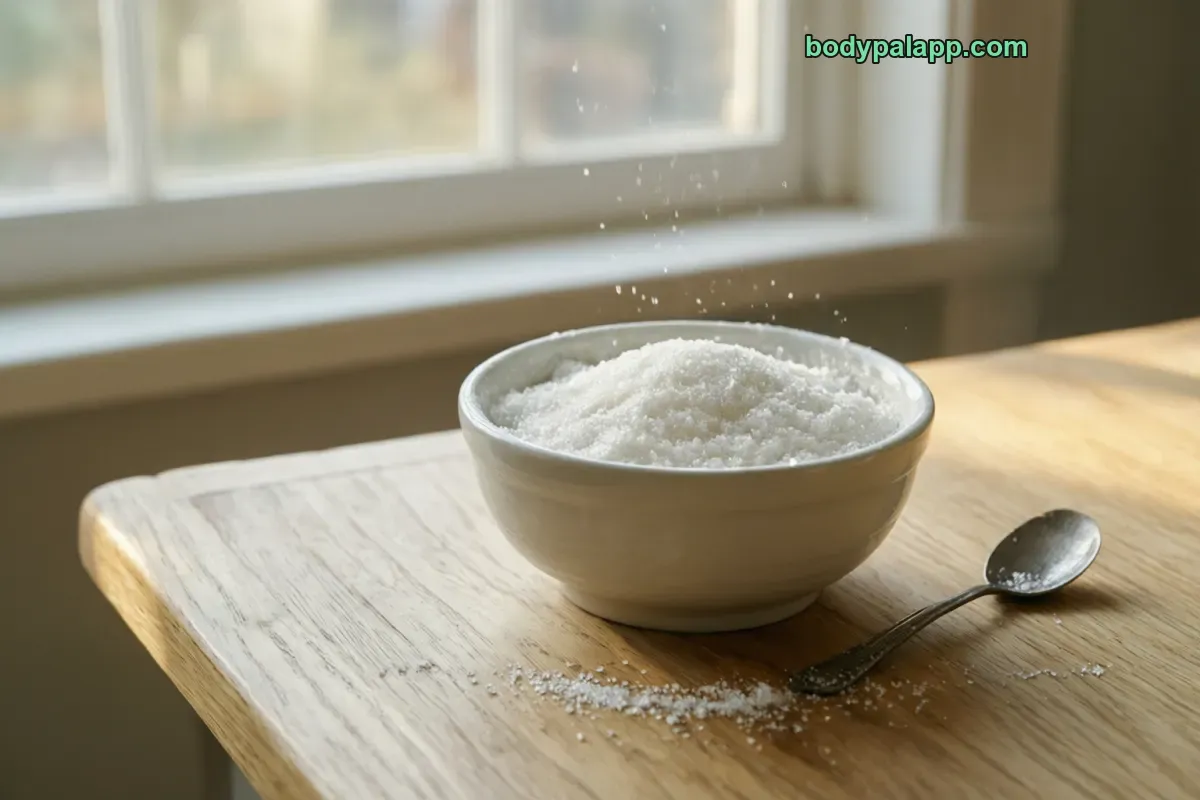
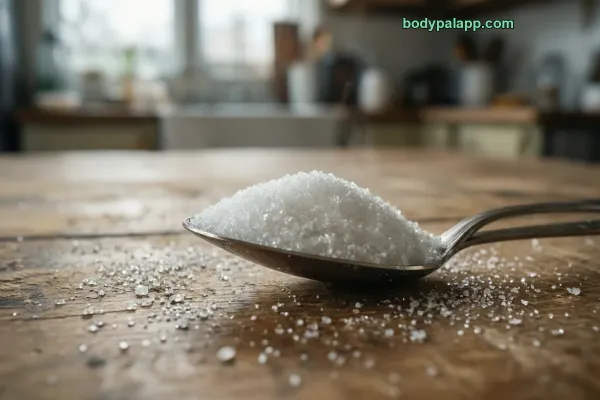
White sugar calories come to 15 for 1 teaspoon (4 g) and 385 per 100 g of granulated sugar. Almost all of that energy is carbohydrate: 99.6 g of carbs per 100 g, 0 g of protein and only 0.3 g of fat. The number to watch is not the teaspoon itself but how many teaspoons you add.
15kcal
1 teaspoon · 4 g, granulated
0%protein
0 gProtein
4 gCarbs
0 gFat
How to burn off 15 kcal
—Walking, brisk
—Jogging
—Cycling, moderate
—Swimming
Skip the math. BodyPal counts these calories from your steps and workouts automatically.
Nutrition facts
Granulated · per 4 g
Calories
15 kcal
Protein
0 g
Carbohydrate
4 g
Fat
0 g
Sodium
0 mg
Potassium
0 mg
Iron
0 mg
Source: USDA FoodData Central
🛡️
Verified nutrition data
Numbers on this page come from USDA FoodData Central, the U.S. Department of Agriculture’s food composition database, and from manufacturer labels where a branded product is named. Last verified September 2026. How we verify our data →
White sugar: calories, protein and sodium by serving
Percent of daily value uses the FDA reference of 2,000 kcal a day.
Serving
kcal
Protein
Carbs
Fat
Sodium
% DV kcal
1 tsp (4 g)
15
0 g
4 g
0 g
0 mg
1%
1 cup (188 g)
724
0 g
187.2 g
0.6 g
2 mg
36%
100 g
385
0 g
99.6 g
0.3 g
1 mg
19%
3 × 1 tsp (4 g)
46
0 g
0 mg
5 × 1 tsp (4 g)
77
0 g
0 mg
A teaspoon is 15 calories, a cup is 724
A level teaspoon of granulated white sugar weighs 4 g and carries 15 calories, about 1% of the daily calorie value. On its own that is close to nothing. The trouble is that sugar rarely shows up as a single teaspoon.
Two teaspoons (8 g) come to 31 calories, three (12 g) to 46, and five (20 g) to 77. Five teaspoons is a realistic total for someone who sweetens a couple of coffees and a bowl of cereal, and it adds up to the calories of a small snack. None of those spoonfuls bring protein, so they add energy without adding much to the meal.
Baking is where the figures jump. A full cup weighs 188 g and holds 724 calories, which is 36% of the daily value in one measure. Split across a batch of cookies or a cake, that cup gets spread thin, but it still sits inside every slice you eat.
Carbs supply 99% of the calories
Granulated sugar is about as close to a single nutrient as food gets. Per 100 g it has 99.6 g of carbohydrate, 0.3 g of fat and 0 g of protein. In calorie terms that is a split of 99% carbs, 1% fat and 0% protein.
That makes the calorie count unusually predictable. Fine, coarse or pressed into cubes, the weight decides the number, and every gram brings close to the same energy. A cup's 187.2 g of carbohydrate is almost exactly its weight in carbs, with 0.6 g of fat as the only other macro worth listing.
What sugar lacks matters as much as what it has. There is no protein and almost no fat, and the minerals are trace amounts: 1 mg of sodium and 2 mg of potassium per 100 g. You are getting sweetness and energy, and very little else. That is not a reason to fear it, just a reason to count it.
Pearls, cubes and sparkling sugar are still sugar
The numbers on this page come from the USDA row for granulated sugar. That is the plain white sugar most kitchens keep in a canister, the kind sold as California and Hawaiian Pure Cane Granulated White Sugar or Azul Granulated White Sugar.
Shelves also carry decorative and shaped versions: King Arthur Flour Sparkling White Sugar, sugar pearls from Dallies, Great Value and Chocolatera de Nayarit, Over the Top Twinkle White Sugar Crystals, and La Medina White Sugar Cubes. They are made for texture and looks rather than for a different nutrition profile, so read the label per gram rather than assuming a spoon of pearls matches a spoon of granulated sugar. Larger crystals pack differently, so a spoonful may not weigh 4 g.
Cubes are the easiest form to count. If your cube is close to a teaspoon in weight, each one is roughly 15 calories, and a box of cubes becomes a simple tally of what went into your coffee. For anything else, a kitchen scale beats a measuring spoon.
Sugar works best as a measured extra
Sugar does nothing for the protein side of your day, so its calories are best treated as a budget line. Decide how many teaspoons you take, then actually measure them instead of pouring from the bag.
If you are cutting calories, the easiest trims are the repeats. Dropping 3 teaspoons a day from drinks removes 46 calories without changing a single meal. In recipes, a cup of sugar at 724 calories is often the largest single line in the ingredient list, which is worth knowing before you double a batch.
Pair sweetened foods with something that brings protein or volume, such as yogurt, fruit or eggs, so the plate has more than sugar to offer. BodyPal can log your coffee or dessert from a photo, which helps when sugar hides in the drinks you tend to forget.
How does white sugar compare?
Here is how white sugar stacks up against brown sugar and other sugar pages, per 100 g and per usual serving.
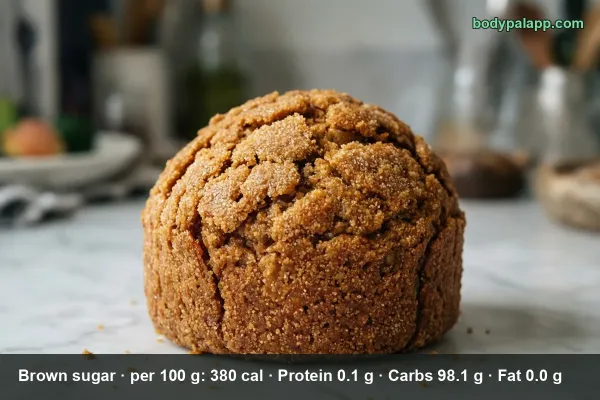
Verdict: The calorie gap is too small to matter: white sugar has 385 calories per 100 g and brown sugar 380, so choose by flavor and texture, not calories. If you watch sodium, white sugar's 1 mg per 100 g is lower than brown sugar's 28 mg, though both are tiny.
Most popular white sugar brands in the United States
Ranked by popularity in the BodyPal database
# Productkcal / 100 g
1Dallies White Sugar Pearls1 tsp · 7 g357 kcal
2Great Value White Sugar Pearls1 tsp · 6 g417 kcal
3Chocolatera de Nayarit White Sugar Pearls1 tbsp · 4 g375 kcal
4La Medina White Sugar Cubes2 pieces · 8 g375 kcal
5King Arthur Flour Sparkling White Sugar1 tsp · 6 g417 kcal
6Azul Granulated White Sugar1 tsp · 4 g375 kcal
7Over the Top Twinkle White Sugar Crystals1 tsp · 4 g375 kcal
8California and Hawaiian Pure Cane Granulated White Sugar1 tsp · 4 g375 kcal
Label values run from 357 to 417 calories per 100 g because each brand rounds its small 4 to 7 g serving its own way, while plain granulated sugar is 385 per 100 g. Source: manufacturer labels / USDA FoodData Central.
White sugar FAQs
How many calories are in a teaspoon of white sugar?
A level teaspoon weighs 4 g and has 15 calories. A full cup (188 g) works out to 724 calories.
Is white sugar high in calories?
Per 100 g it is 385 calories, but a teaspoon is only 4 g, so 15 calories. Four teaspoons through the day add 62 calories.
White sugar vs brown sugar: which has fewer calories?
Brown sugar is 380 calories per 100 g against 385 for white sugar. At a 4 g teaspoon both come to 15 calories.
How many carbs are in white sugar?
100 g holds 99.6 g of carbohydrate, so a 4 g teaspoon is 4.0 g of carbs. Protein is 0 g and fat 0.32 g per 100 g.
How many calories are in a cup of white sugar?
A cup of granulated white sugar (188 g) has 724 calories, 36% of the daily calorie value. It holds 187.2 g of carbohydrate, 0.6 g of fat and no protein.
How many calories are in 3 teaspoons of sugar?
Three teaspoons of white sugar (12 g) come to 46 calories. Two teaspoons are 31 calories and five are 77, so each extra spoon adds roughly 15.
Does white sugar have any protein or fat?
White sugar has 0 g of protein and just 0.3 g of fat per 100 g. Its calorie split is 99% carbs and 1% fat, so nearly all of its energy comes from carbohydrate.
Does white sugar contain sodium?
Barely. White sugar has 1 mg of sodium per 100 g and 2 mg in a full cup, which is 0% of the daily value. Sodium is not a concern with plain granulated sugar.
How many calories are in 100 grams of white sugar?
100 g of white sugar has 385 calories, about 19% of the daily calorie value. That weight holds 99.6 g of carbohydrate, 0.3 g of fat and 0 g of protein.