Sugar calories come to 15 per level teaspoon (4 g) of white granulated sugar and 385 per 100 g. Almost all of that is carbohydrate: 99% of the energy comes from carbs, with no protein and next to no fat. The teaspoon is small. Most of the total comes from how many teaspoons you use, and from baking by the cup.
15kcal
1 teaspoon · 4 g, granulated, white
0%protein
0 gProtein
4 gCarbs
0 gFat
How to burn off 15 kcal
—Walking, brisk
—Jogging
—Cycling, moderate
—Swimming
Skip the math. BodyPal counts these calories from your steps and workouts automatically.
Nutrition facts
Granulated, white · per 4 g
Calories
15 kcal
Protein
0 g
Carbohydrate
4 g
Fat
0 g
Sodium
0 mg
Potassium
0 mg
Iron
0 mg
Source: USDA FoodData Central
🛡️
Verified nutrition data
Numbers on this page come from USDA FoodData Central, the U.S. Department of Agriculture’s food composition database, and from manufacturer labels where a branded product is named. Last verified September 2026. How we verify our data →
Sugar: calories, protein and sodium by serving
Percent of daily value uses the FDA reference of 2,000 kcal a day.
Serving
kcal
Protein
Carbs
Fat
Sodium
% DV kcal
1 teaspoon (4 g)
15
0 g
4 g
0 g
0 mg
1%
1 cup (188 g)
724
0 g
187.2 g
0.6 g
2 mg
36%
100 g
385
0 g
99.6 g
0.3 g
1 mg
19%
3 × 1 teaspoon (4 g)
46
0 g
0 mg
5 × 1 teaspoon (4 g)
77
0 g
0 mg
A teaspoon is 15 calories, a cup is 724
A level teaspoon of granulated sugar weighs 4 g and carries 15 calories. That is 1% of the daily calorie value, small enough to ignore once. The catch is that sugar rarely gets used just once a day.
Two teaspoons (8 g) in a morning coffee add 31 calories. Three teaspoons (12 g) add 46. Five teaspoons, or 20 g, reach 77 calories. That total builds quietly over several cups of coffee or tea, or over a sweetened cereal and a sweetened drink in the same morning. Heaped spoons push every one of these figures higher, because a heaped spoon holds more than the level 4 g.
Baking is where the numbers jump. A full cup of sugar weighs 188 g and holds 724 calories, about 36% of the daily calorie value on its own. Spread across a batch of cookies or a cake, that cup is easy to forget, yet it is often the largest single calorie line in the recipe. If you bake, divide the cup by the number of portions you cut to see what each slice really carries.
Nearly every calorie is carbohydrate
Per 100 g, sugar has 99.6 g of carbohydrate, 0.3 g of fat and 0 g of protein. That works out to a calorie split of 99% carbs and 1% fat. There is nothing else in the bag.
This is what sets it apart from most of the pantry. Flour, oats or beans bring some protein and fiber along with their carbs. Granulated sugar brings none, so its 385 calories per 100 g arrive without anything that adds bulk to a plate. It dissolves into a drink or a batter and leaves no trace you can see or chew.
A teaspoon gives 4 g of carbs, the same number as its weight. That makes tracking simple: grams of sugar and grams of carbs are effectively one figure. If you count carbs, every gram you spoon in counts in full, and a cup adds 187.2 g of carbohydrate to whatever you are making.
Sodium and protein stay at zero
Sugar is one of the few pantry staples where the sodium row barely registers. A teaspoon has 0 mg, a full cup only 2 mg, and 100 g carries 1 mg. Every one of those is 0% of the daily value for sodium.
Potassium is also close to nothing at 2 mg per 100 g, and the protein row reads 0 in every serving. So the only line that matters on this page is calories, and the size of the spoon decides it. There is no hidden salt or fat to account for.
Brown sugar is the one close relative worth a glance here. It carries 28 mg of sodium per 100 g, a little more than white sugar, though still a small amount. The calorie difference between the two is minor, so pick between them for taste and texture, not for the numbers.
Measure it, don't pour it
Sugar works best as a measured ingredient rather than a free pour. If you track intake, log it by the teaspoon in drinks and by the cup in recipes, then split the recipe total by servings. Guessing tends to undercount, because the spoon you picture is usually smaller than the one you use.
Because sugar adds calories without protein or fiber, it fits a day best as a finishing touch on foods that already bring those, such as oatmeal or plain yogurt. A teaspoon over a bowl of oats changes the total by 15 calories. A sweetened drink made with five teaspoons changes it by 77.
Cutting back one teaspoon at a time is an easy lever to pull, since each one you skip is 15 calories saved without changing the rest of the meal. BodyPal can log a sweetened coffee or a slice of homemade cake from a photo, which helps when the sugar is already stirred in and out of sight.
How does sugar compare?
Here is how granulated white sugar stacks up against brown sugar, buffalo sauce and honey mustard, per 100 g and per usual serving.
Verdict: Brown sugar is not a lighter option: at 380 calories per 100 g it is practically the same as white, with 28 mg of sodium per 100 g added. If you want flavor for the fewest calories, buffalo sauce at 2 per tablespoon wins easily, but its 2,917 mg of sodium per 100 g is the trade-off.
Sugar FAQs
How many calories are in a teaspoon of sugar?
A level teaspoon of granulated sugar weighs 4 g and has 15 calories. A full cup (188 g) is 724 calories.
Is sugar good for weight loss?
Sugar is 385 calories per 100 g and 99.6 g carbs, with no protein, so the calories arrive without other nutrients. Each teaspoon stirred into coffee adds 15 calories.
Sugar or brown sugar: which has fewer calories?
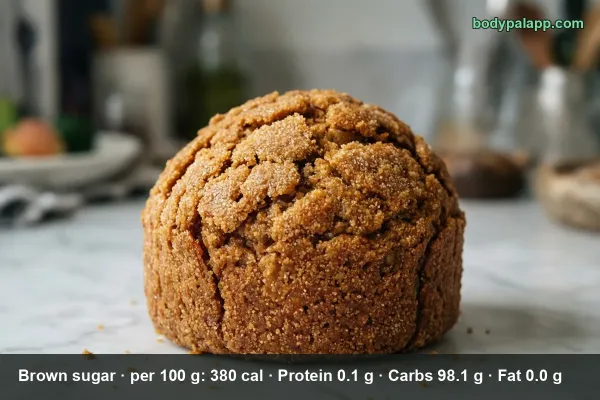
Brown sugar is 380 calories per 100 g and granulated sugar 385, a gap of 5 calories. A packed teaspoon of brown sugar (4.6 g) is 17 calories against 15 for a teaspoon of granulated.
How many carbs are in a teaspoon of sugar?
About 4.0 g of carbs per teaspoon, since granulated sugar is 99.6 g carbs per 100 g. A cup (188 g) holds 187 g of carbs.
How many calories are in a cup of sugar?
A cup of granulated sugar (188 g) has 724 calories. That is about 36% of the daily calorie value, with 187.2 g of carbohydrate, 0.6 g of fat and no protein at all.
How many calories are in 100 g of sugar?
100 g of white granulated sugar has 385 calories, 99.6 g of carbohydrate, 0.3 g of fat and 0 g of protein. That equals 19% of the daily calorie value.
How many calories are in 2 teaspoons of sugar?
Two teaspoons of sugar (8 g) add 31 calories. Three teaspoons (12 g) come to 46, and five teaspoons (20 g) reach 77 calories, nearly all of it from carbohydrate.
Does sugar contain any sodium or protein?
Barely any. 100 g of sugar has 1 mg of sodium and 0 g of protein, and a teaspoon shows 0 for both. Carbohydrate supplies 99% of its calories.
Does honey mustard have fewer calories than sugar?
Yes, per 100 g. Honey mustard has 275 calories per 100 g against 385 for sugar, but 18 g of that is fat, and a tablespoon still carries 41 calories.