
How many calories are in brown sugar?
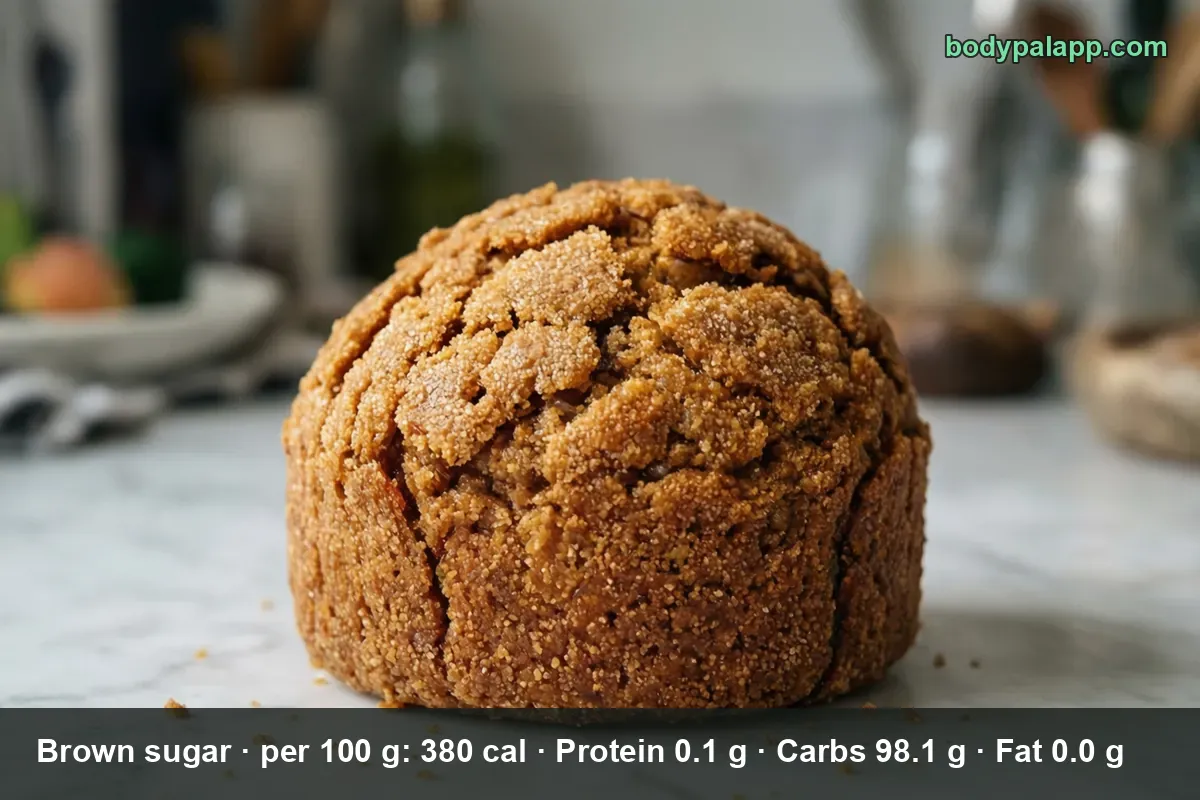
A packed teaspoon of brown sugar is 17 calories, and 100 grams of it is 380 calories. That teaspoon weighs only 4.6 g, which is why the number stays small. The packed cup you scoop for cookie dough is a different animal at 836. Almost all of the weight, 98.09 g per 100 g, is carbohydrate.
On this page
- Brown sugar quick facts
- US servings from a teaspoon to a packed cup
- Light and dark brown sugar
- Brown sugar in cereals and pastries
- Where a tablespoon fits in a day
- How does brown sugar compare
- Most popular brown sugar brands
- Brown sugar FAQs
Brown sugar quick facts
The record behind every number here is SR Legacy 168833, "Sugars, brown". That is the sugar itself, the damp brown stuff in the box or the canister, not one of the dozen packaged foods that carry "brown sugar" in the flavor name. Searching the USDA database for brown sugar returns barbecue sauce, baked beans, toaster pastries and half a shelf of oatmeal before it returns the ingredient, and those are recipes, not sweeteners. The percent Daily Value column below is calculated on the packed teaspoon, because that is the amount most people actually put in a mug.
| Nutrient | Per 100 g | Per 1 tsp packed (4.6 g) | % Daily Value |
|---|---|---|---|
| Calories | 380 | 17 | — |
| Total fat | 0 g | 0 g | 0% |
| Saturated fat | 0 g | 0 g | 0% |
| Carbohydrate | 98.09 g | 4.5 g | 2% |
| Dietary fiber | 0 g | 0 g | 0% |
| Total sugars | 97.02 g | 4.5 g | — |
| Protein | 0.12 g | 0.0 g | 0% |
| Sodium | 28 mg | 1 mg | 0% |
| Cholesterol | 0 mg | 0 mg | 0% |
| Potassium | 133 mg | 6 mg | 0% |
% Daily Value is based on a 2,000-calorie diet.
Verified nutrition data
Numbers on this page come from USDA FoodData Central, the U.S. Department of Agriculture’s food composition database, and from manufacturer labels where a branded product is named. Last verified September 2026. How we verify our data →
There is no added sugars row in the table, and that is not an oversight. The SR Legacy edition of this record does not publish an added sugars figure, and neither does it publish trans fat, so both lines are left out rather than filled with a zero. Total sugars have no Daily Value at all under the FDA labeling rules, which is why that cell shows a dash while carbohydrate gets a percentage.
US servings from a teaspoon to a packed cup
| Serving | Weight | Calories |
|---|---|---|
| 1 tsp packed | 4.6 g | 17 kcal |
| 1 tbsp packed | 13.8 g | 52 kcal |
| 1 oz | 28.35 g | 108 kcal |
| 1 cup unpacked | 145 g | 551 kcal |
| 1 cup packed | 220 g | 836 kcal |
| Per 100 g | 100 g | 380 kcal |
The teaspoon and the two cup weights come from USDA's own household measures for this record. The tablespoon, the ounce and the 100 g line are our own arithmetic from the USDA 100 g figure rather than USDA servings, scaled straight off 380 calories per 100 g.
Here is the trap nobody warns you about. "One cup" of brown sugar means two different weights depending on how you fill it: 145 g loose, 220 g pressed down with the back of a spoon the way baking recipes assume. That is 551 calories against 836, a gap of 285 calories from the same measuring cup and the same box of sugar. If you log a batch of cookies by counting cups, packing is the single biggest source of error in the whole recipe, bigger than the butter you eyeballed.
The spoon has a smaller version of the same problem. A packed teaspoon is 4.6 g; a level, casually scooped one is lighter, and a heaping one is closer to a tablespoon than you would guess. Anything between 15 and 20 calories a spoon is realistic, and none of it matters until you are at three or four spoons a day, at which point it is 51 to 68 calories you never see.
Light and dark brown sugar
USDA keeps one record for the ingredient, "Sugars, brown," and does not split it into light and dark, so there is no calorie difference to report between the two. Dark simply carries more molasses, which is a color, aroma and moisture difference rather than an energy one.
The brand labels tell the same story from the other side. Domino's light brown sugars, the Pure Cane Golden and the Premium Pure Cane, both declare 375 calories per 100 g and print 15 calories on a 4 g teaspoon. USDA measures its teaspoon packed, at 4.6 g, and gets 17. Same sugar, two honest numbers, and the difference is entirely the weight of the spoonful. When a label and a database disagree by two calories on a teaspoon, the spoon is the variable, not the sugar.
That also explains why the molasses story does not survive contact with the numbers. Brown sugar has 133 mg of potassium and 28 mg of sodium per 100 g. In a packed teaspoon that is 6 mg of potassium, 0% of the 4,700 mg Daily Value, and 1 mg of sodium. There are minerals in there, technically. There are not enough of them to count as nutrition.
Brown sugar in cereals and pastries
Most of the "brown sugar" foods in the USDA database are breakfast, not baking. They are worth knowing because their calories per 100 g land suspiciously close to pure sugar while their sugar content is nowhere near it.
| Version | Per 100 g | Typical serving | Calories |
|---|---|---|---|
| Brown sugar cinnamon toaster pastry | 370 kcal | 1 pastry (51 g) | 189 kcal |
| Maple and brown sugar instant oatmeal, dry | 368 kcal | 1 packet (43 g) | 158 kcal |
| Fortified maple and brown sugar instant oats, dry | 386 kcal | 1 packet (43 g) | 166 kcal |
| Maple Brown Sugar LIFE cereal | 373 kcal | 0.75 cup (32 g) | 119 kcal |
| Maple and brown sugar hot wheat cereal, dry | 368 kcal | 0.25 cup (45 g) | 166 kcal |
| Brown sugar Dinosaur Eggs oatmeal, dry | 384 kcal | 1 packet (50 g) | 192 kcal |
Dry flour, dry oats and pure sugar all sit in the same 360 to 390 band per 100 g, so the per-100-g column is nearly useless for telling them apart. The serving weight does all the work. An oatmeal packet is 43 g and 158 calories; the same 43 g of brown sugar, scaled from the USDA 100 g figure, would be 163. What separates them is that the packet brings 7.2 g of fiber and 9.2 g of protein per 100 g, and 30.02 g of sugars, while brown sugar brings 0 g of fiber, 0.12 g of protein and 97.02 g of sugars.
The cereal numbers are all for the dry mix, before the milk or the hot water. Add either and the serving gets heavier and the calories per 100 g fall through the floor, which is why a bowl of prepared oatmeal never resembles the packet's own label.
Where a tablespoon fits in a day
The Dietary Guidelines for Americans put added sugars under 10% of daily calories, which is 200 calories on a 2,000-calorie day. A packed tablespoon of brown sugar is 52 of those, about a quarter of the allowance, spent on one stir of a spoon. Two tablespoons across a morning is 104, more than half, and you have not eaten anything yet.
Sugar stirred into coffee, oatmeal or a marinade counts as added sugar on the finished dish even though USDA's ingredient record carries no added sugars row of its own. MyPlate's guidance on cutting back is the practical version: the easiest cut is the one you make with the spoon, not the one you make by switching sugars.
Scale matters here in a way that a teaspoon hides. A packed cup for a batch of cookies is 836 calories and 215.8 g of carbohydrate, roughly 78% of the carbohydrate Daily Value, sitting in the mixing bowl before the butter and flour join it. Split across two dozen cookies that is about 35 calories of sugar apiece, which is fine. Eaten as four cookies, it is not.
If you are watching calories rather than sugar specifically, brown sugar is a small target with an easy win: halving what you put in coffee saves 8 or 9 calories a cup, and there is no version of this ingredient that saves you more than that per spoon.
How does brown sugar compare
| Food | Per 100 g | US serving | Calories |
|---|---|---|---|
| Brown sugar | 380 kcal | 1 oz (28.35 g) | 108 kcal |
| Caramels | 382 kcal | 1 oz (28.35 g) | 108 kcal |
| Gelatin dessert, dry mix | 381 kcal | 1 oz (28.35 g) | 108 kcal |
| Vanilla pudding, dry mix | 379 kcal | 1 oz (28.35 g) | 107 kcal |
Our take: these four are separated by three calories per 100 g, and per ounce only the pudding mix comes in lower, by a single calorie. Dry sweet things are all about 380 calories per 100 g, whether they are candy with 8.1 g of fat or gelatin mix with 7.8 g of protein, because sugar dominates the weight in every one of them. So there is nothing to gain by swapping brown sugar for another sweet ingredient at equal weight. The only lever that moves is how much of it goes in, and whether the cup was packed.
Most popular brown sugar brands in the United States
Ranked by how widely each product appears among foods sold in the United States, from the BodyPal food database of over 3.3 million products. Calories are the figures printed on each Nutrition Facts label, checked against USDA FoodData Central.
| Product | Calories (per 100 g) |
|---|---|
| Domino Pure Cane Golden Light Brown Sugar | 375 cal |
| Domino Premium Pure Cane Light Brown Sugar | 375 cal |
Brand popularity: BodyPal food database. Nutrition: manufacturer labels / USDA FoodData Central.
Brown sugar FAQs
How many calories are in a teaspoon of brown sugar?
17 calories for one packed teaspoon, which USDA weighs at 4.6 g, off a base of 380 calories per 100 g. Level or scant spoons come in lower simply because they weigh less. Domino's label uses a 4 g teaspoon and prints 15, so the spoonful moves this number more than the brand does.
How many calories are in a tablespoon of brown sugar?
52 calories for a packed tablespoon of 13.8 g, which is our own arithmetic from the USDA 100 g figure rather than a USDA serving. It carries 13.5 g of carbohydrate and no fiber, fat or protein worth naming. Two tablespoons in coffee across a morning is 104 calories.
How many calories are in a cup of packed brown sugar?
836 calories in one cup packed, which USDA weighs at 220 g. An unpacked cup is 145 g and 551 calories, so the same measuring cup can differ by 285 calories depending on how hard you press it down. Baking recipes almost always mean the packed version.
Is brown sugar healthier than white sugar?
Not in any way the numbers support: brown sugar is 380 calories per 100 g and 17 per packed teaspoon, and the molasses that colors it delivers 133 mg of potassium per 100 g, which is 6 mg in a teaspoon, or 0% of the Daily Value. White sugar is not the USDA record this page is built on.
Does dark brown sugar have more calories than light brown sugar?
USDA publishes one record, "Sugars, brown," at 380 calories per 100 g, and does not split light from dark, so there is no calorie gap to report. Dark holds more molasses, which changes color, moisture and flavor. Domino's light brown label sits at 375 per 100 g, or 15 calories on a 4 g teaspoon.
How many carbs are in brown sugar?
98.09 g of carbohydrate per 100 g, which works out to 4.5 g in a packed teaspoon and 13.5 g in a packed tablespoon. There is no fiber at all, so every gram counts toward net carbs. A packed cup carries 215.8 g, about 78% of the carbohydrate Daily Value.
Does brown sugar have any protein or fiber?
Effectively none: USDA lists 0.12 g of protein per 100 g, which rounds to 0.0 g in a teaspoon, plus 0 g of dietary fiber, 0 g of fat and 0 mg of cholesterol. What is left is 98.09 g of carbohydrate per 100 g, of which 97.02 g is sugars.
Is brown sugar an added sugar?
Yes, once it goes into food: total sugars run 97.02 g per 100 g, and sugar stirred into oatmeal or creamed into cookie dough counts as added sugar on the finished dish. USDA's SR Legacy record for the ingredient itself does not publish an added sugars figure, so that row is not in the table above.
Similar foods
- Corn Starch — 488 cal per cup
- Thousand Island Dressing — 216 cal per dipping-size container
- Wheat Germ — 57 cal for 2 Tbsp
- Pudding Mix — 94 cal per 1/4 package
- Spoonful Of Sugar — 15 cal per teaspoon
- Sugar — 15 cal per teaspoon
Count it without the math
Point the camera at the mug or the mixing bowl and BodyPal counts the sugar for you, packed spoon and all.


Burning it off is one side of it. The other is knowing your number: work out how many calories you need a day, with macros and a goal date.