
How many calories are in wheat germ?
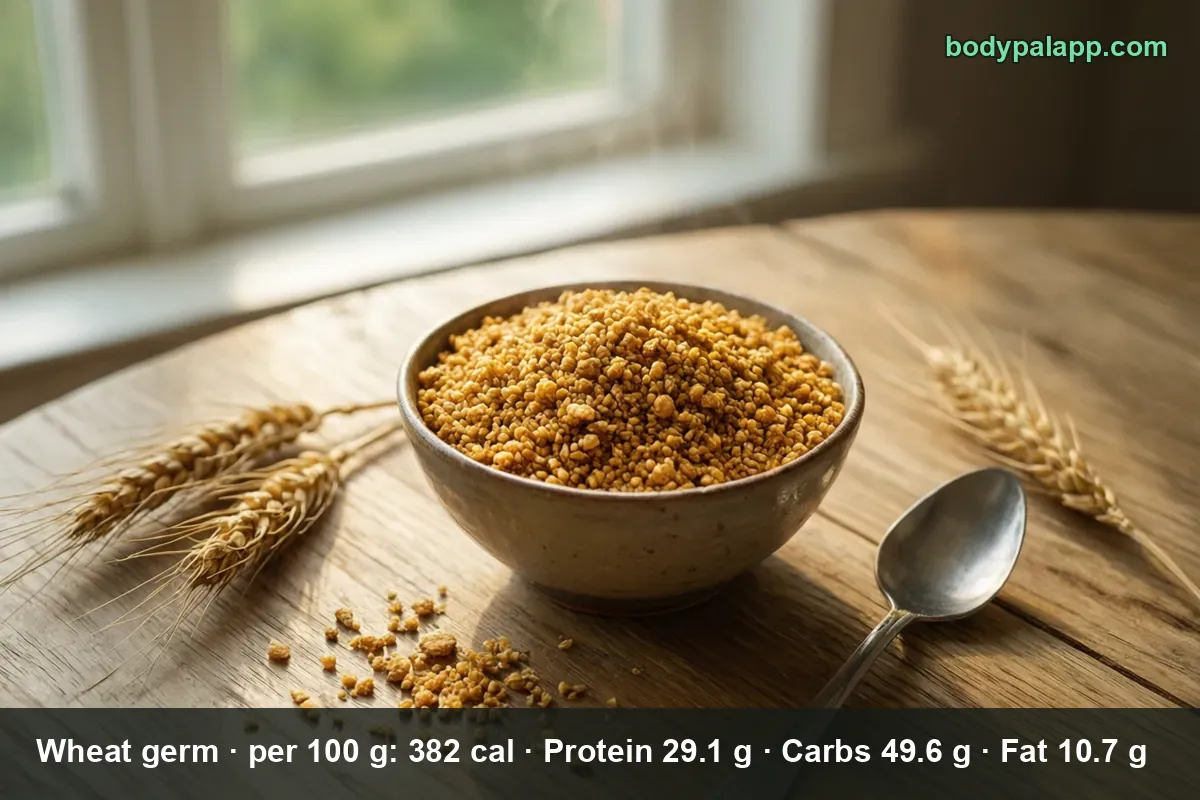
Two tablespoons of toasted wheat germ weigh 15 g and carry 57 calories. Per 100 g it is 382 calories, one of the densest things you can spoon onto yogurt. The catch is the scoop: the same jar measured by the cup lands at 432 calories, not 57.
On this page
- Wheat germ quick facts
- US servings, from two tablespoons to a full cup
- Raw, toasted, honey crunch and wheat germ oil
- Fiber and protein are the rows that pay
- How does wheat germ compare?
- Most popular wheat germ brands
- FAQ
Wheat germ quick facts
The jar in an American pantry is toasted, plain wheat germ — the Kretschmer style that sits next to the oatmeal. That is SR Legacy 173896, "Cereals ready-to-eat, wheat germ, toasted, plain", and it is the row this page is built on. USDA also carries an FNDDS reissue of the same product with an identical profile, so nothing is gained by switching to it.
The label serving on most jars is 2 tablespoons, 15 g. USDA's own household measures for this record are the ounce and the cup, so the 15 g column below is our own arithmetic from the USDA 100 g figure rather than a USDA serving.
| Nutrient | Per 100 g | Per 2 Tbsp (15 g) | % Daily Value |
|---|---|---|---|
| Calories | 382 | 57 | — |
| Total fat | 10.7 g | 1.6 g | 2% |
| Saturated fat | 1.83 g | 0.3 g | 1% |
| Carbohydrate | 49.6 g | 7.4 g | 3% |
| Dietary fiber | 15.1 g | 2.3 g | 8% |
| Total sugars | 7.8 g | 1.2 g | — |
| Protein | 29.1 g | 4.4 g | 9% |
| Sodium | 4 mg | 1 mg | 0% |
% Daily Value is based on a 2,000-calorie diet.
Verified nutrition data
Numbers on this page come from USDA FoodData Central, the U.S. Department of Agriculture’s food composition database, and from manufacturer labels where a branded product is named. Last verified September 2026. How we verify our data →
Two rows you will see on a package are missing here: added sugars and trans fat. USDA does not publish either value for this record, so guessing them would be worse than leaving them out. Cholesterol is 0 mg — wheat germ is a seed part, not an animal food — and potassium runs 947 mg per 100 g, which is 20% of the Daily Value, dropping to 142 mg (3%) in a 2-tablespoon serving.
US servings, from two tablespoons to a full cup
| Serving | Weight | Calories |
|---|---|---|
| 2 Tbsp, the label serving | 15 g | 57 kcal |
| 1/4 cup | 28 g | 107 kcal |
| 1 oz | 28.35 g | 108 kcal |
| 1/2 cup | 57 g | 218 kcal |
| 1 cup | 113 g | 432 kcal |
| Per 100 g | 100 g | 382 kcal |
Only two of those are USDA household measures: the ounce and the cup. The tablespoon, quarter-cup and half-cup lines are our own scaling from the USDA 100 g figure, which is exactly how a food scale would do it anyway.
The gap between the first row and the fifth is the whole story of this food. Wheat germ is light in the hand and heavy in the log. Two spoons over Greek yogurt is a 57-calorie decision. A cup stirred into muffin batter is 432 calories spread across the pan, and recipes are written in cups, never in tablespoons. If you bake with it, cost the cup and divide by the number of muffins; if you top with it, cost the spoon.
One more trap: 1/4 cup and 1 oz look interchangeable at 28 g, but a heaped quarter-cup weighs more than a level one. Wheat germ settles and compacts in the jar, so a scoop taken from the bottom weighs more than one taken from a fresh jar. Level the spoon or weigh it.
Raw, toasted, honey crunch and wheat germ oil
| Version | Per 100 g | Typical serving | Calories |
|---|---|---|---|
| Toasted, plain | 382 kcal | 2 Tbsp (15 g) | 57 kcal |
| Raw, crude | 360 kcal | 1 cup (115 g) | 414 kcal |
| Kretschmer regular | 366 kcal | 2 Tbsp (15 g) | 55 kcal |
| Honey Crunch | 372 kcal | 2 Tbsp (15 g) | 56 kcal |
| Wheat germ oil | 884 kcal | 1 Tbsp (13.6 g) | 120 kcal |
| Granola bar with wheat germ | 471 kcal | 1 bar (43 g) | 203 kcal |
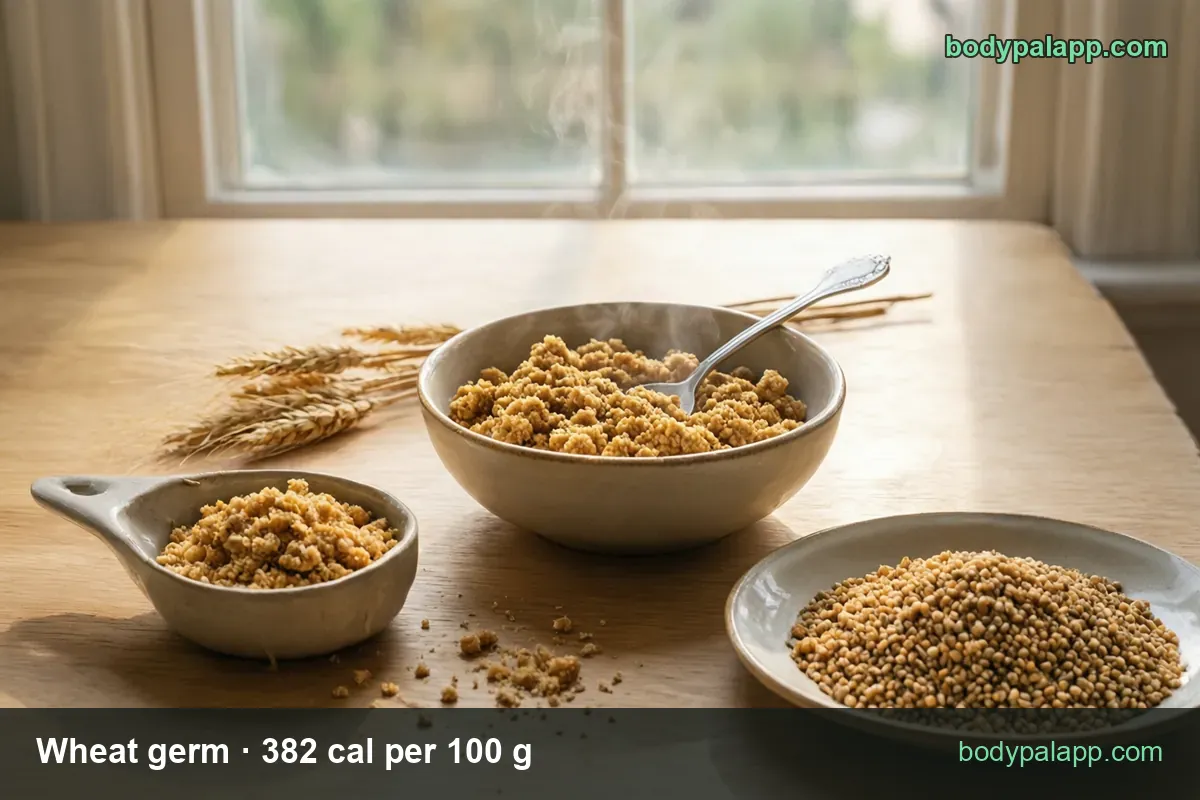
Raw against toasted is the comparison people expect to matter, and it barely does on calories: 360 against 382 per 100 g. What moves is everything else. Protein goes from 23.15 g to 29.1 g and fiber from 13.2 g to 15.1 g, because toasting drives off water and concentrates what stays. You are not buying a lighter food when you buy raw — you are buying a slightly wetter one.
The sweetened version is the one worth reading. Honey Crunch wheat germ is 372 calories per 100 g, almost the same as plain, but its total sugars are 21.43 g per 100 g against 7.8 g in the plain jar — close to three times as much. The calories hide the swap because sugar and starch cost the same per gram. USDA does not publish added sugars for either record, so the honey portion cannot be separated out numerically.
Wheat germ oil is a different product entirely, at 884 calories per 100 g and 100% fat: 120 calories in a tablespoon, with no protein and no fiber. It is pressed from the germ, so the name is honest, but nothing else carries over. And a granola bar built around wheat germ runs 471 calories per 100 g — 203 in a 43 g bar — because the peanuts, oats and sugar around it do most of the work.
Brand labels vary more than you would expect for one ingredient. Kretschmer's own label reads 400 calories per 100 g against USDA's 382 for the same style of toasted germ; King Arthur's stabilized version is 333; Bob's Red Mill and Great River Milling both list 409 and use an 11 g serving, which is why their panels say 45 calories instead of 57.
Fiber and protein are the rows that pay
Per 100 g, wheat germ is 15.1 g of fiber — 54% of the 28 g FDA Daily Value — and 29.1 g of protein, 58% of the 50 g DV. Those are the numbers that get quoted on the front of the jar, and they are true. They are also for a quantity nobody eats in one sitting.
Scale them down and the picture is still good, just smaller: 2.3 g of fiber (8% DV) and 4.4 g of protein (9% DV) for 57 calories. Very few things you sprinkle on a bowl return that much per calorie. The honest framing is that wheat germ is an excellent topping and a poor main event — a spoonful nudges a breakfast toward the whole-grain side of MyPlate's grains guidance without rewriting the day's calories.
Sodium is the quiet win. Four milligrams per 100 g, effectively 1 mg in a serving, so if you're watching sodium this is one of the few crunchy toppings that costs you nothing at all. Compare that with a salted nut or a seeded cracker doing a similar job on the same bowl.
How does wheat germ compare?
| Food | Per 100 g | US serving | Calories |
|---|---|---|---|
| Wheat germ, toasted | 382 kcal | 2 Tbsp (15 g) | 57 kcal |
| Wheat germ, raw | 360 kcal | 1 cup (115 g) | 414 kcal |
| Wheat germ oil | 884 kcal | 1 Tbsp (13.6 g) | 120 kcal |
| Granola bar with wheat germ | 471 kcal | 1 bar (43 g) | 203 kcal |
Our take: buy the plain toasted jar and measure it with the tablespoon that came in the box. It is the densest of the four per 100 g apart from the oil and the bar, yet it lands the smallest number on the plate — 57 calories — because the serving is honest. The oil is more than double that for one tablespoon and brings none of the protein or fiber, so it belongs in a salad dressing, not on your oatmeal. And if you want the germ's fiber, the granola bar is the expensive way to get it: 203 calories for 2.3 g of fiber, roughly what two spoons of the plain germ deliver for a quarter of the calories.
Most popular wheat germ brands in the United States
Ranked by how widely each product appears among foods sold in the United States, from the BodyPal food database of over 3.3 million products. Calories are the figures printed on each Nutrition Facts label, checked against USDA FoodData Central.
| Product | Calories (per 100 g) |
|---|---|
| Kretschmer Original Toasted Wheat Germ | 400 cal |
| Bob's Red Mill Wheat Germ | 409 cal |
| Central Co-op's Madison Market Wheat Germ | 364 cal |
| Simply Balanced Wheat Germ | 385 cal |
| King Arthur Stabilized Wheat Germ | 333 cal |
| Great River Milling Wheat Germ | 409 cal |
Brand popularity: BodyPal food database. Nutrition: manufacturer labels / USDA FoodData Central.
Wheat germ FAQs
How many calories are in 2 tablespoons of wheat germ?
57 calories for 15 g, the serving printed on most jars. That spoonful also brings 4.4 g of protein, 2.3 g of fiber and 1 mg of sodium. It is our own arithmetic from the USDA 100 g figure of 382 calories, since USDA lists ounces and cups rather than tablespoons.
How many calories are in 1 cup of wheat germ?
432 calories. A cup of toasted wheat germ weighs 113 g in the USDA record, so it carries 32.9 g of protein and 17.1 g of fiber along with those calories. That is 7.5 times the 2-tablespoon serving, which is why baking recipes measured in cups add up so much faster than people expect.
Is wheat germ high in protein?
Yes: 29.1 g per 100 g, or 58% of the FDA Daily Value of 50 g. Nobody eats 100 g of it in one go, though. The 2-tablespoon serving most people use gives 4.4 g of protein, 9% DV, for 57 calories, which is a strong ratio for a topping rather than a protein source.
How much fiber is in wheat germ?
15.1 g per 100 g, which is 54% of the 28 g Daily Value. In the 2-tablespoon serving that comes to 2.3 g, or 8% DV, for 57 calories. Few breakfast toppings hold that ratio, and it is why a spoonful over oatmeal changes the meal more than the calories suggest.
Raw vs toasted wheat germ - what is the difference?
Raw wheat germ is 360 calories per 100 g and toasted plain is 382, a gap of 22 calories. The bigger change is protein: 23.15 g raw against 29.1 g toasted, with fiber at 13.2 g against 15.1 g. Toasting drives off water, so everything left behind concentrates slightly.
Is wheat germ good for weight loss?
At 382 calories per 100 g it is not a light food, but the serving size saves it: 57 calories for 2 tablespoons, with 2.3 g of fiber and 4.4 g of protein. If you're watching calories, keep it as a two-spoon topping and measure it rather than pouring straight from the jar.
Does wheat germ contain gluten?
Yes - all 15 g of a 2-tablespoon serving is wheat, since the germ is the embryo of the wheat kernel separated during milling, so it is not gluten-free and does not belong in a gluten-free diet. Stabilized and toasted versions are still wheat; the processing removes oil and moisture, not gluten.
How many calories in wheat germ oil per tablespoon?
120 calories per tablespoon (13.6 g), because the oil is 884 calories per 100 g and 100% fat. That is more than double the 57 calories in 2 tablespoons of the germ itself, with none of the protein or fiber, since pressing keeps the fat and leaves the rest behind.
Similar foods
- Corn Starch — 488 cal per cup
- Brown Sugar — 17 cal per tsp packed
- Spoonful Of Sugar — 15 cal per teaspoon
- Sugar — 15 cal per teaspoon
- Thousand Island Dressing — 216 cal per dipping-size container
- White Sugar — 15 cal per teaspoon
Count it without the math
Point the camera at the bowl and BodyPal counts the wheat germ for you, spoon or cup.


How long does it take to burn off wheat germ?
A 2-tablespoon (15 g) serving is 57 kcal. Enter your weight and the amount you ate to see how long it takes you to burn that off:
lb
| Activity | Time to burn 57 kcal |
|---|---|
| Walking, brisk | 11 min |
| Cycling, moderate | 7 min |
| Swimming, moderate | 8 min |
| Jogging | 7 min |
| Weight training, moderate | 13 min |
Times are for a 155 lb adult at a steady pace; change the weight to see yours. The amount is set to the portion in the text (15 g); change it to what you actually ate. BodyPal works this out from your steps automatically.
One food is easy to picture; a whole day is harder. See how many calories you need a day and what a deficit actually looks like.