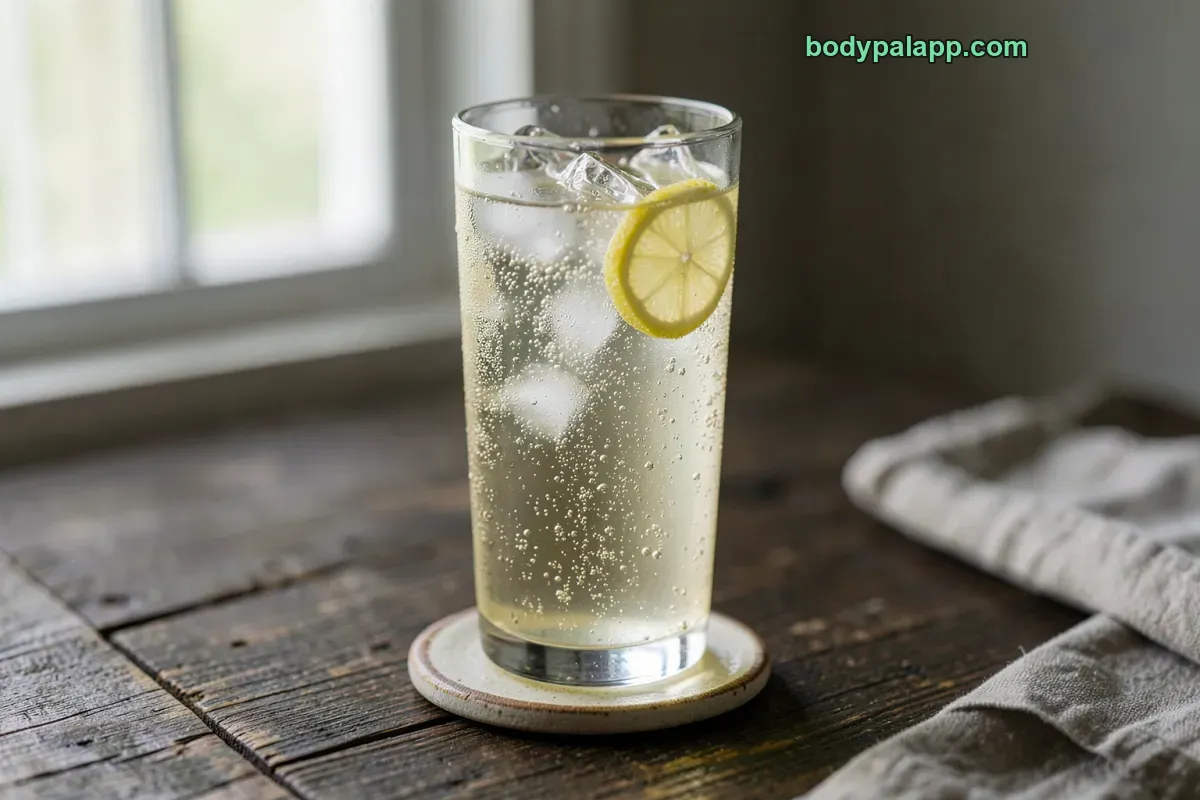
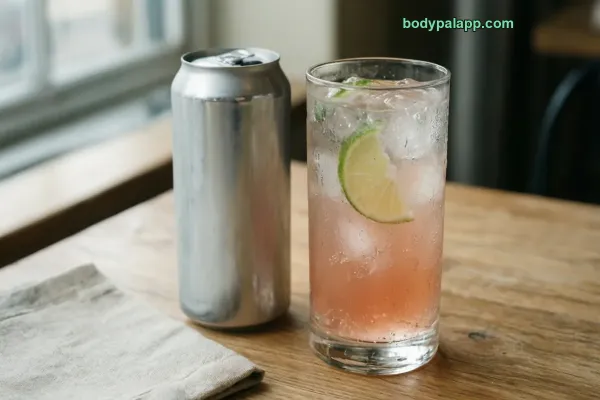
White wine spritzer calories come to 88 for 1 glass (180 g), or 49 per 100 g. The soda stretches the wine, so a glass runs well below plain wine. The label shows almost no carbs, sugar, fat or protein, which means the number that really moves your total is how many glasses you pour.
88kcal
1 glass · 180 g, wine mixed with soda
2%protein
0.1 gProtein
3 gCarbs
0 gFat
How to burn off 88 kcal
—Walking, brisk
—Jogging
—Cycling, moderate
—Swimming
Skip the math. BodyPal counts these calories from your steps and workouts automatically.
Nutrition facts
Wine mixed with soda · per 180 g
Calories
88 kcal
Protein
0.1 g
Carbohydrate
2.9 g
Fat
0 g
Saturated fat
0 g
Cholesterol
0 mg
Sodium
20 mg
Potassium
108 mg
Iron
0.4 mg
Source: USDA FoodData Central
🛡️
Verified nutrition data
Numbers on this page come from USDA FoodData Central, the U.S. Department of Agriculture’s food composition database, and from manufacturer labels where a branded product is named. Last verified September 2026. How we verify our data →
White wine spritzer: calories, protein and sodium by serving
Percent of daily value uses the FDA reference of 2,000 kcal a day.
Serving
kcal
Protein
Carbs
Fat
Sodium
% DV kcal
1 glass (180 g)
88
0.1 g
2.9 g
0 g
20 mg
4%
1 fl oz (30 g)
15
0 g
0.5 g
0 g
3 mg
1%
100 g
49
0 g
1.6 g
0 g
11 mg
2%
3 × 1 glass (180 g)
265
0.2 g
59 mg
5 × 1 glass (180 g)
441
0.4 g
99 mg
Each glass adds 88 calories
A standard glass in this data is 180 g and lands at 88 calories, which is 4% of the daily value used on this page. That is a modest number for a drink, and it is the main reason people order spritzers. Measured by the fluid ounce, it is 15 calories, so a heavy pour or an oversized wine glass changes the total faster than you might expect.
The math stacks up quickly over an evening. Two glasses come to 176 calories, three reach 265, and five glasses (900 g of liquid) hit 441. None of these rows adds protein worth counting: even five glasses carry only 0.4 g.
If you are tracking, log each glass rather than the whole evening as a single drink. Glass size is the variable that matters, since the mix itself is light per ounce. A spritzer poured into a large goblet is not the same entry as one in a small wine glass.
The label barely explains the calories
Per 100 g, a white wine spritzer has 0 g fat, 0 g protein and just 1.6 g of carbs, of which 0.5 g is sugar. A full glass carries 2.9 g of carbs and 0.1 g of protein. On paper, the calorie split reads 98% carbs and 2% protein.
That split is technically right but misleading. Carbs at 1.6 g per 100 g account for only a small slice of the 49 calories in the same weight. The rest comes from the wine's alcohol, which standard macro columns do not list, so the nutrition table can look nearly empty while the calorie line is not.
The practical takeaway is simple. You cannot judge this drink by its carbs or sugar, because those rows stay tiny no matter what. Judge it by the calorie line and by the number of glasses, and the picture is accurate.
Sugar and sodium stay near zero
A glass holds 0.8 g of sugars, far less than sweet mixed drinks built on juice or syrup. The soda dilutes the wine, so you get volume and fizz without adding sweetness. If you mix with a sweetened soda instead, the sugar row changes; these numbers reflect wine mixed with soda as listed in the USDA row.
Sodium is 20 mg per glass, 1% of the 2300 mg daily value. Even five glasses total only 99 mg. Potassium is 60 mg per 100 g against a daily value of 4700 mg, so the drink is not a meaningful source of it either.
None of these rows is the one to watch. Cholesterol, saturated fat and fiber all sit at 0, so the calorie total is the only number on this page that deserves your attention.
A spritzer works best as a slow drink
Because a glass is mostly diluted wine and fizz, a spritzer stretches across a meal better than straight wine. Sipping one glass through dinner keeps the drink at 88 calories instead of creeping toward 176 or 265.
It brings no protein or fiber, so it will not help you feel full. If you are watching calories, pair it with food that does that work, such as grilled fish or chicken, a big salad or roasted vegetables, rather than chips or bread that add calories alongside the drink.
If you want to see how drinks fit into your day, BodyPal can log a spritzer from a photo, and you can adjust the glass count afterward. Counting glasses honestly does more for your total than any recipe tweak.
How does white wine spritzer compare?
Here is how a white wine spritzer stacks up against white wine, a wine cooler and White Claw, per 100 g and per usual serving.
Verdict: For the fewest calories per 100 g, White Claw wins at 28, and a spritzer at 49 is the clear pick over plain white wine at 82 per 100 g or 121 per 5 fl oz glass. Skip the wine cooler if you count carbs: it carries 224 calories per bottle and 10.1 g of carbs per 100 g.
White wine spritzer FAQs
How many calories are in a white wine spritzer?
A 180 g glass of white wine spritzer has about 88 calories, or 15 calories per fl oz (30 g).
Is a white wine spritzer good for weight loss?
It has 49 calories per 100 g compared with 82 for plain white wine, so a 180 g glass is 88 calories instead of 148.
White wine spritzer vs wine cooler: which has fewer calories?
A white wine spritzer has 49 calories per 100 g and a wine cooler has 68. The wine cooler also carries 9.8 g of sugar per 100 g versus 0.5 g in the spritzer.
How many carbs are in a white wine spritzer?
A 180 g glass has about 2.9 g of carbs, of which 0.8 g is sugar.
How many calories are in 1 fl oz of wine spritzer?
One fluid ounce (30 g) of wine spritzer has 15 calories. That makes it easy to scale: a 180 g glass comes to 88 calories, and 100 g comes to 49.
How many calories are in 2 or 3 white wine spritzers?
Two glasses come to 176 calories and three glasses to 265, based on 180 g per glass. Five glasses reach 441 calories, so the count adds up faster than the light taste suggests.
Does a spritzer have fewer calories than a glass of white wine?
Yes. A white wine spritzer has 49 calories per 100 g versus 82 for white wine, which has about 1.7 times the calories by weight. A 5 fl oz glass of white wine is 121 calories.
How much sugar is in a white wine spritzer?
A 180 g glass has 0.8 g of sugars, and 100 g has 0.5 g. Total carbs are 2.9 g per glass, so sugar is not where most of the calories come from.
Is there much sodium in a wine spritzer?
Very little: a glass has 20 mg of sodium, just 1% of the daily value. Even five glasses add up to only 99 mg.