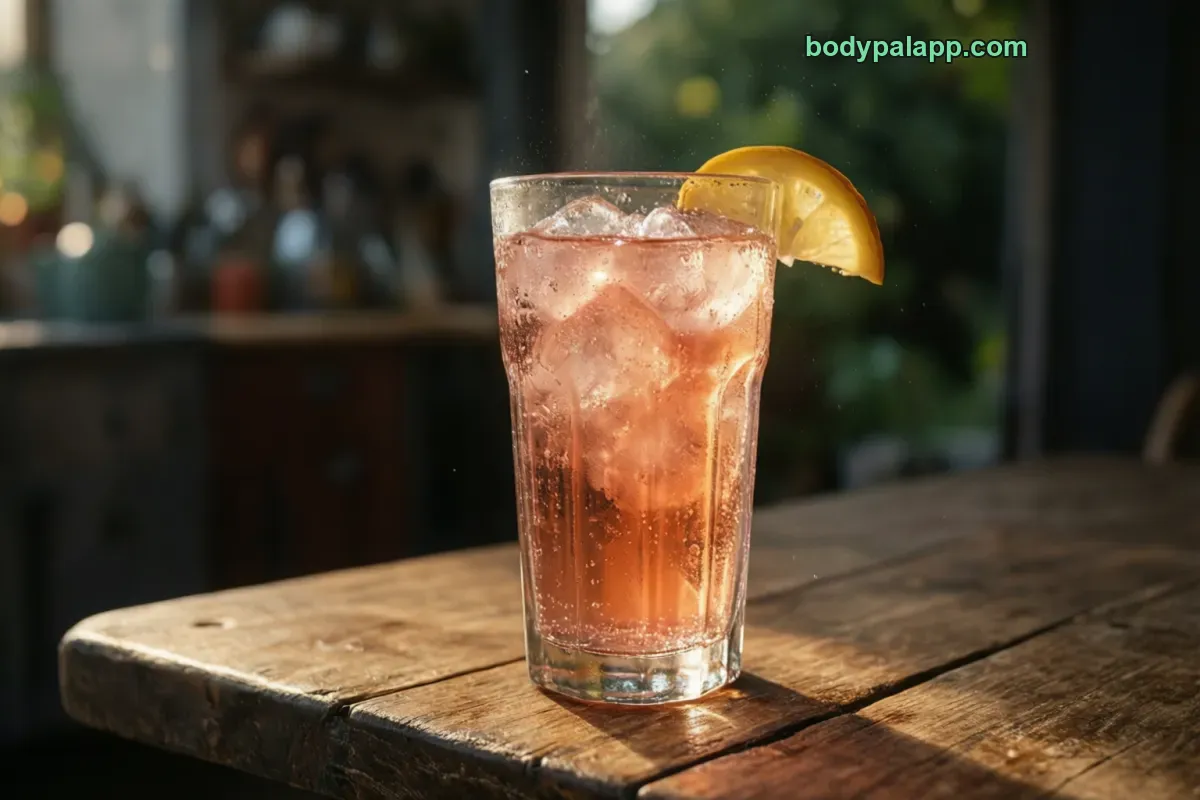
Wine cooler calories come to 224 for one 330 g bottle and 68 per 100 g of the ready-to-drink mix. Look at where they come from: 100% of the energy is carbohydrate, and nearly all of that is sugar. A bottle carries 32.2 g of sugars, with no protein, fat or fiber to slow it down.
224kcal
1 bottle · 330 g, ready to drink
0%protein
0 gProtein
33 gCarbs
0 gFat
How to burn off 224 kcal
—Walking, brisk
—Jogging
—Cycling, moderate
—Swimming
Skip the math. BodyPal counts these calories from your steps and workouts automatically.
Nutrition facts
Ready to drink · per 330 g
Calories
224 kcal
Protein
0 g
Carbohydrate
33 g
Fat
0 g
Saturated fat
0 g
Cholesterol
0 mg
Sodium
17 mg
Potassium
89 mg
Iron
0.1 mg
Source: USDA FoodData Central
🛡️
Verified nutrition data
Numbers on this page come from USDA FoodData Central, the U.S. Department of Agriculture’s food composition database, and from manufacturer labels where a branded product is named. Last verified September 2026. How we verify our data →
Wine cooler: calories, protein and sodium by serving
Percent of daily value uses the FDA reference of 2,000 kcal a day.
Serving
kcal
Protein
Carbs
Fat
Sodium
% DV kcal
1 bottle (330 g)
224
0 g
33.2 g
0 g
17 mg
11%
1 glass (135 g)
92
0 g
13.6 g
0 g
7 mg
5%
100 g
68
0 g
10.1 g
0 g
5 mg
3%
3 × 1 bottle (330 g)
673
0 g
50 mg
5 × 1 bottle (330 g)
1,122
0 g
83 mg
One bottle is a 224-calorie drink, and they add up fast
The standard 330 g bottle lands at 224 calories, which is 11% of the daily calorie value. Pour a 135 g glass instead and you are at 92 calories, or 5% of the day. That gap is the simplest lever you have: a glass is well under half a bottle.
The trouble is that wine coolers are built for easy drinking. Two bottles (660 g) bring 449 calories. Three bottles (990 g) reach 673. Five bottles over a long afternoon, 1,650 g in total, add up to 1,122 calories, more than many full meals, and none of it fills you up.
If you are tracking, count bottles rather than sips. Each one moves the total by 224, so the math stays easy as long as you log every bottle. BodyPal can log a wine cooler from a photo of the bottle or glass, which helps on nights when the count gets fuzzy.
Every calorie comes from carbs, mostly sugar
The calorie split is blunt: 100% carbohydrate, 0% protein, 0% fat. Per 100 g there are 10.1 g of carbs, and 9.8 g of those are sugars. Almost nothing in the drink is anything other than sugar, water and alcohol flavor.
Scaled to a bottle, that means 33.2 g of carbs and 32.2 g of sugars. Against the 275 g carbohydrate daily value it is a modest slice, but it arrives as liquid sugar with no fiber, so it counts fully without adding any staying power. A single glass still carries 13.6 g of carbs and 13.2 g of sugars.
Zero protein and zero fat also mean zero satiety from the bottle itself. If you are watching your intake, treat a wine cooler as a sweet drink first and an alcoholic one second. That framing tends to make the portion decision easier.
Sugar is the row to watch, not sodium
Sodium barely registers. A bottle has 17 mg, which is 1% of the 2300 mg daily value, and a glass has 7 mg. Even five bottles only reach 83 mg. Potassium is low too, at 27 mg per 100 g against a 4700 mg daily value. There is no cholesterol and no saturated fat.
So the line that matters is sugars. At 32.2 g per bottle, the wine cooler sits closer to a soda than to a glass of dry wine. A second bottle doubles that sugar load, all from a drink.
If you watch added sugar, the easiest swap is size. A 135 g glass keeps sugars at 13.2 g, and stretching it with ice or sparkling water makes it last longer without changing what you poured.
How a wine cooler fits a day of eating
Because the drink brings only carbs, the food around it should bring what it lacks. Protein and fiber at the same meal, think grilled chicken, beans or a big salad, make the evening more filling than the sugar alone would.
Salty snacks are the common partner, and they are where an extra few hundred calories slip in. If you plan on more than one bottle, decide the number in advance and plan the snack with it. Alternating each bottle with water slows the pace and keeps the total closer to what you intended.
One bottle at 224 calories fits most days without much trouble. It is the second and third that change the picture, so the portion choice matters more than the drink choice.
How does wine cooler compare?
Here is how a wine cooler compares with white wine, rose wine and a standard glass of wine, per 100 g and per usual serving.
Verdict: Per 100 g the wine cooler is the lightest at 68 calories against 82 to 83 for the wines, and a 135 g glass at 92 beats a 147 g glass of white wine at 121. But each wine carries only 2.6 to 3.8 g of carbs per 100 g versus 10.1 g here, so if sugar is your concern pick dry white wine; if calories per glass are, the wine cooler wins.
Wine cooler FAQs
How many calories are in one wine cooler?
One 11 fl oz bottle (330 g) is 224 calories. A smaller 135 g glass is 92 calories.
Is a wine cooler good for weight loss?
A bottle carries 224 calories, 32 g sugar and no fat or protein. A 135 g glass keeps it to 92 calories.
Wine cooler vs white wine: which has fewer calories?
Per 100 g a wine cooler is 68 calories and white wine 82. A 135 g glass of wine cooler is 92 calories, while a 180 g glass of white wine is 148.
How much sugar is in a wine cooler?
About 9.8 g per 100 g, so roughly 32 g in a 330 g bottle and 13 g in a 135 g glass.
How many calories are in a glass of wine cooler?
A 135 g glass of wine cooler has 92 calories, about 5% of the daily calorie value. It carries 13.6 g of carbs, 13.2 g of them sugars, and no protein or fat.
How many calories are in two wine coolers?
Two 330 g bottles of wine cooler add up to 449 calories. Three bottles reach 673, and five bottles come to 1,122 calories, all of it from carbohydrate.
How many calories does a wine cooler have per 100 g?
A wine cooler has 68 calories per 100 g, with 10.1 g of carbs and 9.8 g of sugars. That is lower than white wine at 82 per 100 g, but with far more sugar.
Does a wine cooler have any protein or fat?
No. A wine cooler has 0 g of protein and 0 g of fat, so 100% of its calories come from carbohydrate. A bottle provides 33.2 g of carbs and 32.2 g of sugars.
How much sodium is in a wine cooler?
A 330 g bottle of wine cooler has 17 mg of sodium, just 1% of the daily value. A glass has 7 mg, so sodium is not a concern with this drink.